Alchemanity (@alchemanity) header
Alchemanity (@alchemanity) profile picture

Transformative insights from the entire spectrum of human experience.

Joined October 2020
Photo by Alchemanity (@alchemanity)Photo by Alchemanity (@alchemanity)Photo by Alchemanity (@alchemanity)Photo by Alchemanity (@alchemanity)Photo by Alchemanity (@alchemanity)Photo by Alchemanity (@alchemanity)Photo by Alchemanity (@alchemanity)Photo by Alchemanity (@alchemanity)Photo by Alchemanity (@alchemanity)Photo by Alchemanity (@alchemanity)
In one dream, Chuang Tzu lost sight of himself as a man. He says he was a butterfly "to all intents and purposes," flying "hither and thither," which means here and there, following a butterfly's whims, or "fancies," as he puts it. He was "unconscious of my individuality as a man," unaware of himself as the man he was. Then he woke up, "myself again." And he says he doesn't know whether he was a man dreaming he was a butterfly, or whether he's a butterfly right now, dreaming he's a man. --- --- --- “Once upon a time, I, Chuang Tzŭ, dreamt I was a butterfly, fluttering hither and thither, to all intents and purposes a butterfly.” — Chuang Tzu Chuang Tzu: Mystic, Moralist, and Social Reformer (1889) --- --- --- #LawOfAttraction Read the source: Chapter II, The Identity of Contraries (translated by Herbert A. Giles). gutenberg.org/cache/epub/597…
5
Making life easier for someone else might be the whole reason we're here. George Eliot gives that idea to Dorothea, who asks it at a dinner table. People are saying something about a man named Lydgate, and Dorothea is convinced he's done nothing wrong. She asks what else we'd live for, if not to lighten things for one another. Her reason is personal: he "advised me in my trouble, and attended me in my illness." She also believes people "are almost always better than their neighbors think they are." Eliot says she came back to the subject "with renewed vivacity," livelier than before. --- --- --- “What do we live for, if it is not to make life less difficult to each other?” — George Eliot Middlemarch (1872) --- --- --- #LawOfAttraction Read the source: Book VIII, Sunset and Sunrise, Chapter LXXII. gutenberg.org/cache/epub/145…
1
12
The first thing Kabir does is laugh. He hears that a fish in the water is thirsty, and that's the joke. Then it lands on you. He says "the Real" is "in your home," yet you don't see it, and you wander "from forest to forest" listlessly, which is to say tired and half-hearted. Think of patting every pocket for the glasses on your head. Go where you will, he adds, and if you don't find your soul, "the world is unreal to you." --- --- --- “I laugh when I hear that the fish in the water is thirsty: You do not see that the Real is in your home, and you wander from forest to forest listlessly!” — Kabir Songs of Kabir (1915) --- --- --- #LawOfAttraction Read the source: Song XLIII (I. 82), translated by Rabindranath Tagore. gutenberg.org/cache/epub/651…
15
Living brightly doesn't require a lucky start. Lilian Whiting says so plainly. She calls that bright way of living "the Life Radiant," a "transfiguration of life" that comes from drawing on what she calls an "infinite reservoir of spiritual energy," which she says God opens to people as they recognize and use it. People in her day talked about "privileged classes," as if some lives were sealed off from others. She calls that "fatally erroneous." If it took wealth and health, she writes, "it would not be worth talking about." One example she gives: a manual laborer who earns a wage while also building "patience, faithfulness, and judgment." "The horizon line of the impossible recedes as we advance." --- --- --- “The Life Radiant can be achieved, and is within the personal choice of every individual.” — Lilian Whiting The Life Radiant (1903) --- --- --- #LawOfAttraction Read the source: The Golden Age Lies Onward (first chapter). gutenberg.org/cache/epub/238…
16
Hope comes first, Helen Keller says, and the work comes after. She calls optimism a kind of faith, the kind "that leads to achievement," so it ends in something actually done. Then she sets the order: without hope, "nothing can be done." Two paragraphs later she says the first half again and gives an example. Lincoln, she writes, "in times of doubt, trouble and need does not falter." He keeps "hoping against hope," hoping on through what she calls "the night of despair," and "thousands rest in his confidence." --- --- --- “Optimism is the faith that leads to achievement; nothing can be done without hope.” — Helen Keller Optimism (1903) --- --- --- #LawOfAttraction Read the source: Part III, The Practice of Optimism. gutenberg.org/cache/epub/316…
9
Practice calm on an ordinary Tuesday, and it's there when the floor drops out. William George Jordan says readiness for life's "great crises" gets learned on plain days. Storms, he says, stir "only the surface of the sea"; below that is "the calm, unruffled deep." In the next paragraph he says how to practice it: when the day's worries "fret you, and begin to wear upon you," then "Stop, rest for a moment, and let calmness and peace assert themselves." A moment. Whenever the grind starts. --- --- --- “To be ready for the great crises of life we must learn serenity in our daily living.” — William George Jordan The Majesty of Calmness (1900) --- --- --- #LawOfAttraction Read the source: I. The Majesty of Calmness. gutenberg.org/cache/epub/691…
1
11
Your choices about yourself belong to you. John Stuart Mill draws that line with care. Power over someone against their will is rightful, he says, only "to prevent harm to others." Your own good "is not a sufficient warrant," which means it isn't reason enough. Other people may argue with you, even plead with you. They may not compel you. He's speaking of adults "in the maturity of their faculties," and in the part of life that concerns only you, he says your independence is "of right, absolute." That's the ground he stands on when he names the individual sovereign. --- --- --- “Over himself, over his own body and mind, the individual is sovereign.” — John Stuart Mill On Liberty (1859) --- --- --- #LawOfAttraction Read the source: Chapter I, Introductory. gutenberg.org/cache/epub/349…
1
6
Something is leaning on your door, and it isn't in a hurry. Ernest Holmes says we live inside a mind much bigger than our own. Later in the paragraph he calls it "Infinite Mind," and he uses "man" for all of us: "we are all in Mind." That mind presses in, but the next sentence says it "awaits his recognition." Just before, he borrows the words "Behold, I stand at the door and knock" and adds that "the opening must be on the part of the individual." What presses is possibility, since "all things exist in mind as a potentiality," and creative power, since Mind "is always creating for us as we think." The latch is on your side. --- --- --- “Man lives in a mind that presses in upon him from all sides with infinite possibilities, with infinite creative power.” — Ernest Holmes Creative Mind (1919) --- --- --- #LawOfAttraction Read the source: Part I, Why, and What Is Man? (p. 8). archive.org/download/creativ…
5
Mary Wollstonecraft wanted women in charge of their own lives, and she didn't wish them power over men. Here she answers Rousseau: educate women like men, he says, and "the less power will they have over us." Her response is agreement. "This is the very point I aim at." By "them" she means women. Earlier in the same paragraph she pictures women carrying out "the important duties of life by the light of their own reason." The power over men that Rousseau expected them to lose is power she doesn't wish them to have. Rousseau saw a loss. She saw the goal. --- --- --- “I do not wish them to have power over men; but over themselves.” — Mary Wollstonecraft A Vindication of the Rights of Woman (1792) --- --- --- #LawOfAttraction Read the source: Chapter 4, Observations on the State of Degradation to Which Woman Is Reduced by Various Causes. gutenberg.org/cache/epub/342…
2
7
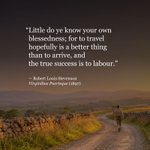
Robert Louis Stevenson's idea of success has no finish line. He spends a paragraph admitting the goal is out of reach. We "shall never reach" it, he says, and it's "more than probable that there is no such place." He calls the place El Dorado, and pictures the hopeful expecting to "descry," or spot, its spires from "some conspicuous hilltop" against the setting sun. Then the twist. He tells those walkers they don't know their own "blessedness," their good fortune. Traveling in hope beats arriving, he says. "Labour" is his British spelling of labor, and he calls it the true success. Somehow that's good news. --- --- --- “Little do ye know your own blessedness; for to travel hopefully is a better thing than to arrive, and the true success is to labour.” — Robert Louis Stevenson Virginibus Puerisque (1897) --- --- --- #LawOfAttraction Read the source: El Dorado, last paragraph. gutenberg.org/cache/epub/386…
1
14
If something good were easy, nearly everyone would already have it. Baruch Spinoza makes that case in the sentence just before the very last one in his Ethics. Earlier in the same paragraph, he admits the way he's laid out "seems exceedingly hard," and adds that it "may nevertheless be discovered." Then comes "Needs must it be hard," meaning it has to be hard, "since it is so seldom found." He reasons from how seldom the way is found to how hard it must be. His final sentence carries that over to "all things excellent": "as difficult as they are rare" means the two match. Steep, he says. Findable, too. --- --- --- “But all things excellent are as difficult as they are rare.” — Baruch Spinoza Ethics (1883) --- --- --- #LawOfAttraction Read the source: Part V, Proposition XLII, Note (R. H. M. Elwes translation). gutenberg.org/cache/epub/380…
1
25
Mars doesn't stop to ask the other stars which way to go. Ella Wheeler Wilcox uses that picture just before these lines: a planet "seeking help from other stars" would be as odd as you swerving off your path to take on someone else's view. So she sends you elsewhere for light, to "the Great Eternal Cause" and "not to any man." Then two words: "Look in." What you find there, she writes, are "your own soul's unwritten laws." Nobody printed them. You learn them by looking. --- --- --- “Look to the Great Eternal Cause And not to any man, for light. Look in; and learn the wrong, and right, From your own soul’s unwritten laws.” — Ella Wheeler Wilcox New Thought Pastels (1906) --- --- --- #LawOfAttraction Read the source: Assistance, lines 9-12. gutenberg.org/cache/epub/325…
13
For Marden, happiness is something you do more than something you get. Orison Swett Marden opens a chapter called "The Habit of Happiness" with this. "Exercise" here means use. You exercise a skill by putting it to work. "The highest happiness" is his phrase for the best kind there is. "The best thing in us" goes unnamed, but his next sentence points at "useful work." Then he adds a dare. Find happiness anywhere else, and "you will be the first man or woman to make the discovery." --- --- --- “The highest happiness must always come from the exercise of the best thing in us.” — Orison Swett Marden Pushing to the Front (1911) --- --- --- #LawOfAttraction Read the source: Chapter L, The Habit of Happiness. gutenberg.org/cache/epub/212…
1
18
You can be robbed loudly or quietly. Horace Fletcher calls anger and worry "thieves," and his very next line tells them apart: anger is a "highway robber," worry a "sneak thief." Think of a hand grabbing your bag versus a hand slipping into your pocket. What they take, he says, is time and energy. A sentence earlier he spells out the cost: while either one holds your mind, growth of mind and body is "suspended," put on pause. One shouts. One whispers. Same empty pockets. --- --- --- “Anger and worry are thieves that steal precious time and energy from life.” — Horace Fletcher Menticulture (1895) --- --- --- #LawOfAttraction Read the source: Sidenote: Anger and Worry are Thieves. gutenberg.org/cache/epub/450…
14
Help from outside can weaken you. Help from inside builds you up. Samuel Smiles calls outside help "often enfeebling," which means weakening. Notice the "often." He doesn't say always. Help from within, meaning your own effort, "invariably invigorates," he says: it gives you fresh strength every time. His next sentence says why. Whatever is done for people "to a certain extent takes away the stimulus and necessity of doing for themselves." Stimulus here is the spur to act, and necessity is the plain need to. Lift the need, and some of the push goes with it. --- --- --- “Help from without is often enfeebling in its effects, but help from within invariably invigorates.” — Samuel Smiles Self-Help (1859) --- --- --- #LawOfAttraction Read the source: Chapter I, Self-Help: National and Individual. gutenberg.org/cache/epub/935…
6
When your will and your imagination clash, Émile Coué says imagination wins. When they agree, he says something stranger happens. He starts with the opposite case. When the two are "antagonistic," meaning set against each other, he says "it is always the imagination which wins." Then he turns it around. When the will and the imagination are "in agreement," he says they don't simply add up. He reaches for multiplication instead. In a note he admits "multiplied by" is "not rigorously exact," just an illustration to make his meaning clearer. Still, it's a striking picture: the side that would have won the argument ends up pulling with you. --- --- --- “When the will and the imagination are in agreement, one does not add to the other, but one is multiplied by the other.” — Émile Coué Self Mastery Through Conscious Autosuggestion (1922) --- --- --- #LawOfAttraction Read the source: The Use of Autosuggestion. gutenberg.org/cache/epub/272…
4
What you see may be smaller than what's there. William Blake puts the limit in the seeing. Perception is how we take the world in, and he pictures it as "doors" that could be "cleansed," washed clean. Then everything would show up "as it is, infinite," meaning without edge or end. In the next sentence he says we've "closed" ourselves up and see "through narrow chinks" of a cavern: thin cracks in a cave wall. The world isn't the small part. The crack is. Think of a fogged window with one patch rubbed clear. --- --- --- “If the doors of perception were cleansed everything would appear to man as it is, infinite.” — William Blake The Marriage of Heaven and Hell (1793) --- --- --- #LawOfAttraction Read the source: A Memorable Fancy (plate 14). gutenberg.org/cache/epub/453…
1
16
You can be fully yourself whether anyone notices or not. Walt Whitman says existing "as I am" is "enough." If no one in the world is "aware" of him, he sits "content," settled where he is. If "each and all," every last person, are aware, he sits just as content. In the stanza before, he says he doesn't trouble his spirit to "be understood." In the lines that follow, he names one world that is aware of him: "that is myself," the world he calls "by far the largest to me." Seen by everyone or by no one, he keeps the same seat. --- --- --- “I exist as I am, that is enough, If no other in the world be aware I sit content, And if each and all be aware I sit content.” — Walt Whitman Leaves of Grass (1855) --- --- --- #LawOfAttraction Read the source: Song of Myself, section 20. gutenberg.org/cache/epub/132…
1
2
10
Frances Hodgson Burnett's fix for a gloomy thought is to give it no room. In The Secret Garden, a novel for young readers, two children, Mary and Colin, stay sickly while their heads are full of dislikes and fears. Just before the rhyme, Burnett spells out the method: when "a disagreeable or discouraged thought" turns up, have "the sense to remember in time" and put "an agreeable determinedly courageous one" in its place. Then the reason, in seven words: "Two things cannot be in one place." The rhyme, set off on its own in the text, says it again in garden terms. Care for the rose, and the thistle has nowhere to grow. --- --- --- “Where you tend a rose, my lad, A thistle cannot grow.” — Frances Hodgson Burnett The Secret Garden (1911) --- --- --- #LawOfAttraction Read the source: Ch. XXVII, In the Garden. gutenberg.org/cache/epub/113…
1
17
First the feeling, then the reasons. Blaise Pascal records M. de Roannez saying that "at first a thing pleases or shocks me without my knowing the reason." The reasons came to him afterward, and he took them for the cause. Pascal doubted that. He believed the reasons "were only found because it shocks him." Then comes Pascal's own claim. The heart has its reasons, and reason, he says, does not know them. We feel this, he says, "in a thousand things." The explanation shows up late and takes the credit. --- --- --- “The heart has its reasons, which reason does not know. We feel it in a thousand things.” — Blaise Pascal Pensées (1670) --- --- --- #LawOfAttraction Read the source: Section IV, 277 (W. F. Trotter translation). gutenberg.org/cache/epub/182…
1
10