

Publisher, archive, rare book dealer. Promulgating the computer-generated book as a material cultural form. Proprietor: @xfoml.
Minneapolis
Joined March 2020
- Tweets820
- Following0
- Followers561
- Likes134









Pinned Tweet
We have a new release!
"Wendit Tnce Inf" is a letterpress volume of computer-generated poetry by @aparrish.
Scroll down or click below to learn more. aleator.press/releases/wendi…
Untitled (1985) by Harold Cohen / AARON – $8500
For your consideration is this beautiful machine drawing signed by Cohen and dated 1985.
Behold its biotic forms!
We are happy to ship to you wherever you may be.
aleator.press/shop/p/cohen-u…
Our third release, a letterpress small edition, is coming soon! Join our mailing list to hear about it first: aleator.press/subscribe.

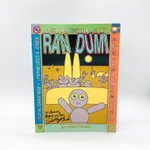
"RAN DUM 1" (2005) by John Pound
A pioneering compilation of comics and other sequential art generated using custom computer programs developed between 1992 and 2005.
🧵


"On Tractatus One" (2018) by @jaapblonk
A tribute to Wittgenstein consisting of procedurally generated visual meditations on the first statement of his "Tractatus Logico-Philosophicus" (1922).
🧵


"Non-Words" (2017) by @rottytooth
A delightfully handmade zine containing selections from a lexicon of computer-generated words, published such that each copy is unique.
🧵

In March 2015, the Twitter bot @nondenotative began emitting a series of curious neologisms—golfmis, hookhawk, pompousstub, tramwit, pilpred, conresectabil—in an attempt to “exhaust all possibilities of non-existent English words." teapawt.org/nondenotative/status/5…

1
1
"Portraits of Imaginary People" (2019) by @mtyka
This vital and evocative work presents a series of computer-generated human faces, in tandem with critical discussion around dark prospects of the underlying deepfake technology.
🧵

Tyka, who has a PhD in Biophysics, has been employing neural networks in artistic contexts for the better part of a decade. Among other highlights, he created some of the earliest artworks using DeepDream (a landmark AI model) and co-founded @artwithMI at Google, where he works.

1
1
"404" (2020) by ball gag
A computer-generated compendium of fictitious human faces, presented in an unusual material format—this one is a stunner!
🧵

ball gag is a Japanese artist who is currently enrolled at the Tohoku University of Art and Design. This project takes the form of an artist's book containing images of human faces generated by Nvidia's StyleGAN model, via Phillip Wang's website thispersondoesnotexist.com.

1
1
"Thomas Browne’s Commonplace Book, or A Network of Texts, or The Garden of Cyrus algorithmically recultivated" (2016) by Stephen M. Pentecost
An ambitious computer-generated commonplace book compiling sentences from a meticulously annotated corpus of 275 books.
🧵


"Talking Gibberish to Strangers" (2019) by @bengymen
A volume of found computer poetry that was incidentally generated by YouTube's automatic captioning technology for video footage comprising mostly gibberish.
🧵


"Clik-A-Mouse: Computerized Art" (1985) by Gary Wray and Brian James Riedel
A collaborative artist's book filled with stunning early digital art created on an Apple computer.
🧵


"Disztichon Alfa: Első Magyar Automatikus Versgenerátor" (1994) by Tibor Papp
This first Hungarian computer-generated book is a volume of computer poetry packaged with a floppy disk, which contains an interactive version of the associated generator.
🧵


"The Impossible Utterance" #3 (1990) by @SethTisue and Brad Russell (eds.)
This special "untouched by human hands" issue of a zine for offbeat language work contains curious neologisms and generative glitch art, each produced by experimental Hypercard stacks.
🧵

Published by the editors' Plaster Cramp Press (tisue.net/pcp/) of Wheaton, Illinois, the zine was devoted primarily to experimental writing, by the likes of John M. Bennett, Geof Huth, Michael Helsem, and others. It ran for six issues, all of them appearing in 1990.

1
"Hell of the Cyr" (2019) by Bornander Halmond
A novel whose author, title, cover, contents, blurb, price, reviewers, and reviews are all procedurally generated by distinct neural networks.
🧵

This novel is one of a series of ten books released as part of the Booksby.ai project of @AndreasRef and @mikkelloose—a bookstore where (nearly) everything is procedurally generated.
1
365 COMPUTER-GENERATED BOOKS
On each day of 2022, we are highlighting an example from our extensive collection of computer-generated books, spanning 1951–2022.
Scroll below for the growing compilation thread, or use this index for easy navigation: aleator.press/365.
🧵
Here's the compilation thread: teapawt.org/aleatorpress/status/14…

With this series, and through the very act of collecting, we aim to showcase the computer-generated book as a material cultural form that is as old as the computer itself.
The examples in our collection currently span a 70-year period, from 1951 to 2021.

1
"Transformer Poetry: Poetry Classics Reimagined by Artificial Intelligence" (2019) by @kane
A collection of computer poetry generated by submitting the opening stanzas of various famous poems as prompts to GPT-2, which completes them.
🧵

GPT-2 is a large-scale pre-trained language model that was created by OpenAI and first announced in February 2019. Hsieh produced this book later in the year, with help from @AdamDanielKing's handy GPT-2 interface talktotransformer.com.

1
Check out this fantastic 13-day residency in Computational Writing—and apply by this Wednesday! banffcentre.ca/programs/comp…
1
"Bagabone, Hem 'I Die Now" (1980) by Melpomene
To our knowledge, this is the first novel that was purportedly written by a computer—in actuality, it is the result of a curious literary hoax.
🧵


"Seven Computer Landscapes" (1993) by Valerie Hollister
A stunning letterpress-printed artist's book, in unusual bindings, containing seven landscape images created using MacPaint.
🧵

