

Building AI safety 🤖 // ride the wave 🌊 // prev: Bytedance Seed
Joined November 2024
- Tweets409
- Following461
- Followers295
- Likes2.5K




Hot take: the UI is the worst part of every B2B product.
Look at where your bugs actually come from. It’s almost always the UI. That’s also where all the features nobody asked for end up. Meanwhile your customer spends 40 minutes clicking through a workflow an agent could’ve finished over the API in 4 seconds.
Services + API + agent. That’s the product.
The rest is a very expensive screenshot for the sales deck.
2
72
Great read on the state of the robotics industry. Matches what I’ve seen in SG talking to 10+ robotics companies.
One thing I’d add is that another pure software play would be targeting non-robotics makers like insurers or ops outsourcing providers.


Talked to a gov official working on robotics (if you know, you know👇)
They’re flying to the US to recruit talent, flying to China to sort out supply chain issues, lending credibility to robotics companies so clients are willing to adopt their solutions, and laying out a long-term strategy for the hardware and software gaps in the market.
All the behind-the-scenes heavy lifting to push the industry forward.
It reminded me of the Chip War story in Taiwan.
In the 1980s, government officials led by K.T. Li bet everything on semiconductors. They recruited Morris Chang from the US to lead the effort. There was no clear business case and no guaranteed return. The government put up about half the money and pressed Taiwan’s business tycoons to invest the rest. When one refused, the prime minister called him personally: “The government has been very good to you for the last twenty years. You better do something for the government now.” That bet became today’s TSMC.
Physical AI isn’t just a private-sector bet. It’s a generational, national strategic bet.
Make things happen, and history will follow.
4
185
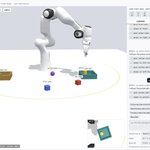
Playing with a model-controlled (Astra 6) Franka arm in MuJoCo physics with an RGB-D camera, using simple natural-language prompts. Takeaways:

1
12
704

4–6 months wait for the Microduck 😭
But it makes me think of a real-life Tamagotchi. You teach (not "train") your pet new things and watch it grow. That kind of attachment could be what makes consumer robotics click.
Maybe before the ChatGPT moment of robotics, we get the iPhone moment of it @pollenrobotics

What if there's a private eval arena where companies upload their real tasks, and every new model is automatically tested as a black box. That way, we evaluate models by their value on real world work not vanity benchmarks

I have a genuine question.
Anthropic has probably been working on Fable 5.1 for a very long time. OpenAI has probably been working on GPT-6 Astra for just as long. These labs are almost certainly building in parallel, not reacting to each other in real time of course.
So why does Fable 5.1 launch just a couple of days before Astra, and then Astra beats it on almost every benchmark by a good margin?
And this isn't a one-off.
Every single launch follows the same pattern: when Anthropic ships a new model, it beats all of OpenAI's previous models.
When OpenAI ships a new model, it beats all of Anthropic's previous models. Now they are actually beating what the other just launched days earlier.
Benchmarks are completely vanity metrics.
3
479
Most AI products are automation, not AI-native. Automation makes the old workflow cheaper. AI-native makes it unnecessary.
My team builds evals for frontier models. Benchmarks: task sets, rubrics, judge pipelines, release gates. AI does most of that work now, so what used to take 10-15 people + 2 weeks takes one operator + 3 days now. Transformative economically. Still the same old process underneath.
AI-native approach would not generate the same old outcome. It would watch failures, find what we do not understand, form hypotheses, run experiments, audit its own judges, and escalate only what matters. It is a living map of where the model works and where it breaks.
2
3
107
What if the next gold rush isn't AI building, but teaching AI your taste?
A Hollywood cinematographer sees 1000 things you don't - which shadow creates tension, why 24fps feels more cinematic than 60, when breaking the 180° rule works
We're moving from selling time → selling outputs → selling the pattern of how we see
Just like lawyers are teaching AI what "good" contracts look like for $500/hr, imagine cinematographers encoding their visual intuition, producers teaching story rhythm, sound designers transferring their feel for emotional frequencies
The most valuable asset isn't your work anymore, it's your taste, packaged as training data
Creative judgment that took decades to develop can now be captured, scaled, sold. Every expert should be asking: how do I bottle what makes my eye different?
The real disruption: human taste becomes a product, not a service

How a 22-year-old dyslexic dropout created the fastest revenue-growing business in history—$1M to $500M in just 17 months.
@BrendanFoody discovered that AI labs were facing a critical bottleneck: they needed human experts to create "evals"—tests that teach models what correct looks like. His company @mercor began connecting labs with lawyers, doctors, engineers, and other specialists to create evals and training data for models (for $95-500/hour).
Today, @mercor works with 6 of the Magnificent 7, all top 5 AI labs, has never had a customer churn, and has a net revenue retention of 1,600%.
In my conversation with Brendan, we discuss:
🔸 Why evals have become the primary bottleneck for AI progress
🔸 How exactly Mercor grew to $500M revenue in 17 months
🔸 Brendan’s meeting with xAI that changed his company’s trajectory
🔸 Which skills and jobs will be most valuable as AI continues to advance (hint: jobs with “elastic” demand)
🔸 Why Brendan believes AGI and superintelligence are not happening anytime soon
🔸 The three unique core values that drove Mercor’s success
🔸 How Harvard Lampoon writers are making Claude funnier
Listen now 👇
• YouTube: youtu.be/ja6fWTDPQl4
• Spotify: open.spotify.com/episode/3wh…
• Apple: podcasts.apple.com/us/podcas…
Thank you to our wonderful sponsors for supporting the podcast:
🏆 @WorkOS—Modern identity platform for B2B SaaS, free up to 1 million MAUs: workos.com/lenny
🏆 @Jira Product Discovery—Atlassian's new prioritization and roadmapping tool built for product teams: atlassian.com/lenny
🏆 @enterpret_ai—Transform customer feedback into product growth: enterpret.com/lenny
2
3
257
Tinkering with an idea that got me:
> 3.5k views in 24h
> 19% upvote ratio (so you can tell it's not pleasant content lol)
> 31 people writing long essays on why I'm wrong
> 10+ stealth website visitors
Lesson: Bad attention beats no attention every time. The real problem is being ignored.
Plot twist: Reddit haters wrote the most helpful 7-8 line feedback I've ever received.
Worth the roast.

2
125
Most AI products fail because they're thin ChatGPT wrappers.
Been thinking about what actually works:
The 2x2 matrix of AI transformations:
> Unstructured → Structured (natural language → code)
> Structured → Unstructured (data → insights)
> Unstructured → Unstructured (summarization)
> Structured → Structured (format conversion)
Sweet spot? Unstructured → Structured with clear validation loops.
Why? You immediately know if it worked. Code runs or doesn't. No ambiguity.
But the real moat isn't the transformation -> it's the thickness of your wrapper.
Cursor and Harvey win because they understand entire workflows, not just single prompts. They accumulate context ChatGPT can't access.
The paradox: Start with one atomic job-to-be-done, but architect for workflow expansion from day one.
Pick something people already do 10+ times daily, suffering through copy-paste with ChatGPT.
The best products create compounding value. Each interaction makes the next one better. Tight feedback loops. Learning from corrections.
If you're building AI products: Stop thinking "what would be cool" and start thinking "what are people already jerry-rigging?"

2
3
154