

Proudly South African 🇿🇦 Partner Braavos Investment Advisers: Passion and mindset are the scarcest assets.
Joined December 2012
- Tweets10.2K
- Following674
- Followers643
- Likes3.2K
Andre Crawford-Brunt retweeted

This is f*cking insane. Meta CEO Mark Zuckerberg on why OpenAI and Google, each building one AI for everything, have the future wrong:
"They think you're going to use Gemini or ChatGPT for all of the different things they want to interact with. And at a high level, that's just not how I think the world is going to go"
"I think in the future, every business, just like they have a website and a phone number and an email address and a social media account, is also going to have an AI"
In 3 minutes, he explains why he thinks one AI for everything is the wrong bet, and why open software has always ended up safer
One AI for Everything → An AI for Every Business → An AI for Every Creator
He says you didn't want one app or one website. You won't want one AI either
Worth more than most $1,900 AI courses
Bookmark and watch it today
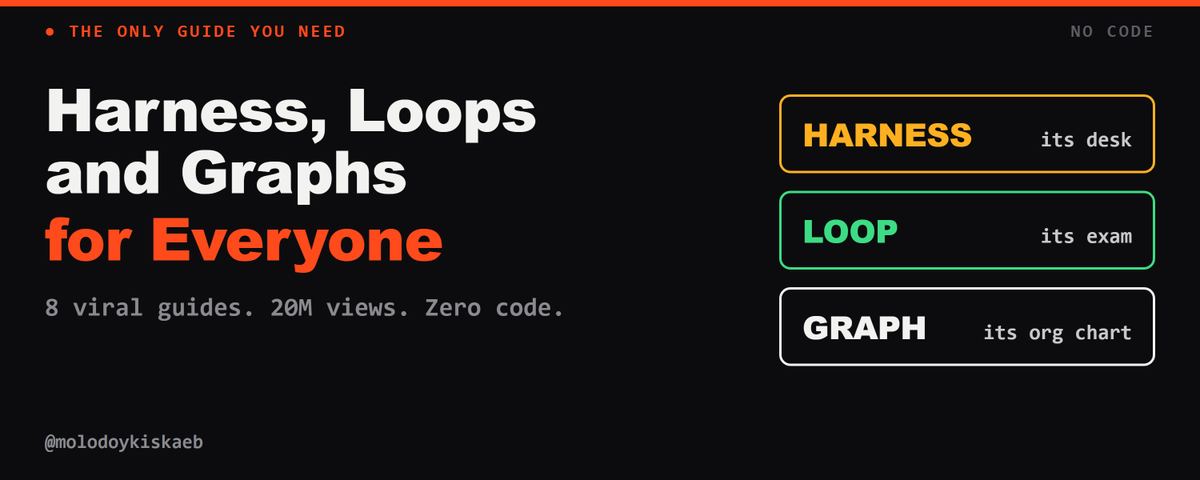
Then read the no-code guide to building an AI for your own business ↓

Andre Crawford-Brunt retweeted

The King 👑.
Stanley Druckenmiller’s take on the current economy.
He’s basically out of the stock market:
Andre Crawford-Brunt retweeted
If power is the real constraint for AI…maybe worrying about models and chips is a misplaced effort.

Andre Crawford-Brunt retweeted

Dan Loeb on "the bear math":
Consensus has hyperscalers and frontier labs spending $5-7 trillion between 2025 and 2030. At a low-teens hurdle rate and sensible depreciation assumptions, that requires $2-3 trillion of incremental annual AI revenue, against roughly $6 trillion of total global IT spend today. The two leading frontier labs, by comparison, generate well over $100 billion in run-rate revenue combined.


Andre Crawford-Brunt retweeted
Let’s be honest, there is only really one news everyone cares about today:
Anthropic going public.
I break down everything with @jasonlk and @rodriscoll - predictions, analysis…
1. Why Anthropic Is the Big Winner From the Downfall of Jensen
Jensen's biggest agenda was a US open-weight alternative, and building these models takes real money. Anthropic's S1 suggests its last model cost roughly $10B to train, and no one else has the dollars to build a significant US open-source product. With more pushback on Chinese open-weight models, Anthropic becomes the US closed-weight provider with pricing power.
2. At $100 Billion in Revenue Anthropic Got There With 1/12 the Employees That Google Had
Anthropic will reach a $100B revenue run rate with fewer than 6,000 employees, versus 81,000 at Google and 71,000 at Meta at the same milestone. AI go-to-market teams are typically about 30% smaller, but Anthropic's headcount is a twelfth. Jason reads this as a sign the jobs outlook is even worse than discussed.
3. All Shareholders Should Want Jensen Back
Rory says that if he owned 100% of NVIDIA's stock, Jensen is the person on the planet he would most want running the company. His only caveat is the US government's effort to put the CEO in prison.
4. Does the Liquidation Preference Count for Anything in a Post-Jensen World?
Jason argues the NVIDIA drama has weakened the liquidation preference. Investors assumed NVIDIA or its friends would always buy out or bail out teams like Reflection, Poolside and Hugging Face, so they could not lose on those deals. With Jensen gone, he doubts NVIDIA's new leadership will spend $17B buying out these companies.
5. The One Question You Need to Ask to Determine Whether to Buy SpaceX Stock
Rory says the case for buying SpaceX stock rests entirely on what Anthropic will be paying for its compute one year from now. Whether Anthropic cancels that compute or relies on it more is, in his view, the only question.
6. How LPs Are Going to Grade GPs in the Future
Jason expects LPs to grade VC portfolios on how many companies valued at $20B and up they hold. When he started investing the benchmark was unicorns, and having one or two was enough for LPs to seek a manager out. The new test is how many $20B-plus companies a firm backed before they reached that valuation.
7. Why Net New Customers Is the Single Most Important Metric
Net new customers was Jason's lighthouse metric when he started investing, and he calls it the only thing that matters at scale. Companies with decent NRR and repeated price increases have masked 20% growth for several years. A business that is not attracting net new customers is, if not terminal, in deep value mode.
(links in comments)
Andre Crawford-Brunt retweeted

On Talks at GS, Pablo Salame, Co-Chief Investment Officer at @Citadel and former Goldman Sachs Vice Chairman, shared his views on how mistakes can produce valuable insight—and why resilience and adaptability are essential to navigating challenging periods.
Watch the full conversation with Goldman Sachs Asset & Wealth Management’s Alexandra Wilson-Elizondo: click.gs.com/aoen
Andre Crawford-Brunt retweeted

Is Anthropic really worth 1.4T?
Andreas Steno has broken it all down in a special IPO preview.
He's gone through the 300-page prospectus and laid out the bull and bear case with a price for each.
Everything is in his free 28-page report…
Andre Crawford-Brunt retweeted
Why Jevons' paradox does not cut it. We are going to 10x that.
“I truly believe that we are going to mega Jevons paradox. It is not going to be a subtle Jevons. It is going to be super-duper.
There is going to be tons and tons and tons of usage, and I think it will completely dwarf the total token consumption of string LLMs.
These things are going to be used everywhere. We are finally going to have AI run in the background, and people will start to feel like, ‘Oh, it actually makes life better.’” @CompleteSkeptic
Love to hear your thoughts @EpochAIResearch @dwarkesh_sp @nathanbenaich @GavinSBaker

So Diogo Almeida is one of the most fascinating CEOs I have ever interviewed.
born in the Philippines
2008: wins bronze for the Philippines at the International Mathematical Olympiad
2013: starts his career as a software engineer at Amazon
2017: joins Google Brain, working on cutting-edge deep learning research
2018: leaves Google Brain and takes roughly 18 months off to figure out what makes him happy
travels the world, experiments with improv, art and meditation
becomes a top-30 League of Legends player
discovers that none of it makes him particularly happy
2020: joins OpenAI when it's still a relatively obscure research laboratory
helps develop reinforcement learning from human feedback (RLHF), the technique that transforms how people interact with AI
2022: co-authors the landmark InstructGPT paper
the work becomes foundational to ChatGPT
November 2022: ChatGPT launches and becomes one of the fastest-growing consumer products in history
2023: contributes to GPT-4, one of the most important model releases in AI history
but starts questioning the fundamental assumptions behind the technology he helped build
2024: leaves OpenAI while ChatGPT is exploding in popularity
people think he's crazy for walking away
co-founds TypeSafe AI with Erik Gafni and Sasha Sheng
spends two years in stealth developing an entirely new class of AI models
September 15, 2026: launches Jev, TypeSafe's first System One model
Company makes $100M in revenue in the first 7 days of launch
raises a reported $40M seed round led by DCVC
October 2026: a reported $870M Series A at a $7.5B valuation, backed by a16z
argues that the next breakthrough in AI will come from making intelligence cheap, reliable and autonomous
My notes from my discussion with @CompleteSkeptic below:
1. Why Jevons' Paradox Does Not Cut It. We Are Going to 10x That
Diogo expects a "mega Jevons paradox", with usage that dwarfs the token consumption of LLMs and AI running in the background everywhere. He expects people to stop seeing AI as something that "slops crap at them" and start seeing it as something that makes life better.
2. Why SaaS Incumbents Are Better Positioned Than OpenAI and Anthropic in Many Application Spaces
SaaS companies know their customers' workflows and have the scale to fund the upfront engineering that real automation requires. Diogo argues their edge comes from being closest to the problems, not from distribution. Teams inside products like TurboTax know where to improve the interface, while OpenAI and Anthropic are "still living in their ivory tower."
3. Why We Do Not Hire From OpenAI
Diogo sees getting into OpenAI as an anti-signal and says its researchers love algorithms and scaling but hate data. Data is a low-status topic at most labs, and the few people focused on the right task would want to pursue their own. That leaves researchers obsessed with algorithms, which he likens to throwing money in the furnace.
4. How the AI Bubble Could Burst and Where the Demand Shock Could Be
Part of today's AI demand is driven by FOMO, from people believing they are getting good results. Diogo finds many buyers miscalibrated and overestimating what AI can do. Once they face the realities of its capabilities, demand could fall quickly.
5. What Metric Did ChatGPT Optimize for in the Early Days?
Before Claude Code, ChatGPT was optimized for monthly active users rather than the best chatbot experience, which is how sycophancy emerged. Companies are now optimizing for the MAU equivalent in coding agents. Without a dedicated model, Diogo doubts they will produce a comparable one soon.
6. Why the Talent Market Is Not Crazy for Us and We Don't Pay for Mercenaries
TypeSafe pays people good amounts but not the highest, which filters out hired guns. Diogo says Anthropic is suffering from mercenaries because it pays more than anyone else, and an entire market now exists to prepare candidates for Anthropic culture interviews.
7. We Wanted Sonya Huang More Than We Wanted Sequoia
Diogo did not want Sequoia's money and brought the firm in because of Sonya. He values her particular shape of brilliance, which offers a perspective no other advisor gives him. One TypeSafe value is to make great decisions slowly, and he sees her as a valuable thought partner for that.
(links in comments)
Andre Crawford-Brunt retweeted
So Diogo Almeida is one of the most fascinating CEOs I have ever interviewed.
born in the Philippines
2008: wins bronze for the Philippines at the International Mathematical Olympiad
2013: starts his career as a software engineer at Amazon
2017: joins Google Brain, working on cutting-edge deep learning research
2018: leaves Google Brain and takes roughly 18 months off to figure out what makes him happy
travels the world, experiments with improv, art and meditation
becomes a top-30 League of Legends player
discovers that none of it makes him particularly happy
2020: joins OpenAI when it's still a relatively obscure research laboratory
helps develop reinforcement learning from human feedback (RLHF), the technique that transforms how people interact with AI
2022: co-authors the landmark InstructGPT paper
the work becomes foundational to ChatGPT
November 2022: ChatGPT launches and becomes one of the fastest-growing consumer products in history
2023: contributes to GPT-4, one of the most important model releases in AI history
but starts questioning the fundamental assumptions behind the technology he helped build
2024: leaves OpenAI while ChatGPT is exploding in popularity
people think he's crazy for walking away
co-founds TypeSafe AI with Erik Gafni and Sasha Sheng
spends two years in stealth developing an entirely new class of AI models
September 15, 2026: launches Jev, TypeSafe's first System One model
Company makes $100M in revenue in the first 7 days of launch
raises a reported $40M seed round led by DCVC
October 2026: a reported $870M Series A at a $7.5B valuation, backed by a16z
argues that the next breakthrough in AI will come from making intelligence cheap, reliable and autonomous
My notes from my discussion with @CompleteSkeptic below:
1. Why Jevons' Paradox Does Not Cut It. We Are Going to 10x That
Diogo expects a "mega Jevons paradox", with usage that dwarfs the token consumption of LLMs and AI running in the background everywhere. He expects people to stop seeing AI as something that "slops crap at them" and start seeing it as something that makes life better.
2. Why SaaS Incumbents Are Better Positioned Than OpenAI and Anthropic in Many Application Spaces
SaaS companies know their customers' workflows and have the scale to fund the upfront engineering that real automation requires. Diogo argues their edge comes from being closest to the problems, not from distribution. Teams inside products like TurboTax know where to improve the interface, while OpenAI and Anthropic are "still living in their ivory tower."
3. Why We Do Not Hire From OpenAI
Diogo sees getting into OpenAI as an anti-signal and says its researchers love algorithms and scaling but hate data. Data is a low-status topic at most labs, and the few people focused on the right task would want to pursue their own. That leaves researchers obsessed with algorithms, which he likens to throwing money in the furnace.
4. How the AI Bubble Could Burst and Where the Demand Shock Could Be
Part of today's AI demand is driven by FOMO, from people believing they are getting good results. Diogo finds many buyers miscalibrated and overestimating what AI can do. Once they face the realities of its capabilities, demand could fall quickly.
5. What Metric Did ChatGPT Optimize for in the Early Days?
Before Claude Code, ChatGPT was optimized for monthly active users rather than the best chatbot experience, which is how sycophancy emerged. Companies are now optimizing for the MAU equivalent in coding agents. Without a dedicated model, Diogo doubts they will produce a comparable one soon.
6. Why the Talent Market Is Not Crazy for Us and We Don't Pay for Mercenaries
TypeSafe pays people good amounts but not the highest, which filters out hired guns. Diogo says Anthropic is suffering from mercenaries because it pays more than anyone else, and an entire market now exists to prepare candidates for Anthropic culture interviews.
7. We Wanted Sonya Huang More Than We Wanted Sequoia
Diogo did not want Sequoia's money and brought the firm in because of Sonya. He values her particular shape of brilliance, which offers a perspective no other advisor gives him. One TypeSafe value is to make great decisions slowly, and he sees her as a valuable thought partner for that.
(links in comments)

Andre Crawford-Brunt retweeted

$IONQ President Chris Ballance on what they're trying to achieve with Superion:
The goal is to simplify, vertically integrate, and prove the commercial scale of this generation of quantum computers.
This is what Oxford Ionics and Skywater were acquired for.
Andre Crawford-Brunt retweeted

a16z is one of the largest investors in the artificial intelligence cycle, and it just released State of Markets II, its 100+ chart view on where tech, AI, and capital are heading.
It makes one big argument: the AI boom is real, it’s earnings-backed, and still super early.
We analysed the whole 90-page deck and listened to the partners’ accompanying podcast (so you don’t have to!), and turned it all into a strategy guide for anyone building, working, or investing in AI.
At the core, two numbers essentially frame the whole deck. Hyperscalers will spend about $780B on capex in 2026, nearly double last year, as they race to build AI capacity. Yet only 2% of S&P 500 companies track an AI metric over time, even though 69% run AI live.
That gap between investment and adoption is exactly where the next decade of AI value will be created and captured.
And which side of it you sit on decides whether you build a category leader or a feature, and whether you back a winner or simply overpay.
Full analysis here: linas.substack.com/p/a16z-st…


Andre Crawford-Brunt retweeted

full video on "Blackstone and Eric Schmidt" YouTube channel
youtube.com/watch?v=PSbUom-p…

Andre Crawford-Brunt retweeted
Eric Schmidt: If I could invest in only 1 AI theme, it would be long reasoning.
A model that can stay on 1 problem for hours/days is a completely different thing from a model that answers and stops, and most people still have not priced that difference.
----
From "Blackstone and Eric Schmidt" YouTube channel, (link in comment)
Andre Crawford-Brunt retweeted

Abridge CEO @ShivdevRao believes healthcare still hasn’t grasped what an AI-native company looks like.
With ambient clinical documentation as the wedge, @AbridgeHQ is now expanding to build for the processes that occur before and after the visit.
Their goal is to craft a healthcare tool that can handle everything from risk adjustment and care gap closure to note-taking. The idea is to provide whatever the clinician or patient needs, with AI assistance.
Shiv explains their mission to Lightspeed Partners Dr. @BrentonFargnoli and Dr. @GalymImanbayev.
When he thinks about approaching problems in healthcare, Shiv zooms in on the end user’s perspective. He asks what an enterprise-grade assistant for a doctor would look like, and how Abridge could build one:
“Some of these outcomes could be financial, but aspirationally, these outcomes should be clinical.”
Watch the full interview below.
00:00 The Clinic Prep Vision: Abridge Working Behind the Scenes
01:43 From History Major and Skateboarder to Physician
07:12 Cardiology and the First Healthcare Software Project
11:57 What Abridge Is Today: Building an AI-Native Health System
15:21 Clinical Jobs the Assistant Can Do: The PET Scan Example
20:09 Pre-Charting Reimagined: Gaps, Prior Auths, and Clinical Trials
24:15 Computer Use Demo: From Generative AI to Actions
28:17 The North Star: A Cardiologist Who Retired Too Early
30:02 Clinician Scientists: Building for Doctors, by Doctors
33:03 Open Weights and Staying Adaptable
39:56 Scaling AI Across the VA
43:27 Life Sciences and Public Health: Spotting an Outbreak Early
46:06 Rearchitecting the Provider and Payer Relationship
52:44 Rapid Fire: Overrated, Underrated, and Investor Advice
Andre Crawford-Brunt retweeted
“The amount you can juice out of your finite data center capacity goes down the faster you try to run it.”
Fractile founder and CEO Walter Goodwin on the cost of faster AI:
“You have to end up running your chips at kind of like really low utilization. Your joules per token shoots up.”
On Lightwork, he shares what the team has spent years developing in a “secret skunkworks”: packaging DRAM directly on top of the logic doing the math, giving models more memory bandwidth to run faster.
@goodwin_ml

BREAKING: FRACTILE RAISES A $720M SERIES C CO-LED BY LIGHTSPEED
I got an inside look at the technical breakthroughs @fractile_ai has been quietly building for years, with Founder and CEO @goodwin_ml, alongside @guruchahal and @jonahcader
🧠 Why memory, not compute, is AI’s real bottleneck - and why today’s chips force a choice between big but slow (HBM) or fast but small (SRAM)
🧱 Stacking DRAM directly on logic gives ~20x the bandwidth per chip of HBM and 10x+ the capacity of SRAM
🔁 Why they chose not to bake the transformer into silicon when models change faster than a chip’s 3-5 year life in the data center
🌍 How a team spanning the UK, US and Taiwan pulled off a “secret skunkworks” in advanced packaging
🧑💻 Hiring across silicon, systems and software in London, Bristol and Palo Alto
(My favorite part was hearing how the team flew to London, drove three hours to Bristol for one day with the Fractile team, and even got to catch an eclipse! 🌘)
FULL SEGMENT BELOW
@lightspeedvp
Andre Crawford-Brunt retweeted

@goodwin_ml joined @HarryStebbings on @twentyminutevc to talk about Fractile's technology, building a frontier AI company in the chip layer, and why he believes the AI buildout will only continue to scale.
youtube.com/watch?v=UZ8eYaAf…
open.spotify.com/episode/6yG…
Andre Crawford-Brunt retweeted

Gavin Baker says no big tech winner ever won by being the cheapest. Apple, Nvidia. Not once.
AI is the first time that flips.
His frame: “the low-cost producer always wins. And we haven’t had that in tech.”
Intelligence now comes down to two numbers. Tokens per answer and cost per token. The labs own the first. Everyone else is fighting over the second.
The math he keeps quoting:
Take a GPU from 40% utilization to 80%
Cost per token drops in half
Margins jump with it
And power is capped. “Seven states have bills to make it illegal to build data centers.” So squeezing the factories you already have is the only lever left.
Then how he caught Tesla and Nvidia early: “when a technological discontinuity encounters first principles thinking.”
Elon put the battery at the bottom of the car. Jensen saw that graphics math was deep learning math.
His read: nobody has done that for AI factories yet.
Cheapest intelligence wins. First time in tech.


Andre Crawford-Brunt retweeted

Who are the best investors at emerging VC firms?
Today we release the 2026 Strebulaev-Jackson Venture Ranking of the top 100 venture capitalists at emerging firms. Emerging firms are bets on people, so we score each investor’s full US record, wherever they built it. At least a quarter of the top 100’s points were earned before the investor’s current firm existed.


Andre Crawford-Brunt retweeted

Full conversation between Anthropic CEO Dario Amodei and JPMorgan CEO Jamie Dimon ahead of Anthropic's IPO:
0:00 - Mary Erdos opens the event
1:31 - Kissinger on Dario and the Enlightenment
4:49 - Jamie Dimon opens the conversation
6:09 - Talent and culture come first
6:53 - The culture interview: no jerks
8:05 - All seven cofounders still there
8:48 - Dario Vision Quest: no corpo speak
9:41 - How the Fortune 100 uses Claude
12:10 - Pointing agents at sensitive data
13:30 - Why Anthropic chose enterprise
14:43 - Agents vs. self-driving cars
16:01 - $900B compute bet: "deepest dilemma"
18:19 - Buying compute like insurance
19:56 - Commodity? Every frontier is a new market
22:28 - Haiku 5.5 vs. Fable on price
24:08 - Cancer, fusion, quantum
24:41 - Math: high school to Fields Medal
25:49 - Biology and pharma's skeptics
26:55 - Cyber risk after Mythos
27:43 - Hundreds of thousands of vulnerabilities
29:04 - Agent swarms for cyber defense
29:50 - Why go public now?
31:03 - "Never be worth a dollar more"
32:01 - 5% to a public benefit fund
33:33 - Countering concentration of wealth
34:20 - Fifteen years from now
35:02 - "Those aren't marketing": AI risks
36:21 - Diseases as relics of the past
36:58 - Close: underpromise, overdeliver

Dario Amodei says he believes AI can cure heart disease, Alzheimer’s and cancer the way bubonic plague and smallpox were beaten, and admits he sounds 'starry-eyed' and 'crazy'
“We’re just at the beginning of what can be done in biology and medicine. There’s a lot of skepticism from pharma, from early-stage biotech, from academic biologists. We can’t know ahead of time. Maybe the skeptics are right. But my hope is that we prove the skeptics wrong.”
“Every disease you can think of, heart disease, Alzheimer’s, cancer, we think of those the way we think of bubonic plague or smallpox today: that they’re relics of the past. I think we can have a much more beautiful world. I think we can have a world in which all of these problems are addressed.”
“It sounds starry-eyed. It sounds crazy. I really do believe it. I really do believe it can be done. I don’t know, five years, ten years, fifteen years, I don’t know exactly, but we’re going to try to do it as fast as we can.”