

Assistant prof at @UniUtrecht, trying to make science as reproducible as non-scientists think it is. Blogs at @the100ci. Now also on the app with nice weather.
Amsterdam, Nederland
Joined June 2011
- Tweets16.7K
- Following1K
- Followers6.4K
- Likes35.4K






Pinned Tweet
It's finally out! journals.sagepub.com/doi/10.… (OA)


New paper!
Got the best news on the weekend: "Why hypothesis testers should spend less time testing hypotheses", by @LeonidTiokhin, @peder_isager, @lakens, and myself, has been accepted at Perspectives on Psychological Science.
psyarxiv.com/vekpu


Anne Scheel retweeted

Some big personal news: I'm moving to join Works in Progress as executive editor, starting next month. I have been hoping for an opportunity to work with @bswud and @s8mb for more than a decade, and I'm incredibly excited to finally have one.
WIP is expanding on every front right now. We'll soon begin coverage of business and finance, as well as putting out more reported features. To that end, we'll be hiring more writers and reporters in the year to come. I'm planning to remain based in the US to help build out our presence here.
The print edition of WIP has existed for less than 12 months, but sometime in the next week or so we will reach our 10,000th paying print subscriber. It's a group that now includes people who've been at the highest echelons of government and who run the world's biggest public companies. We’re already on track to 3x that number next year. We'll be in store at Barnes & Noble, Hudson News and independent newsagents next week too.
I think WIP is providing something that people are craving from physical media right now: fewer, extremely well-crafted pieces in a beautifully designed form. Issues now feature an amazing group of columnists, including Tyler Cowen, Dan Wang and Stephen Kotkin. Each edition is better than the last.
You'll see us in more and more places next year too. In January, our new weekly documentary films will launch on YouTube. We're expanding into the events space, with a new series in North America. The sky is the limit from here on out.
Anne Scheel retweeted

I’m very glad we have a cocktail column in Works in Progress. The rise of teetotalism in places like San Francisco is dangerous to civilization; this feels like a small stand against it. Hopefully we will add non-pretentious writing about wine at some point too.

The new issue of @WorksInProgMag both looks and feels fantastic (they are now using a matte paper instead of glossy).
Featured cocktail in this issue: Hanky Panky

Anne Scheel retweeted

All my work online for a guaranteed 100 years.
It's a new service being offered by WordPress. They tried it out on me. I think it's great.
Explained here: wordpress.com/blog/2025/02/1…


This is such a gift to the world. All of @stewartbrand’s work: writing, festival shenanigans, & 50,000(!) photos, dating back to the 50s: stewartbrand.org/
(Where else could you find Marshall McLuhan, Brian Eno, and Marlon Brando in one place!?)


Anne Scheel retweeted

9 days left to submit an abstract to the 9th edition of the Perspectives on Scientific Error conference that takes place in Copenhagen, Denmark, 27–29 January 2027, errorsin.science. It's my favorite conference combining philosophy of science, metascience, and statistics.
Anne Scheel retweeted
We are excited to announce that we are going to broadcast the second day of Meta-Research Symposium 2026 (this Friday on October 9th) for those who were interested but unable to join in person.
JOIN: teams.microsoft.com/l/meetup…
PROGRAM: docs.google.com/document/u/0…
Anne Scheel retweeted

The "Works in Progress-to-policy" pipeline is working.


Anne Scheel retweeted
There is no good reason for mosquitoes to exist in wealthy countries today.
New technologies can get rid of the mosquito species that cause diseases like dengue, yellow fever, and malaria; and others can prevent them from carrying those diseases.
worksinprogress.co/issue/mos…
So why do mosquitoes still exist?
In a new article for Works in Progress, Maya Rosen explains how state incapacity and risk aversion led to over a decade of delays and billions of unnecessary bites in the United States.
Oxitec, for example, engineered an Aedes aegypti mosquito in such a way that its female offspring would die before adulthood. Through sustained releases, they showed they could reduce local mosquito populations by 80% or more, in field trials.
They sought approval from the USDA in 2010, which then passed it to the FDA, which passed it to the EPA. In 2020, the EPA allowed them to conduct limited field trials in the Florida Keys. Two years ago, their experimental permit expired, and they still need another review before it can be used routinely. Their proposed field trial in California was withdrawn after public opposition.
Another company, MosquitoMate, developed a technique involving Wolbachia, which also suppresses local mosquitoes. They then spent over fifteen years working through the system before finally receiving commercial registration nationwide in 2024.
It seems that, sometimes, the barrier to getting rid of diseases isn’t technology at all. It’s policy and political will.
New products shouldn’t get stuck in regulatory review for so long, especially if the delays are about basic questions like which agency has oversight over the product, rather than testing for safety.
Though some of those uncertainties were being addressed, the broader changes haven’t materialized. After Biden’s 2022 executive order, the agencies planned to update how their coordinated framework was implemented. But Trump rescinded the order last year.
Meanwhile, the EPA unit that reviews new mosquito control products is still a small office backlogged in reviewing a wide range of products.
Mosquitoes are a policy choice. We can get rid of them. Will we choose to?
worksinprogress.co/issue/mos…


Anne Scheel retweeted

An interesting thing is happening to me at the moment. I have a standing bug bounty policy for my first-authored scientific work: I've committed to pay people who report bugs in my code, up to 750€ for severe errors. Since GPT Astra, I'm now getting several bug reports daily.
If you want X AND Y AND Z to be significant, you may even want to *increase* alpha for the individual comparisons to not lose power (and keep your overall alpha at the nominal level).
Which you should preregister of course, because people absolutely won’t buy it if you don’t.

I am afraid @stuartbuck1 is getting multiple comparisons wrong. If you want outcome X AND Y AND Z to be significant (as in the example) you do not correct so the problem never happens. You correct if you want X OR Y OR Z to show an effect.
Anne Scheel retweeted

We are on the cusp of a wave of new therapies for some of the worst diseases. But the world won’t benefit unless the US fixes its drug regulatory system. My new essay for @nytimes, on how slow clinical trials are now the biggest obstacle to curing cancer.
nytimes.com/2026/09/04/opini…
- I interviewed dozens of researchers, especially oncologists at leading U.S. centers. A striking consensus emerged: science is no longer the main bottleneck to new cancer drugs. It is our ability to test discoveries in patients through clinical trials.
- The cost of starting a Phase 1 trial in America has roughly doubled over the past decade. As a result, companies increasingly take early trials abroad: Australia’s Phase 1 trial volume has nearly doubled in a decade, driven mainly by U.S. companies.
- Unfortunately, the underlying incentives are badly asymmetric: Institutions can be blamed for harms caused by moving too fast, but almost no one is blamed when patients deteriorate during avoidable delays. One doctor called the emerging system “ritualized safety over actual risk assessment.” Or as, @DavidHongMD put it: "We often forget that the biggest risk is the cancer itself."
- This problem is becoming more urgent because medicine itself is changing. Sequencing, biological engineering and A.I. make increasingly personalized therapies possible. But our regulatory system was mostly built for standardized drugs tested in large populations.
- @sytse, the co-founder of GitLab, shows what personalized medicine can achieve: after relapsed osteosarcoma and being told there were no options left, he pursued a highly individualized approach and has now been cancer-free for a year. But doing so required extraordinary resources and regulatory expertise.
- Pierce Ogden’s father was less lucky. After molecular analysis identified a drug that might target his glioblastoma, the manufacturer agreed to provide it. But administrative barriers delayed access until it was too late. “My dad was ready to try anything,” Pierce told me. “But the system is paternalistic.”
- The A.I. revolution is making this bottleneck more important, not less. A.I. relies on relevant data. Information from early-stage trials could compound with A.I. tools to achieve truly revolutionary medicines. Without the data, this is far less likely to happen.
- Another important shift is that innovation increasingly comes from academic labs and small biotech companies rather than Big Pharma. These small companies find it far harder to unable to absorb delays and regulatory barriers.
- Apart from cancer, China is the biggest winner from America's outdated medical regulations. China has a much faster trial system, with testing often starting a full year earlier. This allows Chinese pharmaceutical companies to experiment and improve medicines while American companies play with mice. Today, half of all drugs licensed by major pharmaceutical companies originate there, up from less than 5 percent only a decade ago.
- But we don't need to copy China. The best model is Australia: lots of on-site scientific and ethics reviews, and requirements that are proportionate to small, early-stage trials. Phase 1 studies there begin roughly 6–12 months faster, without any notable increases in adverse safety events.
- Operation TrialBlazer, a 2026 HHS initiative is a good start in this direction, but we need legislative action by Congress to truly make Phase I trials faster and more efficient!
I want to thank everyone who helped me with this article: everyone I interviewed and the amazing editors at the Times. This is the result of a months long journey of extensive interviews and research.
Special thanks go to those who came on the record. One of the features of the system is an atmosphere of fear, where practitioners are afraid to publicly come out and explain these issues. So anyone who does is a hero in my book!

Anne Scheel retweeted
Throwing rubbish in a landfill is (usually) better for the environment than recycling it. With few exceptions, recycling ends up emitting more CO2 and costing more money, while landfills are cheap and secure.
- Recycling mid-tier plastics (like plastic bottles or butter tubs) costs thousands of dollars per ton of CO2 saved. It's cheaper to do direct air CO2 capture than that! And there is no shortage of plastic, nor any problem with sequestering it in the ground once we're done with it.
- Modern landfills are extraordinarily secure and are *much* more than just big piles of trash. They capture 75%–95% of methane gas. Groundwater contamination is doesn't really happen with landfills built since 1990. A study of 31 landfills built since 1988 in NY found no adverse effect at all on local groundwater quality.
- The crusade against single-use plastics has driven us to products that use far more materials and energy and would need to be used an absurd number of times to actually be an improvement. A steel straw needs to be used 150 times to be worth using. A ceramic mug needs to be used 1,000 times to beat a polystyrene cup. A cotton bag needs to be reused 173 times to beat single-use.
- Some things ARE worth recycling. Recycling metal saves a huge amount of energy and material – recycling aluminium saves 95% of the energy spent on making fresh stuff. So we do a lot of it already: about 30% of steel worldwide is recycled.
Modern, well-run landfills cause minimal environmental damage. We have plenty of space for them – less than 0.01% of the US is used for landfill and only about 0.02% of Germany. We can even build on top of old landfills, so the land area is not spent permanently.
New in @WorksInProgMag, @robertwiblin and @chalmermagne on why it's usually best to just bury your trash. worksinprogress.co/issue/jus…

Anne Scheel retweeted
Get clued into the news months in advance by subscribing for free to my Substack 🪩


Moderna and @Merck today announced positive topline results from the Phase 3 INTerpath-001 trial evaluating adjuvant treatment with intismeran autogene, a novel investigational mRNA-based individualized neoantigen therapy jointly developed by Merck and Moderna, in combination with KEYTRUDA® (pembrolizumab), Merck's anti-PD-1 therapy, in patients with completely resected Stage IIB-IV melanoma.
Read more:

Anne Scheel retweeted
1. I love the idea of curing most (or all?) diseases. I just wrote an article about it worksinprogress.news/p/futur… and gave a TED talk about it too! ted.com/talks/saloni_dattani…
We should be a lot more ambitious with medical innovation, and the history of science makes me more, not less, optimistic about what’s possible. Many diseases we once thought were untreatable turned out not to be.
2. But what’s possible isn’t the same as what’s going to happen, and it’s very different from claiming it’s possible within a timeline of 10 years.
Even if we grant exponential improvement in our technological capabilities, we still wouldn’t be able to cure most diseases within ten years, because technology is just one part of the equation.
One clear illustration of this is Eroom’s law, where the cost of drug development has risen despite massive technological advancement.
3. In our episode ‘Will AI solve medicine?’ (harddrugs.worksinprogress.co…) Jacob Trefethen and I talk about how funding, institutions, incentives, better measurement, and a lack of data mean that we’ll still have massive gaps in solving diseases despite progress in AI.
These problems fall most heavily on neglected diseases, like rare and tropical diseases, where funding is often the barrier to progress. But they also affect diseases whose clinical trials are long and onerous, disease progression itself is slow, or poorly measured.
4. All this means that, if we want to speed up medical innovation and scale it up worldwide, we should also be unblocking the other barriers to medical progress with clinical trial reform, better data collection, better measurement instruments, better funding models, and more. (See our ‘Clinical Trials Abundance blog’ for some ideas clinicaltrialsabundance.blog…)
It’s going to take a while before we solve these to the point where we can cure most diseases!
5. I thought the policy proposals in ‘Policy on the AI Exponential’ relating to drug development were quite vague and too brief to be useful.
But even if they were all implemented ideally, we would still be lacking cures for diseases for which financing or clinical trial infrastructure are the barrier, or where we’d need entirely new drug modalities to reach targets safely.
FWIW, I’m fairly skeptical of the use of ‘synthetic control arms’ if we actually want reliably effective medicines, not just faster clinical trials. But platform trials, which include shared control groups that many drugs are tested against, probably get at the intention.
6. I’m very skeptical of the idea that “many of the steps in the clinical process that previously required expensive and slow experiments may soon be done via AI simulation or analysis” ... but maybe this depends on one’s definition of ‘many’.
Human biology is extremely complicated and interactions between drugs and molecules in our body are very hard to predict, in part because of the number of combinations and biological states, and the level of measurement that’s possible in the lab; the way we get around this is through experimental data collection, i.e. clinical trials, but for some diseases, progression is very slow, so we’re not going to be able to collect that amount of data in time, even with perfect measurement.
Unfortunately public health datasets typically don’t include much drug-human body data, with the exception of, e.g., prescription datasets, which would be somewhat useful for analyzing historical drugs.
Getting pharma companies to pool sufficient individual participant data from clinical trials to improve these predictions, though, that would be exciting.
7. I sometimes worry about the deluge of AI ‘slop’ science that’s going to enter the academic literature.
We already needed to reform peer review, catch scientific fraud, improve data quality and rigour before AI (see e.g. my articles ‘Real peer review has never been tried’ worksinprogress.co/issue/rea… and ‘The speed of science’ worksinprogress.co/issue/the…), but now it seems like science reform is even more important.
I could imagine a Pangram-like model for AI-written science papers, but that seems like it merely catches the tip of the iceberg of how deep the slop might go, if it involves unpublished data, for example. If AI use increases exponentially, we might end up seeing an AI science slop tsunami, which could affect predictions based on the literature. What’s the solution to this?


2/2 Second, on the messaging around AI. I do not agree that my messaging has been disproportionately negative. In fact it has been about equally balanced between risks and benefits: I’ve written one major essay about each, and even in interviews where I discuss the risks, I make sure to frequently mention the incredible benefits as well as proposing possible solutions to the risks (short clips from my interviews that end up on social media tend to be disproportionately negative, as that gets clicks). In fact, I wrote Machines of Loving Grace because I didn’t feel the AI industry was painting an inspiring enough picture of how the technology could radically transform the world for the better. The bulk of the essay is devoted to refuting skepticism of AI’s potential in health and biology, and showing why I think it will actually be possible to cure most human disease in ~5-10 years, as crazy as it may sound to ordinary people and frankly to biologists as well (I used to be one!). And, if you read my most recent essay (Policy on the AI Exponential), I discuss concrete proposals for how to streamline the FDA process to make sure the deluge of AI-accelerated drugs isn’t slowed down by the regulatory process. I feel the urgency here: I lost my father to Hepatitis C only a few years before the development of direct-acting antivirals (sofosbuvir), which cure 95% of patients and probably would have cured him.
I do agree that the public has a negative view of AI (and that this is a big problem), but I don’t think it is primarily caused by me or any other AI leader warning about AI’s risks. I think it is fundamentally a crisis of trust. I think that ordinary people don’t trust companies, governments, or the tech industry and always suspect that we are cooking up some new way to screw them over. The causes of this go back decades and AI is just the latest iteration of it. I don’t think that a glitzy marketing campaign with a positive spin (which some have advocated that Anthropic do) is the way to win back that trust — at this point, saying that AI will cure cancer is more a cliche than it is inspiring, and most people think it is deceptive. The thing that will work is *actually curing cancer*. I think by far the most accurate criticism of AI companies including Anthropic is that we haven’t yet delivered on our big promises to benefit the world. That is totally on us, and I think it’s the criticism you should be making, instead of all this stuff about messaging and marketing.
We are however doing our best to fix this: Anthropic is ramping up its efforts very quickly in biology and medicine, and we hope to have incredible results in the coming years and some early glimmers in the coming months. When we’ve actually accomplished something real, the whole world will hear about it, as loudly as possible, you have my word on that. But until then I don’t want to make empty promises, and in the meantime I feel compelled to speak honestly about the very real risks of AI and how to address them. Honesty is the right thing on the merits, and in terms of public credibility and trust it is no worse than, and may in fact be better than, an approach that ignores or distracts from risks which people instinctively understand are real.
Anne Scheel retweeted
Saloni’s talk gave me goosebumps. You should watch it.

It's finally here! I gave a TED talk in April in Vancouver, and it was released online today.
You can watch it here:
ted.com/talks/saloni_dattani…
I've also adapted it into an article, which was published last week: worksinprogress.co/issue/fut…

Anne Scheel retweeted
It's finally here! I gave a TED talk in April in Vancouver, and it was released online today.
You can watch it here:
ted.com/talks/saloni_dattani…
I've also adapted it into an article, which was published last week: worksinprogress.co/issue/fut…
Anne Scheel retweeted
New episode of HARD DRUGS!
Are miracle drugs hiding in plain sight?
GLP-1 drugs have transformed diabetes and obesity, can help treat heart disease, kidney disease, sleep apnea, and may also work against dementia.
But they’re far from the only medicine with more multiple uses. Aspirin, colchicine, minoxidil, Botox, and, famously, Viagra were all found to treat more conditions than expected. (Did you know that BCG vaccines are used to treat bladder cancer?)
In fact, about a third of FDA-approved small molecule drugs are later approved for a second use.
But sometimes, it takes several decades - and public funding - to learn whether existing drugs could work for more conditions.
Moxidectin, for example, went untested for human diseases for decades; we now know that it can cure ~70% of whipworm infections in kids. Aspirin was used for over a century before we found it had cardiovascular benefits.
Why? The commercial incentive to test further is time-limited: once a drug goes off-patent and generics can enter, drug developers can get undercut, so it’s no longer worth it to run expensive clinical trials to test other uses.
The problem is even larger for tropical diseases, which are often not profitable to treat in the first place.
The result is that we’re missing out on knowing about a lot of additional uses of already-approved drugs!
There may be more miracle drugs hiding in plain sight. And economists estimate the ‘missing innovation’ would be worth 100 to 400 billion dollars in social value annually(!)
How do we solve this?
In this episode, @JacobTref and I chat about all the above and more!
Anne Scheel retweeted
Works in Progress is hiring!
We are looking for a Social Media Producer and a Commercial Associate. These are full-time, salaried roles.
Social Media Producer: Someone who can run and grow our social media accounts, clip longer Youtube videos for platforms like IG and Tiktok, and make original content. Please be extremely online and be able to find the most shareable bits of WIP's work. Salary is £35,000–£60,000. wip-social-media-producer.lo…
Commercial Associate: Someone who can work with our Head of Commercial to grow our revenues via advertising, subscriptions, events, marketing, and anything else that can make a return. We'd like a real "grafter" for this – you must be very happy speaking to people on the phone! Salary is £35,000–£50,000. wip-commercial-associate.lov…
We are growing quickly and have a lot of fun projects in the pipeline. We're looking for bright, energetic people to join us. Success in these roles will lead to further advancement down the line.
Both jobs are based in London, though this is negotiable in the case of the Social Media Producer for an exceptionally good candidate.

New paper w/ @LeonidTiokhin & @lakens!
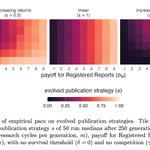
Registered Reports (RRs) are great for science b/c publication is guaranteed before results are known, reducing publication bias & QRPs. This supposedly also makes them great for *scientists*. But is that really true?
tinyurl.com/4sy993rr

If you’re curious about alternative model configurations (or unhappy with our assumptions or parameter settings), feel free to play with the code yourself: github.com/amscheel/rr-model… 16/

This paper has been a long time in the making, but it’s been a super fun and interesting journey. Special thanks to @LeonidTiokhin, who convinced me that models from biology can be very fruitful for meta-science and taught me a ton in this process! 17/17