

Fostering science, technology, policy development and an educated global citizenry to address our planet's needs.
Menlo Park, CA
Joined September 2016
- Tweets5.5K
- Following704
- Followers791
- Likes2.7K




France and the US both went big on nuclear after the 1973 oil shock.
Today: France ~70% of its power from reactors. US ~20%.
Same physics. Different licensing rules.
James Pethokoukis on how policy built the gap: fasterplease.substack.com/p/…
Hungary isn't asking whether it needs more firm power. It's asking who should build it.
Reuters: it's reviewing the Paks expansion's main contractor and sounding out other suppliers.
Who builds your reactors is part of energy security.
#EnergySecurity
reuters.com/business/energy/…

Coal power jobs: +5% in 2025. Nuclear power jobs: +4%.
Both reversed years of decline (DOE 2026 USEER). That's the workforce coal-to-nuclear needs, if policy closes the gap between retirement and replacement.
energy.gov/documents/2026-us… #CoalToNuclear
A nuclear engineer who spent 25 years at Venrock deciding where the capital went.
Stanford hosts Ray Rothrock tonight for a fireside chat as Nuclear Science Week opens. 6:00 PT opening address from ANS President Mark Peters, 6:15 the chat.
RSVP: bit.ly/4yY4RGp
India cut the cycle time to make a critical reactor part from 181 days to 81. Domestic supplier, previously imported.
That's what building identical reactors in "fleet mode" buys you. Next: a 55 MWe SMR aimed at data centres.
world-nuclear-news.org/artic…

Anthropocene Institute retweeted

At #NuclearSymposium2026, this expert panel explored the policy choices, technology decisions, and industrial partnerships needed to extract nuclear energy’s potential.
Thank you to @anthrop_inst for sponsoring the symposium!

Night on the Moon lasts ~2 weeks. Solar can't carry a base through it. NASA + DOE just signed on to fix that: a launch-ready lunar reactor by 2030, and a fission-powered spacecraft to Mars in late 2028.
"A Nuclear-NASA era." bit.ly/4e63Qn2
#SpaceNuclear #EnergyAbundance

U.S. electricity demand grew ~0.1%/yr from 2005–2020.
2027 forecast: 2.5%.
Transmission investment: +22% by 2028. Nuclear generation jobs: up 4% after years of decline.
Source: DOE's 2026 USEER energy.gov/documents/2026-us…
One 1,200 MW reactor in Japan: ~¥4.3T (US$27.2B) in lifecycle economic impact, ~14k construction jobs/yr, 90%+ domestic equipment, 2.9 yrs of fuel on site.
#EnergyAbundance
New JAIF estimate, built on gov't cost data and national input-output tables. world-nuclear-news.org/artic…
Anthropocene Institute retweeted

"Clean versus cheap" is a false binary. 🛑 A post-fossil society isn't just about cutting emissions—it’s about unlocking clean energy abundance!
Read more in this article by @anthrop_inst:
app.wedonthavetime.org/posts…

US Korea plan: 8 large reactors, $120B, building by 2030.
Money isn't what sets the pace, factories are: the few that make reactor vessels and turbines are booked for years.
"The problem isn't money. It's manufacturing capacity." Dan Yurman bit.ly/4ybpD47 #NuclearEnergy

The Green Party of England and Wales has dropped nuclear phase outs from its policies. Party policy now counts fission as low carbon, while keeping wind and solar first and stopping short of backing new build. #NuclearEnergy world-nuclear-news.org/artic…

Anthropocene Institute retweeted

The latest episode of Saving the World from Bad Ideas podcast is live!
In this episode, @mark_lynas is joined by @QuicoToro, Director of Climate Repair at the @anthrop_inst, in discussion of his research on ocean-based carbon dioxide removal via phytoplankton.
In this clip, Quico helps us better understand why nuclear energy has never been allowed to thrive as a power source. He explains that nuclear fission today is based largely on technologies of the past, preventing us from achieving the manufacturing economies of scale that would help us achieve cost cuts and optimization of the power source.
Listen to the full episode here ➡️ weplanet.org/podcast
#WePlanet #BadldeasPodcast #NuclearEnergy #CarbonRemoval
"That doesn't even start to scrape the surface of what's going to happen with AI and data centers."
Heather Hoff, 20 years running a reactor at Diablo Canyon. That one plant: ~10% of California's electricity, power for ~4M people.
youtube.com/watch?v=XmwVPFNW…
"We have achieved energy independence. Now it is time to turn energy into Lithuania's competitive advantage." said Minister @lsavickas when he took office.
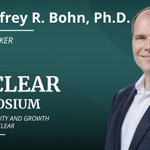
On stage now with our Jeff Bohn, moderated by Madison Hilly (@RadiantEnergyG). Security first, then growth. #NS2026

ALT A person in a suit is featured on the right against a green background. Text on the left reads: "Jeffrey R. Bohn, Ph.D. Speaker. Nuclear Symposium. Energy Security and Growth Through Nuclear."
New reactors are only as strong as the fuel supply chain behind them.
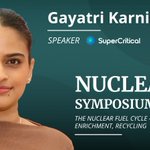
Now @nuclearny: the nuclear fuel cycle from sourcing through enrichment to recycling. Gayatri Karnik of SuperCritical with Carl Perez of Exodys Energy, moderated by Isuru Seneviratne of Lucid Catalyst #NS2026

ALT Certainly! Here's a succinct alternative text description: "Promotional image for the Nuclear Symposium featuring Gayatri Karnik, speaker from SuperCritical. Text mentions 'The Nuclear Fuel Cycle — Sourcing, Enrichment, Recycling.'"
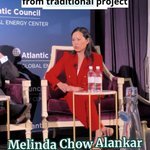
"We need to move away from the traditional project finance model: single SPV, non-recourse debt. It'll take huge effort and negotiation, but it can be done."
Melinda Chow Alankar on fixing nuclear's financing bottlenecks. @ACGlobalEnergy
Watch: bit.ly/4yKfcFi
Day 1 of the Nuclear Symposium at the NYC Bar Association. Rory Christian of the NYS Public Service Commission opening on New York's nuclear moment, then NYISO's Richard Dewey on the reliability math.
We're here as a gigawatt-level sponsor. We'll post what we learn. #NS2026
Anthropocene Institute retweeted

Melinda Chow Alankar from @anthrop_inst speaking about the Regulated Asset Base (RAB) model.
#ACEnergy
"Too expensive, too slow, too hard to build" is the whole nuclear conversation. Kathryn Huff, who ran DOE's nuclear energy office, spends 28 minutes on what building one involves. Episode 5 is on fuel, which Gayatri Karnik takes up Thursday at #NS2026. bit.ly/4xIzMFd
