

Arabiqa is an account dedicated to Arab history and civilization. | Posting a lot on continuity between pre-Islamic and Islamic Arab history.
Joined July 2021
- Tweets1.2K
- Following68
- Followers3.3K
- Likes1.7K




Pinned Tweet
Recently, the Comoros’ historic medinas were registered as a UNESCO World Heritage site.
This rich legacy dates back to a time when Arab sailors traded and settled in these islands, mixing with the locals.
Often forgotten, the Comoros are actually the southernmost Arab country.


ARABIQA 🇵🇸 retweeted

Persia has always relied heavily on the cultural heritage of its neighboring Mesopotamian and Semitic civilizations, including the Arabs. When Cyrus and his nomadic Persian tribes conquered the far more advanced Babylon, they appropriated its architectural and administrative traditions.
Pre-Islamic Persian writing relied on Semitic Aramaic-derived scripts before later adopting the Arabic script. The Academy of Gundeshapur in Arabistan was associated with Mesopotamian scholars who wrote in Syriac, not Persian.
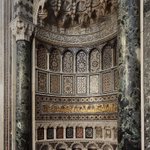
Much of what became Islamic architecture developed as a continuation of the rich architectural traditions that had already flourished in Iraq and the Levant centuries before Islam. From the Nabataeans of Petra and the Arabs of Palmyra (Tadmor) to Hatra, al-Hira, and the Ghassanids of Syria, these societies developed sophisticated architectural and artistic traditions that contributed to the foundations of early Arab-Islamic architecture. Their achievements included monumental construction, sculpture, frescoes, ceramics, and decorative motifs. These traditions continued and evolved under the Umayyads, as reflected in the Dome of the Rock in Jerusalem, the Umayyad Mosque in Damascus, the Umayyad City of Anjar in Lebanon, the Umayyad Palace at the Amman Citadel in Jordan, Qusayr Amra, Khirbat al-Mafjar, and Qasr al-Hayr al-Gharbi. This architectural continuity extended to Islamic Spain, where Abd al-Rahman I established his Rusafa palace and gardens near Córdoba in memory of his family’s Syrian residence.
The architectural heritage of Mesopotamia and the Levant also influenced traditions associated with Persia, while later Persianate Islamic architecture developed through cultural exchanges with the Arab caliphates of Iraq and Greater Syria. Early Arab-Islamic architecture was thus not a sudden creation or simply an extension of Persian architecture, but a continuation and transformation of the flourishing pre-Islamic architectural heritage of Iraq and the Levant.
Even Persian poetry, which flourished after Islam, drew heavily on Arabic literary foundations, particularly the system of prosody codified by the Arab scholar al-Khalil ibn Ahmad al-Farahidi. Classical Persian poetry adopted and adapted Arabic meters, rhyme conventions, the bipartite verse (bayt), poetic genres, and rhetorical traditions rooted in pre-Islamic Arabic literature.
Unlike Sasanian Persia, where formal education was largely restricted to privileged male elites and literacy was limited among the broader population, parts of pre-Islamic Arabia had a remarkably widespread tradition of writing, extending even to nomadic communities. Tens of thousands of Safaitic, Hismaic, and other ancient Arabian inscriptions demonstrate the extensive use of writing among ordinary people. Historian M. C. A. Macdonald argues that literacy may have been nearly universal among certain North Arabian communities and that, by the Roman period, the region may have had a higher proportion of functionally literate people than almost anywhere else in the ancient world. These pre-Islamic traditions formed part of the cultural foundations for the educational and intellectual expansion under the Arab-Islamic Caliphate. The removal of the rigid Sasanian caste system following the Arab conquest of Persia, together with the establishment of new educational institutions, created opportunities for wider intellectual participation, allowing Persian scholars and poets to flourish within the broader Arab-Islamic civilization.


Muslims invaded Iran, took Persian architecture, and rebranded it as “Islamic architecture.”
Everything good labeled “Islamic” was taken from someone else’s culture and history.
This is Persian architecture, not “Islamic” architecture.
@grok, tell them.
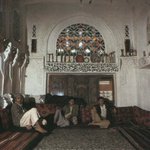
Traditional Yemeni Diwan in a 17th-century house | Bayt al-Belayli. Sanaa, Yemen.
Known as ‘Mafraj’ in Yemen, this room is used for gatherings.
It is always richly decorated with stained glass windows (Qamariyas), finely carved stucco decoration and Arabic inscriptions.


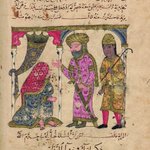
Abū Zayd pleading before the Qadī of Ma'arrat al-Nu'mān, Syria | Maqamāt al-Hariri.
Arabic miniature painting. Egypt, ca. 1334.

31
686


Two people fishing. Arab miniature from Abbasid Iraq, 13th century.
During the Abbasids' time, Baghdad had a thriving fishing culture. Fishing was done in the Tigris and the Euphrates.
Some Baghdadis, like Umm Ja'far, granddaughter of Caliph Al-Mansur, even raised fish indoors.

ARABIQA 🇵🇸 retweeted

🤫
Such a ridiculous lie, and it has become extremely tiresome. These were among the most prominent figures, and they were Arabs living in an Arab empire and writing in Arabic. Even those who lived in what is now Iran were mostly Arabs, descendants of the conquerors who conquered Persia.
Where were your sciences and scholars before the Muslim Arabs, you damned liar? They didn’t exist.


ARABIQA 🇵🇸 retweeted
That’s not true
+the majority of those Iranic scientists were from modern Afghanistan and Central Asia

ARABIQA 🇵🇸 retweeted

• The Persians had no alphabetic writing system of their own at all and borrowed cuneiform from the civilizations of Mesopotamia.
• The Pahlavi script is derived from the Aramaic script.
•more 40% of the Persian terms in everyday use among Iranians are purely Arabic in origin.


unavailable


Lost Arab cuisine — Al-Andalūs Edition:
1/ Hūt Mutajjan: oven-baked fish with fermented sauce.
2/ Mu'assal: a honey pudding.
3/ Tharīda Tuzīd fī l-Bāh: chicken dish with bread.
4/ Ka'b al-Ghazāl: almond-stuffed cookies.


Mashā’Allah and Naubakht designed nothing. They weren’t even engineers; they were astrologers.
The real designers were the Arab engineers who planned the city and its quarters, not those two.
Baghdad was designed as a circle in 4 parts: all 4 designed by Muslim Arab engineers.


Mu'āwiya and his servant visiting Maysūn. Arab miniature, Egypt or Syria, ca. 1315.
The love story between Mu'āwiya and Maysūn is well known in Arabic literature.
Maysūn was a noblewoman from the Christian Arab tribe of the Banu Kalb and the mother of Yazid I.

ARABIQA 🇵🇸 retweeted

Arabs far surpassed the ancient Greeks in mechanical engineering, as demonstrated by Al-Jazari’s remarkable inventions: water clocks, candle clocks, automated musical devices, and water-raising machines.


