

the 1% researcher (99% searcher) | finding early alpha founder @arccden
Joined April 2024
- Tweets30K
- Following1.3K
- Followers2.3K
- Likes99.4K






Pinned Tweet
list of early projects :
here are 11 projects under 3K followers worth watching right now
(bookmark this | extremely early)
- @QMSNetwork
followers : 1275
narrative : layer 1 (quantum resistant)
- @ValkriLabs
followers : 319
narrative : credit infra for (prediction markets)
- @Hyperlauncher_
followers : 49
narrative : hyperliquid ecosystem
- @lattica
followers : 245
narrative : protocol for prediction market
• @traceeco_io
followers : 1.1k
narrative : nft protocol
- @CoinComms
followers : 10.3k
narrative : socialfi + memecoin
- @PrehistoriaNFT
followers : 3.6k
narrative : nft
- @openperpsdotfun
followers : 219
narrative : Permissionless Perp DEX
- @c0mputeAI
followers : 431
narrative : AI/DePIN Network
- @OblivaAi
followers : 1.6k
narrative : AI wallet + DEX
the earlier you are, the better the opportunity will be
nfa dyor
which one are you most bullish on?

arkilus retweeted
list of early projects :
here are 8 projects under 2k followers worth watching right now
(bookmark this | extremely early)
- @HelloNavra
followers : 1400
narrative : onchain finance (recently raised $19m)
- @alloco_fi
followers : 2090
narrative : onchain investment (raised $500k by yzi labs)
- @getcomputable
followers : 330
narrative : ai compute (ycombinator s26 batch)
- @4Dlabs_Official
followers : 9900
narrative : physical ai (backed by yzi labs)
- @eqxlabs
followers : 1600
narrative : tokenized us equities (on @HyperliquidX)
- @Tensorcash
followers : 1500
narrative : ai infra
- @GigaLegendsLTD
followers : 5500
narrative : nft
- @eliospay
followers : 6800
narrative : payments
>>>>
the earlier you are the better the opportunities will be
nfa dyor
have you heard of any of these before?
arkilus retweeted

most exchange VIP programs focus on how much you trade or hold.
@MEXC takes a different approach with VVIP, using an M-Score to determine your tier based on five areas:
- trading performance
- asset level
- security verification
- platform activity
- account tenure
these cover your trading activity, assets, account security, platform activity, and how long you've been on MEXC.
with Score Insights, you can see the breakdown instead of just your overall score.
i checked mine, and I'm currently at 504 points in the Standard tier.
here's how the tiers break down:
- Standard: 350–599
- Premier: 600–799
- Elite: 800+
I'm 96 points away from Premier.
you don't need a minimum asset balance or trading volume to enter Standard, but you do need an M-Score of at least 350.
so, what do you get with VVIP?
depending on your tier and eligibility, the perks include:
- MEXC Card cashback
- Futures position limit boosts
- VIP support
- liquidation SMS alerts
- member vouchers
some vouchers can be claimed every 10 days, subject to the program's conditions.
these may include APR Boosters for eligible Earn products or Futures Loss Coverage for qualifying trades.
the MEXC Card also offers cashback under the applicable Global/APAC promotion:
- Standard: 4%, up to 100 USDT/month
- Premier: 6%, up to 300 USDT/month
- Elite: 10%, up to 800 USDT/month
even Standard members can earn cashback on eligible spending, like shopping, subscriptions, and travel.
higher tiers may offer additional perks, such as faster large withdrawals and exclusive benefits.
MEXC also has Elite Experience Cards that let members share certain perks with friends.
benefits depend on your tier, and eligibility.
MEXC doesn't disclose the exact M-Score formula, and your score can change over time.
you can check Score Insights and your VVIP page to see where you stand and which benefits are available to you.
mexc.com/user/m-score

arkilus retweeted
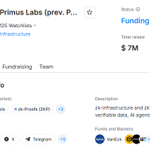
@primus_labs raised a $6.5m seed round in feb25
(but the more interesting part came after 18 months)
the seed was led by vaneck (tier-1 vc)
backed by @SamsungNext and @Alchemy
btw vaneck is the same vc that backed @MorphoLabs, @1inch and binance us in its early time
then in 2026, @YZiLabs (ex-binance labs) joined through incubation round
and jsyk primus's confidential vault is already live on bnb chain
now why does the tier matter?
it affects how a project gets priced and also helped in having connections with the right people (have explained it in detailed in my earlier posts you could read that)
>>>>>
just sharing my understanding of primus and how the funding round works
what's your read?


imagine if anyone could type your name and see exactly how much money is in your bank account
that's exactly how crypto works right now
every wallet is open, your size, your moves, all public
i found a way to hide the amount on bnb chain
by using @primus_labs >>>>
- wrap $u into encrypted $ EU (1:1 unwrap anytime)
- send it or deposit it, the amount stays encrypted
- park it in the unitas vault, same yield as the public one
note : wallet and timing will still be visible, only the amount is hidden
why this matters :
- you find a good strategy, someone copies every move
- you build a big position bots see it and jump in front of you (and you get a worse price)
thats why we need privacy to protect or onchain records
>>>>
would you hide your position size if you could?

arkilus retweeted
morning everyone
hope you doin okayyy
just realized my whole tl is filled with kaito and $axis posts now
while some complaining and some winning
are we finally back?

imagine if anyone could type your name and see exactly how much money is in your bank account
that's exactly how crypto works right now
every wallet is open, your size, your moves, all public
i found a way to hide the amount on bnb chain
by using @primus_labs >>>>
- wrap $u into encrypted $ EU (1:1 unwrap anytime)
- send it or deposit it, the amount stays encrypted
- park it in the unitas vault, same yield as the public one
note : wallet and timing will still be visible, only the amount is hidden
why this matters :
- you find a good strategy, someone copies every move
- you build a big position bots see it and jump in front of you (and you get a worse price)
thats why we need privacy to protect or onchain records
>>>>
would you hide your position size if you could?
arkilus retweeted

some peeps are too scared to back their convictions with real money.
if you're one of them, @nodiens got ya.
you can predict token price movements, market caps, volume and more without depositing a dime.
and the best part? you earn points when your predictions are correct, which might come in handy in the future.
gud tek innit

arkilus retweeted

How to contribute to Primus as a creator
Technical contributors are not the only people who can help an ecosystem grow.
Creators can make complicated technologies easier to understand, help developers discover useful resources, explain real use cases, and document what happens when someone tries the technology.
But there is a difference between creating content about a project and contributing to its ecosystem.
A post repeating the project’s tagline may help someone recognize the name.
A carefully researched guide that explains the problem, demonstrates the technology, and points readers to working resources can help someone actually use it.
That should be our goal.
A. Write educational content grounded in the technology
Start with questions people genuinely need answered.
For example:
What is zkTLS, and why does it matter?
Why can’t smart contracts simply read private information from websites?
What is an attestation?
How does Primus connect off-chain information to applications?
What is the difference between zkTLS and FHE?
How does a developer reproduce a basic integration?
What does DVC add to the workflow?
Each article should answer a clear question rather than trying to cover every feature at once.
Use examples, explain unfamiliar terms, and link to the official documentation.
If a technical detail is uncertain, verify it before publishing.
B. Document your own learning process
You do not need to pretend to be an expert.
If you are learning the SDK, document the process from installation to a successful result.
Show the commands you ran, the errors you encountered, the fixes you applied, and what the resulting output means.
A useful technical post might explain why an attestation was rejected, how you diagnosed the problem, and what the official verification mechanism expects.
That kind of content gives readers something they can reproduce.
It also creates a public record of your progress as a builder.
C. Turn a working integration into a demonstration
Once you have a functioning demo, create a walkthrough that follows the actual workflow.
Explain what data is being requested, how the attestation is generated, what gets verified, and what the application does with the result.
Use screenshots, code snippets, diagrams, or a short screen recording where they help.
Do not claim that the application is fully private, decentralized, or trustless unless you can explain the specific guarantees supporting that claim.
Technical accuracy is part of the contribution.
D. Create explainers that solve one problem at a time
Short-form content can introduce the concepts before readers are ready for a full tutorial.
For example:
Post idea: Why a screenshot is not enough
A screenshot can show a number on a website, but it does not independently establish that the number came from the genuine service or has not been altered.
Explain how verifiable data changes the process, then introduce Primus zkTLS and link to an example.
Another idea:
Post idea: What does a smart contract do when the data it needs lives on a centralized exchange?
Walk through the limitation, explain the need for external data verification, and show where a Primus integration can fit.
These posts work because they begin with a real problem. The technology becomes the answer to a question the reader already understands.
E. Help other builders find their way
Creators can also support the ecosystem by making useful resources easier to discover.
You could publish:
> A curated list of official Primus developer resources.
> A guide comparing the available SDK integration paths.
> A beginner’s explanation of the difference between attestations and application-level verification.
> A troubleshooting guide based on issues you reproduced.
> A summary of new examples or documentation changes, with an explanation of why they matter.
The best versions of these resources are maintained as the ecosystem evolves.


What can developers actually build with Primus?
Understanding the technology is useful, but the more interesting question is what it enables.
Here are several directions worth exploring.
A. Financial verification
An application could use verified information from an external financial service as part of a lending, eligibility, or risk-assessment workflow.
For example, an application might need to establish whether a particular account value exceeds a defined threshold.
The important engineering challenge is to verify the relevant information and ensure the application evaluates the correct condition.
B. Identity and eligibility checks
Some applications need to establish a fact about an online account or user without requiring the user to publish unnecessary information.
A developer could explore ways to verify a specific property of an account and disclose only what the application needs.
The implementation must still respect the source service’s authentication requirements, data-use policies, and the privacy properties of the chosen workflow.
C. Verifiable trading data
Market data from centralized exchanges can be useful in applications that need externally sourced information.
Developers can experiment with verifiable exchange API responses and build workflows that validate selected fields before using them in another application.
Primus’s Skills repository includes examples for Binance and OKX-related data workflows.
These provide concrete starting points for developers who want to learn by running code rather than only reading about the technology.
D. Payments
Payment flows can require a service to establish that a user has satisfied a particular requirement before allowing a transaction to proceed.
A developer could investigate how verifiable data can support account-based eligibility or other conditions within a payment application.
The challenge is to ensure that the attested fact is sufficient for the intended decision and that the system does not mistake a valid data proof for proof of unrelated claims.
E. Applications combining verified data and private computation
More advanced developers can explore DVC workflows that connect external data verification to a separate computation program.
For example, an application might verify a financial input and then produce evidence that a particular rule has been satisfied.
This is a more involved path because it requires understanding both the attestation flow and the computation or proving system.
For a first project, start with a narrow requirement and build up from there.
How to get started as a Primus developer
You do not need to understand every part of the cryptography before making your first useful contribution.
You do, however, need to understand the workflow you are working with and be able to demonstrate that your implementation behaves as expected.
Here is a practical path.
Step 1: Explore the official resources
Start with the official documentation:
docs.primuslabs.xyz/
Then inspect the GitHub organization:
github.com/primus-labs
Pay particular attention to the repositories associated with the SDK you intend to use, its tutorials, and the available example applications.
Do not begin by opening every repository at once. Choose one workflow and understand it properly.
Step 2: Choose the correct integration path
Before writing code, answer these questions:
Is the application running in a browser or on a backend?
Does the workflow use Primus Network infrastructure?
Does the user need a browser extension or wallet interaction?
Which SDK and attestation mode does the official example recommend?
What information must be verified?
Where does verification happen: locally, on-chain, or within a separate computation workflow?
These questions help prevent one of the most common mistakes beginners make: combining code from different SDKs or integration modes without understanding their requirements.

morning everyone
hope you doin okayyy
just realized my whole tl is filled with kaito and $axis posts now
while some complaining and some winning
are we finally back?
imagine if anyone could type your name and see exactly how much money is in your bank account
that's exactly how crypto works right now
every wallet is open, your size, your moves, all public
i found a way to hide the amount on bnb chain
by using @primus_labs >>>>
- wrap $u into encrypted $ EU (1:1 unwrap anytime)
- send it or deposit it, the amount stays encrypted
- park it in the unitas vault, same yield as the public one
note : wallet and timing will still be visible, only the amount is hidden
why this matters :
- you find a good strategy, someone copies every move
- you build a big position bots see it and jump in front of you (and you get a worse price)
thats why we need privacy to protect or onchain records
>>>>
would you hide your position size if you could?
arkilus retweeted
imagine if anyone could type your name and see exactly how much money is in your bank account
that's exactly how crypto works right now
every wallet is open, your size, your moves, all public
i found a way to hide the amount on bnb chain
by using @primus_labs >>>>
- wrap $u into encrypted $ EU (1:1 unwrap anytime)
- send it or deposit it, the amount stays encrypted
- park it in the unitas vault, same yield as the public one
note : wallet and timing will still be visible, only the amount is hidden
why this matters :
- you find a good strategy, someone copies every move
- you build a big position bots see it and jump in front of you (and you get a worse price)
thats why we need privacy to protect or onchain records
>>>>
would you hide your position size if you could?
most vaults show your size, your transfers and your timing to everyone
@primus_labs confidential vault on bnb hides it :
> shield a stablecoin into encrypted eU
> deposit or transfer, the amount stays encrypted
> yield still accrues (unitas vault)
> unshield whenever you want
how it works in simple words :
normally a chain needs to see your number to check it's valid, here your balance is stored as an encrypted value, so the chain can verify the transaction without ever seeing the amount
only you can read your own balance, a scanner sees that something moved, but not how much
and since the yield still goes on the encrypted position, you're not giving up returns for privacy
>>>>>
wallet and timing stay public but the size doesn't
and thats the best part of primus imo
would you hide your position size if you could?
thankyou @axisrobotics and @KaitoStudio_
axis surely turns out to be a pretty good cook
even testnet users get good 3figs
i got 850$ for 11 posts
alhamdullilah
wbu cooking good or you faded axis?

most vaults show your size, your transfers and your timing to everyone
@primus_labs confidential vault on bnb hides it :
> shield a stablecoin into encrypted eU
> deposit or transfer, the amount stays encrypted
> yield still accrues (unitas vault)
> unshield whenever you want
how it works in simple words :
normally a chain needs to see your number to check it's valid, here your balance is stored as an encrypted value, so the chain can verify the transaction without ever seeing the amount
only you can read your own balance, a scanner sees that something moved, but not how much
and since the yield still goes on the encrypted position, you're not giving up returns for privacy
>>>>>
wallet and timing stay public but the size doesn't
and thats the best part of primus imo
would you hide your position size if you could?


arkilus retweeted

8% in USD rewards for depositing into @wirex_one
A $25,000 net deposit = $2,000 in total rewards over 12 months.
How to qualify:
1. Open a Wirex One account (new users or existing users with a $0 balance when the campaign starts).
2. Deposit at least $100 in supported fiat or stablecoins.
3, Keep your balance eligible to receive monthly rewards.
What you should know:
• 8% total reward, paid in 12 monthly installments
• Paid in USD, not tokens or points
• No lock-up. Withdraw anytime
• Partial withdrawals reduce future rewards
• Below $100 balance = no reward for that month
New users and existing users with a $0 balance when the campaign starts can qualify.
If you’re considering Wirex One, this offer gives you a concrete reason to explore it.
One deposit. 8% back in USD.
Campaign details: wirex.one/deposit-promo


got an allocation of 0.45 $axis
i would like to thank my mom and dad
for always believing in me
i never thought i will be able to make that much money ever in my life
but i did it and you can do it as well just believe in yourself
(glad i didnt left university time to go back to studies 😭😭)

most vaults show your size, your transfers and your timing to everyone
@primus_labs confidential vault on bnb hides it :
> shield a stablecoin into encrypted eU
> deposit or transfer, the amount stays encrypted
> yield still accrues (unitas vault)
> unshield whenever you want
how it works in simple words :
normally a chain needs to see your number to check it's valid, here your balance is stored as an encrypted value, so the chain can verify the transaction without ever seeing the amount
only you can read your own balance, a scanner sees that something moved, but not how much
and since the yield still goes on the encrypted position, you're not giving up returns for privacy
>>>>>
wallet and timing stay public but the size doesn't
and thats the best part of primus imo
would you hide your position size if you could?
arkilus retweeted
most vaults show your size, your transfers and your timing to everyone
@primus_labs confidential vault on bnb hides it :
> shield a stablecoin into encrypted eU
> deposit or transfer, the amount stays encrypted
> yield still accrues (unitas vault)
> unshield whenever you want
how it works in simple words :
normally a chain needs to see your number to check it's valid, here your balance is stored as an encrypted value, so the chain can verify the transaction without ever seeing the amount
only you can read your own balance, a scanner sees that something moved, but not how much
and since the yield still goes on the encrypted position, you're not giving up returns for privacy
>>>>>
wallet and timing stay public but the size doesn't
and thats the best part of primus imo
would you hide your position size if you could?
now you can send crypto to an x handle (no wallet address required)
i tried it on @primus_labs pay page >>>
how todo it?
- enter an x or gmail account, and send it
- the amount sits there until they claim it
- then they prove they own the account with the primus extension and then it lands in their wallet
how it works?
- zkTLS is what checks the account if its real or not
- without showing the login or the raw data to users
- the amount stays in a contract until that proof clears
receiver just need the extension and a tiny verification fee
are you sending to a handle or still asking for the address?
arkilus retweeted
finally made it into the top 500 on @axisrobotics lb
rank 253 out of 6k+ creators
and i forgot to submit a post in epoch 2 lol
could’ve been better, but i’m happy with it
i remember last year i wanted to join the zama creator campaign and didn’t, because i was sure i’d never make top 500, or even top 1000
(now i can join any campaign believing i can make it to the top, do the hard work it eventually makes sense)
its all on fdv now if somehow we get a good fdv on tge it could be a good cook otherwise a decent enough
wdyt kaito going to make a comeback?

now you can send crypto to an x handle (no wallet address required)
i tried it on @primus_labs pay page >>>
how todo it?
- enter an x or gmail account, and send it
- the amount sits there until they claim it
- then they prove they own the account with the primus extension and then it lands in their wallet
how it works?
- zkTLS is what checks the account if its real or not
- without showing the login or the raw data to users
- the amount stays in a contract until that proof clears
receiver just need the extension and a tiny verification fee
are you sending to a handle or still asking for the address?