

Research Engineer @perplexity_ai | prev MS @berkeley_ai @berkeleyNLP
San Francisco, CA
Joined January 2023
- Tweets35
- Following341
- Followers596
- Likes1.1K


Pinned Tweet
Many LLMs today are trained to maximize academic benchmarks. Instead, we focused on directly optimizing for user satisfaction by learning from feedback signals in data. The result is a concise and factual model that outperforms Sonnet at a fraction of the cost and 10x the speed!

Arnav Gudibande retweeted

Today we're launching Perplexity Frontier Research.
The goal of Perplexity Frontier Research is to create a system that can perform autonomous research.
The work will focus on multi-agent orchestration, reinforcement learning, continual learning, systems, and pre-training.
We will develop algorithms, models, and evaluations, released openly, and tested in Perplexity products. Our work will be supported by more than 10,000 GPUs.
The Frontier Research team will regularly publish papers, models, data, and benchmarks.
We're actively hiring researchers and engineers for Perplexity Frontier Research in San Francisco, Palo Alto, New York, and London.
research.perplexity.ai


Amazing all hands on deck effort by the @perplexity_ai team to get this out in <1 day. Next step is deploying our in-house models 🚀
Introducing LLaMa Chat: The fastest way to chat with @MetaAI/@meta's Llama2!
Try it here: llama.perplexity.ai/, feedback appreciated!
This is our first step towards building a blazing-fast LLM inference completely in-house, for everyone to try. What's next? We'll be hooking up the bigger LLAMAs and eventually deploying our own in-house LLMs.
All of this in service of building the best and fastest answer engine. Come join us, we're hiring! perplexity.ai/about
jobs.lever.co/PerplexityAI/2…
There's a new version of this post
19
1,631
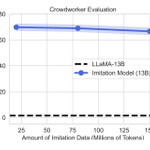
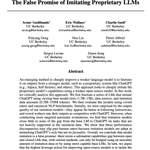
A recent trend is to fine-tune open-source LMs on ChatGPT outputs (e.g., Alpaca, Self-Instruct, Vicuna), with the aim of broadly imitating the model. In our new paper, we critically analyze this approach.
arxiv.org/abs/2305.15717 👇[1/N]

And lastly, we’d like to note that we’re big supporters of open source (we released Koala and OpenLLaMA), but we want the discussion and claims about open source models to be realistic and responsible. This way we can make real coherent progress.
1
23
1,876
For more info on this work, see our paper titled “The False Promise of Imitating Proprietary Language Models” by me @eric_wallace_ @sea_snell @younggeng @haoliuhl @pabbeel @svlevine @dawnsongtweets
Paper: arxiv.org/abs/2305.15717
Code: github.com/young-geng/EasyLM
17
1,851
Arnav Gudibande retweeted

The False Promise of Imitating Proprietary LLMs
Open-sourced LLMs are adept at mimicking ChatGPT’s style but not its factuality. There exists a substantial capabilities gap, which requires better base LM.
arxiv.org/abs/2305.15717

Arnav Gudibande retweeted

Someone said it finally 🔥.
Can you believe a 'leading institution' started this trend? 👀
This is why desperate hype grabbing is so harmful 😦

The False Promise of Imitating Proprietary LLMs
Open-sourced LLMs are adept at mimicking ChatGPT’s style but not its factuality. There exists a substantial capabilities gap, which requires better base LM.
arxiv.org/abs/2305.15717
Arnav Gudibande retweeted

We've released the Koala into the wild🐨
The Koala is a chatbot finetuned from LLaMA that is specifically optimized for high-quality chat capabilities, using some tricky data sourcing.
Our blog post: bair.berkeley.edu/blog/2023/…
Web demo: koala.lmsys.org

Arnav Gudibande retweeted

Check out Koala 🐨: a new chatbot from BAIR researchers fine-tuned on dialogue that approaches ChatGPT quality!
Work led by @haoliuhl @Eric_Wallace_ @ArnavGudibande and Xinyang Geng
Blog: bair.berkeley.edu/blog/2023/…
Demo: koala.lmsys.org/
