
Curious about model cognition! EECS PhD student @MIT_CSAIL Past @medialab @hotosm @outreachy
Joined August 2021
- Tweets750
- Following845
- Followers401
- Likes906



Aruna S retweeted

New work!
Our #neurips2026 paper introduces Parasite Features: spurious features that pass Causal Abstraction’s equivalence tests. Methods like DAS can link a direction separating inputs to an unrelated one steering outputs, so the model seems to implement a feature it doesn’t.🧵
Aruna S retweeted

I'm (once again) recruiting 1-2 PhD students this cycle at @umdcs! Please apply by Dec 4th: cs.umd.edu/grad/apply
More info on my website, including topics of interest: sarahwie.github.io/contact/#…

I am recruiting 2 PhD students to work on LM interpretability at UMD @umdcs starting in fall 2026!
We are #3 in AI and #4 in NLP research on @CSrankings.
Come join us in our lovely building just a few miles from Washington, D.C. Details in 🧵

Aruna S retweeted

🧠 How do language models learn grammars that are possible or impossible for humans?
In our latest WiAIR podcast, we spoke with Julie Kallini about her paper, “Mission: Impossible Language Models”. (1/7🧵)


Aruna S retweeted

I have a major result to share.
I’ve found conclusive forensic evidence that the top 4 Chinese AI labs—DeepSeek, Moonshot, MiniMax and Ant Group—have built their newest models on NVIDIA’s most advanced Blackwell chips, which are barred from export to China.
This sounds insane, but I discovered that almost every AI model carries a hidden signature of the GPU that trained it. When a model is first set up, the starting values of its weights are laid out in a pattern that depends on the exact GPU. Each combination of GPU and seed number produces a unique pattern—a sort of fingerprint of the hardware used to create the model. Traces of that pattern survive training into the published model.
Again, this evidence isn’t based on any insider information or leaking. It’s based on a forensic analysis of the model weights released by the companies themselves.
I searched more than six trillion combinations of chip layout and seed number and matched them to open-weights models. In doing so, I found conclusive evidence that six Chinese AI models—including DeepSeek-V4-Pro, Kimi K3, and MiniMax-M3—were initialized on NVIDIA Blackwell systems. Four of the models match Grace Blackwell, the GB200 and GB300 parts in NVIDIA’s flagship liquid-cooled rack-scale systems.
I then verified these results on real hardware. Running unmodified PyTorch with the seeds I’d recovered, a Blackwell B300 reproduced DeepSeek-V4-Flash’s untouched starting weights bit for bit, and a rented GB200 reproduced Kimi K3’s to a correlation of 0.999995. A Hopper H100 reproduced none of DeepSeek-V4-Flash’s, and changing the seed by one broke the match. (DeepSeek’s seed is 953049583 by the way.) The method also was verified to match 24 known open-weights models to the hardware that developers said they used.
It is exceedingly unlikely that these results are a coincidence. Across six trillion combinations, the best accidental match should reach only about 8 sigma (i.e., eight standard deviations above what random chance would produce). The real matches range from 49 to 1,385 sigma, and even the weakest single test hits 20.
These were data-center-scale training runs. With some analysis of release schedules and model details, I estimate that the largest, Kimi K3 and DeepSeek-V4-Pro, used 2,000 to 3,000 Blackwell GPUs each. Clusters of this size cost on the order of $150 to $200 million each to buy, and across these labs alone would add up to more than half a billion dollars of export-controlled GPUs, not counting experimental compute or otherwise. It’s quite likely that we see multi-billion dollar expenditure on export-controlled GPUs.
I am highly confident in this result, and it has been independently verified by senior researchers at OpenAI and Anthropic. You can read the full report at unemploymentlabs.com/checkpo….
There is much more I’ve identified about these models through other forms of checkpoint forensics like this, and will have more to share soon.

Aruna S retweeted

Excited to share our new work now on Arxiv titled “Deploying Physically and Epistemically Compliant Agents by Distilling Belief-Space Task and Motion Planners”, check it out :)

Aruna S retweeted

We want agents to follow belief-dependent rules when uncertain. In new work, we develop a planner distillation method performing well in POMDPs. Policies trained with this method comply 18 times as often as RL policies in a multimodal task with state + goal uncertainty. 🧵
Aruna S retweeted

We recently went viral on X with the claim that neurons are "already clean." But what do we mean by that? Are neurons are a useful basis for interp? We're finally releasing our technical report on LLM neurons--and what we've found is far more interesting than mono/polysemanticity.teapawt.org/GoodfireAI/status/2120…


In Neural Networks are Already Clean, @nickcammarata argued that neurons were far more legible than previously thought – and that this was great news for interpretability and safety.
Now, we’re releasing the first technical companion to Nick’s essay. It shares our findings from studying thousands of neurons using our novel automated interpretability pipeline, and outlines why we now think of neurons by their computational function, instead of whether or not they are polysemantic. Here’s what we found: 🧵
Aruna S retweeted

In Neural Networks are Already Clean, @nickcammarata argued that neurons were far more legible than previously thought – and that this was great news for interpretability and safety.
Now, we’re releasing the first technical companion to Nick’s essay. It shares our findings from studying thousands of neurons using our novel automated interpretability pipeline, and outlines why we now think of neurons by their computational function, instead of whether or not they are polysemantic. Here’s what we found: 🧵

interpretability might be the most important scientific problem in the world right now, as I don't think we can solve alignment if we don't know what we're building. I think I have good news about it. I co-authored early work in mechanistic interpretability at OpenAI and came away pessimistic, because neural networks appeared to fold into arbitrary tangled knots. years later, I started openai's first large-scale automated interpretability project, finding about 2% of neurons legible with the primitive tools we had
with modern agentic tools and a much closer look, the picture looks totally different. the vast majority in models up to trillions of parameters are legible, and their circuits beautiful. many famous examples of tangled neurons turned out to be misunderstood. The roadblocks I expected mostly aren't there. I now think ambitious interpretability will be solved by the time we need it most, and possibly quite soon, as automated scientists keep improving. it may be a bitter lesson for interpretability: the simple thing, at absurd scale, works
already-clean.goodfire.com/

Aruna S retweeted

Language models should be less confident when an input is ambiguous. We derive ambiguity vectors, and use them to improve confidence estimation in language models. We can also use them to encode these improvements into the model weights!
New work led by @themistoklisnk!

Aruna S retweeted

LLMs are highly overconfident, even when they don’t know something. We used interpretability to improve LLM confidence estimates!
We propose DART, which uses ambiguity steering vectors to guide fine-tuning, improving calibration across 7 models while preserving accuracy.
🧵
Aruna S retweeted
Hope to see you at our Modeling Uncertainty in Robotic World Models Workshop at CoRL on Nov 12th from 2-6pm!
Invited speakers: Leslie Kaelbling (MIT), Anirudha Majumdar @Majumdar_Ani (Princeton / Google DeepMind), Panpan Cai (SJTU), and Chenhao Li @breadli428 (ETH Zurich / Google DeepMind)
Website link: uncertainwm2026.github.io

Aruna S retweeted

Kempner has a blog post on our work on predicting LLM compositionality failures from representational geometry, led by @jenniferlumeng! The perfect quick read while you have a Friday night bath or a Saturday morning coffee (or a Sunday lie-in, or a Monday procrastination time...)

🔍What if we could anticipate which scenarios LLMs will fail on and focus on those? Adversarial Concept Search predicts when a model might make a mistake using representational geometry. More in today's Deeper Learning blog post from the #KempnerInstitute: bit.ly/4ePWsfW

Aruna S retweeted

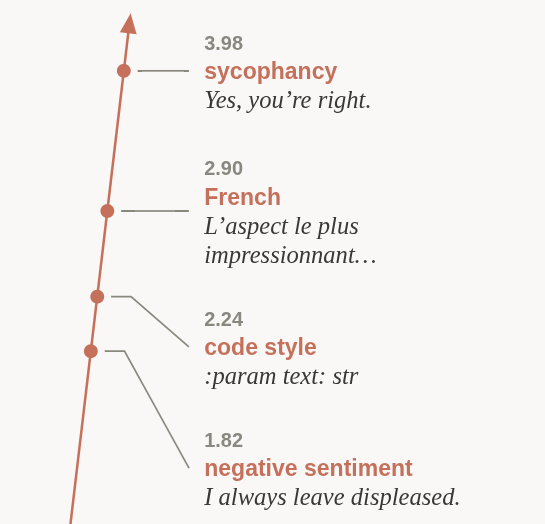
A single direction in LLM activation space, applied as a steering vector with four different norms, can cause the language model to perform a different behavior at each norm.
This and more in a new blog post, Do Not Rely on the Linear Representation Hypothesis. (link below.)
Aruna S retweeted
Come be my colleague at BU CS! We’re hiring in AI, broadly construed. Apply by Dec. 1 for full consideration:
academicjobsonline.org/ajo/j…
We’ve intentionally built a strong community of language, analysis, and ML researchers over the last few years. Looking forward to growing it!

Aruna S retweeted

So how can Astra read neural network weights? A thread 🧵
Weights of a deep NN are famously opaque, with one exception: the first and last layers, which map to known inputs and outputs. Is that what Astra is reading?
Post by @rikiyatakehi et al: teapawt.org/rikiyatakehi/status/21… [1/10]


We asked GPT-6 Astra to edit Qwen3.5-0.8B weights to improve math.
It directly changed only 0.016% of weights, fixing 0.8B's reasoning loops & improving math up to 6x and even instruction following 3x, without gradients or training.
We call this Weight-Space Programming: frontier LLMs can now natively read/write neural network weights! 🧵
Blog: rikiyat.github.io/blog/weigh…

Readers added context they thought people might want to know
LLM was given weights explicitly as text in prompt and used code/forward passes (per authors' logs) to ablate Qwen looping direction, a known thinking-mode issue per model card. Primarily fixed repetition in that mode, not general 'natively' improving weights/math.
rikiyat.github.io/blog/weight-sp…
github.com/RikiyaT/lm_und…
huggingface.co/Qwen/Qwen3.5-0…
huggingface.co/RikiyaT/Qwen3.…
Aruna S retweeted

We asked GPT-6 Astra to edit Qwen3.5-0.8B weights to improve math.
It directly changed only 0.016% of weights, fixing 0.8B's reasoning loops & improving math up to 6x and even instruction following 3x, without gradients or training.
We call this Weight-Space Programming: frontier LLMs can now natively read/write neural network weights! 🧵
Blog: rikiyat.github.io/blog/weigh…
Readers added context they thought people might want to know
LLM was given weights explicitly as text in prompt and used code/forward passes (per authors' logs) to ablate Qwen looping direction, a known thinking-mode issue per model card. Primarily fixed repetition in that mode, not general 'natively' improving weights/math.
rikiyat.github.io/blog/weight-sp…
github.com/RikiyaT/lm_und…
huggingface.co/Qwen/Qwen3.5-0…
huggingface.co/RikiyaT/Qwen3.…
Aruna S retweeted
Interested in putting interpretability on more rigorous foundations? Check out our #EMNLP2026 tutorial slides!
I learned a ton from my fantastic collaborators @rpatrik96, @_shruti_joshi_, @dhanya_sridhar. Recommended for newcomers and experts alike!
📚 tinyurl.com/causality4mechin…

Aruna S retweeted

Neural Thickets (@yule_gan @phillip_isola): add random noise to an LLM's weights, keep the best copies, let them vote. Reasoning jumps, no training.
Why does it work? It's sampling in disguise. Swap noise on billions of weights for one random vector on the logits: same gains 🧵
Aruna S retweeted

So excited to share my postdoctoral work!!
How do hormones that fluctuate over hours to days reshape neural computations that guide social decisions? In this study, we investigated how estrogen alters cortical dynamics during social choice in female mice: doi.org/10.64898/2026.10.25.…
Aruna S retweeted

Tomorrow at 9:10am, I'll be talking about two case studies of "How LLMs Read" @BlackboxNLP. What exactly do I mean by "reading"? Come to P3 tomorrow morning and find out! :)


🎉 Thrilled to announce the keynote speakers for BlackboxNLP 2026 @emnlpmeeting, with three incredible perspectives on interpretability:
🔍 Ivan Titov @iatitov
🔍 Sheridan Feucht @sheridan_feucht
🔍 Michael Hahn @mhahn29
Join us on October 29th! 🇭🇺
