

Search And Discover The Things You Love. Ask Pandi.
- Tweets254
- Following79
- Followers135
- Likes360
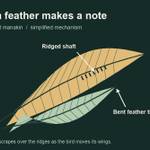


ALT Simplified drawing of two enlarged wing feathers, showing a bent feather tip passing over the ridges of a neighbouring feather. The accompanying video pairs a bird photograph with a recording of its metallic courtship note. Recording excerpt: Niels Krabbe, XC248568, CC BY-SA 4.0, https://creativecommons.org/licenses/by-sa/4.0/. Cropped photograph: Michael Woodruff, CC BY-SA 2.0, https://creativecommons.org/licenses/by-sa/2.0/. This edited clip is CC BY-SA 4.0. Original media: https://askpandi.com/pandipedia/this-little-bird-plays-music-with-its-wings (Sources).

ALT Small green moss balls scattered across the ice of Alaska’s Root Glacier

ALT A glacier moss ball marked with coloured beads beside a ruler during field research

ALT Research maps track glacier moss ball positions from June to August; colours show dates and the right panel enlarges a cluster

ALT A lettuce sea slug, Elysia crispata, with folded leaf-like structures along its back

ALT Elysia crispata feeding on the green alga Bryopsis plumosa

ALT Original research illustration shows chloroplasts moving from algal cells into a sea slug’s own cells

ALT NASA diagram of the Moon’s tilted orbital plane around Earth; Earth and Moon sizes are exaggerated

ALT An illustrated aye-aye perches on a branch in a night forest. Large ears, amber eyes, coarse dark fur and a bushy tail frame a hand with a thin middle finger beside a longer, sturdier fourth finger.

ALT A new explanatory view of one aye-aye hand distinguishes the very thin third finger from the longer, sturdier fourth finger. Small labels 3 and 4 point to the correct adjacent digits. Labels: 3, 4.

ALT An illustrative aye-aye feeds through a small opening in jackfruit skin. Its longer, stronger fourth finger reaches into the fruit while the slender third finger remains visibly separate.

ALT White methane hydrate layers within a sediment block recovered from Hydrate Ridge off Oregon

ALT A flame above ice-like methane hydrate during a laboratory demonstration

ALT Telegraph plant stems with large leaves and their much smaller side leaflets

ALT A small brown mouse peers from a nest woven with pale tying strings inside a rolled bark-painted cloth photography hide. Wire mesh, bamboo slats and loose lacing cords reveal the disguise’s construction.

ALT Original book photograph showing a photographer with a camera inside the opened imitation tree. The cloth sides reveal the working space inside the disguise.

ALT Close-up of pale tying cord beside a nest woven with matching fibers inside the rolled cloth-and-wire hide. Separate loose cord ends and eyelets make the material connection visible.

ALT Patterns of discarded sand pellets around two sand bubbler crab burrows in Khao Lak, Thailand

ALT A sand bubbler crab, Scopimera, feeding among sand grains in Bako National Park, Malaysia

ALT An old spring balance supports a closed mussel shell by a cream cord. Brown anchor threads attach the shell to a suspended stone with added weights. Discreet labels identify the shell, threads and reported total breaking load. 1-inch mussel Anchor threads 4 lb at failure

ALT An explanatory close-up of brown anchor threads extending from the ventral edge of a closed mussel to stone. The threads run at different angles, with some straighter and others more curved.

ALT An archival photograph of pneumatic mail machinery and workers in a post office basement

ALT A cylindrical pneumatic mail canister from the National Postal Museum collection

ALT An archival map of pneumatic tube routes connecting New York City post offices

ALT A glossy green Valonia ventricosa bubble, a single large algal cell

ALT A close photograph of a sea pearl’s surface with other small organisms growing on it

ALT A volcanic vortex ring above Mount Etna, photographed on 1 August 2023

ALT A small gas ring above Mount Etna, with the volcanic landscape and buildings visible below

ALT The plain indigo outside of a mid-19th-century Japanese firefighter’s reversible coat

ALT The decorated inside of the same firefighter’s coat, showing Susanoo and a monstrous serpent

ALT The firefighter’s jacket and patterned trousers displayed together on a mannequin

ALT A naturally formed snow roller near Cincinnati with a hollow centre and a trail behind it

ALT Snow rollers scattered across a field in Illinois, with tracks showing their movement

ALT USS West Mahomet in dazzle camouflage, viewed toward its bow in 1918

ALT An original First World War dazzle-paint scheme for HMS Highflyer

ALT A 1922 illustration compares a dazzle-painted ship and a grey ship through a periscope

ALT Resurrection fern before rain, curled and dry above, and green after rain below

ALT A glassy fulgurite formed when lightning fused sand at Great Sand Dunes National Park

ALT Fulgurite specimens showing sand-coated glass formations

