

High fidelity research
Joined November 2023
- Tweets3.1K
- Following103
- Followers58.2K
- Likes4.8K




Pinned Tweet
OpenResearch was the #1 trending GitHub repo on Friday 🚀
With OpenResearch, you can turn any coding agent into a research agent that reviews literature, develops hypotheses, runs experiments, and produces research artifacts.
Own and automate your research stack end-to-end. Now available on Windows.
Check it out: github.com/alphaXiv/OpenRese…

You can now run frontier-speed research tasks on OpenResearch without anything leaving your laptop 🚀
Flint from @Recursive_SI is a best-in-class local coding model and runs at 125+ tokens/sec on a MacBook Pro. Try it on OpenResearch: github.com/alphaXiv/OpenRese…

alphaXiv retweeted

📄 New Paper: 𝗔𝗹𝗶𝗴𝗻𝗶𝗻𝗴 𝗟𝗮𝗻𝗴𝘂𝗮𝗴𝗲 𝗠𝗼𝗱𝗲𝗹𝘀 𝘁𝗼𝘄𝗮𝗿𝗱𝘀 𝗖𝗼𝘂𝗻𝘁𝗲𝗿𝗳𝗮𝗰𝘁𝘂𝗮𝗹 𝗜𝗻𝘃𝗮𝗿𝗶𝗮𝗻𝗰𝗲
🔗 Link: arxiv.org/abs/2610.22942
👉 Post-training Foundation Models with Reinforcement Learning improves models capabilties in Reasoning and Instruction Following - 𝗯𝘂𝘁 𝘁𝗵𝗲𝘀𝗲 𝗴𝗮𝗶𝗻𝘀 𝗺𝗮𝘆𝗯𝗲 𝗱𝗶𝘀𝗽𝗮𝗿𝗮𝘁𝗲 𝗮𝗰𝗿𝗼𝘀𝘀 𝗽𝗿𝗼𝗺𝗽𝘁 𝗰𝗮𝘁𝗲𝗴𝗼𝗿𝗶𝗲𝘀, 𝘂𝘀𝗲𝗿 𝘀𝘂𝗯𝗴𝗿𝗼𝘂𝗽𝘀 𝗮𝗻𝗱 𝗼𝘁𝗵𝗲𝗿 𝘀𝗲𝗻𝘀𝗶𝘁𝗶𝘃𝗲 𝗮𝘁𝘁𝗿𝗶𝗯𝘂𝘁𝗲𝘀.

alphaXiv retweeted

very cool to see TokenGate already trending on @askalphaxiv — and only a few hours since our release 👀
🚀super excited for this work. check it out and share your questions!
(links in comments)


Check it out on alphaXiv.org!

"Harness^2: Recursive Agent Harnessing for an Open World"
Harness optimization would usually struggle to adapt to new tasks without ground-truth feedback, and improvements made for one task rarely transfer to others too.
So Google's Harness² introduces two levels of recursive self-improvement: it proposes, tests, and combines changes to an agent's prompts, tools, and workflows for the current task, then stores lessons from those experiments to improve future harness modifications.
Across GLM-5 and Gemini 3.5 Flash, it improves performance by up to 11.5% on WorkBuddy-Bench, 4.5% on JobBench, and 11.8% on Legal Agent Bench, without updating model weights.
alphaxiv.org/abs/2610.14224

"Reward Misspecification Degrades CoT Monitorability"
Reward misspecification can teach LLMs to exploit flawed rewards, while their chain-of-thought still appears aligned with the original task, making reward hacking difficult to detect.
This paper proposes Reward Description Training, which infers what the reward function actually favors from training rollouts, then trains models to explicitly discuss that objective in their CoT.
This method raises detection from 18% to 85% across 3 models and 3 tasks, improving monitorability by 24-42%.
alphaxiv.org/abs/2610.reward…

alphaXiv retweeted
We are still so early in the adoption of research agents
Research agents are currently where coding agents were 12-18 months ago: most researchers only like giving agents individual, narrowly scoped tasks & model usage is dominated by a handful of closed, frontier models.
However, like coding, the landscape of autoresearch agents will change. Most researchers will soon let agents to explore lines of experimentation end-to-end and open-source models will become competitive alternatives.
Watch the the autoresearch revolution unfold at openresearch.sh/rankings
alphaXiv retweeted

New from the lab: @LorenaYannnnn finds that reward misspecification during RL causes unmonitorable chain-of-thought. Models talk about the goals in their prompt, even as they learn throughout RL to optimize the misspecified reward. We also propose an intuitive fix; see below.

We are still so early in the adoption of research agents
Research agents are currently where coding agents were 12-18 months ago: most researchers only like giving agents individual, narrowly scoped tasks & model usage is dominated by a handful of closed, frontier models.
However, like coding, the landscape of autoresearch agents will change. Most researchers will soon let agents to explore lines of experimentation end-to-end and open-source models will become competitive alternatives.
Watch the the autoresearch revolution unfold at openresearch.sh/rankings
Want to try autoresearch yourself? Install the OpenResearch desktop app at github.com/alphaXiv/OpenRese…

alphaXiv retweeted
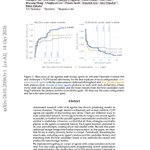
"Understanding LLM Parameter Update Sparsity through the Lens of Fisher"
LLM post-training methods like RL and on-policy distillation often produce highly sparse parameter updates, but why?
This paper uses the diagonal Fisher information to explain this: parameters that barely affect the model's output probabilities tend to receive smaller gradients. It also shows that Fisher can identify these parameters before training begins.
On Qwen3-1.7B, updating just 0.1% of parameters selected by Fisher recovers 85.2% of the improvement from full RL training, while updating 5% recovers 98.8%.
alphaxiv.org/abs/2609.36262

"Depth Memory"
Attention Residuals stores earlier Transformer layer outputs for retrieval but this memory grows with depth.
Linear Depth Memory (LDM) maintains a fixed-size memory across layers, using recursive least squares to store and retrieve earlier layer information alongside the standard residual stream.
On 400M and 1.5B models, LDM achieves lower perplexity than standard residuals, mHC, and AttnRes, while maintaining competitive zero-shot accuracy and comparable throughput with optimized kernels.
alphaxiv.org/abs/2610.18809

alphaXiv retweeted

Jeśli robisz research, eksperymenty z agentami albo chcesz automatyzować cykl „hipoteza > kod > eksperyment > analiza”, to naprawdę solidne i przydatne narzędzie. Warto rzucić okiem.
openresearch.sh/
"Understanding LLM Parameter Update Sparsity through the Lens of Fisher"
LLM post-training methods like RL and on-policy distillation often produce highly sparse parameter updates, but why?
This paper uses the diagonal Fisher information to explain this: parameters that barely affect the model's output probabilities tend to receive smaller gradients. It also shows that Fisher can identify these parameters before training begins.
On Qwen3-1.7B, updating just 0.1% of parameters selected by Fisher recovers 85.2% of the improvement from full RL training, while updating 5% recovers 98.8%.
alphaxiv.org/abs/2609.36262
"Multi-Stream Attention Residuals"
An alternative to mHC and AttentionRes?
Standard residual connections combine information from all previous Transformer layers into one hidden state, making earlier information harder to access as models get deeper.
Multi-Stream Attention Residuals (MSAR) lets each Transformer layer retrieve information from earlier layers using multiple attention heads, with each head looking at a different range of previous tokens to decide which information to retrieve.
MSAR outperforms standard residuals, mHC, and AttnRes across all 12 benchmarks, achieving a 1.58x iso-loss training FLOP efficiency improvement over standard residuals based on fitted scaling laws, while adding just 0.5% training FLOPs per step.
alphaxiv.org/abs/2610.13630

"Training Language Models to Fail Gracefully"
Due to how we use RL for LLMs, there is currently little incentive for models to admit uncertainty, preventing them to guess even when they're unlikely to succeed.
This paper GracefulRL instead trains models to prefer success over safe fallback, and safe fallback over failure. They did it by using a modified RL objective that prevents the model from collapsing into always refusing.
On AIME, it reduces incorrect answers from 79.1% to 8.9%, while sacrificing only 3.1% of correct answers. On Minesweeper, it even improves success from 67.4% to 77.4% while reducing errors.
alphaxiv.org/abs/2610.20401

"Scaling Discovery Requires Forgetting"
Long-running AI research agents plateau as their context accumulates. It also becomes more conservative and make smaller changes instead of exploring new ideas.
So this paper proposes forgetting, where you have the model periodically discarding all agent sessions and experiment histories, keeping only the best solution found so far. A fresh team of agents then resumes exploring from that solution.
Across four coding and optimization tasks, this improves performance by 10% on average over parallel agents, and 22% over a single agent at the same budget.
alphaxiv.org/abs/2610.20563

alphaXiv retweeted
Looking for a fun weekend read?
Introducing the Illustrated NeurIPS 🌎
We indexed all 9000+ NeurIPS papers and built a visual way to explore the whole landscape
Search your favorite topics, open a cluster, and dive right in
Check it out here! alphaxiv.org/conferences/neu…