




this topic should be discussed so here it is
bringing stocks and bonds onchain isn't about tokenizing them.
issuers also need control over what happens after an asset is created.
that's where @injective Mint comes in.
it gives issuers a no-code way to create and manage assets directly on Injective.
▸ what can issuers control?
who can hold an asset
where it can be transferred
who can mint or redeem it
when transfers need to be paused
these controls are built into a single interface, without needing to write custom contracts.
▸ why does this matter?
tokenized assets aren't always freely transferable. they can have regulatory restrictions, approved holders, and specific rules that need to be enforced even after issuance.
Injective Mint also connects to an ecosystem built around trading, lending, derivatives, and collateral, giving tokenized assets a potential path toward broader onchain utility.

9
20
716
injective is slowly becoming a serious home for real world assets, and the latest numbers make that hard to ignore.
here's what happened this week:
▸ RWA growth
over $1.5B in real estate mortgage records are now tokenized on injective.
@PentivHQ added $524.8M worth of mortgage records in a single day.
the long-term target is over $10B in mortgage originations.
▸ Veyra upgrade
Veyra passed governance with 99.51% of INJ stakers voting in favor.
scheduled to go live on November 24.
brings new capabilities for RWAs, privacy, RFQ perps and institutional finance.
▸ Institutional expansion
injective is expanding into Japan through a collaboration with the University of Tokyo.
Wells Fargo ($WFC) is now available onchain, with 24/7 trading and leverage.
▸ Stablecoin growth
USDC supply on injective grew 425% in a week.
total supply crossed $58M, making injective the fastest-growing L1 for stablecoin liquidity.
▸ Ecosystem updates
dYdX v9.9 now routes deposits through injective, with withdrawals arriving as USDC on injective.
average daily active addresses jumped from 187K to 286K in just four days, according to @tokenterminal.
the interesting part isn't just the growth in numbers.
it's how injective is bringing RWAs, stablecoin liquidity and institutional finance together onchain.
and there's more coming with Veyra.
8
22
1,139
you know what
most people hear rwa tokenization and think the entire asset is being put onchain.
but that's not always how it works.
take mortgages as an example.
@injective now has over $1.5B worth of mortgage records brought onchain through Pentiv.
▸ the latest update added 998 mortgage records worth $524.8M
▸ the registry now has 2,897 records across 9 Canadian provinces
▸ it started with 1,259 records back in December 2025
but what actually goes onchain here?
each mortgage gets a standardized digital record linked to the original loan, along with a cryptographic fingerprint that can be used to verify the data.
this means auditors can check whether the records match the original documents, while sensitive borrower information remains offchain.
the actual mortgages still operate under their existing legal and servicing framework. we're not creating new mortgages onchain, just making their records easier to verify.
and Injective's infrastructure plays a role here too:
• Token Factory handles asset issuance
• Permissions Module controls who can hold or transfer assets
• Injective Mint makes these tools accessible without coding
• MultiVM allows assets to work across Injective's different execution environments
there's also Institutional Rail, which connects institutions directly to Injective validators for reliable transaction inclusion and instant finality.
the mortgage token is now called Pentiv Digital Mortgages (PTIV0), following the rebrand from Pineapple Financial, and is issued 1:1 with loan principal.
Pentiv is also working towards bringing over $10B in historical mortgage originations onchain.

13
30
769
yahallo ,
who heared about @injective 's partnership with BDACS.
so if i start from , starting
Stablecoins aren't about having a digital dollar They can also bring other currencies into onchain markets.
you want context ?
so
▸ What's really happening>
• BDACS issues KRW1, a stablecoin backed 1:1 by the Korean won.
• Under an MoU, BDACS and Injective plan to bring KRW1 into Injective's ecosystem as a settlement asset for tokenized RWAs.
• This means tokenized markets could settle in Korean won instead of relying on dollar stablecoins for everything
▸ Why does this matter?
• Korean won denominated assets could settle directly in won, reducing the need for currency conversion.
• It could reduce the exchange-rate exposure that comes with converting between currencies.
• It also opens the door for more Korean financial institutions and assets to move onchain.
Injective Mint also supports configurable holder, jurisdiction and transfer controls for assets issued through it.
The integration is still planned, with further updates expected as specific use cases go live

12
24
646
buying INJC gives you INJ staking exposure on Nasdaq, but you don't actually hold or stake the tokens yourself.
there is quite a bit happening behind the scenes.
where does the INJ actually go?
BitGo acts as the custodian. they hold the real spot INJ tokens and control the private keys. as a shareholder, you own shares of the ETF, not the coins in the vault.
how does staking work?
Canary runs the staking program through third-party staking providers who delegate to Injective validators.
there is also the 21-day unbonding period. when INJ gets unstaked, it earns zero rewards and stays locked for 3 weeks. to handle people selling their ETF shares, the fund keeps some INJ unstaked as a cash buffer. but if a massive wave of redemptions hits all at once, delays could happen.
what happens to the staking rewards?
you dont get a monthly cash payout in your brokerage account.
after staking fees take roughly 30% of the yield, the remaining 70% gets added directly to the fund's daily NAV (share value) and restaked. so the rewards compound inside the share price instead of arriving as a dividend check.
the trade-offs worth knowing:
> 1.10% annual sponsor fee, separate from the 30% staking cut
> staking yield is variable and depends on network conditions, not guaranteed
> governance set downtime and double-signing slashing penalties to zero as of September 2026, but bad validators can still get jailed or tombstoned
the biggest difference:
holding INJC is not the same as holding real INJ in your own wallet.
you cant vote on Injective governance, you cant pick your own validators, and you cant use the tokens across Injective apps or DeFi.
its built for traditional stock investors who want INJ price and yield inside a normal brokerage account without touching seed phrases or crypto wallets.
dyor. thats the breakdown >
@injective

10
22
719
one thing that often gets overlooked when talking about blockchain scalability is how transactions are actually processed.
handling more transactions is one thing. making sure they're executed fairly is another.
i was reading @injective's research on scalability, and its approach goes beyond just increasing throughput.
there are three parts to it:
performance
how efficiently can a network process transactions from start to finish?
this involves more than TPS. block size, block time, latency and finality all affect how quickly transactions move through the network.
resilience
this is where things get interesting, especially for onchain trading.
when orders are processed one by one as they arrive, transaction timing can create opportunities for front-running and other forms of MEV.
Injective addresses this through Frequent Batch Auctions (FBA), built into its Exchange Module.
instead of matching orders individually as they arrive, the system groups them into discrete intervals and executes them together at the end of each batch.
a few details make this work:
sealed orders: incoming orders stay hidden until the batch is executed.
>
uniform clearing price: matching orders within the same batch execute at a common price.
>
batch execution: orders are matched together rather than giving an advantage to whoever gets theirs in a fraction earlier.
this reduces the timing advantage that front-runners can exploit and makes ordering-based MEV harder.
it doesn't mean every form of MEV disappears, but it addresses an important source of unfair execution in onchain markets.
upgradability
the other part is Injective's modular architecture.
its onchain modules work like pre-built infrastructure that developers can use to add functionality to their applications without having to build everything from scratch.
this makes it easier for the network and its applications to evolve as new requirements come up.
what i find important here is that these three parts complement each other.
performance helps transactions move efficiently, resilience makes execution fairer, and modularity gives developers room to build and adapt.
because scaling a financial network isn't just about how much activity it can handle.
it's also about how reliably and fairly that activity gets processed.
@injective

something i like about this collaboration is that it brings blockchain research closer to actual financial applications.
@injective is now partnering with the University of Tokyo's Endowed Chair for Blockchain Innovation.
here's what the collaboration involves.
the first step is a joint lecture on onchain finance, where students can explore how blockchain infrastructure connects with financial markets, trading, tokenization and settlement.
there's also a practical side to it.
students interested in building will have a hands-on component, while both sides are exploring research opportunities around RWA tokenization and onchain financial structures relevant to Japan.
beyond the initial collaboration, there are plans to explore workshops, public events and potentially a future hackathon.
a bit of context: the Endowed Chair was established in 2018 within the university's Graduate School of Engineering. it's now in its third term, with a focus on research, social implementation and talent development.
i think this is a useful direction for blockchain adoption.
infrastructure matters, but so does helping the next generation of researchers and developers understand how to actually use it.
curious to see what comes out of this collaboration.
@injective

yahallo
one thing I noticed while looking into $INJ tokenomics is that Injective doesn't depend on token burns alone to reduce supply.
there are two mechanisms working together, and they approach the supply side from different directions.
here's how they connect.
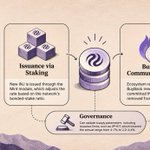
issuance responds to staking
Injective uses a dynamic supply mechanism through its mint module.
the amount of new INJ issued adjusts according to the network's bonded-stake ratio compared with its target.
if staking falls below the target, issuance increases. if it goes above the target, issuance decreases.
so staking does more than secure the network. it also influences how much new INJ enters circulation.
ecosystem activity feeds into burns
Injective originally introduced the Burn Auction, where participants bid INJ for a basket of assets accumulated from ecosystem revenue. the winning bid was permanently burned.
this later evolved into the Community BuyBack.
now, participants commit INJ in exchange for a proportional share of revenue generated across the ecosystem, while the committed INJ is permanently removed from circulation.
governance can change the supply parameters
INJ 3.0 introduced more responsive issuance adjustments and a schedule to gradually tighten the supply rate limits.
then came IIP-617, the INJ Supply Squeeze, approved by the community in January 2026.
it reduced the planned annual issuance range from 4–7% to 2.2–4.4%.
what I find worth looking at is how these mechanisms complement each other.
staking activity influences new issuance, ecosystem revenue drives the buyback mechanism, and governance gives the community a say in how the monetary framework evolves.
so INJ's supply isn't shaped by a burn mechanism alone.
it's a system where both the creation and removal of tokens are connected to what's happening across the network.
@injective

institutions need more than than access to block chain
let me explain why
they need predictable execution, faster feedback and infrastructure they can actually rely on.
that's what @injective is working on with its Institutional Rail.
here's how it works 🧵
┄┄┄┄┄┄┄┄┄┄┄┄┄
1. direct transaction inclusion
transactions go directly to the Enterprise Validator's mempool instead of relying on public endpoints.
this gives institutional transactions priority inclusion in the next block.
2. faster execution feedback
institutions receive an optimistic execution result before the block is committed.
this helps financial and treasury teams prepare their next operations earlier.
3. predictable order execution
batch auctions clear matching orders at a uniform price.
institutional orders still compete on the same network instead of operating in a separate market.
4. secure infrastructure
the Enterprise Validator uses secure hardware and remote attestation.
institutions keep custody of their own keys and assets.
the full validator set still votes on and finalizes every block.
┄┄┄┄┄┄┄┄┄┄┄┄┄
5. real institutional activity
Institutional Rail connects with Injective's broader institutional and tokenization infrastructure.
this includes native asset issuance and an SEC-registered transfer agent.
Google Cloud, LG, POSCO and other institutions are also building on the network.
the system is already in production with a select group of financial institutions and enterprise teams.
┄┄┄┄┄┄┄┄┄┄┄┄┄
the interesting part is that Injective isn't just trying to bring institutions onchain.
it's building the infrastructure they need to operate there.
@injective
10
30
730
yahallo
here are some of injective's achievements over the past year.
thought i'd share a quick recap
5 years of @injective
injective mainnet launched on november 8, 2021
what started as an onchain exchange has now grown into a financial layer 1 focused on trading, rwa, institutions and ai.
here's a look at what happened over the past year.
network growth
> native evm went live.
> $12.86B in onchain orderbook volume.
> nearly $1.8B in rwa perps volume.
> new products like injective options and super intelligence compute index.
inj and institutions
> 517,692 INJ burned through the first 14 community buyback rounds.
> total permanent burns crossed 7.29M INJ.
staking reached 58.8M INJ.
> pentiv brought over $1B in mortgage records onchain.
> posco international and lg cns selected injective for a trade finance pilot.
ecosystem expansion
> INJ expanded to robinhood, coinbase, revolut and solana.
> native USDC launched through circle.
> new ai tools like mcp server, agents platform and x402.
> canary capital's staked INJ ETF launched on nasdaq as INJC.

9
21
762
have u saw it
AI compute now has its own market on Injective
Injective has introduced the Super Intelligence Compute Index ($SICI), bringing NVIDIA GPU rental prices into onchain financial markets.
But what exactly does it track?
SICI follows the rental prices of five GPUs:
H100: 40%
B200: 25%
H200: 15%
A100: 10%
RTX 4090: 10%
Together, these GPUs represent different parts of the AI compute market, from large scale model training to inference.
The index is built by LO using data from compute marketplaces. It updates every hour and uses a 7 day average to smooth out price fluctuations.
Why does this matter?
As AI adoption grows, access to computing power is becoming increasingly important.
Companies need GPUs to run and train their models, while infrastructure providers make money by renting out that capacity.
With SICI, traders can now get exposure to changes in GPU rental prices through an onchain perpetual market, with up to 10x leverage and USDC margin.
Another addition to Injective's RWA ecosystem.
Injective already introduced AIX and an onchain H100 rental market. SICI takes this further by combining five different GPUs into a single index.
The perpetual market is live on mainnet and can be integrated into Injective dApps.
@injective

7
17
849
five years ago, injective mainnet went live since then, it has grown from an onchain trading network into a much broader financial ecosystem.
and the progress over the past year has been interesting.
here's what has changed:
1. expanding beyond trading
native EVM and shared liquidity.
improved oracle infrastructure.
more than $12.86B traded on its onchain orderbook.
new markets for tokenized stocks, commodities and AI compute.
2. real-world assets are becoming a bigger part of injective
over $1B in mortgage records brought onchain through Pentiv.
POSCO International and LG CNS exploring tokenized trade finance.
Injective Mint supporting compliant asset issuance.
institutional infrastructure connecting financial firms to the network.
3. INJ is evolving too
over 7.29M INJ permanently burned through Community BuyBack.
annual token issuance reduced.
staking reached a record 58.8M INJ.
wider access through platforms like Robinhood, Coinbase and Revolut.
the launch of the first US-listed staked INJ ETF.
4. the next chapter: AI and finance
injective is also exploring how AI agents can interact with financial markets, make payments and use onchain infrastructure.
five years is a big milestone, but what interests me more is where this ecosystem goes from here.
from onchain trading to RWAs, institutional finance and AI.
happy 5th mainnet anniversary, @injective

11
38
669
injective is bringing builders together in bangkok
its first-ever hacker house is happening from december 1 10, with 20 selected teams getting 10 days to build
here some detail
mentorship from injective core developers and teams from AWS, Animoca Brands, SMBC Nikko and others.
focus areas include AI, RWAs, privacy and agentic finance.
hands-on support with smart contracts, protocol integrations and product development.
AWS credits, accommodation, meals and travel support.
standout projects could qualify for Ninja Labs grants and further incubation.
the program wraps up with Demo Day on december 9.
applications close november 10
if you're already building on injective, this could be a good opportunity to take your project further.
apply: injectivehackerhouse.com/
@injective

4
26
651
how staking works inside the $INJC ETF
Canary Capital's Staked INJ ETF is designed to bring native INJ staking into a traditional investment product.
but how does it actually work?
injective uses Proof of Stake, where INJ holders delegate their tokens to validators who help secure the network and process transactions.
in return, they earn staking rewards after validator commissions.
inside the INJC ETF, the process is managed by Canary Capital through third-party staking providers.
here's how it works:
> most of the ETF's INJ holdings will be staked.
> some tokens will remain liquid to handle share creations and redemptions.
> staking rewards will accumulate in the fund's NAV.
> net rewards will be restaked instead of being paid out as cash.
there are a few things worth knowing:
> staking rewards are not guaranteed.
> injective has a 21-day unbonding period.
> validators can face slashing penalties.
> staking participation can change over time.
the biggest difference?
INJC shareholders won't directly control the underlying INJ, choose validators or participate in Injective governance.
they get exposure through ETF shares while staking is handled within the fund.
basically, it's INJ staking packaged into a traditional investment product.
@injective

13
25
1,188


Rumi retweeted

The strange part of the upcoming @FungoLabs Genesis sale is that bidding 15K cZAMA does not mean you will pay 15K.
Yeah...
Let me explain how the auction actually works :)
✦ ✦ ✦
First, why cZAMA instead of an ordinary token?
The "c" simply means confidential. Regular ZAMA can be shielded into cZAMA 1:1, after which balances and transfer amounts remain encrypted onchain.
The wallet addresses and transactions are still visible, but the balances and transferred amounts are not.
Without cZAMA, the auction could carefully encrypt your bid and then let the payment reveal how much you moved into the contract... not particularly sealed, lol.
✦ ✦ ✦
Each bid contains two things:
• the maximum price you would pay for one NFT
• how many NFTs you want
Both remain encrypted while the auction is open. Using FHE from @zama, the contract can record and process those values without showing them publicly.
Anyone watching Ethereum can still see who submitted a bid, when it happened and how many bids were placed. They just cannot see the price or quantity.
Once bidding closes, the bids are revealed and ranked from highest to lowest.
The lowest successful bid that fills the 2,500th NFT becomes the final price for every winner.
✦ ✦ ✦
This is the part where I needed actual numbers:
• you bid 15,000 cZAMA each for 3 NFTs
• the final price becomes 10,000
• you receive all 3, pay 30,000 and get 15,000 back
Those who bid exactly at the final price divide the remaining NFTs proportionally. Bids below it receive no NFTs and get their cZAMA back.
I like that you can enter the maximum you are genuinely willing to pay without automatically paying all of it. If the auction settles lower, you keep the difference.
The less comforting detail, though, is that bids cannot be withdrawn, and the small encrypted-bidding fee is not refunded.
✦ ✦ ✦
So tomorrow Ethereum can know that someone placed a bid without immediately learning whether they were cautious, optimistic or completely unreasonable...
That info can wait until the auction is over, which is probably healthier for everyone involved!
Two Fungo questions down; three left ↓
fungolabs.org/launchpad/c/cf…


The @FungoLabs X Campaign is live, and creators can submit up to five posts.
I knew what my first one had to answer:
how can an NFT be public on Ethereum while the character inside stays private?
✦ ✦ ✦
Ethereum still handles everything we normally expect from an NFT: it records that the token exists, which wallet holds it and every transfer between wallets.
What stays out of public view is the character itself. When a Fungo Genesis NFT is minted, the contract creates two encrypted values:
• the look: its artwork
• the essence: its class, four stats and element
They are encrypted as soon as they are created, so Ethereum stores them without exposing a readable version to the public or even the Fungo team!
✦ ✦ ✦
The tek behind this is FHE from @zama, short for fully homomorphic encryption. I'll be sticking to the acronym from here :)
For the NFT, that means the contract can work with encrypted info without revealing it first. The holder still gets to look inside: a wallet signature opens a private view in the browser, while everyone else continues to see the sealed collection mark until the artwork is published.
From there, the holder chooses what happens to the art:
• publish it for everyone, permanently
• keep it sealed, even when selling the NFT
Things get even stricter with the essence: Fungo Genesis doesn't even have a public reveal function for its class, stats or element, so those values remain encrypted onchain.
✦ ✦ ✦
There is something much more fun about revealing the artwork whenever the holder feels like it, or never revealing it at all :)
Okay, one Fungo question answered! Four more waiting ↓
fungolabs.org/launchpad/c/cf…
Rumi retweeted

Great opportunity to get some share of $FUNGO token.
Fungolabs is launching x campaign where the reward pool is 3% of total supply.
To join:
1) Connect X on Fungo Campaign
2) Submit 5 best Fungo posts
Start: fungolabs.org/launchpad/c/cf…
Only posts from 1st Nov 14 utc counts.

🟨 $FUNGO X Campaign is live!
Reward pool: 300,000,000 $FUNGO
→ Connect your X on Fungo Campaign
→ Submit your 5 best Fungo posts
Posts from 2026-11-01 14:00 UTC onward count.
Leaderboard revealed when the campaign ends. Rewards hit your wallet at TGE.
fungolabs.org/launchpad/c/cf…

Rumi retweeted

Happy weekend everyone ✨
@injective Trench Treasury just bought 5% of $RUNNER.
@runupdotfun is building a new way to launch tokens on Injective using perpetual markets.
Hmm, the idea is simple , trading fees go into onchain treasury strategies. Profits can support token buybacks, while holders earn rewards in INJ from platform activity.
RunUp has also expanded to Solana. Anyone can now launch tokens paired with INJ, and holders can earn INJ rewards.
It is already connected with @JupiterExchange , @Backpack and @coinbase , helping more Solana users discover INJ.
RunUp's first launch brought over 30,000 unique users into the Injective ecosystem.
The Trench Treasury previously acquired 10% of NinjaCat and now holds 5% of RunUp's supply. It says it will never sell these acquisitions.
Good to see the Treasury backing projects that bring new users, real utility and more activity to Injective.
Welcome to the Injective family, @runupdotfun .
Let's run it up.
