

The AM Podcast highlights technical human-centered AI research by interviewing the leading minds. Hosted by @EchoShao8899 @shannonzshen @michaelryan207
Joined January 2026
- Tweets95
- Following3
- Followers710
- Likes100





Pinned Tweet
AI used to be a distant promise; now it permeates our lives. AI is getting better, but is it making us better? We are promised that AI will augment our minds, but how?
We--@EchoShao8899, @shannonzshen, and @michaelryan207--are excited to launch the Augmented Mind Podcast (The AM Podcast), a podcast about technical human-centered AI work. We'll share compelling research, infrastructure, and systems through monthly episodes, featuring interviews with the pioneering minds behind them.
We release EP0 today to share who we are, why we started this podcast, and what we're looking forward to.
0:00 - Prelude: the problems we care about
1:48 - Host introduction
2:03 - Why we started the AM Podcast
2:31 - Hot takes on human-centered AI
10:45 - Format of our podcast
11:28 - Unique technical challenges in human-centered AI
16:45 - Let the journey begin!
We were fortunate to chat with Jeremy earlier this year. Many of the topics we discussed feel even more relevant given many recent news in AI & Math.
augmented-mind.github.io/epi…


Augmented Mind Podcast retweeted
“When I say understanding is the new bottleneck, what I mean is that I need to keep a clear understanding of what’s going on in my head to advance the project and be a full creative participant in that project.”
"Coding agents make coding more lonely. Can we open up that process to make it inherently collaborative?"
For EP7, “Software With Taste,” we welcome @geoffreylitt, design engineer at @NotionHQ, whose work explores malleable software and designing environments for thinking.
AI speeds up our work, but is our understanding keeping up? Geoffrey explains the risks of optimizing for speed at the expense of human understanding, why he uses AI to quiz himself during code reviews, and how to develop taste and build tools that help us stay creative, think deeply, and work together.
0:00 - Introduction
0:47 - Design Is More Than Better Animation
3:32 - Malleable Software and Coding Agents
9:06 - Human-Software Interaction is a Full-Stack Problem
12:43 - Getting Users On Board and Deeper
15:53 - The Trap of Just Building More
20:27 - Primitive Design Is a Taste Problem
22:20 - Understanding Is the New Bottleneck
27:22 - How To Develop Taste?
34:49 - Productivity vs. Speed
38:10 - Will Better AI Hurt Human-Human Collaboration?
44:34 - Advice for Designing Better Products
Augmented Mind Podcast retweeted

Did a podcast interview organized by some awesome Stanford researchers!
Among other things, discussed one of my favorite topics: once code is free to write, what are the infrastructure changes that need to happen to take full advantage of that democratization?

“When I say understanding is the new bottleneck, what I mean is that I need to keep a clear understanding of what’s going on in my head to advance the project and be a full creative participant in that project.”
"Coding agents make coding more lonely. Can we open up that process to make it inherently collaborative?"
For EP7, “Software With Taste,” we welcome @geoffreylitt, design engineer at @NotionHQ, whose work explores malleable software and designing environments for thinking.
AI speeds up our work, but is our understanding keeping up? Geoffrey explains the risks of optimizing for speed at the expense of human understanding, why he uses AI to quiz himself during code reviews, and how to develop taste and build tools that help us stay creative, think deeply, and work together.
0:00 - Introduction
0:47 - Design Is More Than Better Animation
3:32 - Malleable Software and Coding Agents
9:06 - Human-Software Interaction is a Full-Stack Problem
12:43 - Getting Users On Board and Deeper
15:53 - The Trap of Just Building More
20:27 - Primitive Design Is a Taste Problem
22:20 - Understanding Is the New Bottleneck
27:22 - How To Develop Taste?
34:49 - Productivity vs. Speed
38:10 - Will Better AI Hurt Human-Human Collaboration?
44:34 - Advice for Designing Better Products
Podcast Links:
Podcast website: augmented-mind.github.io/
Youtube: youtube.com/@Augmented-Mind
Apple Podcasts: podcasts.apple.com/us/podcas…
Spotify: open.spotify.com/show/40Kcul…
RSS: anchor.fm/s/10dbf5b7c/podcas…
Geoffrey’s Homepage: geoffreylitt.com
Malleable Software: inkandswitch.com/essay/malle…
Understanding is the new bottleneck: geoffreylitt.com/2026/07/02/…
Notion Workers: developers.notion.com/worker…
Huge shoutout to:
- @jeanpeic: Filming and Editing
- @Diyi_Yang: Podcast Advising
- @oshaikh13: Guest Connections
- @schmidtsciences: Support for this Episode
“When I say understanding is the new bottleneck, what I mean is that I need to keep a clear understanding of what’s going on in my head to advance the project and be a full creative participant in that project.”
"Coding agents make coding more lonely. Can we open up that process to make it inherently collaborative?"
For EP7, “Software With Taste,” we welcome @geoffreylitt, design engineer at @NotionHQ, whose work explores malleable software and designing environments for thinking.
AI speeds up our work, but is our understanding keeping up? Geoffrey explains the risks of optimizing for speed at the expense of human understanding, why he uses AI to quiz himself during code reviews, and how to develop taste and build tools that help us stay creative, think deeply, and work together.
0:00 - Introduction
0:47 - Design Is More Than Better Animation
3:32 - Malleable Software and Coding Agents
9:06 - Human-Software Interaction is a Full-Stack Problem
12:43 - Getting Users On Board and Deeper
15:53 - The Trap of Just Building More
20:27 - Primitive Design Is a Taste Problem
22:20 - Understanding Is the New Bottleneck
27:22 - How To Develop Taste?
34:49 - Productivity vs. Speed
38:10 - Will Better AI Hurt Human-Human Collaboration?
44:34 - Advice for Designing Better Products
EP7 of the AM Podcast drops tomorrow!
Software engineering has never been faster. How do we avoid the risks of optimizing for speed at the expense of human understanding?
We sat down with @geoffreylitt, a design engineer at @NotionHQ, to unpack taste, malleable software, and what it means to build for human understanding.
Here’s a preview 👀
Check out our conversation with Zora to learn more ideas behind this release!
augmented-mind.github.io/epi…


Agents trained on population-scale data can do a lot of things.
But ask a professional to stake their reputation on an AI-generated artifact? “Pretty good” isn’t good enough.
We introduce TAHI: a Test-time Adaptive agent framework through Human-agent Interaction. Featuring:
📈 Test-time adaptation via context (memory, skills) and weight training
⚡ Efficient adaptation to individual expertise within tens of tasks
✔️ Creating comprehensive rubrics for “non-verifiable” tasks
🔍 Analysis of shared community guidelines vs. personalized tacit expertise
Might be a good chance to repost given another release on AI formalized proof today!
"AI may have the answers, but mathematics has the questions."
With all the recent excitement around AI for math, many start to wonder: can mathematics be automated? And what does it mean to learn and understand math?
For EP5, we're thrilled to talk with Prof. Jeremy Avigad, philosopher & mathematician @CarnegieMellon and one of the early forces behind 3w. This episode features rich technical discussions on AI & mathematics, as well as many touching moments where Jeremy shares his vision for the future of mathematicians, math education, and mathematics itself.
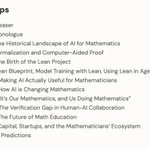
Outline:
0:00 - Teaser
1:04 - Monologue
2:50 - The Historical Landscape of AI for Mathematics
7:28 - Formalization and Computer-Aided Proof
11:56 - The Birth of the Lean Project
21:21 - Lean Blueprint, Model Training with Lean, Using Lean in Agentic Systems
29:48 - Making AI Actually Useful for Mathematicians
32:46 - How AI is Changing Mathematics
36:29 - "It's Our Mathematics, and Us Doing Mathematics"
43:04 - The Verification Gap in Human-AI Collaboration
47:46 - The Future of Math Education
52:23 - Capital, Startups, and the Mathematicians' Ecosystem
1:01:08 - Predictions
"If you look at … where the economic value concentrates, the software engineer only captures around less than 5% of human employment, but there are a lot of other occupations out there that are using computers."
For EP6, we welcome @ZhiruoW, a CS PhD student at Carnegie Mellon studying how AI agents and humans work, and how they can better work together. In this episode, Zora explains why the "automation vs. collaboration" debate is a false dichotomy and argues that by deeply understanding human workflows, we can build agents that actually empower us to do more!
0:00 - Introduction
4:57 - Agent Workflow Memory
9:26 - From Program Synthesis to Agent Research
11:16 - Tools, Actions, and Skills
18:47 - Human Work vs. Agent Work
21:19 - Autonomous Agents vs. Collaborative Agents
29:47 - Picking Research Problems in the Age of AI Agents
34:09 - The Role of Coding Ability in Agent Development
36:49 - Cutting Through the Fear Mongering: Building Agents Responsibly
45:02 - What’s Next? (The Future of Human-Agent Collaboration)
52:42 - Final Takeaway
Podcast Links:
Podcast website: augmented-mind.github.io/
Youtube: youtube.com/@Augmented-Mind
Apple Podcasts: podcasts.apple.com/us/podcas…
Spotify: open.spotify.com/show/40Kcul…
RSS: anchor.fm/s/10dbf5b7c/podcas…

References:
Zora’s Homepage: zorazrw.github.io/
Agent Workflow Memory: arxiv.org/abs/2409.07429
How Do AI Agents Do Human Work? Comparing AI and Human Workflows Across Diverse Occupations: arxiv.org/abs/2510.22780
In EP6 we chatted with @ZhiruoW -- a PhD student at @CarnegieMellon University working on progressive adaptation of agents and human-agent collaboration! Zora's work builds agents that empower people to accomplish more!
Preview below, full episode coming tomorrow!
We’ve seen a lot of exciting community engagement around the podcast lately.
To give people a shared place to exchange ideas, questions, and hopes for human-centered AI, we’re launching the AM Forum: an open discussion space for human-centered AI research.
CongJie Pan and Shurui Liu have already kicked us off with great posts on AI Personalization and Mathematics Research Agents.
Come read, respond, and join the discussion!


Shurui offers a clear overview of agentic tools mathematicians are using to augment their research.
A key framing: “Humans supply direction; the machine supplies verified execution and its own repairs.”
augmented-mind.github.io/for…

Make a post yourself or leave a comment and join the discussion!
You can make a post using your GitHub profile here: github.com/orgs/augmented-mi…

Happening now!

Human-Agent Collaboration behind the making of the Augmented Mind Podcast
youtube.com/live/xkQDIWlpsnA…

Here's a concrete example of how we release our recent episode. github.com/augmented-mind/au…

@shannonzshen is explaining how we made the opening animations in our EP0 (youtu.be/kv5sQbVhh4w) through human-AI collaboration.
