


Roberto Carlos says he lost 99% of everything he earned in football. He has 11 kids by different women. At 53, he says he's paying off a 50-year mortgage at 1,500 euros a month.
Real Madrid's own page credits him with 527 matches and 69 goals from 1996 to 2007. He won 128 caps for Brazil, the 2002 World Cup, three Champions Leagues and four Ligas.
On June 4, 2026, he sat down on La Revuelta, David Broncano's late-night show on Spain's TVE, for its classic money question.
In the video below, Broncano opens with "you've earned a lot of money, many millions," and Roberto Carlos answers, "But I lost everything." On child support? "Child support. Separation." He says he was married to two of the mothers.
He won't give a figure. "I don't know how much I have." Then: "No idea. I don't keep track of my life." More millions than kids? "No, no. Not that much." Broncano admits he can't tell when his guest is serious.
Asked if he's fine financially, he says, "Yes, I live well." His house is near Madrid's airport. When he forgets the word for the bank loan, Broncano supplies it: a mortgage. "Instead of paying over 30 years, I pay over 50, so it's 1,500 euros a month."
Broncano jokes that with "the new heart" his guest will make it to 100. He had two stents put in last December and has said it was not a heart attack. The clip ends with him telling Broncano, "So I changed your whole script, brother."
In September, on stage at the Portugal Football Summit in Lisbon, he put a number on it. COPE quoted him: "I lost 99% of everything I had earned in football." He blamed agents, family problems and people who left his account at zero.
In August 2017 a Rio de Janeiro state court ordered 3 months of closed-regime civil imprisonment over 61,000 reais in late child support for two of his kids. His office said he then paid. On July 25, 2026, seven weeks after the episode aired, he married Souhaila Ettahiri, who works in player management, per Moroccan outlet Le360. He called her "my wife" to Saudi daily Okaz.
Some will say 11 kids by different women and two divorces explain where the money went. Others will take his Lisbon words at face value: agents and family emptied the account.
A World Cup. Three Champions Leagues. 11 kids. One 50-year mortgage at 1,500 euros a month.
Did Roberto Carlos spend his fortune, or did the people around him take it?
9
197
axon retweeted
$1.8M per episode. That's reportedly what Charlie Sheen was making when Warner Bros. fired him in 2011. 15 years later his ex-wife went on his new podcast and told him: "Security would never suspect me bringing drugs into the house. Which I did."
Denise Richards married Sheen on June 15, 2002, filed for divorce in March 2005, and the divorce was final on Nov 30, 2006. They have two daughters, Sam and Lola.
In the video below, they sit facing each other in the Mostly Sheenius studio. It opens on her telling him, "I learned a lot about vaginas from you." At 1:28 she brings up one of his old drug dealers, and she laughs through parts of what follows.
She had meant to tell this in Netflix's doc on Sheen, she says, but "I didn't know he was going to do the doc."
Back then Sheen had strict security. "Only these people were allowed in. I was one of them." She says the dealer called her because he "had a plan to wean you off of drugs," and the guards would never suspect her.
Sheen: "And you're like the most undercover mule there possibly could be."
Denise: "I'm a terrible mule, though."
She met the dealer outside the gate, she says, and he threw it in the car, "and it touched me." She had brought food prep gloves. Sheen cuts in: "So you thought there would be like fentanyl-type transfer." She never touched anything, she says.
Inside, she says, "security said hello, and I'm upstairs on a chair on top of the bookcase hiding it."
Andrew Renzi, who directed Netflix's "aka Charlie Sheen" (Sept 10, 2025), told Variety that Sheen's father Martin and Sheen's therapist asked the dealer in the film, "Could you just help us get him off of drugs?" Renzi says the dealer "stopped giving him strong drugs to eventually he was just giving him baking soda." Sheen called it "the moon landing of a solution." In this clip Denise doesn't name her dealer, give a year, or say what she carried.
Sheen has been sober since 2017. "Mostly Sheenius with Charlie Sheen" launched Nov 12, 2026, from Red Seat Ventures, and Denise is his first female guest.
Some will say she helped save his life by carrying it past his own guards. Others will say she just admitted to a crime on camera, on a Fox-owned show, while her ex-husband called her a mule.
Married 2002. Divorced 2006. One bookcase. One pair of food prep gloves.
Did she help save him, or did she just confess on camera?
On Monday, the 30-year Treasury yield hit 5.66%, reaching a 24-year high.
Exactly 47 years ago, Paul Volcker made the move that pushed US interest rates toward 20%.
In a 2013 interview at GW Law, Volcker revealed the internal tension. His latest discount rate hike had barely scraped through on a split 4-3 vote. Wall Street immediately brushed it off, assuming the tightening cycle was over.
Volcker realized a soft touch would fail: "We got to do something more dramatic... get people's attention."
On Saturday, October 6, 1979, he executed a seismic policy shift, moving the Fed away from steering the target funds rate to aggressively restricting bank reserves. Fed funds skyrocketed toward 20%.
Volcker later admitted: "I had no idea that they were going to reach 20%."
The part most history clips leave out is the real rate gap. By June 1981, the Fed funds rate minus CPI reached +9.55 percentage points. Today, that real rate sits near just +0.5.
Inflation was broken by that massive margin, held firmly through the painful 1981-82 recession and a wave of public backlash that even saw skull-and-crossbones warning ads running in the Wall Street Journal.

On Oct 1, SoftBank wired $10B into OpenAI.
Total tally: $64.6B for roughly a 13% stake. That latest $10B check came directly from junk bonds issued just days earlier at aggressive coupons up to 9.75%.
Masayoshi Son has played this exact high-stakes game before.
Right before the 2000 dot-com crash, Son claimed his net worth was skyrocketing by $10B every week. In his own words: "For three days, I was richer than Bill Gates."
Then the dot-com bubble burst. SoftBank shares plummeted 98.6%, nearly wiping the firm off the map.
He survived. In 2006, he set his sights on acquiring Vodafone Japan: "It was a $20B deal. I only had $2B. I looked the bankers in the eye and said, Trust me and lend me the money. And they did."
Today, OpenAI is aiming for a massive $1.4T valuation with no IPO in sight until at least 2027.
Do you actually know how your largest position will perform when the next crisis hits?
2
83
On Oct 1, SoftBank wired $10B into OpenAI.
Total tally: $64.6B for roughly a 13% stake. That latest $10B check came directly from junk bonds issued just days earlier at aggressive coupons up to 9.75%.
Masayoshi Son has played this exact high-stakes game before.
Right before the 2000 dot-com crash, Son claimed his net worth was skyrocketing by $10B every week. In his own words: "For three days, I was richer than Bill Gates."
Then the dot-com bubble burst. SoftBank shares plummeted 98.6%, nearly wiping the firm off the map.
He survived. In 2006, he set his sights on acquiring Vodafone Japan: "It was a $20B deal. I only had $2B. I looked the bankers in the eye and said, Trust me and lend me the money. And they did."
Today, OpenAI is aiming for a massive $1.4T valuation with no IPO in sight until at least 2027.
Do you actually know how your largest position will perform when the next crisis hits?
$130M fund. Dead at 7:30 a.m., before the market opened.
Victor Niederhoffer, ranked the world's No.1 hedge fund manager a year earlier.
Oct 27, 1997: the Dow drops 7.18%. His broker Refco demands cash he does not have.
Oct 28: Refco liquidates him. About 7:30 in the morning, he says.
Hours later, the Dow closed up a then-record 337 points. He was already out.
Mortgaged the house. Borrowed from his children. Sold his silver at Sotheby's.
Months later a Japanese TV crew filmed him paging through the auction catalog of his own silver:
"Mine. Mine. Gone with the wind. Gone with a bad speculation. All gone."
His grandfather lost everything on margin in 1929, he says.
"From shirt sleeves to shirt sleeves in three generations."
Died this August at 82.
When one morning can force a sale, the position was already too big.

axon retweeted

Two Telegram bots. Two unfair edges.
Chameleon Callouts: live wallet tracker for the sharpest hands in the game. Every buy from top traders lands in your chat in real time, sorted, ranked, stacked. You see exactly which KOLs and smart money are already loaded on the same ticker, so the best plays basically light up on their own.
Chameleon Scope: your personal filter for safu bags with real upside. Fully customizable, dials in on your style, spits out only the cleanest setups. No noise. No exit liquidity traps. Just picks worth clicking on.
A few calls in and we're already printing "safe" 2x-3x this week.


axon retweeted
Stanley Druckenmiller went 30 years without a losing year - in March 2000 he bought back the tech stocks he had sold two months earlier, and a week later: "I know I'm dead"
this is him explaining why he sold everything in January and couldn't stand watching it keep going up, the week Quantum went from up 14% to up 1%, and the day he walked into Soros's office and said he was quitting
he says he missed the top by about an hour. not a day. an hour
the lesson isn't the loss. he already knew the rule, broke it anyway, and instead of trading his way out he liquidated, sent 200 clients a letter saying he might not come back, and walked away for four months
bookmark & watch to the end - what he did after the loss is the whole point ↓
Citadel founder Ken Griffin shared the story of an immigrant family that arrived in America with zero dollars.
"The parents told the two sons, we will be temporarily poor. And they were dirt poor. Today, both sons are centimillionaires."
This is how the head of a $60+ billion hedge fund hires elite talent, builds world-class teams, and views the true American dream.
Here are the core principles driving Citadel's hiring philosophy:
1. Never hire for conformity: "Don't try to clone yourself. Try to find people who are really bright, but completely different than you are."
2. Global operational scope: "The head of my commodities business grew up in Australia. My co-CIO grew up in Ecuador. The head of my fixed income business grew up in Taiwan."
3. True merit over corporate metrics: "Diversity doesn't matter as a checklist on a piece of paper to fill in some blank for a government body. It matters because different perspectives build resilience."
Wall Street spent decades filling out compliance forms. Citadel built a global powerhouse by focusing purely on raw drive and cognitive diversity.
Bookmark this breakdown and watch the 60-second clip below.
Chamath Palihapitiya asked his CTO a simple question about their AI budget.
The answer was terrifying: "Our token costs are doubling every 45 days."
He just took over as CEO at 8090 after a $135 million round. This isn't a prediction. It's his own company's invoice.
Here is the brutal truth about corporate AI spend, why CFOs are blind to it, and what happens next:
"I sat down with my CTO today. I said, how are we doing on token spend."
The actual productivity gain from that doubling bill?
"Maybe 5% max."
Why nobody stops the leak:
"CEOs and CFOs have no idea how much is going on inside their organizations."
The real crisis isn't adoption. It's paying 100% more every month for 5% output.
Expect this exact pattern to shatter upcoming tech earnings calls.
Bookmark this and watch the full breakdown below.
axon retweeted
Paul Singer took $50,000 from his mother’s dresser to launch a hedge fund.
Soon after, he lost 88% of it.
Here is how he turned total devastation into a $72B empire, and why he says markets are facing a catastrophic collapse today.
"You could not name a way to lose money that Dad and I did not hone to the finest edge."
"My desire never to lose money again came from real devastation and wanting to get my parents' money back."
His brutal warning about today's financial system:
"Markets are as risky as I've ever seen. Decades without a massive crash have lulled people into believing they'll always get bailed out."
Today, Elliott Management manages $72,000,000,000.
Bookmark this and watch the full breakdown below.

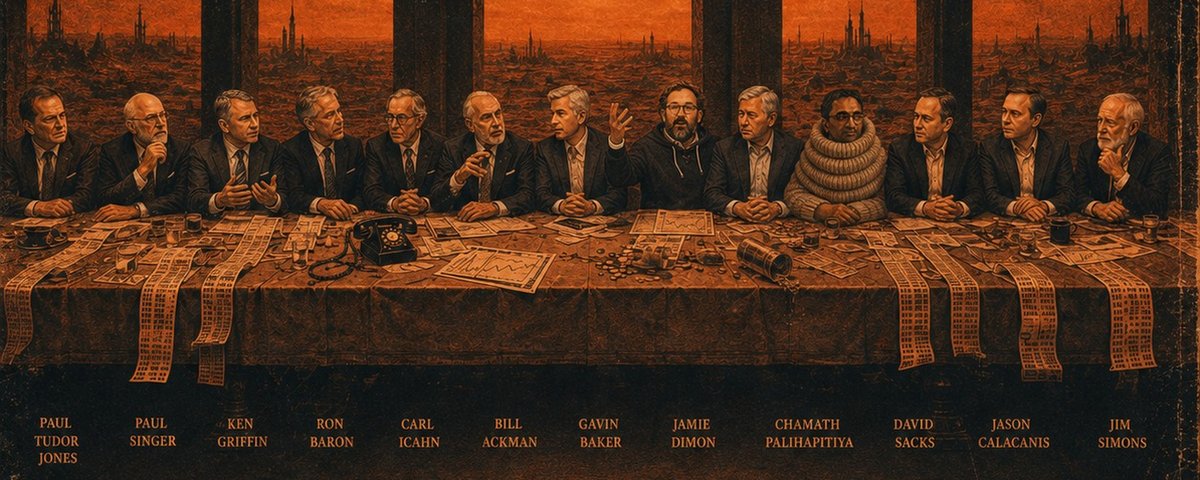
Chamath Palihapitiya asked his CTO a simple question about their AI budget.
The answer was terrifying: "Our token costs are doubling every 45 days."
He just took over as CEO at 8090 after a $135 million round. This isn't a prediction. It's his own company's invoice.
Here is the brutal truth about corporate AI spend, why CFOs are blind to it, and what happens next:
"I sat down with my CTO today. I said, how are we doing on token spend."
The actual productivity gain from that doubling bill?
"Maybe 5% max."
Why nobody stops the leak:
"CEOs and CFOs have no idea how much is going on inside their organizations."
The real crisis isn't adoption. It's paying 100% more every month for 5% output.
Expect this exact pattern to shatter upcoming tech earnings calls.
Bookmark this and watch the full breakdown below.
Paul Singer took $50,000 from his mother’s dresser to launch a hedge fund.
Soon after, he lost 88% of it.
Here is how he turned total devastation into a $72B empire, and why he says markets are facing a catastrophic collapse today.
"You could not name a way to lose money that Dad and I did not hone to the finest edge."
"My desire never to lose money again came from real devastation and wanting to get my parents' money back."
His brutal warning about today's financial system:
"Markets are as risky as I've ever seen. Decades without a massive crash have lulled people into believing they'll always get bailed out."
Today, Elliott Management manages $72,000,000,000.
Bookmark this and watch the full breakdown below.
Ken Griffin, founder of Citadel, once stepped into an elevator not knowing if his firm would survive the day:
"I hope at the end of the day that we're still in business."
This is his candid breakdown of the 2008 financial crisis, the failure of Wall Street giants, and the single most critical rule of risk management.
"It was a near-death experience. There was nothing interesting about it."
"Lehman Brothers actually just flat out failed. Merrill Lynch was one of the best sales ever by a corporation - Bank of America had to be basically bailed out on the back of that purchase."
"What none of us appreciated was that in a period of crisis, access to credit would not just slow down or fall a bit - it would cease. It would end."
His ultimate takeaway from 2008:
"Don't pretend to be a bank unless you are a bank."
Bookmark and watch the full video below.
6
31
1,742
in the summer of 1929 a twenty-three-year-old made his first trade. he sold a copper company short.
two months later the crash came, and he was one of the few people on the street who made money on it.
he went back to the office for the next eighty-six years.
his name was irving kahn. he was benjamin graham's teaching assistant at columbia, he opened his own firm in 1978, and he was still coming in when he died in 2015, at 109.
the last long recording of him is a lecture to a room of students in 2005. eight thousand two hundred and ninety-two people have watched it.

5
33
1,747
In 2015, Sam Altman made a statement 99% of people treated as a joke:
"AI will probably lead to the end of the world, but in the meantime, there will be great companies created."
Today, OpenAI is valued at over 80 billion dollars.
Entire industries are collapsing in real time, and the largest transfer of wealth in human history is happening right now while most people just watch.
He was not joking about the end of the world. He was giving you a deadline to build wealth before the rules change forever.
Are you getting ahead of this wave, or waiting to be replaced?
1
22
838
in 1975, 60 Minutes explained a new idea with a cartoon: the workers get the stock.
it was invented by a lawyer named louis kelso. the first one, in 1956, let the staff of a small newspaper chain buy the paper from its owners.
congress wrote it into the pension law in 1974. today that paperwork holds fifteen million americans and just over two trillion dollars.
kelso died in 1991, at seventy-seven.
the segment is called A Piece of the Action. four thousand seven hundred and eighty-seven people have watched it.
Fifteen million Americans own a piece of the company they work for. The paperwork that makes it possible now sits on top of two trillion dollars. It was drafted by one lawyer in San Francisco in 1956, so that the staff of a small newspaper chain could buy the paper from its owners.
His name was Louis Kelso.
The record of him explaining it is a 60 Minutes segment. Mike Wallace across the table, April 1975, thirteen minutes.
The order of what happened: he built the first employee stock ownership plan in 1956 for Peninsula Newspapers. He wrote the argument down in 1958, in a book with the philosopher Mortimer Adler. Sixteen years later Senator Russell Long dropped it into the pension law of 1974, and the thing took its name from a paragraph of the tax code, which is how it became famous without him.
Kelso died on 17 February 1991, in San Francisco. Age seventy-seven.
The current count: six thousand six hundred and nine plans, fifteen point one million participants, and just over two trillion dollars in assets.
The tape survives for one reason. The firm that posted it was founded by a man who worked under Kelso on the 1974 bill. It has been on YouTube since 2 July 2013. Free. Thirteen minutes and one second.
Four thousand seven hundred and eighty-seven people have watched it.
Fifteen million are living inside it.
3
29
785
In the Second World War, one office in Washington set the ceiling price on most of what an American could buy. Its deputy administrator was a Canadian-born economist who, thirty years later, spent thirteen television hours explaining where money comes from.
His name was John Kenneth Galbraith.
The series is The Age of Uncertainty, made by the BBC with CBC, KCET and OECA. It premiered on 10 January 1977. Episode six is the one about money, broadcast on 14 February 1977.
In it he walks through the Bank of Amsterdam, John Law and his Banque Royale, the founding of the Bank of England, the creation of the Federal Reserve, and ends in the Great Depression. Four centuries, one point: money was never a natural fact. Every version of it was an invention, built by people who needed to be paid.
He had already written the book on the last part. The Great Crash 1929 came out in 1955 and has not been out of print since.
Galbraith was the American ambassador to India under Kennedy, from 1961 to 1963. He died on 29 April 2006, in Cambridge, Massachusetts. Age ninety-seven.
The episode has been sitting on the Internet Archive since 21 April 2016. Fifty-seven minutes and thirty-five seconds. Free. Seven hundred seventy-six people have opened it.
Almost none of them work with money for a living.
Joe Louis earned 4.6 million dollars in the ring. He kept about 800 thousand of it
this is the documentary about where the rest went - and about the twelve years he spent as the most famous man in America while other people owned his income
he turned pro on 4 July 1934 against Jack Kracken and was paid 59 dollars
he held the heavyweight title from 1937 to 1949. eleven years and eight months, still the record in any division. twenty-five straight title defences
in May 1950 the IRS said he owed more than 500 thousand dollars in back taxes, interest and penalties. by the end of that decade it was over a million
in 1953 his mother died and left him 667 dollars. the IRS took that too
he started professional wrestling in 1956. he finished as a greeter at Caesars Palace, shaking hands with tourists in a casino lobby
he died on 12 April 1981, aged sixty-six
seventy-five minutes - free - six years on the Internet Archive - three hundred and seventy-five people have watched it
he was the best in the world at selling his hours. that was the whole problem
bookmark & watch today ↓
4
26
1,337