

A-Z Animals was founded on three guiding principles: accurate content you can trust, spreading knowledge on the animal kingdom, and giving back.
United States
Joined August 2009
- Tweets2.3K
- Following1.4K
- Followers1.3K
- Likes85



Why get wet when you can invent a fishing rod? These chimpanzees have turned ordinary sticks into surprisingly effective tools for collecting algae.
And just like humans, young chimps learn the tricks of the trade from their elders.
Read this interesting new article to learn more.
a-z-animals.com/blog/how-chi…

Nobody has ever been this excited about cardio.
Shared via @steveofficial_04.12 on Instagram
Could a butterfly's appearance determine its chances of survival? A study involving more than 21,000 people across 100+ countries ranked 492 butterfly species by beauty. Researchers found that colorful, patterned butterflies received higher ratings, while smaller, brown butterflies were often overlooked.
This beauty bias raises troubling questions about endangered butterflies, wildlife conservation, biodiversity, and which species receive the most attention.
Discover why lesser-known butterflies like the San Bruno elfin and alpine grayling deserve protection.
Read the full story at A-Z Animals: a-z-animals.com/blog/21000-p…
Talk about a comeback with some muscle. In 1993, 300 bison were introduced to an Oklahoma preserve. Today, more than 2,000 roam the prairie, helping native plants thrive alongside carefully controlled burns.
These shaggy landscapers do more than look majestic. Read how their return is helping restore a disappearing ecosystem.
a-z-animals.com/articles/300…

Happy World Sloth Day! Meet Alface, the adorable two-toed sloth at Chicago's Shedd Aquarium!
Born at the Dallas Zoo in 2023, Alface made history when he arrived at Shedd Aquarium in 2025 as its first sloth in more than 20 years! His name means “lettuce” in Portuguese, a nod to the first solid food he ever ate.
Today, we're celebrating Alface and all the wonderfully slow, tree-dwelling sloths that remind us life doesn't always have to move so fast!
Check out our full interview with Alface on our YouTube Channel.
youtu.be/LuqlbnRjjhE

How does an animal without ears feel sound? Meet the sea squirt, a stationary ocean filter feeder that contracts when exposed to certain vibrations.
Researchers suspect tiny sensory structures help it detect movement, but the mechanism remains unsolved.
Discover the science behind this surprising sea blob in our latest article.
a-z-animals.com/blog/this-br…
Your cat signed up for naps and window seats, not an unpaid role in your dog’s action movie.
Read the full article to learn why stopping the chase matters for a more peaceful home.
a-z-animals.com/articles/nev…

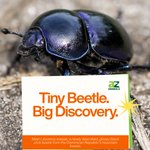
Scientists described a new glossy black click beetle, Lissomus arawak, from the Dominican Republic’s mountain forests. Its anatomy suggests ancestral beetles may have reached the Greater Antilles in at least two separate waves.
Named to honor Arawak Indigenous heritage, the tiny beetle highlights the region’s overlooked biodiversity, with at least 15 more click beetle species believed to await discovery.
a-z-animals.com/blog/a-glass…

Separated by 240 million years of evolution, two distantly related spider families developed nearly identical funnel-shaped hunting webs!
Scientists discovered that these spiders evolved similar hunting strategies through different genetic pathways, a remarkable example of convergent evolution. Despite being millions of years apart, nature found the same clever solution twice.

Most Arizona Rattlesnake Bites Happen at HOME, Not on Trails!
Think rattlesnake bites mostly happen while hiking in Arizona? Think again! Banner Health warns that many rattlesnake encounters occur right at home.
A 25-year study of more than 4,000 Arizona snakebite calls found that 59% happened on residential property. Even more surprising, 83% of victims didn't know a snake was nearby before being bitten.
From garages and gardens to backyard brush piles, here's where Arizona rattlesnakes hide and how to reduce your risk.
a-z-animals.com/articles/ban…
What happens when you spend 30 years getting to know sharks?
Cristina Zenato shares surprising stories about their personalities, building trust, and why they need our help.
Watch the full interview on our YouTube channel.
youtu.be/8A-USPvz99g
I always thought crane machines were for grabbing stuffed animals at the arcade, not live pigs!
Excellent save and smart thinking from this excavator operator. 👏👏👏
Shared via @indothainews on Instagram
Most cats ask for tuna. This one appears to be ordering an entire cow!
Shared via @threenawtycats on Instagram
Epic journeys. No GPS.
This World Migratory Bird Day, celebrate the birds crossing continents and the habitats that help them along the way. Every bird counts, and your observations matter.
What migratory birds have you spotted near home?
A two-headed turtle sounds like a once-in-a-lifetime discovery. But this Cape Cod hatchling is the third two-headed terrapin found in the area in five years!
Shared via @NBC1Boston/Cape Wildlife Center
Your front door just got a new bouncer!
This orb weaver is spinning an insect-catching masterpiece right at the entrance.
Would you let this eight-legged neighbor stay?
The Nikon Comedy Wildlife Awards finalists are here, and they’re absolutely wild!
More than 10,000 entries from 112 countries were narrowed down to 43 hilarious finalists. Now YOU get to pick the winner of the Sterna People’s Choice Award.
Vote for your favorite at the link!
comedywildlifephoto.com/peop…


How do tarantulas actually eat? They don’t chew their prey, and those huge fangs aren’t giant straws. Tarantulas are liquid feeders that begin digesting their prey outside their bodies, turning it into a nutrient-rich liquid they can consume.
Thanks to @TheTarantulaCo1 for the incredible video. Follow them for more tarantula content and A-Z Animals for more wild animal facts.
Watch the full video on our YouTube channel. youtu.be/FMK_I1ZRPfA