

NASA Solar System Ambassador | NASA Eclipse Ambassador | ACEAP Ambassador | https://teapawt.org/t.co/34C1wWorFW Ambassador | VP Phoenix Astronomical Society | Astrophotographer
Scottsdale
Joined May 2022
- Tweets54
- Following78
- Followers134
- Likes55
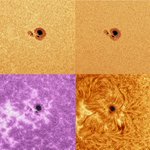




One sunspot. Four views.
🔹 Top left – 430 nm G-band
Highlights granulation walls
🔹 Top right – 540 nm photosphere
Classic continuum view
🔹 Bottom left – 393.4 nm Calcium K
Bright areas reveal intense magnetic fields
🔹 Bottom right – H-alpha 656.28 nm
Fibrils and filaments

After a quiet stretch where active regions virtually vanished from the solar disk, the Sun is starting to show some life again.
Here’s a side-by-side look at yesterday’s primary emerging region in two wavelengths:
☀️ 540 nm (Photosphere): Reveals dark sunspot umbrae, light bridges, and the bubbling pattern of solar convection granules.
💜 393.4 nm (Calcium K): Looks higher in the solar atmosphere, revealing bright plages—intense concentrations of magnetic fields surrounding the active region.
#sun #star #activeregion #sunspot


71
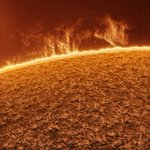
Surge vs. Hedgerow Prominence ☀️
Side-by-side on the solar limb, two very different magnetic beasts:
🚀 Surge (Left): A focused jet of plasma blasted straight into space along tight magnetic field lines.
🌳 Hedgerow (Right): A towering, arching curtain of plasma held in place by complex magnetic loops.
Wait for the Earth to scale callout at the end of the video—it puts the true size of these solar structures into mind-blowing perspective! 🌎✨
#solarastrophotography #space #astronomy
10
376
Perspective matters when imaging the Sun! ☀️
Just like a filament on the disk becomes a prominence on the limb, it’s easy to confuse spicules with chromospheric fibrils near the edge.
Though foreshortening makes them look similar near the limb, they're quite different:
🔹 Spicules = Vertical jets of plasma blasting upward into space like a forest of needles.
🔹 Fibrils = Horizontal plasma structures tracing magnetic field lines across the solar surface.
Check out the annotations in the video to spot all three features in action! 🎥✨
2
62
A hedgerow prominence — plasma suspended by magnetism
A prominence is a filament seen at the Sun’s edge. It forms above a polarity inversion line, where the magnetic field changes direction.
The plasma isn’t just “balanced” between opposite polarities. It is held in complex magnetic loops and dips that support it against gravity.
What you’re really seeing is solar plasma tracing the Sun’s magnetic field.
I took this image last Thursday with a high resolution solar telescope in Arizona.

Quiescent vs. Active ☀️
Side-by-side comparison of solar plasma structures in H-alpha:
Center: A long, stable quiescent filament draped across quiet-Sun territory.
Lower-Left: A tightly curved active region filament hugging a bright magnetic rosette.
The dynamic range and structure of the chromosphere never cease to amaze.
#sun #star #filament


2
41
325,000 km long quiescent filament channel on the Sun today. Had to stitch 3 photos together to show it all. About 40 Earths long.
#solarimaging #sun

11
412
A filament is cool, dense solar gas held up by magnetic fields. On the disk it looks like a dark ribbon. Off the limb, the same thing is a prominence.
First image: active filaments in a complex region — twisted, sitting on bright plage, likelier to erupt.
Next 2 : the same quiet filament, normal then inverted. Dark is the normal view. Bright is only inverted luminance to reveal structure.


Rain on the Sun. ☀️
This is a coronal loop arcade—a magnetic highway where superheated plasma cascades back down to the solar surface following a flare. Capturing these fine, filamentary structures in Hydrogen-alpha with this level of stability is extremely rare.
🔭 Setup: TEC160FL/ERF/4x/Solar Spectrum 0.3A etalon/Player One IMX174 camera
⏱️ Duration: 35-second time-lapse representing 136 minutes of real-time activity.
#astronomy #solar @NASA @NASASun @ESA @SpaceDotCom

Announcing the Solar Observer's Handbook youtu.be/BQOui789tQg?si=EMU6… via @YouTube

2
91
One of the most common questions I get - how can the Sun be on fire if there is no oxygen in space?
5
61
In my upcoming book, I classify 17 distinct solar structures. Here are a few of the prominences you can see on the limb of the Sun.
8
61
Another beautiful solar prominence from yesterday. This one is about 27,000 miles high. Looks to me like someone with their arms outstretched! At the bottom of the image you can see a filament, which is a prominence on the surface of the Sun. I used my solar telescope to take this image.
Many people are familiar with the Orion Nebula, one the most spectacular objects in the night sky. But fewer are aware of the Running Man nebula nearby. Encased in a blue reflection nebula is the outstretched figure of a man running through space. I took this photo with a telescope from Scottsdale AZ.

2
58
Looks like 2 more days of cloud and I'll finally be able to resume solar imaging. In the meantime, here's a spectacular time lapse from August 29th I captured with my solar telescope. The left prominence is 100,000 miles high.
55
I went out very late (for me) to look at the sun after lunch. Typically by then the ground has heated up and caused undesirable air currents that diminish the quality of solar imaging. That was case today. But under poor to average conditions, here's what the Sun looked like about an hour ago!


8
143
I caught a solar flare! Flares are not the structures you often see on the limb of the Sun. Flares are sudden bursts of X and gamma rays, often near sunspots. Intense flares, if pointed towards Earth, can create radio blackouts and disrupt satellites. This time lapse shows AR4267 on Nov 1 from 15:34 to 17:51 GMT. Follow me for more fun with the Sun!