

Life long animal advocate; horse lover; vet tech; accountant; rescue work; horse trainer; riding instructor; Eventing; Dressage; & helping misunderstood horses.
United States
Joined December 2023
- Tweets473
- Following36
- Followers25
- Likes687




Tirza Eden retweeted

SHARE-SHARE-SHARE!
𝗧𝗵𝗲 𝗥𝗮𝗿𝗲 𝗖𝗼𝗹𝗹𝗲𝗰𝘁𝗶𝗼𝗻 𝗙𝗿𝗼𝗺 𝗗𝗲𝗲𝗽 𝗔𝗻𝘁𝗶𝗾𝘂𝗶𝘁𝘆: 𝗪𝗵𝘆 𝗧𝗵𝗲 𝗟𝗮𝘀𝘁 𝗪𝗶𝗹𝗱 𝗛𝗼𝗿𝘀𝗲𝘀 𝗦𝘁𝗶𝗹𝗹 𝗠𝗮𝘁𝘁𝗲𝗿
By: William Simpson II - © Oct. 21, 2026
Around 6,500 years ago, humans began a large-scale experiment on the horse. We started selecting for the traits we wanted—size, color, gait, temperament, and the ability to carry or pull under human direction. That selective breeding, repeated across generations, narrowed the genetic diversity that natural selection had assembled. Many of the older alleles that had been tested by drought, predators, disease, and sparse forage were reduced or eliminated in the lines that became today’s domestic horses. What remained was a population shaped more by human preference than by the continuous filter of the environment.
Not every horse population was pulled into that process. In more remote parts of North America, some groups continued on paths closer to the older evolutionary trajectory. As more genetic data emerges, the case strengthens that splinter populations of free-roaming horses persisted through the period of increasing human presence. These animals were not managed for a registry standard or a show ring. They were tested by the landscape itself and carried forward a rare collection of genetic variants from deep antiquity.
One visible marker of that older collection is the Dun factor. It is not simply a paint job. The ancestral allele D on the TBX3 gene lightens the body while leaving the primitive markings—dorsal stripe, leg bars, and shoulder shadows—that functioned as camouflage in open country. Related ancient alleles such as nd1 appear in horses that lived tens of thousands of years ago, long before farms, bits, or selective breeding for solid, richer colors. The later domestication-associated allele, nd2, tends to erase that wild appearance. A horse can carry D or nd1 without displaying the full dun pattern; the allele is not always obvious from a distance. When it is present and expressed, however, it is a flag that an older working copy of the species’ survival toolkit is still present.
The privately owned cultural-heritage herd of roughly 200 horses at Wild Horse Ranch, managed by William E. Simpson II, Michelle Gough, and Wild Horse Fire Brigade, includes individuals that still show these ancestral markings—dorsal stripes and leg and body bars. Simpson has lived among and observed this herd continuously for more than twelve years, accumulating tens of thousands of hours of close-range study. The herd is not a random collection of animals removed from public lands and held. It is a documented, intact population under ongoing observation in a mountain wilderness setting, where natural selection still operates and family bands remain together. In that herd, elements of the rare collection from deep antiquity remain visible and available for study.
Domestic horses, by contrast, have paid a different genetic price. Centuries of line-breeding and selection for human standards have reduced diversity in many breeds. Traits once refined by environmental pressure—certain forms of hardiness, disease resistance, and the ability to thrive on sparse or variable forage—are less common. When an old challenge reappears, whether a pathogen, prolonged drought, or a landscape altered by fire, the animals that still carry the older alleles represent a living archive that domestic populations largely no longer hold. A vaccine or a management protocol is a response after the fact.
Ancestral genetic variation is the record of prior solutions that have already been tested across deep time.
Current federal management under the Department of the Interior and the Bureau of Land Management emphasizes removal, holding, and fertility control. These tools reduce numbers and, in many herds, reduce gene flow. When animals carrying rare or unsequenced alleles are gelded, sterilized, or removed before their genetics are read, those copies from the ancient collection are gone. Appropriate Management Levels already place many herds near or below the rough population sizes geneticists have flagged as minimal for maintaining diversity. Adding widespread chemical contraception (use of EPA registered pesticides 'PZP' & 'GonaCon') further limits the next generation’s contribution to the gene pool. The result is not merely fewer horses; it is a smaller and less variable remaining store of the traits that once defined the species under natural conditions.
The alternative demonstrated at Wild Horse Ranch is straightforward in concept: keep intact family bands on appropriate landscapes where they can continue natural selection, graze fine fuels that contribute to wildfire risk, and remain available for observation and, where warranted, genetic documentation. This does not require treating the animals as pests or discarding unsequenced variation in the name of short-term population targets. It treats the remaining wild horses as a living repository of genetic material from deep antiquity—material whose older alleles have already survived tests that domestic lines largely never faced.
The Dun factor visible in parts of the Wild Horse Ranch herd is one readable signal of that repository. It is not the only signal, and absence of the markings does not prove absence of the alleles. What the markings do provide is a concrete, observable reason to pause before the next round of removals or sterilizations permanently reduces what is left. Once those copies are removed and the animals are not sequenced, later policy cannot restore them.
Supporting the ongoing research and the herd at Wild Horse Ranch is one practical way to keep a portion of that rare collection from deep antiquity in play—under continuous observation, on a landscape where natural selection still operates, and available for the genetic work that current large-scale management has not prioritized. The domestic horse population is large. The remaining free-roaming animals that still carry the pre-domestication alleles are not. The difference between managing the outward appearance and preserving the underlying genetic archive is the difference between a narrowed breed and a species that still holds the tested variants its ancestors used to stay alive across deep time.
William E. Simpson II - Wild Horse Researcher
Founder, Wild Horse Fire Brigade
Wild Horse Ranch
Supporting materials and further reading are available at wildhorsefirebrigade.org.
References
1. Imsland, F., McGowan, K., Rubin, C. J., et al. (2016). Regulatory mutations in TBX3 disrupt asymmetric hair pigmentation that underlies Dun camouflage color in horses. Nature Genetics, 48, 152–158.
doi.org/10.1038/ng.3475
pmc.ncbi.nlm.nih.gov/.../PMC…
2. Ludwig, A., Pruvost, M., Reissmann, M., et al. (2009). Coat color variation at the beginning of horse domestication. Science, 324(5926), 485.
doi.org/10.1126/science.1172…
pmc.ncbi.nlm.nih.gov/article…
3. Pruvost, M., Bellone, R., Benecke, N., et al. (2011). Genotypes of predomestic horses match phenotypes painted in Paleolithic works of cave art. Proceedings of the National Academy of Sciences, 108(46), 18626–18630.
pnas.org/doi/10.1073/pnas.11…
4. Ludwig, A., Reissmann, M., Benecke, N., et al. (2015). Twenty-five thousand years of fluctuating selection on leopard complex spotting and congenital night blindness in horses. Philosophical Transactions of the Royal Society B, 370(1660), 20130386.
doi.org/10.1098/rstb.2013.03…
5. Schubert, M., Jónsson, H., Chang, D., et al. (2014). Prehistoric genomes reveal the genetic foundation and cost of horse domestication. Proceedings of the National Academy of Sciences, 111(52), E5661–E5669.
pmc.ncbi.nlm.nih.gov/article…
6. Librado, P., Der Sarkissian, C., Ermini, L., et al. (2015). Tracking the origins of Yakutian horses and the genetic basis for their fast adaptation to subarctic environments. Proceedings of the National Academy of Sciences, 112(50), E6889–E6897.
doi.org/10.1073/pnas.1513696…
7. Fages, A., Hanghøj, K., Khan, N., et al. (2019). Tracking five millennia of horse management with extensive ancient genome time series. Cell, 177(6), 1419–1435.e31.
doi.org/10.1016/j.cell.2019.…
8. Gaunitz, C., Fages, A., Hanghøj, K., et al. (2018). Ancient genomes revisit the ancestry of domestic and Przewalski’s horses. Science, 360(6384), 111–114.
science.org/doi/10.1126/scie…
9. Der Sarkissian, C., Ermini, L., Schubert, M., et al. (2015). Evolutionary genomics and conservation of the endangered Przewalski’s horse. Current Biology, 25(19), 2577–2583.
pmc.ncbi.nlm.nih.gov/article…
10. Stachurska, A., Brodacki, A., & Grabowska, J. (2012). Variation in TBX3 gene region in dun coat color Polish Konik horses. Journal of Equine Veterinary Science, 32(12), 811–814.
doi.org/10.1016/j.jevs.2012.… (related work; see also OMIA entry)
11. Online Mendelian Inheritance in Animals (OMIA). Coat colour, dun in Equus przewalskii.
omia.org/OMIA001972/9798/
12. Petersen, J. L., Mickelson, J. R., Cothran, E. G., et al. (2013). Genetic diversity in the modern horse illustrated from genome-wide SNP data. PLOS ONE, 8(1), e54997.
journals.plos.org/plosone/ar…
13. National Academies of Sciences, Engineering, and Medicine. (2013). Using Science to Improve the BLM Wild Horse and Burro Program: A Way Forward. National Academies Press. (Genetics chapter)
nap.nationalacademies.org/re…
14. Bureau of Land Management. (2009). Wild Horse and Burro Genetic Baseline Sampling, Instruction Memorandum 2009-062.
blm.gov/policy/im-2009-062
15. Bureau of Land Management. Wild Horses and Burros Management Handbook, H-4700-1.
blm.gov/.../Media%20Library_…...
16. Wild Free-Roaming Horses and Burros Act of 1971, Pub. L. 92-195, 85 Stat. 649.
govinfo.gov/.../STAT.../pdf/…
These references document the genetic basis of the Dun phenotype and ancestral alleles, the timing and genetic costs of domestication, reduced diversity in modern domestic horses relative to ancient and certain free-roaming populations, and the population-genetic considerations relevant to management of remaining wild herds.
Concluding statement:
On the criteria of a 'naturally living, free-roaming herd not subject to genetic bottlenecking through roundups or chemical sterilization', the privately owned cultural-heritage herd of approximately 200 horses managed by Wild Horse Fire Brigade at Wild Horse Ranch stands among the largest—and quite possibly the largest—remaining such population in California. This makes the WHFB herd, and the continuous long-term field research conducted there, uniquely relevant to understanding and preserving the genetic and ecological attributes of free-roaming horses under natural selection in the state.
#WildHorses #WildHorse #WildHorseGenetics #WildHorseResearch #WilliameSimpsonII #WildHorseFireBrigade #WHFB @IUCN @IUCNsos @IUCNssc @theNASciences @PBSNature @EquusEngland @thehorse @thehorsemag @ScienceNews @ScienceMagazine @ScienceChannel @SecKennedy @AMAZlNGNATURE @NaturePortfolio @Nature

Tirza Eden retweeted
WHY AREN’T WE SEEING MORE SUPPORT FOR REWILDING AMERICA’S WILD HORSES WHEN IT COULD SAVE TAX PAYERS & THIS COUNTRY $100’s OF MILLIONS EVERY YEAR??
Learn More About Wild Horse Fire Brigade’s Rewilding Solution — A REAL WIN-WIN! #savewildhorses #wildfires #truthsocial @DougBurgum @realDonaldTrump
facebook.com/share/p/1JBpz53…

🐴EVERYONE NEEDS TO RALLY SUPPORT FOR REWILDING AMERICA’S ICONIC WILD HORSES AND BURROS🫏
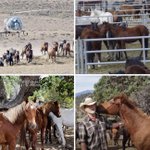
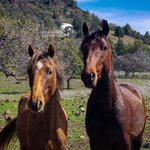
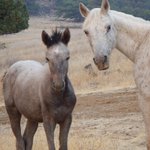
**Which Set Of Pics Do You Think Resembles Protection Of An American Icon—Top Or Bottom?**
The Top Pics Represent The Bureau Of Land Management’s (BLM) Current Wild Horse & Burro Management Program 👎🏻
The Bottom Pics Represent What We Could & Should Have In Place To Protect America’s Iconic Wild Horses & Burros — Wild Horse Fire Brigade’s Rewilding Solution. An Innovative WIN - WIN Solution Protecting The Animals, The Landscapes, & The American People 👍🏻
The Contrast Exposed —>
Roundup / Removals / Pesticides = Treating The Wild Horses As Problematic Liabilities That Cost This Country $145 Million A Year. Only Benefits The Private Interests That Personally Benefit From Wild Horse Removals, In One Way Or Another.
VERSUS
Rewilding = Treating The Wild Horses As The Ecological Assets They Truly Are — Allowing Them To Naturally Graze Down Wildfire Fuels, Decrease CWD Outbreaks, Amongst Many Other Ecological Benefits Worth Well Over $600 Million A Year To This Entire Country!
________________________
KEEP THE WILD IN AMERICA’S WILD HORSES — PLEASE SUPPORT WILD HORSE FIRE BRIGADE’S REWILDING EFFORTS
NO ONE Out There Is More Qualified, Or Devoted To Protecting America’s Last Remaining Wild Free-Roaming Horses & Burros!! 🐴🩷🇺🇸
*photo credits:
TOP pics — BLM;
BOTTOM pics — Michelle Gough from Wild Horse Fire Brigade (WHFB)
#horses #wildlife #wildhorsefirebrigade @realDonaldTrump @realRFKJr @DougBurgum


Tirza Eden retweeted
The True Study of Wild Horses is achieved via the 'Goodall Method'... Not by snapshot observations of transect.
A transect is a line or strip you lay across habitat and sample along it — counts, tracks, plants, dung, GPS points — so the sample is systematic instead of “whatever we happened to see.”
A two-week transect is that method run for about 14 days: walk or ride the same lines (or a grid of them), record what is on or near the line, then leave. It is a short, scheduled field burst, not a residence.
In wildlife work it is used to get a snapshot: how many animals crossed here, what forage is up, where pellets or beds are. Repeat the same lines later and you can compare seasons. It is cheap, repeatable, and publishable.
What it is not (few examples):
*living with the animals
*night after night on the same ground
*watching who foals to whom, foals born on the land
*who stands sentry
* Forensics - Who got eaten and why
*how a band relocates after dark
A two-week transect answers “what was on this line in this fortnight.” It does not answer “what this herd does when no one is visiting.”
That is why field ecology treats it as a sample, not as an ethology.
The 12-year ongoing study (no 'off-switch') of wild horses at our wilderness research site in the mountains on the OR-CA border, 'Wild Horse Ranch'.
This is the longest continuous study of free-roaming wild horses (cultural heritage herd of 200 horses) in the wilderness ever done!
pitchstonewaters.com/not-you…
#wildhorses #WildHorseResearch #WildHorseManagement #GoodallMethod #WildHorseEthology #WildHorseBehavioralEcology #WildHorseEcology #WildHorseRanch #WildernessResearch @JaneGoodallInst @KatiWeis @NPR @nprpolitics @npratc @thehorse @thehorsemag @raypaulick @paulickreport @ucdavisvetmed @6666Ranch @6666ranch6rfb @cowboymag


Tirza Eden retweeted
!! ACTION ITEM !! - EVERYONE SEND TO:
President Donald J. Trump (@POTUS @realDonaldTrump)
From: Capt. William E. Simpson II - USMM ret.
Dear Mr. President: THE DEBT IS DUE - Loyalty to the Horses That Built America - America's Wild Horses
Managed Genocide ('AML') via roundups and sterilization is not loyalty or protection under the 1971 Act to protect them.
Every living American who can name a family line can, if they look back far enough, find a horse in it.
Not a metaphor. A horse.
The wagon that carried a family west. The plow that opened a field. The mount that carried a letter, a rifle, a water pump, a badge.
For five hundred years on this continent, and for millennia before that in Eurasia after North American horses crossed Beringia, horsepower was not a slogan. It was how work moved.
———
THE HORSE FAMILY IS A NORTH AMERICAN ORIGIN STORY
Equids evolved here. They crossed the Bering land bridge more than once.
Late Pleistocene horses in Alaska and the Yukon were related to Eurasian populations and moved both ways between 50,000 and 13,000 years ago. Deeply divergent lineages lived north and south of the ice.
That is not a BLM pamphlet. That is the genome.
The conventional, and now obsolete, Government agency line is that those horses then vanished from their natal continent about 10,000 years ago and only returned with the Spanish.
That line is not a closed book. It is a management story.
Environmental DNA from Yukon permafrost has been reported at a dated level corresponding to roughly 5,700 years ago — thousands of years after the supposed extinction.
The 2023 Science paper that mapped early historic horses on the Plains itself notes that environmental DNA suggests horses in arctic zones as late as 5,000 to 6,000 years before present, and that few archaeozoological studies have carefully tested persistence at lower latitudes through the Holocene.
Bones are rare because fossils take a long time to form and because the Holocene record was never systematically hunted for horses after the question was declared solved.
Absence of a bone is not proof of absence.
———
INDIGENOUS KNOWLEDGE NEVER ACCEPTED THE EXTINCTION STORY
Lakota and other nations hold that they had a relationship with the horse from Pleistocene time through contact.
Yvette Running Horse Collin’s 2017 dissertation argued that the Indigenous horse of the Americas survived the ice age and that the Spanish arrival was a reunion, not a first introduction.
Claire Henderson set out the same oral-history case: Dakota and Lakota elders and other nations contend the North American horse survived, that a horse culture existed before Europeans, and that distinct prairie horses were still on the land into the nineteenth century until government roundups destroyed them to keep people on reservations.
Holocene radiocarbon series on Equus have also been published from Mexico.
None of that is an Interior press release. It is the record the agencies bury under a talking point.
Critics have alleged that Interior and BLM have mishandled or destroyed fossil material that does not fit the extinction narrative. That charge is an allegation, not a courtroom finding.
It does not need a verdict for the next fact to stand: the disappearance date is contested, the Holocene gap is real, and managers who have already been caught writing convenient biology should not be trusted to close the book on a genus that originated here.
———
THE PREDATOR LINE WAS WRITTEN TO GREASE AML
The same agencies that sell a clean extinction date told Congress and the public that wild horses have “virtually no natural predators” and a “lack of natural predators.”
Mountain lions take foals. Wolves take foals.
That sentence was written to grease AML, not to describe the mountain.
*An institution that will lie about predation to win a stocking rate is not the referee on whether a lineage died. Liars do not get to certify the science.*
———
WHAT HAPPENED AFTER THE SPANISH HORSES ARRIVED
What is not in dispute is what happened after Spanish horses reached the mainland in the early 1500s. They were larger cavalry animals. They mixed with whatever was already on the land.
Genomics of historic and modern North American horses show strong Iberian affinities, then British blood.
They do not erase the origin of the genus, the Holocene question, or the oral record.
The working horse of America is what followed.
Loyalty does not require a fairy tale. It requires not erasing the descendants before anyone has read what they still carry.
Those descendants built this country. The government is now running a genocide against them for grass and money.
———
THE LABOR RECORD OF A SPECIES
In the 1700s and 1800s the ranch horse was the engine of the Spanish and Mexican north, then of the American cattle trade.
The vaquero system, the long drive, the open range — none of it moves without a horse that can work all day on poor feed and rough ground.
Farmers used the same animal for plow, harvest, and haul.
The U.S. Cavalry rode them. The Pony Express ran them.
Cities ran them under police saddles and in front of steam fire engines, because when a building burned the first water that arrived came behind a horse.
Mounted officers still exist because a horse can go where a cruiser cannot.
That is not nostalgia. That is the labor record of a species.
The industry that got rich on that labor now wants the free-roaming remnant off the public range.
———
THE 1971 ACT NAMED THE DEBT. WHAT FOLLOWED BETRAYED IT.
The 1971 Wild Free-Roaming Horses and Burros Act did not invent that debt. It named it.
Congress called these animals “living symbols of the historic and pioneer spirit of the West.”
The Act did not say they were surplus livestock to be driven to a spreadsheet called Appropriate Management Level.
It said they were to be protected from capture, branding, harassment, and death.
What followed was the opposite of the preamble: helicopter gathers, holding pens, pesticide darts, and a planned shrink.
That is not a policy disagreement. That is statutory betrayal carried out in daylight.
———
AML IS NOT SCIENCE
AML is a political number dressed in range language.
For most herds it sits below the Bureau’s own genetic floor.
Handbook H-4700-1, section 4.4.6.3, says about 150 to 200 animals — 50 effective breeders — is what is recommended to keep loss of genetic variation at 1 percent a generation.
One percent is already a managed decline. AML is often lower than that floor.
The National Academies said in 2013 that how AMLs are set is not transparent and is not grounded in a consistent scientific method.
The 2019 Path Forward, written with the cattle lobby at the table beside national humane groups, proposed to drive the national herd toward that number — on the order of 27,000 horses and burros — by helicopter removal and fertility control on most of what was left.
That is not conservation. That is a kill plan with a press kit.
Finish the reduction first. Read the gene pool never.
———
THE TOOLS ARE NOT WHAT THEY ARE CALLED
ZonaStat-H, the PZP product in the field, is an EPA-registered pesticide, Reg. No. 86833-1.
GonaCon-Equine sits on an EPA label.
Neither is an FDA-approved veterinary vaccine.
Used year after year they decide which mares copy their alleles forward.
Combined with gathers to AML, they are a human breeding program imposed on a population that has not been sequenced.
Marker heterozygosity is not a genome.
Assateague’s published genetics are mitochondrial haplotypes, a handful of microsatellites, and a pedigree.
Neutral markers can look fine after rare alleles are gone.
Calling that “management” is a fraud.
———
WHAT THOSE UNREAD ALLELES MAY STILL HOLD
Dun is the wild-type coat. TBX3 lays pigment on one side of the hair and produces the dorsal stripe, the leg bars, the masks.
non-dun2 is a recent domestic mutation. Dun and non-dun1 are older and sit in ancient horse DNA.
A band that still throws those markings is still carrying the ancestral switch.
Domestication shrank brains in managed mammals; older comparisons put the domestic horse about 14 to 16 percent below Przewalski’s horse in brain mass and endocranial volume.
Horses are treated in the prion literature as unusually resistant; no prion disease has been reported in the horse; residue S167 stabilizes equine prion protein.
That is species-level biology, not a sequenced difference between a free-roaming band and a barn.
The point is the same in every case: the traits people can see in the field have not been catalogued in the animals now being removed.
Colonial Spanish remnants — Pryor, Cerbat, Sulphur, and private mission and tribal lines — are already rare.
The Livestock Conservancy notes that the pure Spanish horse in North America was almost gone by 1950.
Gus Cothran’s work found Iberian markers in a few herds. Most Great Basin horses carry later draft and saddle blood.
That is a reason to sequence what is left, not a reason to finish the deletion.
If splinter populations carried older North American lineages through the Holocene, as oral history and the Yukon eDNA allow, then the unread pool is not only Iberian. It may still hold what the extinction story said was gone.
You cannot know which it is until you sequence the living animals.
Reducing them first is how you make the question unanswerable.
That is gross negligence. When it is done on purpose, it is malfeasance.
———
CATTLE FIRST, NOT SCIENCE FIRST
Nature does not issue a press release when a grazer is removed.
A horse on a mountain eats fine fuel. It does it every day.
That is not a substitute for every other land practice. It is a working animal doing what grazers do.
The same agencies that will spend billions after a fire will not leave the grazer on the ground that would have eaten the ladder fuel.
That is not science first. That is cattle first.
———
THIS IS COMING OUT OF THE WHITE HOUSE
This is not an accident of bureaucracy.
Respectfully Mr. President (President Trump, you put ranching and extractive interests in charge of the land agencies.
Doug Burgum at Interior. Brooke Rollins at Agriculture.
Stevan Pearce, sworn in May 19, 2026, as the 20th Director of the Bureau of Land Management — oilfield operator, former New Mexico congressman, livestock-country politics in the chair that decides who lives on the public range.
The Forest Service sits under Rollins at USDA. BLM sits under Burgum at Interior.
The appointments are not neutral. They put men and women whose political base wants the grass for cattle over the horses that built the ranches.
Call it what it is: greed with a federal badge.
They did not invent AML. They inherited a machine built to treat a living symbol as a stocking rate, and they are running that machine.
They can (and must) stop it until the remaining gene pool is read (sequenced). They have not.
A government that lets a cattle allotment outrank an unread bloodline is not managing wildlife. It is looting a heritage for forage.
———
CALL THE DAMAGE BY ITS NAME
Once the last mare that carries an allele is darted out of breeding, or trucked off the mountain, that allele does not return because a later director feels regret.
That is irreversible. Soft words will not bring it back.
This is a genocide in progress: the planned, official destruction of a culture-bearing lineage so complete that the next generation cannot inherit it.
These horses carried families, armies, police, and fire companies. Their descendants still carry genetics the domestic industry did not keep.
Driving them to AML under the Path Forward, before a genome exists, is the destruction of that lineage in the dark.
DOI, USDA, the Forest Service, and BLM are the operators. The White House named the operators.
———
IF THIS BECOMES THE RULE
What happens if that becomes the rule the rest of the country copies?
If the standard is that a politically useful number outranks an unread inheritance, then every commons is for sale and every living archive is a cost.
The chaos is not only a riot in the street. It is a country that has decided loyalty is optional and theft is policy.
A people that will not keep faith with the animal that built their roads and their farms will not keep faith with much else.
Loyalty is not a feeling. It is the refusal to erase the thing that carried you.
———
THE DUTY IS SIMPLE
Halt the national drive to AML. Halt the Path Forward.
It is not a science plan. It is a removal plan.
SEQUENCE what is left of the free-roaming wild horse herds.
PROTECT the intact cultural-heritage bands that still live in family structure, respect privately-owned herds, including the privately held herd at Wild Horse Ranch — about 200 animals, co-owned and managed by Wild Horse Fire Brigade, William E. Simpson II, and Michelle Gough — because a herd of that size, still breeding, is one of the few collections large enough to hold alleles the agencies have not read.
Use the best science available.
That is not radical. That is the minimum a country owes the horse that brought it here.
Anything less is complicity.
The baby colt 'Scratch' closed a neck wound in about a month with no hospital. The scar is dated September 27, 2026. The allele that did that is not in a database. Remove his line and it leaves with him.
That is the whole argument.
The rest is whether this country still knows what a debt looks like, or whether it has decided that greed is the only law left.
America was made great by virtue of its moral integrity, not based upon a worship of Mammon.
We cannot continue to succeed as a nation if greed is the driver and money is the bottom line.
Trust me when I say, in the last minutes of our lives on this planet, nobody is thinking about how much money they have or didn’t make.
———
REFERENCES
Running Horse Collin Y, et al. Sustainability insights from Late Pleistocene climate change and horse migration patterns. Science. 2025;388(6748):748–755. science.org/doi/10.1126/scie…
Taylor WTT, Running Horse Collin Y, et al. Early dispersal of domestic horses into the Great Plains and northern Rockies. Science. 2023;379(6639):1316–1323. Notes environmental DNA suggesting horses in arctic zones as late as 5,000–6,000 years B.P., and that few studies have tested Holocene persistence at lower latitudes. science.org/doi/10.1126/scie…
Murchie TJ, Monteath AJ, Mahony ME, et al. Collapse of the mammoth-steppe in central Yukon as revealed by ancient environmental DNA. Nature Communications. 2021;12:7120. Horse eDNA reported from a Yukon permafrost horizon dated to roughly 5,700 years ago. doi.org/10.1038/s41467-021-2…
Running Horse Collin Y. The Relationship between the Indigenous Peoples of the Americas and the Horse: Deconstructing a Eurocentric Myth. Ph.D. dissertation, University of Alaska Fairbanks, 2017.
Henderson C. The Aboriginal North American Horse. Dakota/Lakota oral history: Ice Age survival, pre-contact horse culture, and nineteenth-century destruction of prairie horses.
Jass CN, et al. Post-Pleistocene horses (Equus) from Mexico. Holocene radiocarbon series, Rancho Carabanchel, San Luis Potosí.
Cirilli O, et al. Evolution of the Family Equidae, Subfamily Equinae, in North, Central and South America, Eurasia and Africa during the Plio-Pleistocene. Biology. 2022;11(9):1258. doi.org/10.3390/biology11091…
Weinstock J, et al. Evolution, systematics, and phylogeography of Pleistocene horses in the New World. PLoS Biology. 2005;3(8):e241. journals.plos.org/plosbiolog…
Imsland F, et al. Regulatory mutations in TBX3 disrupt asymmetric hair pigmentation that underlies dun camouflage color in horses. Nature Genetics. 2016;48:152–158. nature.com/articles/ng.3475
Balcarcel AM, et al. The mammalian brain under domestication. Journal of Experimental Zoology Part B. 2022;338(8):460–483. doi.org/10.1002/jez.b.23105
Sanchez-Garcia J, Fernandez-Funez P. D159 and S167 are protective residues in the prion protein from dog and horse. Neurobiology of Disease. 2018;119:1–12. doi.org/10.1016/j.nbd.2018.0…
Bureau of Land Management. Wild Horses and Burros Management Handbook H-4700-1 (2010), §4.4.6.3. blm.gov/.../Media_Library_BL…...
Bureau of Land Management. Instruction Memorandum 2009-062, Wild Horse and Burro Genetic Baseline Sampling. blm.gov/policy/im-2009-062
National Research Council. Using Science to Improve the BLM Wild Horse and Burro Program: A Way Forward. 2013. nap.nationalacademies.org/ca…
Wild Free-Roaming Horses and Burros Act of 1971, 16 U.S.C. §§ 1331–1340.
Associated Press. Controversial wild horse plan headed to Senate floor. Sept. 26, 2019. Path Forward. apnews.com/general-news-unit…...
U.S. Environmental Protection Agency. ZonaStat-H, EPA Reg. No. 86833-1.
Bureau of Land Management. Maintaining Range and Herd Health. Agency language: “lack of natural predators.” blm.gov/.../maintaining-rang…
U.S. Department of the Interior. Wild Horses and Burros. Agency language: “virtually no natural predators.” doi.gov/ocl/wild-horses-and-…
The Livestock Conservancy. Colonial Spanish Horse. livestockconservancy.org/col…
Bureau of Land Management. Stevan Pearce, BLM Director, sworn in May 19, 2026. blm.gov/bio/steve-pearce
Eggert LS, et al. Pedigrees and the study of the wild horse population of Assateague Island National Seashore. Journal of Wildlife Management. 2010;74(5):963–973. doi.org/10.2193/2009-231
Field record, Wild Horse Ranch. Scratch, neck laceration late August 2026; scar September 27, 2026. Photographs by William E. Simpson II.
#WildHorses #WildHorseGenocide #PresidentTrump #GROK #StoptheRoundups #NEWS #BREAKINGNEWS #AML #PATHFORWARD #BLM #USFS #DOI #USDA @aos_ksa_ @theNASciences @NatureRevGenet @GeneticsSociety @JaneGoodallInst @USDA_NRCS @SecRollins @SecretaryBurgum @katiehobbs @AZGovEducation @codyreim247 @ElkoDaily @nytimes @seattletimes @latimes @grok @bot @ParisBarns @EpochTimes @cnnbrk @FoxNews @NPR @nprscience @KIEMNews @PBS @OPB @ScienceNews @AP @MichaelJaco9 @ShawnRyan762 @KatiWeis @WestermanAR @RepWesterman @NEWSMAX @NewsmaxScience

WHY AREN’T WE SEEING MORE SUPPORT FOR REWILDING AMERICA’S WILD HORSES WHEN IT COULD SAVE TAX PAYERS & THIS COUNTRY $100’s OF MILLIONS EVERY YEAR??
Learn More About Wild Horse Fire Brigade’s Rewilding Solution — A REAL WIN-WIN! #savewildhorses #wildfires #truthsocial @DougBurgum @realDonaldTrump
facebook.com/share/p/1JBpz53…
Tirza Eden retweeted
BREAKING NEWS! Redwood News - Treasured-Protected American Wild Horses Slaughtered Under BLM Management!
News Story Just Out! youtube.com/watch?v=CTd1RgbZ…
#WildHorses #WildHorseSlaughter #NEWS #BreakingNews #NewYorkTimes #BLMHorseSlaughter #StoptheRoundup #StopRoundups #GROK #WildHorseFireBrigade #WHFB #PZPkills #WilliameSimpsonII #RedwoodNews #LaurenBrenner #WildHorse #WildHorseConservation @ShawnRyan762 @ShawnRyanShow @SRS_Producer @TuckerCarlson @joerogan @joeroganhq @MichaelJaco9 @ScottMcKayQ @nytopinion @washingtonpost @PostOpinions @SecKennedy @realDonaldTrump @DonaldJTrumpJr @IvankaTrump @EricTrump

Tirza Eden retweeted
ANYONE with a functioning set if eyes and a brainstem can see that Sterilizing wild horses (been going on for decades) DOES NOT STOP ROUNDUPS. Many of the horses heading to slaughter are sterilized with PZP and/or GonaCon.
PZP promoters are simply misinformed or are part of the Sterilization Cult, which peer reviewed published science states damages the genetic diversity of wild horses, and causes a HOST of ethological issues and triggers autoimmune diseases in wild horses. People who are selling PZP are totally misinformed and sterilizing horses helps the BLM's planned extermination.
In closing, here is a song written by America's leading wild horse researcher, William E. Simpson II
youtube.com/watch?v=sWBdiMRf…
#WildHorses #PZPCult #SterilizationCult #TruthMatters #PZPlies #StopTheGrift #PZPGrifters @azritnede

Tirza Eden retweeted
Yes, "highly successful" at causing Genetic Collapse and Loss of Genetic Diversity among other serious side effects... Grifters selling snake oil (PZP) that have never stopped a roundup, but PZP certainly makes these Grifters a lot of Money!
YOU must be part of the Sterilization Cult! #WildHorses #PZP #PZPkills @grok @azritnede
facebook.com/share/p/1DEJspp…
FEDERAL AGENCIES WEAPONIZING YEAR ROUND GRAZING AGAINST PROTECTED WILDLIFE “COMPONENTS” — WILD FREE-ROAMING EQUINES @RobertKennedyJr @DOGE_BLM #savewildhorses #wildfiremitigation #rewilding

Tirza Eden retweeted
facebook.com/share/1GD9mqyDa…
GONACON EQUINE AND ZONASTAT-H EPA REGISTERED PESTICIDES ARE POTENTIALLY SELECTIVELY BREEDING FOR TB SUSCEPTIBILITY IN WILDLIFE, CREATING AN UNACCEPTABLE BIOSECURITY RISK! **FDA CITIZENS PETITION ATTACHED TO HALT THEIR USE FOR FURTHER TESTING FOR THIS** #savewildhorses #savewildlife #congress #biosecurityrisks

A new proposed Bill that could save our iconic wild horses, as well as saving human lives from toxic wildfire smoke that costs 35,000 Americans their lives prematurely every year. PLEASE SHARE!🙏🏻 #savewildhorses #savewildlife #wildfires #CWDprevention #rewilding
facebook.com/share/p/1AJoVan…
Tirza Eden retweeted

Today @USDA @SecRollins and I secured a major win for animal welfare.
Ridglan Farms will transfer its remaining 475 beagles out of a research breeding facility and into the care of a no-kill rescue, where they can begin the path to adoption.
Thank you, @LaraLeaTrump, for championing this issue.
We are also launching a new @NIH office, ORIVA, to speed the transition away from animal testing and toward modern, human-based science.
We will keep fighting for humane treatment of animals, better science, and accountability.
facebook.com/share/1GD9mqyDa…
GONACON EQUINE AND ZONASTAT-H EPA REGISTERED PESTICIDES ARE POTENTIALLY SELECTIVELY BREEDING FOR TB SUSCEPTIBILITY IN WILDLIFE, CREATING AN UNACCEPTABLE BIOSECURITY RISK! **FDA CITIZENS PETITION ATTACHED TO HALT THEIR USE FOR FURTHER TESTING FOR THIS** #savewildhorses #savewildlife #congress #biosecurityrisks
Tirza Eden retweeted
facebook.com/share/p/18VaUR7… LETTER TO SEND TO YOUR REPS RE: Bureau of Land Management’s WILD HORSE and BURRO PROGRAM MISMANAGEMENT— #wildhorses #congress #savewildhorses #truthrevealed #stopblm

Tirza Eden retweeted
facebook.com/share/18Z66jJi4… WHAT EVERY WILD HORSE AND BURRO ADVOCATE NEEDS TO KNOW ABOUT FREUNDS COMPLETE ADJUVANT (FCA, mFCA, Adjuvac) —FOUND WITHIN THE EPA REGISTERED PESTICIDES ZONASTAT-H/PZP AND GONACON-EQUINE FORMULAS. Why is the federal gov okay with giving our wildlife a disease that mimics TB? #savewildhorses #Congress #TruthPrevails

facebook.com/share/1AFdZVPHM…
ARE FERTILITY CONTROL FORMULAS (ZonaStat-H/PZP & GonaCon-Equine) SETTING WILD HORSES AND BURROS UP TO BE SCAPEGOATED BY RANCHERS AS SOURCES OF TB TESTING INTERFERENCE CONFLICT? How does something known to cause a disease like state that mimics TB find its way into wildlife fertility control formulas? #savewildhorses #stopanimalresearch #wildlife
