

Power Markets at Modo Energy
Brooklyn, NY
Joined May 2024
- Tweets190
- Following94
- Followers455
- Likes217

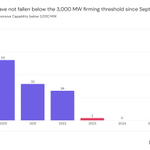






ERCOT's firming requirements take effect from 2028 for new generators with IAs signed from 2027.
Initial cost should be small with few resources obligated, but it will become a structural cost for new generation if low reserve margins return and the obligated pool grows

1/ Some volatility returned to ERCOT's Real-Time Market this week.
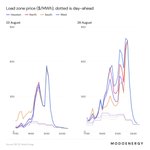
Settlement prices peaked at $561/MWh on August 23 and $781/MWh on August 26, were in the mid-triple digit range for multiple hours each day, and settled above day-ahead in nearly every interval.

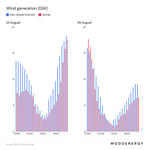
4/ What was specific to the 23rd was thermal outages. Dispatchable capacity on outage for that evening rose 3 GW after the day-ahead market closed, from 8 to 11 GW.
ERCOT's 90th percentile expectation for August is just 8.5 GW, and their modeled maximum is 11.7 GW.


4/ What was specific to the 23rd was thermal outages. Dispatchable capacity on outage for that evening rose 3 GW after the day-ahead market closed, from 8 to 11 GW.
ERCOT's 90th percentile expectation for August is just 8.5 GW, and their modeled maximum is 11.7 GW.


It's a highly uncertain time in US power markets, and policy noise has made FTM grid-scale BESS harder and pricier to develop lately. But the long-run signal is intact: Li-ion pack prices have fallen from $1,200/kWh in 2010 to about $108 today.
🧵

But BESS development isn't the only variable in flux in power markets. Demand is moving too, even though headline load forecasts look inflated (as supported by Gov. Abbott's letter to the PUCT and ERCOT this week, New York's data center moratorium and PJM market design uncertainty). Despite headwinds for load growth, our ERCOT projection still indicates ~25% growth in observed peak demand by 2030, which is staggering for a grid operator.


The biggest talking point out of ERCOT this week is load, which set a new all-time peak yesterday above 91 GW.
More impressive is that it peaked on a day with relatively low wind generation, and operationally, it was essentially a non-event.
A couple of years ago, a day like this would have been a four-figure price day. The difference is batteries.


