




"Efficiency," as every libertarian knows, is when a statist command economy subsidizes its producers and manipulates its currency enough to underprice competitors burdened by the need to generate a market return, building enough capacity in the process to satisfy 100% of global demand for advanced manufactured goods. Of course we must accept those goods duty-free - doing anything else would be socialism. I think I read that in Hayek.
Back in reality, China's global trade surplus is growing *because* we're tariffing them. Our tariffs put pressure on Chinese producers, which employ Chinese consumers. Producer stress is consumer stress, which means the Chinese domestic market ends up generating less and less demand. Producers can only survive by increasing exports to make up for anemic domestic consumption. But the US market is no longer available to them - so they have to flood everyone else.
If a tidal wave of Chinese imports were so efficient, they would unlock growth in receiving countries who would count their blessings and laugh at our mistake. Nope - other countries are freaking out about the deindustrialization these imports are unleashing. They're following our lead by rushing to develop their own tariffs on China. Now that US tariffs have redirected the fire hose of Chinese exports toward everyone else, a natural anti-China trade bloc is forming because of the impact of these distorted, subsidized exports. Maybe the Cato people can let the Europeans know they're making a big mistake. I'm sure there's an Adam Smith quote that covers this.
At root, the libertarian error is to see free trade with China as capitalism and tariffs as socialism. It's exactly the opposite. Importing Chinese goods means importing their subsidies, their currency manipulation, and their industrial policy, letting these distortions determine prices in our country. Tariffs preserve our capitalist system by ensuring that prices reflect free competition between firms rather than Beijing's decision to subsidize a strategic industry. The real socialists are the ones who want a socialist state to determine who wins and who loses in the American economy.

Once you grant that we need to tariff China, it follows that we need to tariff the world. China can transship and set up factories in any country it wants. Tariffing China and leaving every other country open just incentivizes China to route its exports through third countries. It's a losing game of whack-a-mole.
No China tariff policy makes sense without also tariffing every other country that trades freely with China. But this is still a disreputable view, much like China tariffs were in 2016-2020. Respectable intellectuals still feel that they need to keep their distance from the full-bore Trump trade policy, but my guess is that they'll end up belatedly signing on to global tariffs in a year or two - just as they did with the China tariffs.

Libertarians absolutely outraged that the U.S. is still discernible on this map in 2025, obviously the correct free market outcome is the world gets subsumed into an enormous China blob and we assume our natural Ricardian comparative advantage position as one of the little stick figures

Complete nonsense from the FT. You can't innovate if your firms are drowning under a wave of subsidized Chinese exports. There's no margin to invest in that scenario, which is exactly why China does it.

Yeah ok everyone’s mad about this but does it replicate


Free trade economists have assured me that getting a massive spike in Chinese imports should be a huge win for the receiving countries. After all, imports are the real reward of international trade and trade deficits are no different than having a deficit with your grocery store. If China wants to subsidize cheap imports, countries should take the money and say thank you.
So that’s what we should expect. Everyone will enjoy all their new benefits and say thank you to China. Under airtight free trade doctrine, these countries won the trade lottery. What would they have to complain about? Will monitor the situation and report back.

China's trade surplus is going vertical. The reason is its exports to everywhere outside the US (blue), which are rising massively. This means 2 things: (i) China is doubling down on exports; (ii) it's furiously trying to cut its dependence on the US...
robinjbrooks.substack.com/p/…

Sure. Our domestic policy is to tax subsidized imports that have nowhere else to go, our Iran policy is to blockade exports that Iran can’t afford to lose. Next

"Regardless, reporters should ask Trump and Bessent how the same tactics meant to “liberate” the US economy can “asphyxiate” Iran’s. Inquiring economists would love to know." thedailyeconomy.org/article/… via @aier

Just a little more migration. It’s the secret to growth. There’s trillion dollar bills on the sidewalk. Growth is right around the corner we just haven’t done enough migration. Please I promise

The funny thing about this is screens actually do have a plausible corporate villain, instead they’re going with “capitalists are hiding all the books”

Everyone blames screens for the decline of reading.
Nobody blames the consolidated corporate publishing industry that made books pricier, more generic, and harder to find. jacobin.com/2026/10/books-pu…

Seeing this being reposted a lot, the headline makes it sound like the layoffs are happening in Ohio. They’re not. They’re happening Canada.

US-owned steel plant with a plant in Middletown OH begins mass layoffs amid Trump tariffs:
In a memo sent by Cleveland-Cliffs to workers, the company explicitly linked the move to Trump's steel tariffs on Canada, which it said had "significantly shrunk the market" for its products.
yahoo.com/news/us/articles/u…

Readers added context they thought people might want to know
Cleveland-Cliffs' layoffs (up to 500 workers) are at its Stelco plant in Hamilton, Ontario, Canada, due to US tariffs on Canadian steel imports. Its Middletown, Ohio plant has no such layoffs and is receiving a $1B upgrade investment.
newsweek.com/us-owned-canad…
manufacturingdive.com/news/cleveland…
Free enterprise is when your cost structure has to beat subsidies from the People’s Republic of China as a condition for remaining in business

🚨NEW TODAY🚨
@CatoInstitute is launching Restoring Free Enterprise (@Cato_RFE): a multiyear, multimedia project to analyze the federal government's new & unprecedented ownership of private US firms - and to push for these deals to be unwound ASAP:
cato.org/restoring-free-ente… /1

You posted a screenshot of the Sopranos Columbus Day episode? On actual Columbus Day? You changed the subtitles to reference something topical? You riffed on the reference? Incredible dude
Modernists can never just prefer modernism. They have to elevate modernism into a moral triumph, the victory of truth over fakery and pastiche, and deny the basic legitimacy of building in classical styles

Every classical free trade theorist since Adam Smith has recognized that national security is an exception to free trade. When that meant something like “don’t buy grain from the Soviet Union,” it didn’t imply much of a limitation on the trading system.
Today, China has managed to build an unbelievably powerful industrial system that sets the market clearing price for the world’s most important tradable goods. Because that price reflects enormous Chinese state subsidies, firms that need to make a market return can’t compete and get wiped out. Free trade with China therefore means losing your industrial base, an unacceptable national security threat.
You’d think that free trade people would say “aha! We must protect our capitalist pricing system and our national security by excluding subsidized Chinese goods from our market. Just as Smith foresaw.”
Nope. Rather than accept that classical free trade theory would imply a significant constraint on free trade as practiced today, they deny reality by denying the existence of the constraint. They minimize the threat posed by China, they pretend that comparative advantage still applies, they refer to the “China Shock hoax,” they describe accurate threat assessments as “warmongering,” etc. etc.
The truth is that a major threat to national security will demand a major revision to free trade. But if your real loyalty is to free trade as a doctrine rather than to America as a nation, you’ll deny that this is necessary and sacrifice the country to save your theory.


Other countries are writing the rules of the 21st century economy while we sit on the sidelines

Ottawa negotiating deal with Angola as trade diversification efforts expand
theglobeandmail.com/world/ar…

Liberation Day did more than any previous measure, by far, to address Chinese industrial overcapacity.
Blocking Chinese exports diverted a large share of those goods to Europe and Asia. Ordinarily, European and Asian producers would offload the pressure from new Chinese competition by simply increasing exports to the US. But because we tariffed European and Asian exports as well, that option wasn't available. The US wasn't able to serve as the consumer of last resort and balance everyone else's imbalances.
Instead, these countries are forced to deal with Chinese exports by tariffing China instead of offloading the imbalance to the US. They don't want to do this because of the risk of Chinese retaliation, but the alternative - steady deindustrialization under a firehose of subsidized Chinese exports - is even more unattractive.
Liberation Day forced that choice. Before, "addressing Chinese overcapacity" basically amounted to holding conferences and asking the Chinese nicely to increase consumption. That failed - no one had an incentive to actually do anything painful to China. But now that countries have real skin in the game and risk deindustrialization if China's behavior continues, they're finally willing to act instead of talk.
The immigration analogy would be to border state governors that started shipping illegal migrants to Martha's Vinyard and inland blue states to give them a taste of what they were dealing with during the Biden open border era. The US was on the front lines of the Chinese export monster for decades. Now that everyone else is getting a taste, everyone else is finally starting to act.

Blowing up green cards and putting $100,000 fees on H-1Bs and students is going to "fix" high skilled immigration the same way liberation day fixed Chinese industrial overcapacity.
When your economy is dependent on exports, you’re vulnerable. You depend on the goodwill of others to keep receiving your goods. Importers like the U.S. end up holding the cards, which is why there’s been less retaliation than expected on U.S. tariffs.
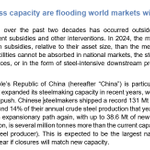
Germany is now experiencing this vulnerability. Its domestic market is being flooded by subsidized Chinese goods, but Germany struggles to get buy-in on a response because German industrial producers are themselves uniquely export-dependent. For them, European tariffs on China are an unacceptable risk because it could lead to Chinese retaliation on their exports. So they’re opposing Europe’s effort to protect its market - see the below paper.
The result is European paralysis. Its industrial giants, weakened by Chinese competition at home, become more desperate to hang onto the slice of the Chinese market they still have. They fear the pain of Chinese retaliation and hope they can simply negotiate for relief from Chinese exports.
They can’t. China exports out of economic necessity. The longer Europe waits to block these exports, the weaker its firms become and the harder it will be to recover. Better to accept the short-term risk of retaliation than remain frogs in boiling water, facing the certainty of steady deindustrialization.
As vulnerable as Germany is, China is walking on a razor’s edge. When China’s trade partners decide they are no longer willing to accept massive volumes of subsidized goods, its economic model will collapse. Despite Europe’s cross-cutting incentives, we can all see that that day is getting closer.

