

Software house for your blockchain solutions. Free knowledge and statistics on X. Educating, not giving financial advice.
Joined August 2025
- Tweets4.4K
- Following14
- Followers812
- Likes2.6K







Pinned Tweet
In crypto UX, one simple goal often requires too many tools.
Check prices in one app.
Stake in another.
Manage payments somewhere else.
Track transactions separately.
Result: users spend more time navigating tools than completing the actual task.
For @orokai_com, we designed the experience as an aggregator that brings essential tools into one place.
One hub = saved time, smoother UX and a more convenient user journey.

What would make crypto easier to use?
0%Better wallets
50%Lower fees
50%Fewer networks
0%Clearer UX
2 votes • 5 daysVehicle history & used-car marketplaces
For dealerships, leasing firms and used-car marketplaces, vehicle history directly affects price.
Mileage.
Repairs.
Accidents.
Ownership.
Inspections.
The problem is that those records come from different companies.
A shared vehicle history can make resale data harder to manipulate and easier to verify.

Binance says a compromised DevOps laptop may have been the entry point for a $6.3B security incident.
Not a broken blockchain.
Not a leaked private key.
A laptop with access to production infrastructure.
Sometimes the weakest part of a billion-dollar system is still the endpoint.
🤖 Made with AI

AI can write Solidity fast.
That does not mean it can design a secure smart contract.
The dangerous bugs usually live in the things the prompt never mentioned.
Edge cases. Incentives. Permission logic. Unexpected interactions.
AI is great for speed.
Security still needs judgment.
For hospitals, labs and healthcare platforms, patient data already exists.
The problem is that it lives across different systems.
Blockchain does not need to store medical records.
It can help verify who created them, who accessed them and whether they were changed.
Keep the data private.
Make the history verifiable.

The easiest way to spot a real blockchain use case:
Multiple companies.
One process.
Different databases.
Too much reconciliation.
Start there.
Not with the chain.
Deutsche Bank is preparing to launch crypto custody within weeks.
Next on the roadmap:
stablecoin transactions,
tokenized deposits,
digital securities.
The interesting part is that the bank does not see this replacing traditional banking.
It sees it becoming another part of banking.
That is probably the more realistic adoption story.

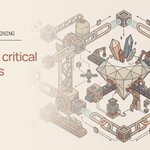
For mining companies, manufacturers and commodity buyers, provenance is becoming increasingly important.
Where did the material come from?
Who processed it?
Did it meet compliance requirements?
A verifiable chain of custody can follow materials from mine to manufacturer.
Not just “where it came from.”
But proof of how it got there.

17% of Visa’s stablecoin-linked card volume now comes from business and commercial programs.
Not retail speculation.
Businesses using stablecoins for settlement, treasury and cross-border payments.
Visa already supports 160+ stablecoin-linked card programs.
The boring use cases are becoming the real ones.

“Sign message”
is worse UX than
“Confirm that you want to log in. This does not move any funds.”
A signature can mean very different things.
The interface should explain what this one actually authorizes.
Dubai is already testing tokenized property ownership.
The real opportunity is not simply turning buildings into tokens. It is connecting ownership records, investor onboarding, payments, compliance checks and registry updates into one reliable workflow.
Done well, tokenization could reduce settlement time, improve access to fractional ownership and give every participant a clearer view of who owns what.

“Gas fee: 0.0038 ETH”
is worse UX than
“This transaction will cost about $9.40”
Protocol-native units are useful to developers.
Users need to understand the consequence in terms they already know.
What will be the first truly mainstream stablecoin use case?
100%B2B payments
0%Payroll
0%Treasury
0%Consumer payments
1 votes • Final resultsFor agricultural marketplaces, lenders and food processors, many producers remain difficult to finance because reliable operating data is limited.
Verified production, delivery and payment records can create a clearer picture of performance.
Blockchain should remain in the background.
For the farmer, the experience should stay simple.

traditional B2B:
“we reconcile at the end of the month”
blockchain:
why wait a month to discover we disagree?
For universities, certification providers and recruitment platforms, credential verification is still too manual.
Verifiable credentials allow institutions to issue a record once and employers to verify it instantly.
The institution issues.
The candidate controls access.
The employer verifies.


Blockchain doesn’t create trust.
It makes trust easier to inspect.
Who approved it?
When?
Under which rules?
Was the record changed?
That’s a much more useful way to think about it than “trustless.”
Cross-border B2B payments remain slow because money, compliance data and accounting records often move through separate systems.
Stablecoin settlement can speed up the transfer itself, but settlement is only one part of the workflow.
Businesses still need treasury controls, transaction monitoring, invoices, ERP integration and reconciliation.
The winning product will hide the blockchain complexity and make international settlement feel like normal financial infrastructure.
