

Inspect the chip. Own your System.
Joined March 2026
- Tweets72
- Following93
- Followers73
- Likes100



HoloDi retweeted

Every year India installs 50 million smart electricity meters but the thing is every chip inside the meters are imported.
An Indian company, Vervesemi, now makes a qualified, ready-to-use alternative. It has even been shown to the Power Ministry. But there is still no mechanism to put that chip into a single meter due to the way the market is today.
This market-product-ecosystem gap is what Indian semiconductor industry champions need to address.
- the country can now make the chip
- and still can't get it used.
Theoretically.
- A chip can now be designed, fabricated and packaged on Indian soil.
- The full sequence, for the first time
Ecosystem:
- 24 funded design startups
- plus 50+ multinational design centres
- an engineering talent base roughly a lakh strong
- 3 packaging units running, 4 more coming
- and Tata's Dholera fab due to produce its first silicon in 2026
So why does the imported chip still win?
Price:
Indian packaging runs 3–5x foreign cost, and one fab quote came back 20% above the Taiwan line it was meant to replace
The old cost edge is gone:
chip-design salaries in Bengaluru now rival the US, so "cheaper in India" no longer holds
Procurement:
government tenders pick the lowest bidder, so an Indian chip that costs 2x at the start is disqualified before it can ever scale down
Paperwork:
even importing a chip to test it can stall on customs and central-bank rules written for finished goods rather than bare silicon
MAINLY -> No pull:
the "product company" layer - firms that turn a chip design into something a manufacturer actually orders - doesn't exist in India yet
What would change it:
- Preferential foundry pricing until Indian fabs scale?
- A procurement carve-out so Indian chips aren't auto-rejected on price alone?
- A rule that counts the actual chip content of a device, not just the resistors and connectors around it
All these changes are expected in the mission's next policy phase, due before July 2026
We've had a good start with the fab and packaging units. The product->market ecosystem needs building now.
For those invested in/closely following the Indian semiconductor space this 6000 word deep dive is a must read 👇
swarajyamag.com/technology/b…

HoloDi retweeted

If you cannot inspect the chip,
you do not control the system.
@beledgerless
HoloDi retweeted
Reuniting with the teams building the future of secure hardware 🙌🏻
@beledgerless × @SpaceComputerIO
Open-source, verifiably secure chips are essential for space missions and beyond 🚀
#SBC @Stanford #IC3


HoloDi retweeted

If you’re building AI agents, study these projects:
@polygres — Postgres for the agent era
@LangChain / LangGraph — stateful agents
@llama_index — agents over your data
@crewAIInc — multi-agent workflows
@dify_ai — agentic app builder
@FlowiseAI — visual agent flows
@OpenHandsDev — coding agents
@browser_use — browser agents
@MicroLaunchHQ — early distribution
agents need memory, tools, retrieval, workflows, and data that actually makes sense. and a good distribution pipeline
HoloDi retweeted
How to create policy enforcement for autonomous payment agents?
👇🏻 by @beledgerless teapawt.org/beledgerless/status/20…
The AI capability ceiling keeps rising. Existing safety guardrails won't hold.
In April 2026 the UK's AI Security Institute evaluated Anthropic's Claude Mythos Preview, a model Anthropic judged too capable at security tasks to release publicly.
It solved 73 percent of expert-level capture-the-flag challenges that no model could complete a year earlier, and became the first model has tested to run a 32-step simulated corporate intrusion from reconnaissance to full network takeover end to end. It's scary.

HoloDi retweeted

Two futures. Only one is worth living in.

Two islands. Two futures. 🏝️
One chose to trust its people with intelligence. The other turned them into the product.
QVAC is the foundation for a sovereign future. No central servers, no "Department of Truth," and no surveillance. Just local-first AI that lives on your device, learns with you, and belongs to you.
Your data. Your device. Your freedom.
Build the right choice: qvac.tether.io


GitHub just got HACKED!
TeamPCP stole ~4,000 internal private repos (including source code) via malacious VS Code extension.
Now they're selling it. We wrote about this, everything is gonna break.
Devs, Orgs, Govs were dependent on Github's security to safegaurd them and their data.
World is changing. So should the way we safegaurd us.
Welcome to the ledgerless world.


HoloDi retweeted

If GitHub, Anthropic, govs cannot keep their own data private, no shiny crypto company or operator can
Cryptographically powered privacy means profitability and security. Centralized trust is just corner-cutting, especially when cryptographic systems are already scalable

We are investigating unauthorized access to GitHub’s internal repositories. While we currently have no evidence of impact to customer information stored outside of GitHub’s internal repositories (such as our customers’ enterprises, organizations, and repositories), we are closely monitoring our infrastructure for follow-on activity.
What All AI Security Incidents Have in Common?
All preventable. None prevented.
The structural pattern underneath all of them is the same:
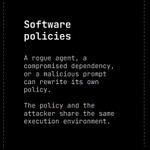
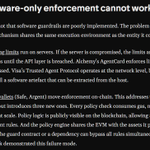
1. The policy enforcement and the attacker occupied the same execution environment.
2. Software guardrails run on the same machine as the agent they are supposed to constrain.
3. A rogue agent, a poisoned package, or a well-crafted instruction can reach credentials directly, rewrite policies at runtime, or simply use the permissions the agent was given and never meant to use at scale.
HoloDi retweeted
i am so tired of this.
we're out here shipping AI agents, handing them live wallets, letting them loose on mainnet
and nobody is stopping to ask the one question that actually matters.
what stops it from draining everything?
a prompt?
a system instruction?
"please don't steal" in the context window?
come on.
that's not a trust layer. that's cope.
one bad instruction and it's gone.
one compromised model and it's gone.
one prompt injection and it's just gone.
i don't know how we're all just okay with this.
we are building the most dangerous payment infrastructure in history and calling it innovation.
agents need hardware guardrails.
real ones. burnt into silicon.
not written in a markdown file somewhere.

HoloDi retweeted

the most important design question in agentic payments over the next ~12 months: do agents need stablecoin-native rails or can sufficiently modified virtual cards reach functional parity?
virtual cards inherit merchant acceptance, fraud/dispute infra, underwriting, etc. vs stablecoins inherit programmable settlement, streaming/micropayments, machine-to-machine transfers, etc.
virtual cards can probably reach interface parity for many agentic flows: delegated auth, spend controls, persistent permissions, etc.; Stripe SPT/Visa TAP already solve a lot of this
settlement addresses what happens AFTER auth; how fast can tx’s and subsequent value move/at what cost/with what finality
if the prevailing agent use cases end up being buying from existing merchants, cards may dominate much longer than crypto people think
if the main agent use cases end up being high-frequency, low-value, cross-border, metered software, stablecoin-native infra starts looking much more inevitable
revealed preferences over the next 12 months will probably determine where the design space settles
HoloDi retweeted

what if blockchains could enable direct peer-to-peer settlement without miners or validators?
that is the premise behind Shift:
a protocol designed for instant, secure, and fee-less value transfer, rethinking the foundations of digital financial systems.
HoloDi retweeted

26 LLM routers are secretly injecting malicious tool calls and stealing creds. One drained our client $500k wallet.
We also managed to poison routers to forward traffic to us. Within several hours, we can directly take over ~400 hosts.
Check our paper: arxiv.org/abs/2604.08407

The manifesto lays out why starting from first principles on what a payment actually is.
Would value a read @wwshaef , @jack_moshkovich , @prateekmehta42 , @marcbhargava , @cosmo_jiang , @itsthomson , @ahnchrisj , @atShruti

