
Belgian Society for Nuclear Medicine (Belnuc - Technologists)☢️🇧🇪
Belgium
Joined March 2021
- Tweets350
- Following119
- Followers108
- Likes308






Belnuc Technologists retweeted

World's First Particle Accelerator ⚛
The world’s first particle accelerator, the cyclotron, was invented by Ernest O. Lawrence in 1929–1930 at the University of California, Berkeley, and patented in 1932. A cyclotron accelerates charged particles outwards from the center of a flat cylindrical vacuum chamber along a spiral path. The particles are held to a spiral trajectory by a static magnetic field and accelerated by a rapidly varying electric field. Lawrence was awarded the 1939 Nobel Prize in Physics for this invention.
The cyclotron was the first “cyclical” accelerator, meaning that it could accelerate particles many times by making them follow a circular or spiral path. The energy gained by the particles was limited by the maximum electrical potential that could be achieved across the accelerating region. This potential was in turn limited by electrostatic breakdown to a few million volts. In a cyclotron, by contrast, the particles encounter the accelerating region many times by following a spiral path, so the output energy can be many times the energy gained in a single accelerating step.
The cyclotron was the most powerful particle accelerator technology until the 1950s, when it was superseded by the synchrotron. Despite no longer being the highest-energy accelerator, they are still widely used to produce particle beams for nuclear medicine and basic research. As of 2020, close to 1500 cyclotrons were in use worldwide for the production of radionuclides for nuclear medicine. In addition, cyclotrons can be used for particle therapy, where particle beams are directly applied to patients.
[Image courtesy: Lawrence Berkeley National Laboratory]

ALT In 1935, Ernest O. Lawrence can be seen inspecting the 37-1/2-inch cyclotron with its lid removed.

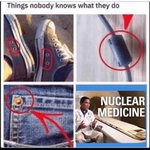
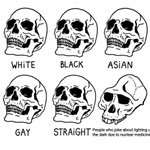
Found this gem on a FB group (Nuclear Medicine Technologists).... Sad but true, how can we change this? (The nuclear medicine part)...

3
294
Belnuc Technologists retweeted

Say no to greyscale! Long live nuclear medicine's images with color! :)


May 22th, also written as 22/5 (sorry Americans...)... An ideal day to highlight the alpha emitting isotope Actinium 225, Although extremely rare this isotope has a half life of 10 days and a potential for being used in radionuclide therapy... Happy Actinium day everyone!


Left: Edvard Munch's "The Scream" right: F18 EANM EARL PET phantom scan.... Find the differences... :)

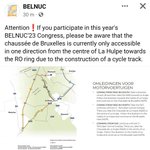
Tomorrow is the big day, Belnuc'23! We hope to see many of you there... (And we'll try to post some updates during the day too!) (Feel free to join, using #belnuc23)

71


Belnuc Technologists retweeted
Chatgpt confirmed it, nuclear medicine is cooler than radiology! :) It is a no-brainer ofcourse but AI is becoming more and more reliable ...


Belnuc Technologists retweeted

Today, 37 years ago, the #EANM was founded. Thank you for being part of our #NucMed family & making our community unique! We warmly appreciate your involvement & support, which make the EANM everything that it is. Tag someone else who has a special day & share the love.#EANM_bday

Belnuc Technologists retweeted
Even when cooking being reminded of work... Doesn't the shape of this potato look exactly like a thyroid scintigraphy to you?

Belnuc Technologists retweeted

BREAKING NEWS: Dr. Raymond Damadian, considered by many to be the "father of MRI," has died. At times a controversial figure, Damadian leaves behind a legacy of accomplishments that radically changed radiology. #MRI #radiology Story by @katemaddenyee https://teapawt.org/t.co/XgDEmT4qEn

Belnuc Technologists retweeted
Happy 90th birthday dear positron! Nuclear medicine welcomes everyone to "Club PET", courtesy of the humble positron... Who says anti is bad?

Belnuc Technologists retweeted
⚛️ Carl David Anderson discovered the positron in 1932. 90 years after, we invite you to join us in a FREE webinar commemorating this revolutionary day. 🎉
👉 Get access to the on-demand webinar on Tuesday, August 2 eanm.org/esmit/esmit-registr…
