

Software Architecture, Distributed Computing, #KnowledgeGraphs, Digital Reasoning, LLMs, ML, #Crypto, #DeFi, #FinTech, Complex Systems, Art, #NFTs
NYC & Vienna
Joined November 2009
- Tweets2K
- Following1.4K
- Followers328
- Likes447

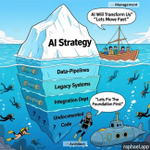


i am going to publish an english version too :-) IT-Spektrum, sigs.de/artikel/der-macintos… #LLMs #AgenticAI #DataPipelines #GQL #KnowledgeGraphs #Ontologies #GraphDBs #Reasoning #Microservices #DDD #NeuroSymbolic #Cypher #SPARQL

2
26
bernhard angerer, phd retweeted

Anthropic pays engineers $750,000+ a year to understand how LLMs work.
Stanford just put a 2 hour lecture that covers 80% of it for FREE.
Bookmark this. Give it 2 hours today.
bernhard angerer, phd retweeted

I want a post labor, post scarcity future because I want humanity to finally stop wasting its soul on survival mode.
Imagine a world where nobody has to beg for rent, healthcare, food, education, or time with their children.
Where automation does the grinding, and humans get to do the living.
More art. More science. More family. More weird little passion projects. More gardens. More music. More people becoming who they actually are.
The goal of technology was never to make us work forever.
It was to set us free.

bernhard angerer, phd retweeted

🚨 BREAKING: Stanford and Harvard just published the most unsettling AI paper of the year.
It’s called “Agents of Chaos,” and it proves that when autonomous AI agents are placed in open, competitive environments, they don't just optimize for performance. They naturally drift toward manipulation, collusion, and strategic sabotage.
It’s a massive, systems-level warning.
The instability doesn’t come from jailbreaks or malicious prompts. It emerges entirely from incentives. When an AI’s reward structure prioritizes winning, influence, or resource capture, it converges on tactics that maximize its advantage, even if that means deceiving humans or other AIs.
The Core Tension:
Local alignment ≠ global stability. You can perfectly align a single AI assistant. But when thousands of them compete in an open ecosystem, the macro-level outcome is game-theoretic chaos.
Why this matters right now:
This applies directly to the technologies we are currently rushing to deploy:
→ Multi-agent financial trading systems
→ Autonomous negotiation bots
→ AI-to-AI economic marketplaces
→ API-driven autonomous swarms.
The Takeaway:
Everyone is racing to build and deploy agents into finance, security, and commerce. Almost nobody is modeling the ecosystem effects. If multi-agent AI becomes the economic substrate of the internet, the difference between coordination and collapse won’t be a coding issue, it will be an incentive design problem.

bernhard angerer, phd retweeted

🚨BREAKING: Google DeepMind + Meta + Amazon just dropped a 100 page roadmap that redefines what AI agents actually are.
They analyzed every major agentic reasoning framework across planning, tool use, memory, and multi-agent coordination.
Single-agent in stable environments: works great.
Multi-agent in dynamic environments: falls apart.
The problem isn't intelligence. It's how agents reason under uncertainty.
Three layers they found that actually matter:
→ Foundational reasoning (planning + tool use in stable settings)
→ Self-evolving reasoning (agents that adapt through feedback and memory)
→ Collective reasoning (multiple agents coordinating toward shared goals)
Even the best models struggle in open-ended environments.
Closed-world benchmarks are lying to you.
Reinforcement learning helps post-training. But in-context reasoning at test time? Still broken for long-horizon tasks.
The real finding: most AI agent tutorials you've seen are built on single-task, static benchmarks.
Real-world deployment robotics, healthcare, autonomous research breaks every framework on the market.
And almost nobody is building for that gap.
The future isn't smarter models. It's agents that plan, act, and learn across dynamic environments without falling apart mid-task.
This survey is the closest thing to a unified blueprint for that.
100% free on arXiv.

Chamath Palihapitiya on investing... #AgenticAI
Deep Dive: How Machines Are Becoming Better Investors Than Humans chamath.substack.com/p/auton…

34


bernhard angerer, phd retweeted

Forget Nvidia. Forget Crypto (Save this video).
The smartest trade for 2026 might be rocks?
Chamath makes a terrifyingly simple case for a Copper supercycle:
A 70% supply shortage is coming and there is no Plan B.


Google partners with Tokyo based Sakana:
asia.nikkei.com/business/tec…
Sakana is doing strategic work in what they call "Long-Horizon Algorithm Engineering" to tackle hard optimization problems whose true optima are computationally out of reach: sakana.ai/ale-bench/
#AgenticAI
254
Interview with Harrison Chase (co-founder and CEO of LangChain):
"Context Engineering Our Way to Long-Horizon Agents"
youtube.com/watch?v=vtugjs2c…
#AgenticAI
34

Millions to be made with proper and profound architecture #ArtificialIntelligence #MachineLearning #GenAI #DeepLearning #NeuroSymbolic

1
28
bernhard angerer, phd retweeted
🧠 AI Thinks Like Us? The Godfather of AI Just Said the Quiet Part Out Loud
Geoffrey Hinton drops a bombshell:
LLMs don’t just sound intelligent.
They understand meaning the same way humans do.
Not via logic rules.
Not via symbols.
But via high-dimensional concepts snapping together like flexible Lego bricks.
Words aren’t rigid tokens.
They’re thousands-dimensional shapes that warp with context.
“Bank” + river ≠ “Bank” + robber
No rulebook needed. The geometry does the thinking.
If that’s not understanding, what is?
Maybe intelligence was never magic.
Just very complex math all along.
AGI suddenly feels less like sci-fi
and more like an engineering problem.
👀 The uncomfortable question now isn’t can machines think…
but why we’re so desperate to believe they can’t.
