

Building apps & testing AI 🤖 Local models • Agents • Automation • AI Video • Game Dev Real experiments. Honest results.
Ireland
Joined October 2026
- Tweets1.7K
- Following1.4K
- Followers1.1K
- Likes2K





Pinned Tweet
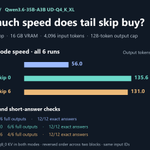
157 output tokens/s on my 16 GB RTX 4090 laptop. That was my fastest full 128-token run with Qwen3.6-35B-A3B on PolyStrata. I put the exact same GGUF through Strata to see how much of that speed held up across 68 requests.
With a 64-token prompt, median decode speed was 144.2 tok/s on PolyStrata vs 43.3 on Strata. After a 4K prompt, it was 143.2 vs 44.6 tok/s. That’s 3.21× the generation speed on the longer prompt. At each length, Strata reached all 128 output tokens on 6/6 attempts and PolyStrata on 5/6. Those medians use the full-length runs.
Reading the prompt gave a different result. At 4K, Strata had a small lead at 1,940 vs 1,852 input tok/s. At 32K, PolyStrata reached 2,917 vs 1,922 input tok/s. That cut my wait for the first token from 17.05 seconds to 11.26.
One result I still can’t explain: two early 4K reads on PolyStrata took 65–70 seconds with synthetic inputs. Its two early 4K reads in the matched text test took 1.57 and 1.60 seconds.
I used the same UD-Q4_K_XL file on an i9-13900HX with 80 GB RAM. Each engine got the same 34 inputs with a 65,536-token context window and zero cached tokens reused. I reversed engine order halfway through.
Strata 0.1.59 used FP32 KV and MTP depth 2, with 3.08 GiB of experts in VRAM at startup. PolyStrata 0.1.45 used q8_0 KV and tail-skip 6, with 11.3 GiB of experts in VRAM. Only 1 of 12 paired generation tests produced identical token sequences. I measured speed and didn’t score answer quality.
#LocalLLM #Qwen #Polystrata #strata

8
43
6,559
Found something interesting while looking for a faster way to run Inkling 2 Mini locally.
NInfer-all reports 140 tok/s on an RTX 4090, against 75 tok/s with llama.cpp.
Same GGUF. Nearly 1.9x the decode speed.
It also has a 16GB GPU benchmark at 72 tok/s using pinned system RAM for the experts.
I will be Benchmarking it soon

7
10
519
NInfer-all:
github.com/iamwavecut/ninfer…
Inkling 2 Mini benchmark methodology:
github.com/iamwavecut/ninfer…
Inkling 2 Mini model and supported quantizations:
github.com/iamwavecut/ninfer…

47
Inkling 2 Mini reached about 82 decode tok/s in my PolyStrata test. The setting behind that number needs a caveat.
I ran UD-Q4_K_XL on my RTX 4090 Laptop GPU with a 13,714-token cold prompt, 32K context, FP8 KV, high reasoning, drafting off and a 256-token output cap. Every capped run ended incomplete; I did not score answer quality.
Maya 1.1.74 with IK2_CPU=1: cold 2,372.4 prefill / 57.2 decode tok/s, 5.853s TTFT. Cached follow-up: 115.4 / 57.4 tok/s and 0.331s TTFT.
PolyStrata 0.1.66 setup: cold 1,547.2 / 25.8 tok/s and 9.009s TTFT; cached 87.6 / 41.7 tok/s and 0.523s TTFT.
With PolyStrata --expert-swaps 0, two pairs measured 81.9–82.4 cold and 80.1–82.4 cached decode. Cold TTFT ranged 8.809–11.809s; cached TTFT was 0.262–0.275s. Cold prefill median was 1,365 tok/s.
PolyStrata's release notes flag a fidelity tradeoff: 95.70% next-token agreement with swaps off versus 98.05% with its small-card setup in their test. I treat ~82 tok/s as a speed result until this exact setup has a quality check. Maya's stored-response continuation reused 13,969 of 14,001 cached-call tokens; PolyStrata's stateless Responses API replayed the conversation and reused 13,713 of 13,743. The cached calls are close, but not identical.
#LocalLLM #Inkling #PolyStrata

1
6
409
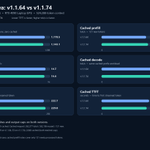
Cache state changed which Project Maya version looked faster in my GLM-5.3-Flash test.
I replayed the same installed Maya-XS pack on my RTX 4090 Laptop GPU in v1.1.64 and v1.1.74. Both runs used the same prompt hashes, 524,288-token context, KV/cache settings and output caps.
On the cold 262,157-token prompt, v1.1.64 was slightly ahead: 1,178.5 vs 1,143.1 prefill tok/s, 14.7 vs 14.4 decode tok/s, and 222.67 vs 229.77 seconds to first token. That is a 7-second TTFT difference on a prompt that took almost four minutes to read.
The cached follow-up flipped the small lead. With 262,156 tokens reused and only 121 new tokens to prefill, v1.1.74 reached 58.9 vs 56.4 prefill tok/s, 16.7 vs 16.1 decode tok/s, and a 2.12 vs 2.23 second TTFT. Both cached generations reached their 2,048-token cap.
There’s a limit to the cold decode comparison: those outputs stopped at 39 tokens on v1.1.64 and 53 on v1.1.74, despite the same 256-token cap. I wouldn’t call that a meaningful decode win from a single short run. The cached outputs did reach their full cap.
One run per version and case; speed only, no answer-quality scoring. The result I’d repeat first is the cold 262K read. #LocalLLM #ProjectMaya

2
3
384
Official Project Maya releases:
v1.1.64 — github.com/mw00/project-maya…
v1.1.74 — github.com/mw00/project-maya…
The same existing GLM-5.3-Flash Maya-XS pack was used for both runs. It’s a local pack and has no public download link. The attached chart separates cold and cached results.

46
Wait, your coding agent can delegate work to another computer?
Pane lets you connect multiple machines, launch coding agents remotely, and keep their work in separate Git worktrees.
Imagine having your main laptop coordinate while your second laptop handles another task.
That's a pretty interesting way to put spare hardware to work.

1
3
173
GitHub: github.com/greenfield-inc/Pa…
Cross-machine workspace documentation: github.com/greenfield-inc/Pa…
Latest release: github.com/greenfield-inc/Pa…
Windows, macOS and Linux builds available.

1
1
34
This is the kind of hardware hacking I love.
Imagine getting my 4090, 3080 20GB and 5070 working together across two laptops. Not just sharing models, actually making better use of all that compute.
Time to investigate 👀
github.com/Cinderella-Man/ho…

Okay, what the heck?! This wasn't supposed to happen! 🤯😱
Every RTX 20 / GTX 16 card ships with a 256 MB "window" into its memory. That's all the CPU or another GPU can see of it at once: a keyhole into several GB of VRAM
I FOUND A HACK that opens the window to cover ALL of the card's memory, 16-32× bigger, at every boot. No flashing, no Linux kernel patches: I just move the GPU's own USB-C controller out of the way🤯
Combined with my earlier RTX 3090/3080 writeup, this unlocks GPU-to-GPU P2P on Turing too: one card writes straight into the other's memory, no detour through system RAM.
I'm literally shaking with excitement. This could open the door to P2P and other low-level hacks on a lot of older Turing cards 🚀
Result: P2P between an RTX 2060 and a GTX 1650 SUPER, two different chips(also previously not tried!). 20× less delay between the GPUs, up to +78% faster data exchange, and as fast as my RTX 3080 pair in the same slots.
What it took:
🔌 Remove the GPU's built-in USB-C + UCSI controllers at boot. They sat in the same PCIe address range and blocked the window from growing
📐 Grow the window with noon-at-cgn's geforce-bar1-resize, big enough for each card's whole memory. Gone at power-off, reapplied at every boot
🔓 Patched NVIDIA driver modules, with P2P switched on per card
🎭 A tiny LD_PRELOAD shim, because CUDA refuses P2P between two different chips even when the driver says yes
✅ Integrity test: 1.3 TB of GPU-to-GPU copies, 0 errors
Full guide (experimental!):
github.com/Cinderella-Man/ho…

2
14
865
You don't need to animate every scene yourself anymore.
This GitHub project turns a topic or script into a complete stickman video workflow: storyboarding, visuals, voiceover, captions, sound effects and rendering.
It works with Codex and Claude Code, with two modes: AI video generation or an agent-driven local rendering pipeline.
15 visual styles, MIT licensed.
Pretty interesting for anyone experimenting with automated content creation.
GitHub: github.com/kaomei/stickman-v…
Installation:
npx skills add kaomei/stickman-video-director --skill directing-stickman-videos
The README includes both workflows, visual examples, setup instructions and the available styles.

1
52
Inkling-2-Mini gave me 2,416.6 prompt tokens/s, then decoded at only 24.6 tokens/s on my 16 GB RTX 4090 laptop. Prefill and generation stress this setup differently.
The 17.6 GB UD-Q4_K_XL file exceeds the roughly 14.7 GB VRAM budget Maya had available. About 64% of the experts were resident on the GPU; the rest were pinned in system RAM. Prompt prefill can batch work. During generation, the model routes each next token through experts and repeatedly needs weights that don’t all fit in VRAM. That puts the offloaded path on the token-by-token decode loop, where transfers over PCIe can become the limiter. Project Maya’s v1.1.74 notes describe this offload path as PCIe-bound.
I tested four profiles on the same 13,714-token cold prompt. IK2_CPU=1 was fastest: 57.2 tok/s cold decode and 57.4 cached, about 2.3× the default’s 24.6/24.5. IK2_SUP=8192 was close at 56.8/57.0. Adding IK2_CPU_LAZY=0 to CPU=1 didn’t improve the cold run.
Caching changed the wait to start, not the generation rate: with CPU=1, TTFT went from 5.853 seconds cold to 0.331 cached, while decode was 57.2/57.4 tok/s. The cached input had 13,969 tokens reused and only 32 new tokens, so its 115.4 prefill tok/s isn’t comparable to the cold 2,372.4.
Each profile got one cold and one cached run, at 32K context with FP8 KV and drafting off. All four outputs used their full 256-token cap on reasoning and stopped before finishing the answer. This is a short throughput test, not a quality result or long stability soak.
#LocalLLM #Inkling #MAYA

3
11
1,136
Model file and Maya notes:
huggingface.co/unsloth/Inkli…
github.com/mw00/project-maya…
Cold / cached decode tok/s:
Default 24.6 / 24.5
IK2_SUP=8192 56.8 / 57.0
IK2_CPU=1 57.2 / 57.4
IK2_CPU=1 + IK2_CPU_LAZY=0 56.2 / 57.4
The attached graphic shows cold and cached rates and the TTFT change.

2
94
GLM-5.4 is operating at the 750B parameter scale, but takes a different route to deeper reasoning: it reuses 28 existing transformer layers twice.
Z.ai says it reaches the intelligence level of 2T–3T parameter models.
It also brings vision to coding, with ambitions spanning games, video, 3D and CAD.
750B is still far beyond local hardware. Really hoping Z.ai eventually brings this architecture to a much smaller Flash model with open weights.

Introducing GLM-5.4: Generalized Coding with Our First Loop Transformer.
- Loops existing layers in the GLM-5 base model for deeper reasoning
- Pushes beyond traditional coding to video, games, 3D shaders, and CAD modeling
- Adds vision capabilities for stronger visual coding
API access will open after safety evaluation. Model weights will be released responsibly.
Tech Blog: z.ai/blog/glm-5.4

3,198 prompt tokens/s on my 16 GB RTX 4090 laptop. I ran 36 requests across two Qwen3.8-Flash-Next checkpoints to see what changed in Strata 0.1.65.
On a fresh 32K prompt, IQ3 cut first-token time from 12.17s to 10.07s. IQ2 had the bigger cached decode gain: 91.4 → 109.4 tok/s.
#LocalAI #Strata #Qwen
5
2
440
4/ Direct resident engine, single request at a time. 524,288 configured context; YaRN ×2, original context 262,144; INT8 KV, 32,768 resident; automatic prefill and expert cache; 2,304 MiB VRAM reserve; 15 pool workers; MTP window 4, confidence 0.5; route tail skip 7. Text-only requests. Temperature 0.6, top-p 0.95, top-k 20.
Each engine handled three alternating pairs of synthetic 7,881- and 32,106-token inputs. A changed first token forced zero reuse on fresh runs. Each 8K response was appended to the next prompt for the cached test. Matched generated token counts on all twelve cached completions. Sampled first answers varied in content and length, so follow-up histories also varied. No fixed sampling seed. Maximum output 256, with normal early stopping. These prompts use constructed token sequences and differ from the previous day's benchmark.
Prefill = newly read tokens / engine-reported prompt time. Decode = generated tokens / engine-reported generation time. TTFT = host time from sending the tokenized request to reading the first output token. Model loading, chat templating, tokenization, HTTP and agent queue time are outside that clock.
Three runs per cell. New engine always ran first; thermals, clocks and power were not controlled. Single laptop, no quality evaluation. Long-context fixed-length decode remains unverified. See runs.csv for per-run times, output lengths, stop reasons, prefix reuse and speculative acceptance.
20
3/ After an 8K turn, cached decode at 256 output tokens: IQ3 101.9 → 106.0 tok/s (+4.0%); IQ2 91.4 → 109.4 tok/s (+19.7%). Cached first token: IQ3 156 → 148 ms; IQ2 163 → 141 ms.

7
2/ Hardware: RTX 4090 Laptop GPU (16 GB), Windows, NVIDIA driver 616.56. Engines: Strata CUDA 13, 0.1.59 (712fec6b4297) and 0.1.65 (26350e4387b8). Each pair used the same model files and settings.
Qwen3.8-Flash-Next GSQ-RCO IQ3_XXS; SC117 GSQ-RCO abliterated IQ2_XS. Separate checkpoints and MTP weights. Compare each row across engines. Route prior: 1.0 for IQ3, 0.5 for IQ2.
Official release: github.com/Niko1221/Strata/r…

3
158
One more and we’re at 1K 🫶
Appreciate everyone I’ve met here. If we haven’t talked yet, say hi and tell me what you’re into.
Let’s connect

18
23
614
64GB on one consumer GPU would be pretty wild for local AI.
But I'm more curious about MUSA support. llama.cpp already has a backend for Moore Threads, so there's at least a starting point.
If Lushan gets proper support, this could get interesting. I just want to see real tokens/sec, memory bandwidth and pricing before getting excited.
#LocalAI

🇨🇳 Is China about to release a consumer GPU with 2x the VRAM of NVIDIA's RTX 5090?
Chinese GPU manufacturer Moore Threads is teasing a new graphics card called Lushan that could break the record for consumer GPU memory capacity.
And the rumored number is 64GB. 👈
For quick comparison ...
🟢 NVIDIA RTX 5090 → 32GB GDDR7
🔴 Moore Threads Lushan → 64GB? 👈👀
Moore Threads previously claimed its next-generation architecture would deliver ...
🚀 4× graphics memory capacity
🚀 64× AI compute performance
🚀 15× AAA gaming performance
🚀 50× ray tracing performance
These are manufacturer-reported generational targets, and not real comparisons against an RTX 5090.
Its previous MTT S80 GPU had 16GB VRAM.
Now a Moore Threads product manager has said that Lushan could offer the largest VRAM capacity ever seen on a consumer graphics card.
Moore Threads already has its own GPU compute platform called MUSA, and llama.cpp has an upstream MUSA backend for existing Moore Threads GPUs.
If Lushan really ships with 64GB and receives compatible inference support, it could potentially run 70B-class quantized models entirely in VRAM on ONE consumer GPU. 👈👀
Of course, we still need to know details on
❓ Actual VRAM capacity
❓ Memory bandwidth
❓ FP4 inference performance
❓ llama.cpp tokens/sec
❓ Price and availability
The card is expected to be discussed at Moore Threads' December 29–30 developer conference.
Would you consider a 64GB Chinese GPU for local AI if the price and inference performance were competitive?
Links in ALT.

ALT https://mthreads.com/news/367 https://www.tomshardware.com/pc-components/gpus/moore-threads-unveils-next-gen-gaming-gpu-with-15x-performance-and-50x-ray-tracing-improvement-ai-gpu-with-claimed-performance-between-hopper-and-blackwell-also-in-the-works https://github.com/ggml-org/llama.cpp/blob/master/docs/build.md https://videocardz.com/newz/moore-threads-teases-new-gpu-with-highest-vram-capacity-on-a-consumer-graphics-card
5
308
Model: Qwen3.6-35B-A3B · UD-Q4_K_XL GGUF
huggingface.co/unsloth/Qwen3…
Strata 0.1.59
github.com/Niko1221/Strata
PolyStrata 0.1.45
github.com/simplexai-labs/Po…

2
231