

grad student || UW || PNSN || earthquake detection & location || dog dad
- Tweets88
- Following377
- Followers81
- Likes752







ALT Two seismic recordings of the most energetic part of the debris flow. The debris flow started closer to the station at the top and eventually travelled downstream, getting closer to the bottom station and increasing the amplitude of the signal. Times are in UTC.





ALT Three people on a rural roadside, two crouched over one standing, look at a battery and seismometer on the ground.

ALT A portable seismometer is placed on the road. There are four more visible up the road in the background.

ALT Three people stand around a box with wires along the side of a road. A seismometer sits in the street.
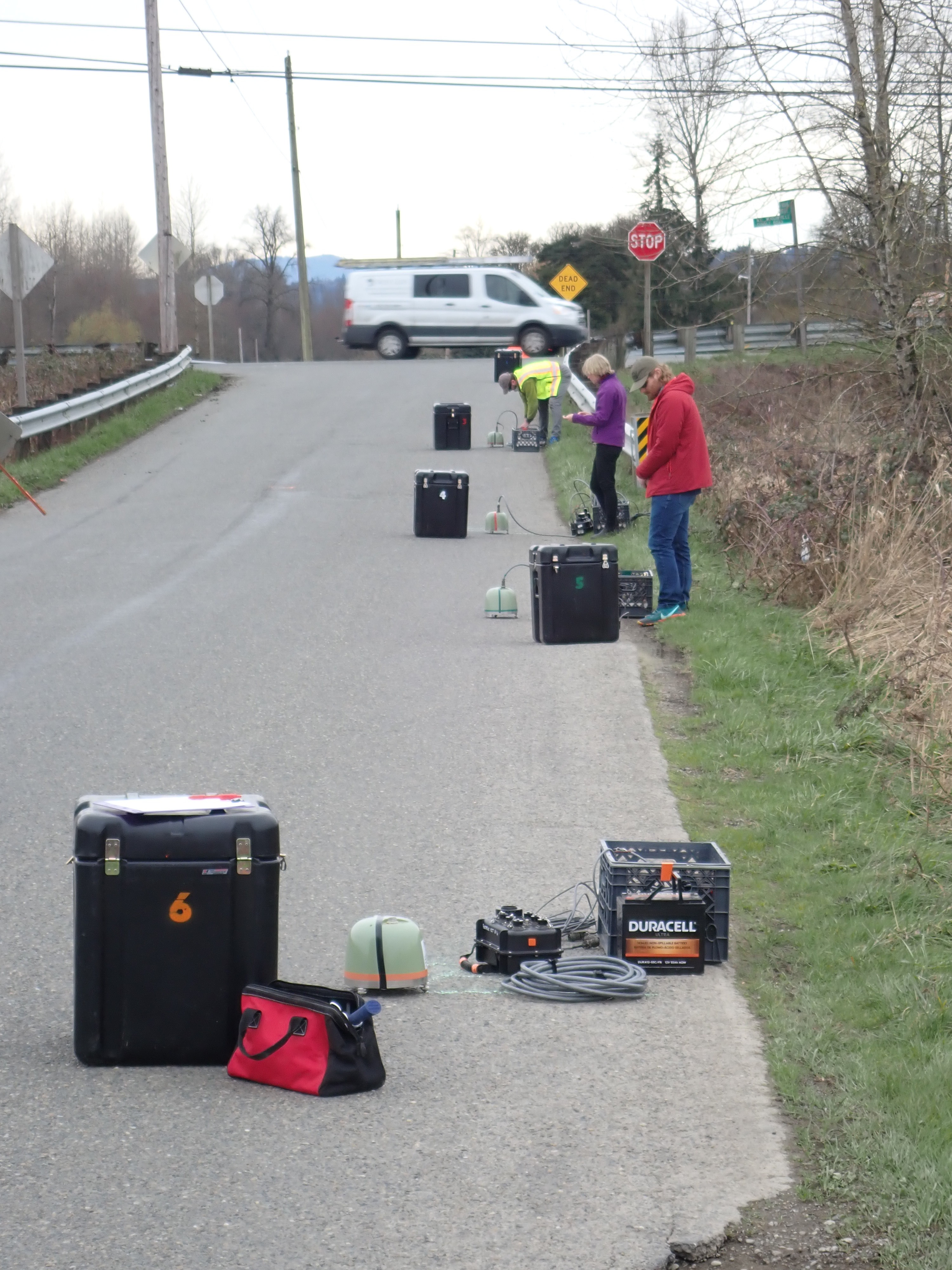
ALT Perspective image of five portable seismometers aligned on the side of a road. The three in the far background have a person standing behind them.


ALT Figure showing subduction zone structures, behaviour and their relationship to hazard. Geometry, roughness and sediment thickness on the incoming plate can impact earthquake occurrence. Rupture of the shallowest (less than ~15 km), updip portion of the megathrust and splay faults is important for tsunamigenesis. Events occurring solely in this region (tsunami earthquakes) can rupture with high amounts of slip, yet are depleted in high-frequency energy (Mentawai event). Seismogenic zone events at intermediate depths (~15–35 km) tend to produce earthquakes with higher-frequency energy (for example, the Iquique aftershock), with deeper events and asperities producing higher stress drops and high-frequency radiation (for example, the Miyagi event). These relatively higher frequencies can be seen in example normalized event waveforms and spectra in panels b and c.