

I'm for individual liberty, limited government, and free markets. Anti-populist. https://xitter.cf/t.co/xfvQudydrM | @bobweeks.bsky.social | “Post-truth is pre-fascism”
Wichita, KS
Joined May 2008
- Tweets36.2K
- Following1.6K
- Followers3.5K
- Likes9.5K
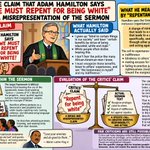



THE CLAIM THAT ADAM HAMILTON SAYS "WE MUST REPENT FOR BEING WHITE" IS A MISREPRESENTATION OF THE SERMON
@KansasGOP | @KansasDems | @RogerMarshallMD | @Hamilton4Kansas
Critics of Adam Hamilton have used his 2020 sermon to claim Hamilton says we must repent for being white. Here is what the transcript actually shows, drawn from the relevant sections.
WHAT HAMILTON ACTUALLY SAID
Hamilton speaks in the first person about his own experience and then generalizes:
- He states that he grew up "blind to certain things in our society" and has "certain benefits by virtue of being educated, white and male."
- He notes that white people often dislike hearing this.
- He contrasts his own lack of fear when stopped by police with the fear commonly experienced by African-American men he knows.
- He concludes that he must recognize those benefits/privileges, listen to others' experiences, and see "the brokenness in myself and my indifference."
- He defines the needed response with the Greek term metanoia (repentance): a change of mind that leads to a change of heart that leads to a change of actions-specifically, seeing the world through other people's eyes and acting against injustice.
The call to repentance is directed at indifference, blindness to others' pain, making excuses for injustice, and failing to practice justice (mishpat), righteousness (tzedakah), and kindness (hesed) toward the marginalized. He applies this to himself first and to the church broadly. He does not say that the mere fact of being white is a sin requiring repentance, nor does he call for people to repent "of being white."
CONTEXT WITHIN THE SERMON
- The larger framework is biblical: Exodus (God hearing the cry of the oppressed), Amos (God wanting "justice-oceans of it"), Micah 6:8, the prophets, Jesus' protest against systems that marginalized people, and the example of Moses.
- Hamilton affirms protests as a democratic and prophetic tool while clearly rejecting riots, looting, violence, and dehumanizing language toward police.
- He describes attending protests, listening, and seeking unity rather than division.
- He criticizes broad-brush statements such as "all cops are bad" and quotes Martin Luther King Jr. on loving enemies and non-cooperation with evil.
EVALUATION OF THE CRITICS' CLAIM
The claim collapses a specific call-to recognize unearned advantages, listen, and repent of indifference or complicity in injustice-into the far broader assertion "repent for being white." That is not what the text says. Hamilton's language is about privileges that often accompany being white (and educated and male) in the American context he is describing, and about the moral responsibility that follows. It is not an ontological claim that whiteness itself is sinful.
Critics can fairly disagree with Hamilton's diagnosis of systemic problems, his emphasis on privilege, or his political and social conclusions. They can argue that his framing is one-sided or insufficiently attentive to other factors. Those are substantive critiques. The specific charge that he teaches people must "repent for being white," however, does not match the words or the structure of the sermon.

THE ART OF THE DEAL: JARED KUSHNER'S HACKED PHONE REVEALED HIS SECRET NEGOTIATIONS-INCLUDING MORE THAN $700 MILLION IN TRANSFERS
One-Sentence Summary: Investigative journalist Matthew Cole alleges that Jared Kushner secretly obtained access to approximately $2 billion in accounts funded by Saudi Arabian and United Arab Emirates leaders while serving as a senior White House adviser, raising serious questions about foreign influence, financial disclosure violations, and potential bribery.
Key Takeaways:
• Dutch intelligence allegedly monitored Kushner's iPhone beginning in early 2018 after discovering evidence of Russian penetration of the device.
• Gulf leaders allegedly provided access to approximately $2 billion across multiple foreign accounts during Kushner's White House tenure.
• Approximately $750 million reportedly entered a UAE account controlled by an Emirati foundation, with Kushner allegedly holding signatory authority.
• Another approximately $1 billion was allegedly placed in an Israeli account, with part of the money reportedly routed through Cyprus.
• Cole alleges the arrangements served diplomatic and political objectives, while one account was reportedly designated for Kushner's personal benefit.
• Kushner's attorneys deny the existence or his knowledge of the alleged accounts and deny wrongdoing.
• The article raises possible disclosure, bribery, and foreign-agent issues but does not establish that any crime occurred.
Article Summary: In an excerpt from his forthcoming book, Princes and Thieves, published by Vanity Fair on October 22, 2026, Matthew Cole describes a clandestine financial network allegedly connecting Jared Kushner, senior Middle Eastern leaders, and billions of dollars in secret bank accounts.
The investigation began with an intelligence discovery. In late 2017, Dutch military intelligence recruited a Russian intelligence operative who provided access to servers containing information stolen by Russian hackers. Investigators discovered screenshots from Kushner's iPhone X.
By early 2018, Dutch intelligence had exploited a vulnerability that enabled agents to monitor Kushner's phone screen. They reportedly observed him accessing a UAE bank account that had received hundreds of millions of dollars through an Azerbaijani bank.
Cole describes two principal accounts:
• Account Alpha: Beginning in 2017, Saudi and Emirati interests allegedly transferred approximately $750 million into an account at First Abu Dhabi Bank. The account was owned by Watani Al Emarat Foundation, a government-funded Emirati charity that sources say also facilitated covert military and intelligence financing. Kushner allegedly possessed signatory authority, although he did not personally own the account.
• Account Beta: By spring 2018, UAE leader Mohamed bin Zayed allegedly arranged approximately $1 billion in transfers through Azerbaijan into an account connected to Israel's central bank. Cole's source characterized the allocation as intended for Kushner's personal benefit. The article alleges that Israeli Prime Minister Benjamin Netanyahu exercised oversight and that Ambassador David Friedman facilitated communications about transactions. Some money reportedly passed through Cyprus.
Cole also describes a third, separate account established to finance possible Israeli military assistance to the UAE during an Iranian attack.
The alleged arrangements developed amid intersecting political ambitions. Saudi leader Mohammed bin Salman sought to consolidate his path to the throne. Mohamed bin Zayed wanted American support for regional priorities, including opposition to the Iran nuclear agreement. Kushner sought a Middle East diplomatic breakthrough that would normalize relations between Israel and Arab governments.
According to Cole, the Gulf leaders initially discussed contributing more than $10 billion to a foreign-policy fund that could also support Trump's political objectives, including his promised border wall. That broader proposal reportedly collapsed, but the smaller financial arrangements proceeded.
The article raises several potential legal issues.
First, as a senior White House adviser with access to classified information, Kushner had financial disclosure obligations. Cole argues that undisclosed foreign bank access could have violated federal reporting requirements.
Second, the alleged arrangements could implicate laws governing foreign influence and bribery if Kushner accepted financial benefits in exchange for using his government position to advance foreign interests.
A former prosecutor involved in the Mueller investigation told Cole that even a promise to advocate for foreign leaders could potentially create criminal exposure if exchanged for financial benefits.
However, important qualifications remain.
Kushner's attorneys categorically denied knowledge of the alleged accounts and maintained that he complied with all applicable laws. Friedman likewise denied knowing about or participating in the purported financial arrangements. Kushner's counsel also stated that his arrangements with foreign officials were approved by President Trump and served American interests.
The article relies heavily on confidential sources and intelligence accounts. It does not reproduce the underlying bank statements, intercepted screenshots, or financial records. Consequently, its detailed allegations should not be confused with independently established findings or proven criminal violations.
The investigation nevertheless poses a significant accountability question: Did a senior American official use undisclosed, foreign-funded financial arrangements while conducting United States diplomacy, and did foreign governments receive favorable treatment in return?
Cole, Matthew. "The Art of the Deal: Jared Kushner's Hacked Phone Revealed His Secret Negotiations-Including More Than $700 Million in Transfers." Vanity Fair, 22 Oct. 2026
COMPARING JOBS GROWTH: BIDEN'S FINAL 19 MONTHS VS. TRUMP'S FIRST 19 MONTHS
Every month, the Bureau of Labor Statistics (BLS) reports how many jobs the U.S. economy added or lost. Six charts below use that data to compare two specific stretches of time: the last 19 months of Joe Biden's term (roughly July 2023 through January 2025) and the first 19 months of Donald Trump's second term (roughly February 2025 through August 2026). Lining these two periods up side by side, month one against month one, is one way to compare the pace of job growth under each.
By both measures shown here - total nonfarm payrolls and private-sector payrolls - job growth was slower in the first 19 months of Trump's second term than in the final 19 months of Biden's term, whether measured by monthly average or cumulative percentage growth. The gap is wider in total jobs than in private-sector jobs alone, which traces back to opposite trends in government employment during the two windows. How much weight to put on that pattern, given the caveats above, is where reasonable people will disagree.


Analysis:
wichitaliberty.org/politics/…

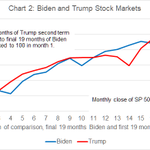
BIDEN VS. TRUMP STOCK MARKETS: WHAT THE CHARTS SHOW
Two charts compare S&P 500 performance under Biden's final 19 months in office against Trump's first 19 months of his second term - one tracking raw index values, the other indexing both stretches to a common starting point of 100 to compare growth rates side by side.


Analysis and explanation:
wichitaliberty.org/economics…


𝗕𝗼𝗯 𝗪𝗲𝗲𝗸𝘀 🇺🇸🗽🇺🇦🙀☕️ 🐾🥬🥡 retweeted

Whoa. Kansans are both less satisfied with the @KansasGOP than the @KansasDems and more dissatisfied with the Kansas GOP than Kansas Dems. This in KANSAS where Dems are less than 1/4 of registered voters! #ksleg
Source: FHSU Docking Institute Kansas Speaks Survey 2026

HAMILTON REVISITS MARSHALL'S INFAMOUS TOWN HALL MOMENT AS VANCE RALLIES GOP
One-Sentence Summary: Democratic U.S. Senate candidate Adam Hamilton visited voters in Oakley, Kansas, where Republican Sen. Roger Marshall abruptly ended a contentious 2025 town hall, highlighting their contrasting approaches to constituents as President Donald Trump and Vice President JD Vance campaign to help Marshall win reelection.
Key Takeaways:
• Hamilton's Oakley appearance intentionally revisited Marshall's controversial March 2025 town hall.
• Marshall left the meeting after facing criticism about Trump and Musk, describing the audience as unusually rude.
• The confrontation occurred in a strongly Republican county where Trump received nearly 85% of the 2024 presidential vote.
• Marshall subsequently characterized town halls as potentially dangerous, an explanation Hamilton has turned into a campaign issue.
• Hamilton's Oakley meeting emphasized listening to ordinary Kansans, including farmers concerned about agricultural policy.
• Political scientist Bob Beatty believes the Oakley incident could become a defining moment if Marshall loses.
• Trump and Vance have personally campaigned for Marshall, demonstrating the national Republican Party's interest in defending his seat.
• The race illustrates competing approaches to campaigning: national partisan mobilization versus direct engagement with constituents.
Best Quotations:
• Roger Marshall: "This is one of the rudest audiences I've ever had."
• Adam Hamilton: "They're good, decent people who want leaders that listen to their concerns."
• Bob Beatty: "A U.S. senator is expected to be able to handle questions in a town hall in Oakley, Kansas."
• JD Vance: "I believe that Kansas has no better friend in Washington than Doc Marshall."
Bayless, Kacen. "Hamilton Revisits Marshall's Infamous Town Hall Moment as Vance Rallies GOP." The Wichita Eagle, 27 Oct. 2026

PUTIN'S STRATEGY IS WORKING
One-Sentence Summary: Michael McFaul argues that President Donald Trump's withdrawal of support for Ukraine and accommodation of Russia are helping Vladimir Putin pursue objectives his military has struggled to achieve, although Ukrainian resilience, European assistance, and U.S. political changes could reverse that advantage.
Key Takeaways:
• McFaul's central argument is that American policy is improving Putin's prospects despite Russia's battlefield difficulties.
• Reduced aid, sanctions relief, and communications disruptions are the principal mechanisms he identifies.
• The article leaves responsibility for Starlink and Starshield disruptions unresolved.
• Ukrainian resistance, European support, and weapons innovation could change the trajectory.
• McFaul's expectations about congressional action and future presidents are forecasts, not established outcomes.
Article Summary: Michael McFaul argues that Vladimir Putin's longstanding cultivation of Donald Trump is producing strategic benefits in Ukraine. In his assessment, reduced American assistance, eased sanctions, and pressure on Ukrainian President Volodymyr Zelensky are increasing Russia's chances of retaining occupied territory and influencing Ukraine's future decisions.
McFaul describes a war whose momentum has repeatedly shifted. Ukraine reversed early Russian advances in 2022 and, he writes, regained momentum in spring 2026 through improved long-range missiles, drones targeting Russian supply routes, and interceptor drones. With Russian ground advances stalled, Putin has intensified attacks on civilians and essential infrastructure, seeking to make Ukrainians pressure their government to capitulate. McFaul identifies expanded ballistic-missile production and faster Geran 5 drones as particularly serious threats heading into winter.
The article traces Putin's relationship with Trump through business connections, Russian interference in the 2016 election, and Trump's public admiration for Putin. McFaul distinguishes attempted electoral influence from proven electoral impact: Russia sought to help Trump, he writes, but whether its activities changed the outcome cannot be established. He also acknowledges that senior national security officials constrained major policy changes during Trump's first administration.
McFaul presents Trump's second term as a more consequential departure. He says Trump ended direct military and economic assistance to Ukraine, while permitting a much smaller flow of American weapons purchased by European governments. Supplies of Patriot interceptors are especially constrained, partly because of their use in the U.S. war with Iran. Trump has also rejected Ukrainian NATO membership and pressured Zelensky over territorial concessions and his continued presidency.
The article describes additional measures benefiting Moscow: relief for Russian diesel exports, suspension of newly enacted sanctions, interruptions in intelligence sharing, and disruptions to Ukraine's Starlink and Starshield communications. McFaul explicitly says responsibility for the communications disruptions remains unclear. He also discusses proposed transactions involving Lukoil assets, Nord Stream 2, and an Alaska liquefied natural gas project, arguing that completed deals could generate revenue for Russia's war.
Nevertheless, McFaul does not regard Russian success as inevitable. Ukrainians remain willing to fight, European governments have supplied substantial support, and Ukrainian companies are developing defenses against new Russian weapons. He argues that Democratic congressional victories could enable investigations, renewed assistance, and stronger sanctions enforcement, although these remain possibilities.
McFaul concludes that Putin's advantage depends heavily on Trump and may diminish as his presidency advances. His recommendation is that Putin negotiate a cease-fire while conditions remain comparatively favorable, rather than assume time will indefinitely strengthen Russia's position.
McFaul, Michael. "Putin's Strategy Is Working." Foreign Affairs, 26 Oct. 2026

𝗕𝗼𝗯 𝗪𝗲𝗲𝗸𝘀 🇺🇸🗽🇺🇦🙀☕️ 🐾🥬🥡 retweeted
You MUST read this brilliant essay by Judge Michael Luttig: “The Final Battle for America’s Democracy”newrepublic.com/article/2151… via @newrepublic

ZELENSKY HAS FIGURED OUT WHY TRUMP LOVES PUTIN
One-Sentence Summary: Max Boot argues that Trump's admiration for wealthy autocrats helps explain his accommodation of Vladimir Putin and renewed pressure on Ukraine, policies Boot says prolong the war and increase Ukrainian suffering.
Article Summary: Max Boot's opinion column traces another deterioration in relations between President Donald Trump and Ukrainian President Volodymyr Zelensky. After Trump's early hostility, Ukraine's mineral-rights agreement with Washington and willingness to accept a reciprocal ceasefire appeared to improve relations. Boot describes supportive remarks from Trump and a September meeting as signs of that temporary rapprochement.
According to the column, the reversal followed an October 9 conversation between Trump and Putin. Trump subsequently announced plans to purchase approximately 36 million barrels of Russian diesel and waived sanctions provisions targeting Moscow. Boot argues that these decisions reward Russia financially while Trump unfairly blames Ukrainian refinery attacks for rising fuel prices, which Boot attributes instead to Trump's war in Iran.
Boot also challenges Trump's statements about American assistance, putting aid at roughly $195 billion rather than $350 billion and stating that Ukraine has received no American Tomahawk missiles. He recounts Ukrainian officials' reports of threats to intelligence sharing and weapons sales, alongside degraded satellite internet service. Responsibility for the internet restrictions remains uncertain in the article, although Boot cites reporting that Musk proposed them and Trump agreed.
Ukraine briefly suspended attacks on Russian oil facilities but resumed them after continued Russian strikes on Ukrainian energy infrastructure.
For Boot, Zelensky's explanation-that Trump admires autocrats and great wealth-is more persuasive than theories of a hidden conspiracy. Boot treats this as an interpretation of Trump's behavior, not a demonstrated motive. He concludes that increased European support has reduced Ukraine's dependence on Washington, but American restrictions can still cost Ukrainian lives and prolong Russia's war.
Boot, Max. "Zelensky Has Figured Out Why Trump Loves Putin." The Washington Post, 19 Oct. 2026

A BILLIONAIRE WANTED A TRUMP PARDON. HIS FAMILY GAVE ALINA HABBA A $50 MILLION DEAL.
One-Sentence Summary
A New York Times investigation reveals that the family of a billionaire seeking a presidential pardon awarded Trump ally and Justice Department adviser Alina Habba a contract worth more than $50 million, raising serious questions about political influence and conflicts of interest after Trump subsequently granted the pardon.
Article Summary
Tyler Pager reports that the family of Venezuelan billionaire banker Julio Herrera Velutini agreed to pay Alina Habba, a former personal attorney to President Donald Trump and a Justice Department adviser, more than $50 million over four years. The arrangement was reached while Herrera was seeking a presidential pardon, which Trump granted weeks after Habba formally began the job. The reporting raises questions about potential influence in the clemency process but does not establish that Habba arranged the pardon or that the payment bought it.
Herrera faced federal felony charges stemming from an alleged scheme to bribe Puerto Rico Governor Wanda Vázquez to remove a banking regulator investigating his institution. In August 2025, Herrera, Vázquez and a former FBI agent involved in the case accepted misdemeanor plea agreements, a result that frustrated prosecutors who had sought stronger penalties. Herrera nevertheless wanted his remaining conviction erased. His attorney, Christopher Kise, who also represented Trump, pursued clemency. Herrera's daughter Isabela donated $3.5 million to a Trump-aligned super PAC.
In late October 2025, Isabela established Concord Partners in Florida, a company whose actual business activities were unclear. Within days, Habba finalized an agreement to serve as its general counsel for $10 million annually plus bonuses, with total guaranteed compensation exceeding $50 million. At the time, she was still serving as U.S. attorney for New Jersey; she subsequently became a special government employee and senior adviser at the Justice Department. She began working for Concord on January 1, 2026. Trump pardoned Herrera, Vázquez and the former FBI agent weeks later, before their scheduled sentencings.
People familiar with the contract told the Times they believed Habba was hired to assist the pardon effort. Habba emphatically denied any involvement and said her outside employment had been disclosed to and vetted by the Justice Department. The department and White House likewise denied that she intervened; the White House said normal pardon review procedures were followed.
Pager situates the episode within a growing business of politically connected intermediaries seeking presidential clemency for wealthy clients. The article also discusses Habba's departure from the New Jersey U.S. attorney position after an adverse judicial ruling, her subsequent marriage to Turkish investor Turhan Mildon, and her separate dispute with Trump ally Richard Grenell. Those details illuminate her access and political relationships, but the reported timeline remains the principal basis for the article's concerns.
Pager, Tyler. "A Billionaire Wanted a Trump Pardon. His Family Gave Alina Habba a $50 Million Deal." The New York Times, 20 Oct. 2026


DOES SUPPORT FROM THE POLITICAL LEFT MEAN ADAM HAMILTON IS NOT A BIBLE-BELIEVING CHRISTIAN?
@KansasGOP | @KansasDems | @RogerMarshallMD | @Hamilton4Kansas
THE CLAIM:
"If Adam Hamilton were truly a Bible-believing Christian, the left would not be supporting him."
ANALYSIS:
This statement makes a claim about Adam Hamilton's religious beliefs based on the political affiliations of his supporters.
The central logical problem is guilt by association. Whether someone is a Bible-believing Christian cannot be established by examining which political groups support that person.
Moreover, "Bible-believing Christian" is not a universally agreed-upon theological category. Christians who regard the Bible as authoritative can disagree substantially about its interpretation, including questions of sexuality, immigration, poverty, abortion, and the relationship between church and state.
WHAT THE EVIDENCE SHOWS:
Hamilton has led the Church of the Resurrection for decades. He describes his theology as "progressive evangelicalism," combining faith in Christ with social justice and compassion.
His congregation includes Republicans, Democrats, and independents. Former Republican Kansas Governor Bill Graves has endorsed him.
Some conservative Christian leaders challenge Hamilton's interpretations of biblical authority, salvation, sexuality, and abortion. Those are substantive theological disagreements, not evidence supplied by the political affiliations of his supporters.
THE IMPORTANT DISTINCTION:
Political affiliation and religious doctrine are different things.
A person can support a political candidate without subscribing to that candidate's theology, just as Christians can disagree politically while sharing fundamental religious beliefs.
A more meaningful evaluation would identify a particular teaching of Hamilton's, examine the relevant biblical passages, and explain why different Christian traditions interpret them differently.
CONCLUSION:
Political support, by itself, cannot settle a theological question.
Whether Adam Hamilton's teachings are consistent with biblical Christianity should be evaluated through his actual teachings and theological arguments, not by identifying who supports his Senate campaign.

DID ADAM HAMILTON TELL CHRISTIANS TO REPENT FOR EATING BEEF?
@KansasGOP | @KansasDems | @RogerMarshallMD | @Hamilton4Kansas
The claim has a factual basis, but it misrepresents what Hamilton actually said. He encouraged Christians to consider changing their diets to reduce greenhouse gas emissions, and he called for repentance over environmentally harmful behavior. However, the evidence does not establish that he specifically characterized eating beef as a sin or demanded that Christians stop eating it.
The controversy originated in a January 27, 2020, sermon titled What Would Jesus Say About Climate Change? It resurfaced during Hamilton's 2026 U.S. Senate campaign against Republican incumbent Roger Marshall.
WHAT HAMILTON ACTUALLY SAID
In the sermon, Hamilton discussed how food production contributes to climate change. Referring to cattle, he said:
"Some of the things that we grow because we like to eat them like cattle end up producing more carbon dioxide than other crops that we could grow or other forms of food that we could have."
Later, discussing ways individuals could reduce greenhouse gas emissions, he suggested:
"Maybe changing your diet so that the things that you eat are requiring less production that creates methane and carbon dioxide."
Still later, Hamilton urged his congregation to reconsider environmentally harmful behavior:
"I'm calling us to repentance."
He explained that repentance involved recognizing one's environmental impact and changing one's behavior. His examples also included reducing fossil fuel consumption, driving more efficient vehicles, properly inflating tires, and planting trees.
The crucial distinction is that Hamilton called for broader environmental responsibility, with dietary changes among several possible actions. He did not expressly command his congregation to repent specifically for eating beef.
HOW THE POLITICAL ACCUSATION DEVELOPED
A 2026 advertisement from the Main Street Fund super PAC combined portions of Hamilton's sermon, placing his comments about cattle emissions close to his call for repentance.
The Kansas City Star investigated the advertisement on August 17, 2026, and documented how the original sermon had been edited. The Associated Press independently reported that the accusation relied on stitching together separate portions of the sermon.
Marshall subsequently repeated the criticism. In a September debate, he accused Hamilton of saying Kansans should repent for eating beef. On October 16, Marshall went further, asserting that Hamilton wanted to shut down the beef industry.
PolitiFact examined that additional accusation on October 20 and found no evidence that Hamilton had advocated shutting down the industry.
IS HAMILTON'S UNDERLYING ENVIRONMENTAL ARGUMENT SCIENTIFICALLY SOUND?
The scientific basis is well established, although Hamilton's wording could have been more precise.
Cattle emit significant amounts of methane through digestion. The Congressional Budget Office reported that cattle accounted for approximately 35% of U.S. agricultural greenhouse gas emissions in 2024. Research also finds that beef production generally generates considerably more greenhouse gas emissions per unit of protein than plant-based alternatives.
However, whether Christians have a religious obligation to reduce beef consumption is a theological and ethical question, not something established by climate science. One can acknowledge beef's environmental impact without concluding that eating it is sinful.
WHAT DOES HAMILTON SAY TODAY?
In an October 2, 2026, interview with Politico's Dasha Burns, Hamilton acknowledged that eating less meat could reduce emissions. But he also stated:
"I eat a lot of meat myself."
He said he would support Kansas's cattle industry and discussed reducing methane emissions through changes in cattle feed. These statements clarify his current position, although they do not erase what he advocated in 2020.
CONCLUSION
The evidence supports three distinctions:
Documented: Hamilton urged Christians to reconsider behavior that contributes to climate change, including potentially changing their diets.
Not established: Hamilton specifically declared eating beef sinful or demanded repentance solely for beef consumption.
Contradicted by his public statements: The broader accusation that he wants to eliminate Kansas's beef industry.
A more accurate description is:
In a 2020 sermon, Adam Hamilton called for repentance over environmentally harmful behavior and suggested dietary changes to reduce greenhouse gas emissions, citing cattle production as one contributor. Political advertisements subsequently combined separate portions of that sermon to suggest he specifically demanded repentance for eating beef.
That formulation preserves the substance of Hamilton's remarks without attributing a more categorical religious command to him than the evidence supports.

"NOT TO MY KNOWLEDGE" AND "YOU'RE A DUMMY": FACT-CHECKING TRUMP'S PRESS GAGGLES, OCT. 19-24, 2026
In six days of Marine One, Air Force One and Palm Beach press scrums, reporters kept pressing President Donald Trump on the same handful of stories, and his answers shifted, dodged or turned into attacks on the questioner. On Ukraine, he defended waiving the new Graham Act sanctions on Russia by saying they would have killed the talks that freed American teacher Stephen Hubbard (released Oct. 21), then called ABC and CNN reporters "stupid" and a "dummy" for asking what Russia got in return. On Starlink, his story moved from "I don't know who it was" to "I wasn't involved" to declining to say whether he called Elon Musk, and finally to confirming he has spoken to Musk about Ukraine but "can't" say what was said. On Iran, he said "we're not negotiating" on Oct. 21 and "they wanna make a deal" on Oct. 24, while saying he might "finish it off" any day. He defended the Vivek Ramaswamy ad featuring Amy Acton's estranged mother across four straight days, even after reporters told him Acton says her stepfather raped her as a child and was indicted in 1978. He said Camp Lejeune water-contamination claimants might not get paid if Republicans "don't do well." And he unveiled a 1% "Fraud Whistleblower Incentive Program" that a reporter noted pays far less than the roughly 15%-30% already available under the 1863 False Claims Act. Along the way, several of his numbers did not hold up: Kansas, Mississippi and Iowa victory margins, a "17 months" with no illegal crossings, a Hormuz oil boast, a 301% Iran inflation rate and "hundreds of thousands" of illicit California votes. Link following.


FACT CHECK: KANSAS WEEK'S 2026 KANSAS 4TH DISTRICT CONGRESSIONAL CANDIDATE FORUM
What did Kansas congressional candidates Ron Estes, Katy Tyndell, and Drew Cranmer get right-and wrong-during the October 23, 2026, PBS Kansas Kansas Week candidate forum? This fact-check examines their statements about inflation, tariffs, health care, Medicaid, federal debt, public broadcasting, and immigration. Using federal economic data, congressional voting records, and independent research, we assess 20 major claims made during the Kansas 4th Congressional District discussion. Link following.

