

Official account for the braidpool decentralized Bitcoin mining software. Decentralize share accounting, payout, and tx selection. https://xitter.cf/t.co/BMk6ZnEfim
Earth
Joined May 2019
- Tweets479
- Following85
- Followers1K
- Likes682






braidpool retweeted

Sharon (@nkatha_kk) is a developer based in Nairobi 🇰🇪, and an alumna of @DadaDevs and @btrust_builders.
She completed the 2026 BOSS Challenge, where she made her first major Bitcoin open-source contribution.
Her grant-funded work focuses on @braidpool's mining infrastructure: strengthening Stratum V1 reliability, addressing gaps in protocol implementation, and improving scalability.
This work helps connect existing mining ⛏️ equipment with decentralized pool software.
Nkatha also helps lead discussions at @BitDevsNBO meetups, supporting learning and knowledge-sharing within the local developer community.


braidpool retweeted
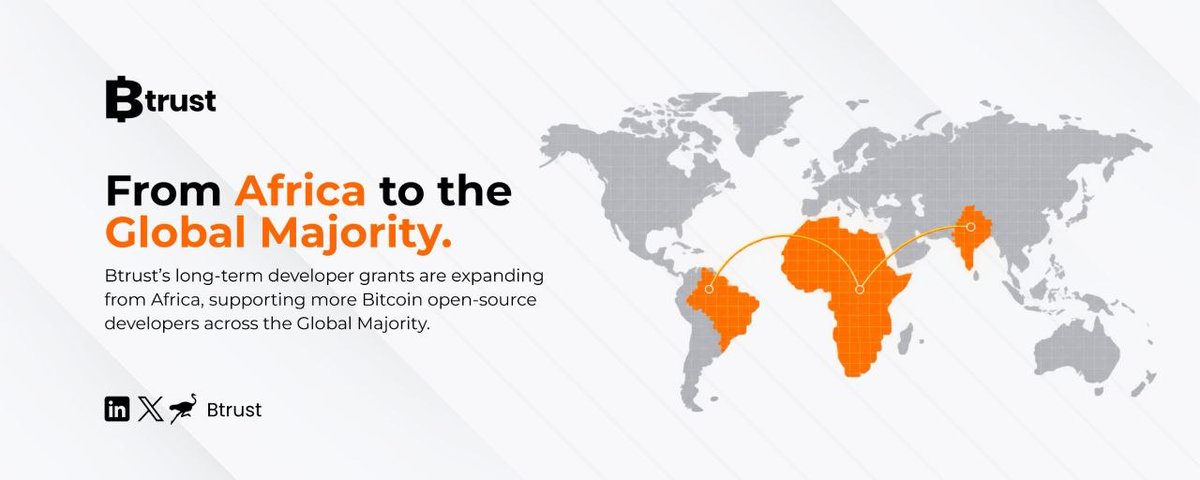
Ansh (@AnshSharma54105) is a developer based in India 🇮🇳 and one of the first developers to receive direct Btrust grant funding outside Africa.
His work focuses on @braidpool, a project developing decentralized Bitcoin mining ⛏️ pool infrastructure.
With the long-term grant, Ansh will focus on performance, scalability, and network resilience, helping Braidpool remain responsive and reliable as participation grows and network conditions change.

braidpool retweeted

Our 2024 alumnus, @braidpool contributor & current @OpenSats/@HRF grantee @zaidmstrr dropping some serious alpha for this year’s cohort on going from a summer internship → long-term contributor → full-time Bitcoin open-source dev.
Alumni pulling the next cohort forward!


braidpool retweeted

This is what a healthy Bitcoin developer ecosystem looks like.
We’re proud to have supported @AnshSharma54105 along his journey, from Bitshala Fellowship and Starter Grant support to now working full-time on @braidpool with @btrustteam’s long-term support.

braidpool retweeted
What happens when you try to make Bitcoin mining software work with every kind of ASIC?
It gets messy. @priyaashuu takes us through 1.5+ years of building @braidpool's miner dashboard, from failed approaches and stubborn Antminer S9 firmware to automatic ASIC discovery with asic-rs.
A real open-source engineering story about hardware, software, and everything that breaks in between.
Read the full article ↓


braidpool retweeted
🟠New article by @AnshSharma54105 on @braidpool is out now! 🚀
We dive into mining decentralization, the mining monopoly problem, and how Braidpool addresses it. We also explores the core mechanics behind the Braid Consensus engine and Braidpool.
Check it out below.⤵️
#Bitcoin #Mining #Braidpool
braidpool retweeted
From Bitshala Fellow to Starter Grant recipient.
@AnshSharma54105 began contributing to @braidpool through the Bitshala Fellowship, and his work quickly stood out.
Later he got upgraded to a Starter Grant to continue building critical infrastructure for decentralised Bitcoin mining.
His current focus includes:
• Implementing decentralized mining pool architecture
• Integrating Stratum V2
• Optimizing consensus and P2P networking
• Building robust testing and validation workflows

braidpool retweeted
This summer we've accepted 2 @summerofbitcoin students, @priyaashuu and @KKinra80406! Priya was a SoB student last summer and has been a steady contributor wrangling our front-end and we look forward to working with @KKinra80406! Look for our launch this year!
braidpool retweeted
We have a side project on AI for this @summerofbitcoin with @Aru__09, @ParthDudhe07, @AnshSharma54105, and @rasesh_shetty. AI-based, automatic transcription of conference talks! Tons of ideas!
Check out the beta: genesis-kb.github.io/
Join the Discord: discord.gg/4fK7aRPTYQ
braidpool retweeted

⛏️ Traditional mining pools rely on a central authority, making co-option possible
@braidpool is a P2P pool where miners collaboratively build blocks without a central operator
HRF supports dev @zaidmstrr to contribute to a more decentralized & transparent mining model
braidpool retweeted

@braidpool just got our "Audit Mode" PR. You'll be able to use Braidpool with an upstream pool like DMND or OCEAN (there are good business reasons for that) and prove to creditors your hashrate.
We can all get along.
braidpool retweeted
.@zaidmstrr is awarded starter grant for @braidpool - decentralized mining pool where miners handle share accounting, payouts & tx selection themselves.
He’ll spend next 6 months hardening reliability, improving coordination logic & advancing scalable, verifiable mining infra!

ALT .@zaidmstrr is awarded starter grant for @braidpool - decentralized mining pool where miners handle share accounting, payouts & tx selection themselves. He’ll spend next 6 months hardening reliability, improving coordination logic & advancing scalable, verifiable mining infra!


Congratulations to Braidpool contributor and @bitshala_org grantee @zaidmstrr on getting his second PR merged into Bitcoin Core!
xitter.cf/KevKevPal/status/19909…
braidpool retweeted

Just dropped a new blog post diving deep into lessons learned from building @braidpool with Rust, Tokio, and async programming. Check it out for insights on async challenges and solutions! #rust #tokio #async
abd-aze.github.io/blog/braid…
braidpool retweeted

🚨Official Solo Satoshi Giveaway🚨
*The New and Improved NerdQaxe++*
🔸 How to Join?!🔸
1. Share 🔁
2. Follow @HomeMiningPod
3. Subscribe youtube.com/@Solo.Satoshi
🌎FREE Worldwide shipping🌍
🚀Winner announced Friday! 🚀


braidpool retweeted

Great thread from Steve Barbour of Upstream Data here on why Ocean does not decentralize Bitcoin mining. He's the guy who pioneered stranded flare gas mining in 2017 by the way (not an appeal to authority, just a legendary fact).
This isn't meant to be an inflammatory post, it's meant to elucidate the nuance of what it means to actually be decentralized in the face of the realistic & tangible threats to Bitcoin's continued growth.
There's nothing wrong on the face of what Ocean is trying to do (I'll even ignore all of their less than savory marketing tactics), but the claims that their work will somehow decentralize Bitcoin mining or improve Bitcoin systemically (other than at some slim margin) is demonstrably false.
Miners are not the enemy in Bitcoin, they are in many respects, highly invested in Bitcoin's success. That's not to say that all miners are good people or have your best interest at heart, that's not how Bitcoin works, it is to say that they have aligned incentive, profit motive, and economic buy in in the form of considerable capital investment.
While it is good (all else being equal) to offer pool contributors the choice of making suggestions for block templates, Ocean is not obligated to comply with those suggestions. Ocean is a centralized entity, with a centralized server client architecture, and a closed source code base.
Ocean could be swayed by a coercive force into behaving a certain way and that could be done without anyone even being aware in the case of a gag order. This is the case of any centralized service with control levers behind the curtain.
It's not inherently bad, but it is inherently true so it's best to have a clear understanding of the full picture. It doesn't do you any good to buy into delusion, even if it's a comfortable one.
One individual company with all the best people in the world is no more resistant to the actual tangible threats (nation state actors) to Bitcoin's security framework than any other pool, nor are they moving the needle as much as many would like to believe.
These are just simple truths and they are not meant to imply that Ocean doesn't have a right to run a pool or that it is not a positive that they are bringing a version of Matt Corrallo's Stratrum V2 to market.
Block templates are really a very small (positive) thing, and not some silver bullet where Ocean is going to single-handedly deliver Bitcoin to the decentralized promised land or whatever their marketing people seem to have convinced the influencer apparatus to consistently chirp.
In order to believe Ocean's narrative that they are going to decentralize mining, you also have to believe the idea that the biggest threat to Bitcoin are the large miners and/or pools themselves, who are just profit motivated actors, rather than nation states who might try to co-opt them.
Bitcoin works because it's incentives work. Nation states are big enough to step in the way of those incentives.
I am not making the case that I think Nation State's are going to co-opt Bitcoin mining, but I am making the case that we should consider they might try.
Bitcoin's design success owes quite a lot to focusing specifically on hardening against Nation State level attacks.

It's a lot easier and more fruitful to get on a spaces or other format to discuss, rather than write a novel here that maybe 3 people might read and we end up talking past each other and missing points... So I'll just reply once and any time you want to discuss I'll do so.
In short, some high level comments:
Your hypothetical scenario only covers censorship by miners chasing profit and completely ignores the actual real threat we need to "decentralize" against - the State.
The incentives already punish profit-seeking miners who censor Txs or censor competing blocks. Pools / miners who censor Txs get paid less (compare Oceans fee revenue with Mara, for example), and self select by Darwin-ing themselves off the network via bankruptcy.
Pools that censor entire blocks (do not build on competing valid blocks) risk losing the block race but also risk losing most of their user's, who may or may not continue with the pool given there's is an implicit expectation to act in good faith of the network with the hash they are entrusted with.
Miners who control enough hash directly to censor other miners and ignore their blocks - they do not need a pool anyway, and Foundry or Ocean would both be at the majority hash's mercy and have no choice but to mine on top of the majority's blocks, or shut off to conserve energy. The network of merchants using bitcoin may not even care in this scenario because in this scenario only blocks are getting censored, there is no Tx censorship, users may or may not care about relatively slower blocks and higher fee congestion.
Regarding the *real* threat that is of actual concern, which you completely ignore here, the State will punish Ocean, or any pool they can identify for that matter, who serves miners stratum work if the pool collectively does not comply with the State's mandate. *Especially* if the pool is profiting off their client's block templates, as Ocean is by charging their clients pooling fees. The State does not care that Ocean's codebase allows a user to select the template, just as they don't care if you were unaware that you operated a server that served your client State secrets for profit. They will shut you down regardless.
Ocean is a white market business and will comply to the letter of the law, or their directors will go to jail. Like most pool servers, Ocean likely also logs IPs and has other info on the hashers connected to it, which is also not ideal and definitely not "decentralizing".
People confuse my criticism for being specific to Ocean, I've been consistently criticizing the client-side block templates ever since the day Matt Carallo proposed it with BetterHash a half decade ago.
In terms of your hypothetical specifically. Nobody can stop a majority miner from 51% the network of they choose to. If you are saying that Foundry as the operator leverages and aggregates its users' hash to attack the network, that would probably breach the confidence of those miners and they would likely leave Foundry. Yes it would take some time for Foundry's clients to realize it, but they would shift and the censorship by Foundry would stop, with a tarnished reputation. Despite this, 51% attack are ***valid*** behavior and something that is secured against via market ***incentives*** and contemplated by the economic security model - it is market driven, not ideal driven. Also, pool clients might NOT leave and stay with Foundry if the market is not signalling for them to leave (crashing price for example). You can only expect miners to do what is maximally profitable for themselves alone.
Any pool that has enough hashpower to censor the network, such as 80% as you suggest, risk losing their entire business by abusing their client's hash. That cost is likely far higher than the short term gains they may earn monopolizing the blocks, which is the only actual profit path for the 51% hash power. A pool can try, at their peril.

braidpool retweeted

Join us tonight at 7pm for our monthly socratic seminar!
meetup.com/miami-bitdevs/eve…
Find topics on Github: github.com/Bitcoin-Grove/mia…
Stick around after the socratic for a short presentation on @Braidpool
If you can't make it in time, we'll regroup next door @ Magie after the event

braidpool retweeted
I will be presenting a status report on the @braidpool project, and with any luck, a working demo. Come see!

Announcing Bob McElrath @braidpool as a speaker at bitcoin++ Mempools + Mining Edition in Austin, TX, May 7-9, 2025.
Get your tickets: btcpp.dev/conf/atx25.
Made possible by @NYDIG, @HRF, @spiralbtc and @River.

braidpool retweeted

Summary of the Bitcoin Mining Process:
1) Collect transactions from mempool.
2) Form block header including previous block hash, Merkle root, timestamp, target difficulty.
3) Hash block header (double SHA-256).
4) Check hash result against the difficulty target.
5) If not valid, increment nonce and repeat hashing.
6) If nonce exhausted (32-bit means 4B possibilities), change header parameters (e.g., timestamp) and retry.
7) When valid hash found, broadcast block.
That’s it. There’s no global super computer. Bitcoin miners are independently repeating this process until one of them finds a valid hash and broadcasts a block.
braidpool retweeted

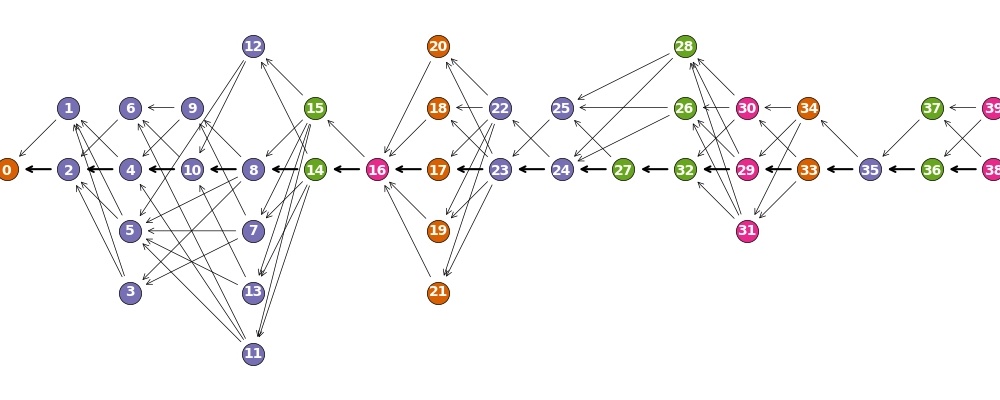
I did a Braidpool DAG simulator to show it can get consensus in less than 3x median latency. It handles 20x increases in hashrate without a problem. No timestamps needed. You just target the DAG width. Difficulty is stable when hashrate is constant and yetadjusted correctly in only 50 blocks.
github.com/zawy12/difficulty…