


Brendan Rius retweeted

Turns out alchemical dreams were real. We converted sand into superintelligence. Who cares about gold… We transmuted the most ordinary into the most extraordinary.
Brendan Rius retweeted

Robert and I are thrilled that our gift of over 2 million shares of SpaceX stock will be distributed to children’s Trump accounts in December!
Our initial gift (shares transferring to escrow as we speak) will go to 11 to 17-year-olds who live in zip codes with median family income (MFI) of $57,000 or less, and to those who live in zip codes with too few residents for an MFI to be reported in the census. These families should receive a notice by Monday.
In a few weeks, an additional gift will be finalized for eligible 11 to 17-year-old children in military families serving overseas, children in foster care, and more children whose MFI is $90,000 or less living in counties near our home in the great state of Texas.
Thank you to the incredible team @SpaceX, @Treasury, @IRS, @DellFdn, @GreaterHorizons, @InvestAmerica24, and the legal firms of Morgan Lewis and Gibson Dunn for working over the past few months to make this happen.
We are deeply grateful for the groundbreaking work that Brad Gerstner @altcap and @MichaelDell have done for the long-term financial security for millions of kids.
God Bless America!
Brendan Rius retweeted

1/ Attempted to replicate Cohere's Qwen 3.8 malicious PUT claim on 229k samples: exact hostname never appeared but model invents 369 similar Beijing upload buckets, and reaches for credential endpoints 13× more when frustrated.
Results raise more questions than answers.
good explanation

Many of you don't understand how serious this is, so let me break it down.
In computer science there is a famous kind of puzzle called 3-SAT. You are given a long list of yes-or-no switches and a set of rules about how they must be arranged, and you have to find a combination that satisfies every rule. The obvious way to solve it is to try every combination, but each new switch doubles the number of possibilities, so a puzzle with a few hundred switches would take longer than the age of the universe to brute force.
For decades, the smartest people in the field found clever tricks that made this a little faster, but every trick still hit the same wall: the time required kept exploding as the puzzle grew.
About 25 years ago, two computer scientists, Russell Impagliazzo and Ramamohan Paturi, working with Francis Zane, turned that wall into a formal idea.
They proposed the Exponential Time Hypothesis, which says this explosion is not a failure of human cleverness but a law of nature. No algorithm, however brilliant, will ever solve 3-SAT without the time blowing up exponentially. Nobody could prove it, but almost everyone believed it, and it became one of the foundations of modern computer science.
Researchers used it as a measuring stick. If you could show that solving some other problem quickly would also crack 3-SAT quickly, you had shown that problem was hopelessly hard too. Hundreds of papers, across scheduling, graphs, logic and much more, rest on this one assumption.
Now an internal AI model at OpenAI claims to have broken it. It says it found an algorithm that solves these puzzles meaningfully faster than the hypothesis allows, and it has checked the proof in a computer verification system called Lean.
And here is the remarkable part: the very people who proposed the hypothesis, Impagliazzo and Paturi, along with MIT's Ryan Williams, are now leading the public review of whether a machine has disproved their own idea.
So what happens next? If the disproof holds, a large part of theoretical computer science has to be revisited.
Every result that said "this problem cannot be solved faster, assuming ETH" loses its foundation, and researchers will have to work out which of those walls were real and which were simply where we stopped looking. It does not mean everything becomes easy. The new algorithm is still slow in absolute terms and this is not the famous P versus NP problem being solved.
But it means our map of what is possible was wrong in a place we were very confident about, and it was an AI that redrew it. If the disproof fails, the hypothesis survives and the field breathes out, but we will still have watched an AI produce serious, checkable work on one of the deepest questions in the discipline, closely enough that the founders of the idea had to take it seriously. Either way, something has shifted.
100% agree. Hackers have ben using abliterated models for months already leaving us in a situation where attackers have unrestricted access to cyber-capable models, while defenders have to navigate bureaucracy to get access to similar models.

A few months after Michael Dell pledged $6.25B (2.5% of his net worth) to American kids through Trump Accounts, Musk announces he's giving $10.5B (1% of his net worth) too.
That's roughly the same percentage of wealth many politicians want to tax billionaires.
What it shows:
1/ Give billionaires a way to give back directly, with no middlemen, and a lot of them will.
2/ They'd rather give billions directly to people than hand that money to politicians who will probably waste much of it, with little tangible impact on anyone's life.
As is often the case, the problem isn't evil billionaires. It's waste and fraud in government spending.
I hope many more wealthy Americans follow suit.
Kids getting thousands of dollars invested in the stock market, compounding tax-free for decades, will have FAR more impact on their lives than a few extra tens of billions swallowed by a wasteful government.
we're still early

Dusting off this tweet from April because this gap in shared understanding of LLM capability is *widening*. It's now less "two groups of people speaking past each other" and more a sharp funnel.
- Napkin math somewhere around 6B people (~75% of the population) have barely come in contact with LLMs at all.
- Around 1-2B (~20%) are casual and infrequent users of free-tier ChatGPT-like products. This group sees derpy chatbots and treats them a bit like a better Google search, a writing aid, or etc. Maybe an agent tries to book you a flight. I have non-tech friends who (reasonably, imo) say they have not much use for it at all. Even many professionals outside of math&code are in this tier. For example, execs and many other functions spend a lot of their time talking to other people, so while they understand what is happening intellectually, it is still second-hand and a bit abstract.
- Now we get to professional use of frontier-grade LLMs in math&code. Somewhere around 20M people (0.2%) see first-hand that large, complex projects that used to take them weeks/months can now be completed by agents with a prompt. Building apps, copying apps, translating apps, decompiling apps from binaries... This has all happened very quickly and recently - less than 1 year ago, I was writing code manually by hand, typing memorized computer code commands into a code editor character by character, occasionally pressing Tab to autocomplete a little chunk of code.
- And finally we get to the ~5,000 people (~0.00006%) with access to frontier-grade systems internally. The external world has seen the preview. It looks like swarms of thousands of agents collaborating over weeks on software mega projects: minting zero days, running cyber attacks and defenses at machine speeds, discovering new science, advancing the frontier of mathematics. Things that would have taken top professionals in the industry years of work. Meanwhile, human review and comprehension are starting to fall behind. For example, people are still involved in the "archeology" of the OpenAI-HF incident from many months ago. Mathematicians may be poring over the 722 manuscripts on frontier mathematics for a while.
The funnel is driven by a combination of factors:
1. The impact scales with ambition, problem size, and horizon. A question with a paragraph answer barely stresses the system. You need a reservoir of big, difficult problems that you really care about. This aspect drives the consumer / professional dimension of the funnel.
2. The jaggedness of the system (which I have written about a lot separately). Capability peaks in domains that are digital, verifiable and economically valuable. This is because LLM capability emerges from reinforcement learning on verifiable rewards on a curated environment mixture driven by revenue potential. This aspect primarily drives the area (e.g. math&code) dimension of the funnel.
3. Access. Free-tier, paid-tier, internal.
So this is the weirdness of the moment. The general public has mostly not interacted with these systems. When they have, it looks like a derpy chatbot. The majority of professionals still see only a modest uplift. And a small sliver of professionals are experiencing the vertigo of the curve going vertical. And it is all happening at the same time.
What even is the difference between an app, a plugin and a MCP @ChatGPT ? The whole UX around apps is a nightmare
"aha moment" with AI agents comes after the AI has access to a few things like mail, calendar, etc.
Yet somehow it looks like ChatGPT (and Claude) are trying to make it complicated to reach it
The UX to enable plugins/MCPs in ChatGPT is absurdly complicated. GrokBot's is way better: always-on CTA to "Connect Apps" and a menu that really makes you want to connect them all. ChatGPT is a UX nightmare where you need 10 clicks to add anything



Brendan Rius retweeted

New caste system just dropped

Readers added context they thought people might want to know
Engagement farming with stolen content
x.com/usr_bin_roygbi…
Good way to understand how Jev works

“Wonder if we could build that?” is a pretty normal response to new tech at @Shopify. Its a fun place to work 😄
Jev got me curious, so I built Reflex: a Qwen-based experiment in structured decisions + probabilities running on WebGPU
kshetrajna12.github.io/refle…
Brendan Rius retweeted

If Dario wants to slow down the pace of AI, he should just move the company to Europe.
I used to think it was obvious Tesla would win the autonomous driving race: it builds the cars and has an enormous, constantly growing dataset from its fleet.
But if we actually get AGI that's at least as capable as a human, it will learn to drive from a few hours of experience rather than billions of miles of training data.
In that world, Tesla's data moat mostly disappears. Any automaker can get good self-driving, and competitors like Waymo are effectively saved by AGI.
Tesla could still win on manufacturing. But the argument that its fleet/data makes autonomy winner-take-all gets much weaker.
Very annoying ChatGPT bug that I think damages the trust in the permission layer:
App permission = “Always ask.”
* MCP tool call triggers approval
* I click “Allow once”
* Subsequent tool calls from that app execute WITHOUT asking again
OpenAI docs say “Allow once” should approve only the current action and not change the saved permission.
This seems to effectively turn “Allow once” into a multi-call/session approval, which defeats “Always ask.”
Reproducible for me. Happy to send a screen recording/repro details.
@mxstbr @coreyching @OpenAIDevs

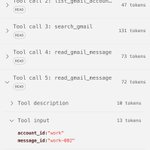
This is confirmed by the tool call list, where it clearly shows that it called 3 different tools, one of them twice.
Only one call of one tool was allowed. This breaks the whole concept of the "Always ask" permission
@mxstbr @coreyching @OpenAIDevs
