

Chief Engineer Bering Sea Commercial Fishing Vessels Telegram https://teapawt.org/t.co/dGmOLhkewP
Boise, ID
Joined May 2015
- Tweets74.6K
- Following7.5K
- Followers3.2K
- Likes206K
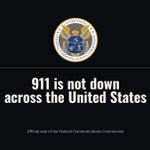







FALSE: 911 Is Not Down Across the United States
UK Report, a conflict-news account on X, told about 35,000 people this afternoon that "widespread issues" were hitting "the 911 emergency response system across the United States." It named no city, no agency and no source. Nobody who runs 911 has backed it up.
The Federal Communications Commission, the agency that oversees 911, has put out no outage statement. The Federal Emergency Management Agency has said nothing about one. Associated Press and Reuters have not reported a national 911 failure. Verizon ($VZ), AT&T ($T) and T-Mobile ($TMUS), the three national wireless carriers, have posted no nationwide 911 notice. Neither have Lumen ($LUMN) or Comtech ($CMTL), two companies that route 911 calls, or Intrado, a private 911-systems vendor.
A nationwide 911 crash would be hard to pull off. 911 runs through thousands of local public safety answering points, the call centers that pick up when you dial, run by cities and counties. There is no single national switch to flip off.
The whole claim rests on Downdetector, a website where anyone can click a button saying a service is down. Its 911 reports started at 1:57 p.m. Eastern, 10:57 a.m. Pacific. Clicks pile up fast when a scary post goes viral. A 1:55 p.m. Pacific screenshot had 911 second on Downdetector's "Most reported right now" list, behind Apple Support. Apple ($AAPL) had a real outage of its own this morning, and people were already clicking.
The one confirmed 911 outage close to today was in two Texas counties, and it was fixed before the post went up. On Monday, a cut AT&T fiber line in Raymondville knocked out phones and some 911 systems in parts of Hidalgo and Willacy counties. KRGV, Channel 5 News in the Rio Grande Valley, said service came back Tuesday just before 8 a.m. Central, about 6 a.m. Pacific.
Small local glitches happen all the time. On Nov. 15, Verizon warned 911 centers in several Pennsylvania counties about an on-and-off problem that mostly hit landlines. Al Kearney, Lackawanna County's 911 coordinator, told WNEP test calls were going through again that afternoon. On Nov. 10, the Harrison County Sheriff's Office in West Virginia said T-Mobile callers could reach 911 but could not hear the operator. Neither one was national.
Then a second rumor piled on. At 2:20 p.m. Eastern, 11:20 a.m. Pacific, FEMA and the FCC ran a scheduled nationwide test of the Emergency Alert System, the network that breaks into radio and TV in a real emergency. It was announced months ago and never went to cell phones. Ten minutes in, a viral post claimed the alert "did not work because it is currently hacked." FEMA had already said stations could air the test anytime from 2:20 to 2:50 p.m. Eastern. A Department of Homeland Security official told CNN it went smoothly. Radio World, a broadcast trade paper, said early reports showed no major technical problems. That alert system has nothing to do with 911 call centers.
No official has reported a hack of either system, and no hacker group has claimed one.
If you need help, dial 911. Your local center is answering.
North Korea's Lazarus Group: Could It Hold the FAA for Ransom? teapawt.org/brianskellenger/status…



Nvidia Guides $130 Billion Off Its Lowest Close in a Year
Nvidia ($NVDA) just told Wall Street to expect $130 billion in fourth-quarter revenue, plus or minus 3%. After hours the stock is up about 2%, to near $158. That bounce comes off today's regular-session close, about $155, the lowest since July 2025.
The quarter itself beat. Revenue was $115.8 billion, against a Wall Street estimate of about $109 billion from LSEG, a market-data firm. Adjusted earnings were $2.68 a share, against $2.48 expected. The data center segment, the chips and systems sold to cloud companies and other operators of computer servers, brought in $107.6 billion, more than double a year earlier.
Guidance is the company's own forecast for the next quarter. That forecast covers a quarter with an extra week in it, and it assumes no data-center compute revenue from China. Gross margin, the share of each sales dollar left after the cost of making the goods, came in at 74.9% this quarter, on an adjusted basis. For the fourth quarter, Nvidia said to expect 71% to 72%.
Colette Kress, the interim chief executive and the company's longtime chief financial officer, said, "Our momentum is real." Nvidia also said it returned $28 billion to shareholders this quarter in stock buybacks and dividends, with about $227 billion still authorized for buybacks.
The shares were already down about 24% this month. Last week they closed out a sixth straight weekly drop, the longest streak since 2012.
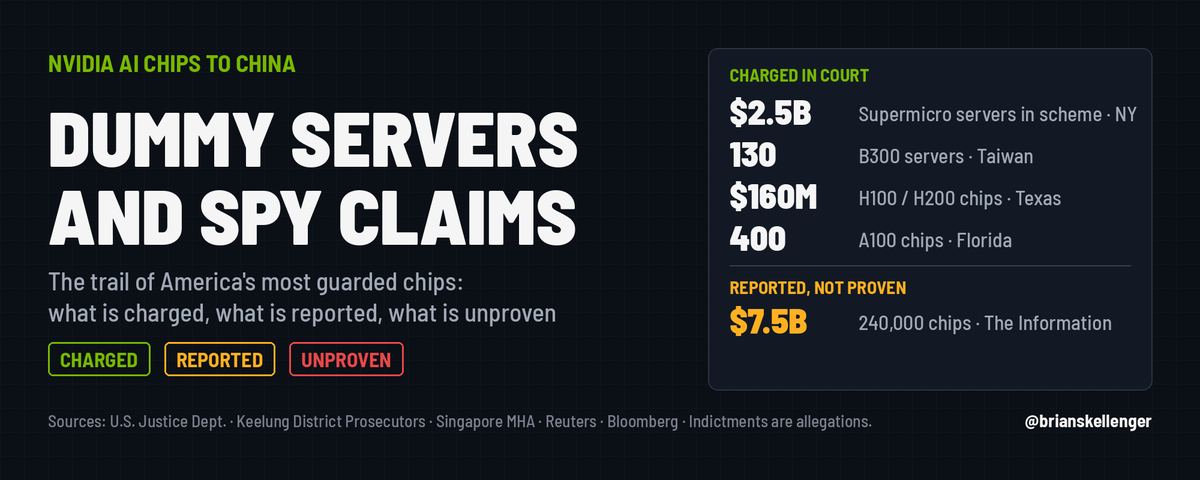
Dummy Servers and Spy Claims: The Trail of Nvidia's AI Chips to China teapawt.org/brianskellenger/status…
Sources:
Nvidia press release, Nov 17, 2026: globenewswire.com/news-relea…
Nvidia IR quarterly results: investor.nvidia.com/financia…
CNBC, Nov 17, 2026 (LSEG estimates, month-to-date drop, weekly streak): cnbc.com/2026/11/17/nvidia-n…
CNBC, Nov 16, 2026 (lowest close since July 1, 2025): cnbc.com/2026/11/16/nvidia-s…

262
Four Republicans voted against the SAVE America Act amendment on June 4: Susan Collins, Mitch McConnell, Thom Tillis and Lisa Murkowski. Three of them will be gone in January. Collins lost Maine to Troy Jackson, and McConnell and Tillis retired.
Murkowski is the one left, and her seat is up in 2028. But Alaska has no Republican primary to beat her in. It has one open top-four primary and a ranked-choice general, and in 2024 Alaskans voted to keep that system by 743 votes after a recount. She already survived it in 2022 against Trump-backed Kelly Tshibaka.
Before anyone talks about primarying her, Alaska needs a primary she can actually lose.
teapawt.org/brianskellenger/status…

Here’s What I Know
Some current Republican Senators need to be primaried & defeated in 2028.
Why? They didn’t have the boldness or courage required to codify legislation while Republicans held the House, Senate, & White House.
The only way to persuade Republican voters to come out in 2028 is if they know things will be different.
41
Ask Trump: is this in The Art of the Deal?
The national debt just hit $40.6 trillion.
Biden added $8.5 trillion in 4 years, about $5.8 billion a day.
Trump has added $4.4 trillion in 22 months, about $6.7 billion a day. That's faster, not slower.
That flat line in early 2025 wasn't cuts. It was the debt ceiling. Once Congress raised it in July, borrowing took right back off.
Conservatives used to care about this. Who's going to stop it?
Source: U.S. Treasury, Debt to the Penny – at United States

11
How did a Plantation Owner escape getting cancelled?
Aunt Jemima: cancelled.
Uncle Ben: cancelled.
Mrs. Butterworth: placed under review.
Meanwhile, an old Southern man in a white planter's suit and a string tie, who insisted everyone call him "Colonel," has been smiling from every bucket since 1952. Not one boycott.
The cancel mob has exactly one rule: nobody touches the 11 herbs and spices.
$YUM – at Winnemucca, NV

12
Is $2 trillion a year in new debt conservative by Trump?
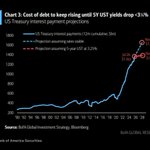
Interest on the national debt is already $1.4 trillion a year. Bank of America projects $1.7 trillion by November 2028.
Here's why. The cheap Covid-era debt, borrowed under 2%, is coming due. Every year $8 to $10 trillion gets refinanced at today's higher rates. On top of that, we add another $2 trillion in new debt every year. The total goes from $40.5 trillion to around $45 trillion by the end of 2028.
Washington takes in a little over $5 trillion a year. More than a quarter of it goes to interest, before one dollar reaches the military, Social Security, or a road.
That isn't conservative, no matter which party is in charge. Conservative means you don't spend money you don't have and hand the bill to your kids.
Who in Congress is actually voting to stop it?
Source: Bank of America Global Research – at United States

18
BOLSHEVIK 2.0, Part 11: Liquidate the Class
On Dec. 27, 1929, Joseph Stalin, by then the Soviet Union's sole ruler, told a Moscow conference of Marxist farm economists that the Party had moved from "restricting" the kulaks to "eliminating the kulaks as a class." His plan: "strike at the kulaks, strike so hard as to prevent them from rising to their feet again." On seizing kulak property: "When the head is off, one does not mourn for the hair."
What was a kulak? The word is Russian for "fist." Officially, a peasant rich enough to hire help or rent out land. In practice, whoever local Party men said it was. A 1930 report by the OGPU, Stalin's secret police, found only 55% of those branded kulaks in one region met even the official test. Priests, middle peasants and anyone resisting the new collective farms got the label too.
On Jan. 30, 1930, the Politburo, the Party's top committee, issued "On measures for the elimination of kulak households in districts of comprehensive collectivization." Category I: property seized, head of household sent to a camp or shot. Category II: property seized, whole family deported to Siberia, the Urals, the North or Kazakhstan. Category III: part of their property seized, moved off the collective farm's land. Moscow assigned each region a quota. By October 1930, 284,000 people had been arrested under Category I alone.
The result: 2.1 to 2.3 million people deported to "special settlements" from 1930 to 1933, and 20,000 to 30,000 shot by three-man troika panels without trial. Historian Manfred Hildermeier puts deaths from dekulakization alone, not counting the famine, at 530,000 to 600,000. The deported became the Gulag's labor pool. Then came the famine, including Ukraine's Holodomor.
Now 2026. South Africa's Expropriation Act 13 of 2024, signed by President Cyril Ramaphosa of the African National Congress (ANC) in January 2025, says in Section 12(3) that "nil compensation" may be "just and equitable" when land is taken in the public interest. Its examples: unused land held for its rising value, land the owner "abandoned," certain state land, and land worth no more than past state investment in it. The list says "including, but not limited to."
Three groups sued in the Western Cape High Court: the Democratic Alliance, South Africa's second-largest party and the ANC's coalition partner; AfriForum, a civil-rights group for the Afrikaner minority; and IRR Legal, arm of the Institute of Race Relations, a classical-liberal group founded in 1929, the year Stalin declared war on the kulaks. The case was argued in early August 2026, then postponed, with no ruling reported. AfriForum's counsel told the court the Constitution "does not have a category of no compensation."
President Trump (R) answered in February 2025 with Executive Order 14204, halting U.S. aid to South Africa and offering refugee resettlement to Afrikaners, saying the Act lets the government "seize ethnic minority Afrikaners' agricultural property without compensation."
The fair difference: South Africa's Act requires a public purpose and gives owners a court. Nobody is being shot or deported, and Ramaphosa's lawyers say "nil" is only an exception. Our Fifth Amendment bars taking private property "without just compensation." The pattern to watch is Stalin's: name a class of owners undeserving, write the category into law, and let officials decide who is in it.
Sources: Stalin, marxists.org; Wikipedia, Dekulakization; The Citizen, Aug. 4; BusinessDay, Aug. 5; AfriForum, Aug. 7; federalregister.gov/d/2025-0…
Previous parts:
1 x.com/brianskellenger/status…
2 x.com/brianskellenger/status…
3 x.com/brianskellenger/status…
4 x.com/brianskellenger/status…
5 x.com/brianskellenger/status…
6 x.com/brianskellenger/status…
7 x.com/brianskellenger/status…
8 x.com/brianskellenger/status…
9 x.com/brianskellenger/status…
10 x.com/brianskellenger/status…
Full series: brianskellenger.substack.com… – at Meridian, ID

After the kulaks were deported came the hunger. Directive 65/sh, signed by Stalin and Molotov on January 22, 1933, told police in Moscow, Belarus and the Volga to arrest Ukrainian peasants who had made it north looking for bread and ship them back.
teapawt.org/brianskellenger/status…
Stalin Barred Starving Peasants From Leaving Ukraine | Bolshevik 2.0, Part 12
On January 22, 1933, Joseph Stalin and Vyacheslav Molotov, chairman of the Soviet Council of People's Commissars, signed Directive No. 65/sh. Reports had reached them, the order said, that a "mass departure of peasants 'for bread'" had begun in Ukraine and the Kuban, the grain country of the North Caucasus. Stalin and Molotov wrote that they had "no doubt" the movement was organized by "enemies of Soviet power," including the Socialist-Revolutionaries, a rival party, and "agents of Poland," to agitate against the collective farms. Officials who had "overlooked" a similar exodus the year before were not to repeat it.
The order was blunt. Party and secret-police officials in the North Caucasus were "not to allow the mass departure of peasants" to other regions, or entry from Ukraine. Officials in Ukraine were "not to allow the mass departure of peasants from Ukraine to other regions," or entry from the North Caucasus. Police in Moscow, Belarus, the Volga and the Central Black Earth region were to arrest peasants from Ukraine and the North Caucasus who had "made their way north," separate out the "counterrevolutionary elements," and send the rest back to where they had come from. The text is held in the Russian State Archive of Socio-Political History and published on Wikisource.
The next day, Ukrainian Party secretary Mendel Khatayevich and Ukrainian government head Vlas Chubar told every region to stop selling train tickets beyond Ukraine to peasants who did not have a local-government exit permit or papers showing they had been recruited for state work.
Grain had already been taken under Stalin's procurement quotas. People tried to walk or ride out "for bread." The state shut the roads and the ticket windows and sent them home to starve. Later demographic work puts the death toll in Soviet Ukraine at about 3.5 to 5 million. A 2003 joint statement at the United Nations, signed by 25 countries, had put it at 7 to 10 million. The lower range is the one the later counts support. Kazakhstan and parts of Russia starved in the same years. Ukraine was hit especially hard, and this order named Ukraine and the Kuban.
Now 2026. Foreign Policy, on August 6, reported that the Black Sea's grain corridors are again at the center of Russia's war on Ukraine, as they were in 2022 and 2023, when a Russian naval blockade stopped Ukrainian maritime exports and shook food markets worldwide. This time, the magazine said, the problem is not a physical blockade of the channel. Russia is striking ships, crews, and cargo, and the insurance and freight risk has gotten so high that merchant vessels will not make the trip. "Grain isn't moving despite an open corridor." Ukraine had already shipped much of its recent harvest, and global stocks are relatively flush, so the shock is not yet the 2022 panic. The pattern is older than this war: food, and the routes that carry it, used as a lever.
The fair difference: 1933 was a government sealing its own peasants inside a famine. 2026 is a war between states, and there is no Holodomor unfolding in Ukraine this year. Nobody should talk as if the two are the same event. The method to watch is the older one. When people are already hungry, or when the world's bread moves through one sea, the power to close the exit is the power to decide who eats.
Sources: Directive 65/sh, Jan. 22, 1933, RGASPI, via Wikisource: ru.wikisource.org/wiki/%D0%9…
Holodomor death-toll range: en.wikipedia.org/wiki/Holodo…
Foreign Policy, Aug. 6, 2026: foreignpolicy.com/2026/08/06…
Previous parts:
Introduction: teapawt.org/brianskellenger/status…
1: teapawt.org/brianskellenger/status…
2: teapawt.org/brianskellenger/status…
3: teapawt.org/brianskellenger/status…
4: teapawt.org/brianskellenger/status…
5: teapawt.org/brianskellenger/status…
6: teapawt.org/brianskellenger/status…
7: teapawt.org/brianskellenger/status…
8: teapawt.org/brianskellenger/status…
9: teapawt.org/brianskellenger/status…
10: teapawt.org/brianskellenger/status…
11: teapawt.org/brianskellenger/status…
Full series: brianskellenger.substack.com…

10
Newsom Dined With a Dozen, Capped Home Bible Study at 3 Households | No Kings, Part 8
On November 6, 2020, Governor Gavin Newsom (D-CA) sat down at the French Laundry, a Michelin-starred restaurant in Yountville in Napa County, for the 50th birthday of Jason Kinney, a registered lobbyist and longtime advisor. The Los Angeles Times reported more than three other households at the table. California's rules then limited private gatherings, including a Bible study in a living room, to three households.
On November 16, 2020, Newsom apologized: "I need to preach and practice, not just preach and not practice." The same day he ordered 28 counties back into the purple tier, where indoor private gatherings were banned. In fairness, the state's restaurant rules set no household limit per table, so the dinner broke no written rule. Four households praying in a home did.
Purple was the worst of four color-coded tiers in the Blueprint for a Safer Economy, California's system ranking each county by COVID spread. Everywhere else, home gatherings were capped at three households, with masks, six feet of spacing, two hours or less, and no singing indoors.
Jeremy Wong, associate pastor of Orchard Community Church, and Karen Busch, both of Santa Clara County, had hosted weekly Bible studies and prayer meetings in their homes before the pandemic, about eight to twelve people. They sued on October 13, 2020, with Ritesh Tandon, a Republican congressional candidate, and others. A federal judge in San Jose and the Ninth Circuit, the appeals court for California, Idaho and seven other western states, turned them down.
On April 9, 2021, in Tandon v. Newsom, the Supreme Court ordered California to stop, 5–4, in an unsigned opinion. The Court relied on the Free Exercise Clause, the part of the First Amendment that forbids government from "prohibiting the free exercise" of religion. It found California let hair salons, retail stores, movie theaters, and indoor restaurants bring together more than three households at a time. When a rule treats "any comparable secular activity more favorably than religious exercise," it faces strict scrutiny, the toughest test in constitutional law: the state must prove that nothing less restrictive would work.
California could not. The Court said the state cannot "assume the worst when people go to worship but assume the best when people go to work." The state promised to ease the rules April 15, but the Court said officials "with a track record of 'moving the goalposts'" could reimpose them at any time. And: "This is the fifth time the Court has summarily rejected the Ninth Circuit's analysis of California's COVID restrictions on religious exercise."
In fairness, Justice Elena Kagan, joined by Justices Stephen Breyer and Sonia Sotomayor, dissented. She argued California limited all home gatherings, religious and secular alike, and that the law "does not require that the State equally treat apples and watermelons." She cited state experts: homes are smaller, less ventilated, and host longer visits with less masking. Chief Justice John Roberts would also have denied the request.
California later agreed to pay $500,000 to the Tandon plaintiffs' lawyers, and more than $4 million in all to churches and others who challenged Newsom's orders, the Sacramento Bee reported.
Democrats chant "No Kings." A Democratic governor dined with a dozen people while his rules told citizens they could not pray at home with a fourth household. It took the Supreme Court, a fifth time, to stop it.
Court opinion:
supremecourt.gov/opinions/20…
French Laundry apology:
latimes.com/california/story…
Legal fees paid:
sacbee.com/news/coronavirus/…
Previous parts:
Part 1: teapawt.org/brianskellenger/status…
Part 2: teapawt.org/brianskellenger/status…
Part 3: teapawt.org/brianskellenger/status…
Part 4: teapawt.org/brianskellenger/status…
Part 5: teapawt.org/brianskellenger/status…
Part 6: teapawt.org/brianskellenger/status…
Part 7: teapawt.org/brianskellenger/status…
Series archive:
brianskellenger.substack.com…

Biden Backed Eviction Order He Doubted Was Legal | No Kings, Part 7
On August 3, 2021, President Joe Biden (D) was asked whether a new eviction moratorium would pass Supreme Court muster. He answered: "The bulk of the constitutional scholarship says that it's not likely to pass constitutional muster." Then he gave his reason for doing it anyway: "But, at a minimum, by the time it gets litigated, it will probably give some additional time while we're getting that $45 billion out to people who are, in fact, behind in the rent." That evening the Centers for Disease Control and Prevention (CDC) issued it.
Congress's March 2020 CARES Act paused evictions for 120 days, but only for properties tied to federal assistance programs or federally backed loans. When that ran out in July 2020, Congress did not renew it. So in September 2020, under President Trump (R), the CDC wrote its own nationwide moratorium with criminal penalties. Congress extended it one month in December 2020. Under Biden, the CDC then extended it on its own through March, June and July 2021.
The CDC claimed its power came from Section 361 of the Public Health Service Act, a 1944 law. That law lets the agency make rules to stop diseases from spreading between states, and it lists the kinds of steps it means: "inspection, fumigation, disinfection, sanitation, pest extermination," and destruction of infected animals or articles. The Court later noted it had rarely been invoked, generally for quarantines and a 1975 ban on small turtles that carry salmonella, and never before for evictions.
Realtor associations and rental property managers in Alabama and Georgia sued. On May 5, 2021, a federal judge in Washington, D.C. ruled the CDC lacked the authority, but stayed that ruling during appeal. On June 29, 2021, the Supreme Court left the stay in place 5–4 because the order was set to end July 31 and rent aid was still going out. Justice Kavanaugh, the fifth vote, agreed the CDC had exceeded its authority. The order expired July 31. Congress did not pass the legislation Kavanaugh said was necessary. Three days later the CDC reissued it, limited to counties with "substantial or high" COVID spread, which the Court found covered at least 80 percent of the country. Violators faced fines up to $100,000, or $250,000 if a death resulted, and up to a year in jail.
On August 26, 2021, in Alabama Association of Realtors v. Department of Health and Human Services, the Court ended it, 6–3. The Court said it was "difficult to imagine" the landlords losing, called the CDC's reading "a breathtaking amount of authority," and called the 1944 law "a wafer-thin reed on which to rest such sweeping power." It asked if that logic would let the CDC order free grocery delivery or free internet. It noted many landlords "have modest means" and lost "the right to exclude," a basic right of ownership. Its conclusion: "It is up to Congress, not the CDC, to decide whether the public interest merits further action here."
In fairness, Justices Breyer, Sotomayor, and Kagan dissented. They argued the new order was more tailored, tenants had to declare lost income and no other housing, and Delta was surging. The Court did not rule that helping renters was wrong. Congress had already provided nearly $50 billion in rental assistance. The Court ruled on who has the power to cancel a landlord's right to collect rent or reclaim his property.
Democrats chant "No Kings." Here a Democratic president said out loud he doubted the order was constitutional and backed it anyway to buy time in court. The Court said no.
Court opinion:
supremecourt.gov/opinions/20…
Biden's August 3, 2021 remarks:
bidenwhitehouse.archives.gov…
The CDC's August 2021 order:
federalregister.gov/document…
Previous parts:
Part 1: teapawt.org/brianskellenger/status…
Part 2: teapawt.org/brianskellenger/status…
Part 3: teapawt.org/brianskellenger/status…
Part 4: teapawt.org/brianskellenger/status…
Part 5: teapawt.org/brianskellenger/status…
Part 6: teapawt.org/brianskellenger/status…
Series archive:
brianskellenger.substack.com…

Newsom (D-CA) capped a living-room Bible study at three households. Gov. Tom Wolf (D-PA) vetoed the legislature's resolution ending his COVID emergency, so voters amended the constitution. Now an emergency ends at 21 days unless lawmakers extend it.
teapawt.org/brianskellenger/status…
Wolf Vetoed an End to His Emergency. Voters Capped It at 21 Days | No Kings, Part 9
On March 6, 2020, Gov. Tom Wolf (D-PA) declared a disaster emergency over COVID-19. Under the state's Emergency Management Services Code, that proclamation could last no more than 90 days unless the governor renewed it himself. The same statute said the General Assembly "by concurrent resolution may terminate a state of disaster emergency at any time." The governor would then have to issue an order ending it.
Wolf used the declaration to move money, suspend regulations, and, on March 19, 2020, order non-life-sustaining businesses closed. The Pennsylvania Supreme Court later upheld that business order in Friends of Danny DeVito v. Wolf. On June 3, 2020, Wolf renewed the emergency for another 90 days.
On June 9, 2020, the Republican-controlled House and Senate adopted a concurrent resolution, H.R. 836, directing Wolf to end the disaster emergency he had declared on March 6 and renewed. The next day the secretary of the Senate formally notified him. Senate President Pro Tempore Joe Scarnati (R) and Majority Leader Jake Corman (R) went to court to enforce it.
On July 1, 2020, the Pennsylvania Supreme Court sided with Wolf. Justice David Wecht, joined by Justices Max Baer, Debra Todd and Christine Donohue, held that H.R. 836 was "a legal nullity" because a resolution with the force of law had to be presented to the governor for his approval or veto. The legislature could still override a veto with a two-thirds vote in both chambers. It did not have the votes. Chief Justice Thomas Saylor, joined by Justice Sallie Mundy, dissented. Justice Kevin Dougherty filed a separate concurrence and dissent. The court said it was not judging whether Wolf's COVID policy was wise, only whether the legislature could end the emergency without putting the resolution on his desk.
On July 14, 2020, Wolf vetoed H.R. 836 anyway. The emergency stayed in place.
On May 18, 2021, they approved two constitutional amendments. Ballotpedia reported at the time that these were the first in the country, after the pandemic began, to address a governor's emergency powers. Question 2 added Article IV, Section 20: a disaster emergency "shall be in effect for no more than twenty-one (21) days, unless otherwise extended in whole or part by concurrent resolution of the General Assembly." The governor also may not issue a new declaration "based upon the same or substantially similar facts and circumstances" without the legislature's express approval. Question 1 amended Article III, Section 9 so the legislature can terminate or extend a disaster declaration by a simple majority, without presenting the resolution to the governor. Wolf himself proclaimed both amendments adopted on June 15, 2021, after the secretary of the commonwealth certified the vote.
The 21-day cap passed 1,174,528 to 1,085,371, about 52 percent to 48, per certified totals compiled by Ballotpedia. The veto-strip amendment passed 1,165,851 to 1,074,205, also about 52 percent.
Democrats chant "No Kings." A Democratic governor kept a disaster emergency in force after both chambers voted to end it, then vetoed their resolution, until voters changed the constitution and capped any new declaration at three weeks unless the legislature agreed to extend it.
Court opinion (Wolf v. Scarnati, July 1, 2020):
pacourts.us/Storage/media/pd…
21-day cap, as Wolf proclaimed it:
pacodeandbulletin.gov/secure…
Amendment on ending a declaration without the governor's signature:
pacodeandbulletin.gov/secure…
Veto, July 14, 2020:
patch.com/pennsylvania/acros…
Certified totals:
ballotpedia.org/Pennsylvania…
ballotpedia.org/Pennsylvania…
Previous parts:
Part 1: teapawt.org/brianskellenger/status…
Part 2: teapawt.org/brianskellenger/status…
Part 3: teapawt.org/brianskellenger/status…
Part 4: teapawt.org/brianskellenger/status…
Part 5: teapawt.org/brianskellenger/status…
Part 6: teapawt.org/brianskellenger/status…
Part 7: teapawt.org/brianskellenger/status…
Part 8: teapawt.org/brianskellenger/status…
Series archive:
brianskellenger.substack.com…

7
The 2 AM Strikes That Killed Gaza's De Facto PM and Ended a Truce | THE KILL FILES, Part 17
Can a government end a signed ceasefire with a kill list, and who answers for everyone killed around the targets?
March 18, 2025, Gaza Strip. At about 2:30 a.m., during the Muslim fasting month of Ramadan, Israeli jets struck from Beit Hanoun in the north to Rafah in the south. Gaza's Hamas-run Health Ministry reported more than 400 dead that day and said most were women and children. AP called it Israel's deadliest bombardment of Gaza in the 17-month war.
New to this series? THE KILL FILES walks through Israel's targeted-killing policy one case at a time, oldest and newest in turn. The backbone is "Rise and Kill First" (2018) by Israeli journalist Ronen Bergman, which counts at least 2,700 Israeli targeted-killing operations in about 70 years. The focus is state policy, never the Jewish people.
The targets: the Israel Defense Forces said it killed four senior Hamas officials, led by Essam al-Daalis, head of Hamas's government committee, roughly Gaza's prime minister, per the Times of Israel. Also killed: Mahmoud Abu Watfa, who ran the Interior Ministry that controls Gaza's police; Bahjat Abu Sultan, chief of internal security; and Ahmed al-Hetta of the Justice Ministry. Reuters reported officials died with family members, including political bureau member Mohammad al-Jmasi, whose grandchildren were in his house.
Where this fits: a three-phase deal brokered by the U.S., Qatar and Egypt took effect Jan. 19, 2025. In Phase 1, Hamas released 33 Israeli hostages and five Thais for Palestinian prisoners. Phase 2 was to free the roughly 24 hostages still thought alive, with a full Israeli withdrawal and a permanent end to the war. The Times of Israel reported Prime Minister Benjamin Netanyahu held off on Phase 2 because full withdrawal was a red line for his far-right partners. Per AP, Hamas refused Israel's demand to free half the remaining hostages to extend Phase 1. On March 2, Israel cut off all aid into Gaza.
White House press secretary Karoline Leavitt told Fox News: "The Trump administration and the White House were consulted by the Israelis on their attacks in Gaza tonight" (Reuters).
On national TV, Netanyahu said: "This is only the beginning." And: "The previous releases proved that military pressure is a necessary condition for freeing hostages" (AP).
The Hostages and Missing Families Forum, which speaks for families of those taken Oct. 7, 2023, said: "We are horrified, furious and scared by the intentional shattering of the process of returning our loved ones," warning it "will cost us the 59 hostages who are still in Gaza" (Telegraph). Far-right leader Itamar Ben-Gvir, who quit in January over the deal, said he was coming back. And Netanyahu's testimony in his own corruption trial was canceled for the day at his request, citing an urgent security meeting (Times of Israel).
The war ran nearly seven more months, to the Oct. 10, 2025 truce.
The question is not whether Hamas leaders were legitimate targets after Oct. 7. It is who decides when a signed ceasefire ends, how many people around a target are an acceptable cost, and how the hostages' safety was weighed. Who should have the final say?
Tell me below. Sourced corrections welcome.
Sources:
AP: apnews.com/article/israel-pa…
Reuters: reuters.com/world/middle-eas…
Reuters: reuters.com/world/middle-eas…
Times of Israel: timesofisrael.com/liveblog_e…
Times of Israel: timesofisrael.com/netanyahus…
Telegraph: telegraph.co.uk/world-news/2…
Previous parts:
1: teapawt.org/brianskellenger/status…
2: teapawt.org/brianskellenger/status…
3: teapawt.org/brianskellenger/status…
4: teapawt.org/brianskellenger/status…
5: teapawt.org/brianskellenger/status…
6: teapawt.org/brianskellenger/status…
7: teapawt.org/brianskellenger/status…
8: teapawt.org/brianskellenger/status…
9: teapawt.org/brianskellenger/status…
10: teapawt.org/brianskellenger/status…
11: teapawt.org/brianskellenger/status…
12: teapawt.org/brianskellenger/status…
13: teapawt.org/brianskellenger/status…
14: teapawt.org/brianskellenger/status…
15: teapawt.org/brianskellenger/status…
16: teapawt.org/brianskellenger/status… – at Meridian, ID

THE KILL FILES, Part 16
What happens when a state's hit team kills the wrong man?
July 21, 1973, Lillehammer, Norway. Ahmed Bouchikhi, a Moroccan waiter, was walking home from a movie with his pregnant wife, Torill. A car pulled up, two men got out, and they shot him 13 times in front of her. He died on the street. Lillehammer had not had a murder in 36 years.
New to this series? THE KILL FILES walks through Israel's targeted-killing policy one case at a time, alternating between the oldest cases and the newest. The backbone is Ronen Bergman's "Rise and Kill First" (2018), which counts at least 2,700 Israeli targeted-killing operations in roughly 70 years. The focus is state policy and how these decisions get made, never the Jewish people.
Where this fits: after 11 Israeli athletes were murdered at the 1972 Munich Olympics, Golda Meir's government launched a campaign against the people it blamed, later called Operation Wrath of God. Part 12 covered the first killing (Wael Zwaiter, Rome) and Part 14 the second (Mahmoud Hamshari, Paris). The top target was Ali Hassan Salameh, Black September's chief of operations.
In summer 1973 Mossad got a tip that Salameh was hiding in Lillehammer, a small town in central Norway. A team of about 15 arrived, joined by Mossad director Zvi Zamir and operation commander Michael Harari. Agents followed a known Palestinian courier to a public pool, saw him chatting with Bouchikhi, decided Bouchikhi looked like Salameh's photos, and took his French as a sign he was the multilingual Salameh. He had no connection to any Palestinian armed group. The conversation was a coincidence.
The team learned it had the wrong man only when the news came out the next day. Nine members, including the two shooters, left Norway. Six were arrested, two of them in the same getaway car, still on the same plates. Norwegian judges concluded the operation was run by Mossad (NYT). Five were convicted of complicity, with sentences from one to five and a half years; they were released and back in Israel in 1975. Their papers and safe-house keys helped expose Mossad's network across Europe. Under the pressure, Meir suspended the campaign; it later resumed.
The cost kept coming. Israel never officially took responsibility. In December 1995, Israeli minister Shulamit Aloni told Norwegian papers Israel was behind it; in January 1996, Prime Minister Shimon Peres said Israel would "never" accept responsibility (UPI). Later that month, Israel agreed to pay the family about $400,000 as a "humanitarian gesture," without an admission (NYT, JTA). Israel's ambassador to Norway put it plainly: "We did not take responsibility and we did not apologize" (UPI). Norway issued an international arrest warrant for Harari in 1998 and closed the case in 1999, judging a conviction impossible.
Salameh himself was killed in Beirut on Jan. 22, 1979, by a remote-controlled car bomb that also killed eight other people, per Time.
So the question is not whether Munich deserved an answer. It is what checks exist before a team pulls the trigger. A tip, a resemblance, a language and a swimming pool chat were enough to kill a man who had done nothing. Who verifies the target, and who answers when they get it wrong?
Share other cases of mistaken identity below. Corrections with sources welcome.
Sources:
NYT 1996: nytimes.com/1996/01/28/world…
JTA 1996: jta.org/archive/israel-to-co…
UPI Jan 10, 1996: upi.com/Archives/1996/01/10/…
UPI Jan 28, 1996: upi.com/Archives/1996/01/28/…
Overview: en.wikipedia.org/wiki/Lilleh…
Previous parts:
1: teapawt.org/brianskellenger/status…
2: teapawt.org/brianskellenger/status…
3: teapawt.org/brianskellenger/status…
4: teapawt.org/brianskellenger/status…
5: teapawt.org/brianskellenger/status…
6: teapawt.org/brianskellenger/status…
7: teapawt.org/brianskellenger/status…
8: teapawt.org/brianskellenger/status…
9: teapawt.org/brianskellenger/status…
10: teapawt.org/brianskellenger/status…
11: teapawt.org/brianskellenger/status…
12: teapawt.org/brianskellenger/status…
13: teapawt.org/brianskellenger/status…
14: teapawt.org/brianskellenger/status…
15: teapawt.org/brianskellenger/status…

The March 2025 strikes left the same question Beirut left in 1979: who answers for the people near the target? On Rue Verdun, the car bomb that killed Ali Hassan Salameh also killed four passersby, a German nun and an English student among them.
teapawt.org/brianskellenger/status…
They Missed Salameh in Norway. A Beirut Car Bomb Got Him | THE KILL FILES, Part 18
What does a government do after its hit team kills the wrong man?
January 22, 1979, Rue Verdun, West Beirut. At 3:35 p.m., a Chevrolet station wagon carrying Ali Hassan Salameh and four bodyguards passed a parked Volkswagen. A bomb in the Volkswagen turned the street into "a violent shambles of smoke and flames," Time reported the next week. The five men in the Chevrolet were mortally wounded. Four passersby, including a German nun and an English student, were killed. Eighteen other people were injured.
New to this series? THE KILL FILES walks through Israel's targeted-killing policy one case at a time, oldest and newest in turn. The backbone is "Rise and Kill First" (2018) by Israeli journalist Ronen Bergman, which counts at least 2,700 Israeli targeted-killing operations in about 70 years. The focus is state policy, never the Jewish people.
Where this fits: after 11 Israeli athletes were murdered at the 1972 Munich Olympics, Golda Meir's government launched a campaign against the people it blamed, later called Operation Wrath of God. Israel held Salameh to be Black September's chief of operations, the top name on that list. Part 16 told what happened when a Mossad team hunting him in Lillehammer, Norway, on July 21, 1973, shot Ahmed Bouchikhi, a Moroccan waiter with no militant ties, 13 times in front of his pregnant wife. Six agents were arrested and five convicted. Meir suspended the campaign.
It did not stay suspended. Time reported that as many as 14 Israeli agents, some of them veterans of the Lillehammer failure, were involved in the Beirut operation. "Last week they finally got him." Palestinian investigators traced the attack to three foreigners who then vanished, including a woman traveling on a British passport in the name of Erika Mary Chambers. She had rented an apartment overlooking Rue Verdun three months earlier, posing as a sketcher known to neighbors as Penelope. Time said a man using the name Peter Scriver had rented the Volkswagen, and that British officials said no passport was ever issued in that name.
Salameh had been staying off and on in an apartment just off Rue Verdun with his second wife, Georgina, a former Miss Universe, Time said. He had ordered heavy steel rollers installed in the windows. Two weeks before the bombing he was warned, through Christian Maronite leaders, that Israel had assigned a new squad to kill him. When Time correspondent Dean Brelis had asked if he worried about the Israelis' determination, Salameh said: "They're the ones who should be worried after all their mistakes. But I also know that when my number is up, it will be up. No one can stop it."
Yasser Arafat, who called Salameh an "adopted son," said when the news reached him in Damascus, "We have lost a lion." Time said Arafat was a pallbearer at a funeral in Beirut attended by 50,000 Palestinians. "Stand proud," he shouted. "We bury a martyr!"
The question is not whether the men who murdered 11 Israeli athletes should have been hunted. It is what a state does after it has already killed the wrong man, and how many people on a city street are an acceptable cost of finishing the job. Who sets that limit, and who answers for the nun and the student on the sidewalk?
Tell me below. Sourced corrections welcome.
Sources:
Time, Feb. 5, 1979: content.time.com/time/subscr…
Washington Post, Jan. 23, 1979: washingtonpost.com/archive/p…
Previous parts:
1: teapawt.org/brianskellenger/status…
2: teapawt.org/brianskellenger/status…
3: teapawt.org/brianskellenger/status…
4: teapawt.org/brianskellenger/status…
5: teapawt.org/brianskellenger/status…
6: teapawt.org/brianskellenger/status…
7: teapawt.org/brianskellenger/status…
8: teapawt.org/brianskellenger/status…
9: teapawt.org/brianskellenger/status…
10: teapawt.org/brianskellenger/status…
11: teapawt.org/brianskellenger/status…
12: teapawt.org/brianskellenger/status…
13: teapawt.org/brianskellenger/status…
14: teapawt.org/brianskellenger/status…
15: teapawt.org/brianskellenger/status…
16: teapawt.org/brianskellenger/status…
17: teapawt.org/brianskellenger/status…

7
Box 13: 202 Late Votes Gave LBJ an 87-Vote Win | Election Fraud Part 13
1948, Alice, Texas. On August 28, 1948, Texas Democrats voted in a runoff, a second election between the top two finishers, for the U.S. Senate nomination. Texas was a one-party state, so the nomination was as good as the seat.
It was Congressman Lyndon B. Johnson (D), a New Deal man from the Austin area, against Coke R. Stevenson (D), a lawyer who had just served as governor of Texas. The first unofficial count had Stevenson ahead.
Six days after the polls closed, a new return came in from Precinct 13 in Jim Wells County. The Associated Press reported on September 13, 1948, that 202 votes, 201 for Johnson and one for Stevenson, "turned up in the precinct 13 count" that were not in the first count. The party secretary's tally gave Johnson 494,191 to Stevenson's 494,104, an 87-vote margin out of nearly a million.
Next door was Duval County, home of George B. Parr (D), the Democratic boss called the "Duke of Duval." The Handbook of Texas, the Texas State Historical Association's encyclopedia, says the Jim Wells officials were "probably acting on Parr's orders" and that "Amid charges of fraud, the voting lists disappeared." Stevenson's side said the added names were in alphabetical order, in a different ink.
The state party committee voted 29 to 28 to certify Johnson. Stevenson sued. On September 22, 1948, a federal judge in Fort Worth blocked Johnson's name from the ballot because "there was evidence of fraud in the official returns from certain election officials in Jim Wells, Zapata, and possibly other counties," and sent special masters, court-appointed evidence gatherers, to open the boxes.
They never finished. Johnson's lawyers, including Abe Fortas, whom Johnson later put on the Supreme Court, went to Justice Hugo Black, a former Alabama senator and Franklin Roosevelt (D) appointee who oversaw the Fifth Circuit, the appeals court for Texas. In late September, Black stayed the order. The boxes stayed shut and Johnson went on the ballot.
On October 7, 1948, in Johnson v. Stevenson, the Fifth Circuit ordered the case dismissed. Judge Samuel Sibley wrote that "whatever may be the truth as to the fraudulent returns," a federal court could not hear a state primary contest; that belonged to Texas courts or the Senate, which judges its members' "elections, and returns" under Article I, Section 5. Johnson claimed more illegal votes went to Stevenson. No court ever weighed either side's evidence.
Johnson beat Jack Porter (R) in November. In 1977, Luis Salas, the election judge for Box 13, told AP reporter James Mangan, "Johnson did not win that election; it was stolen for him." Salas said he had lied under oath in 1948.
Today a disappearing voter list is a federal crime. Under 52 U.S.C. 20701, from the Civil Rights Act of 1960, election officers must keep federal election records, primaries included, for 22 months, or face up to a year in prison.
In 1948 the evidence vanished and the courts said it was not their case. In 2026, who is checking that the records are kept?
Sources: Johnson v. Stevenson, 170 F.2d 108 (5th Cir. 1948), law.justia.com/cases/federal…; Handbook of Texas, George B. Parr, tshaonline.org/handbook/entr…; 52 U.S.C. 20701, law.cornell.edu/uscode/text/…. Photo: Coke R. Stevenson, 1946, Cactus Yearbook, University of Texas, public domain.
Previous episodes:
Part 1: teapawt.org/brianskellenger/status…
Special Edition: teapawt.org/brianskellenger/status…
Part 2: teapawt.org/brianskellenger/status…
Part 3: teapawt.org/brianskellenger/status…
Part 4: teapawt.org/brianskellenger/status…
Part 5: teapawt.org/brianskellenger/status…
Part 6: teapawt.org/brianskellenger/status…
Part 7: teapawt.org/brianskellenger/status…
Part 8: teapawt.org/brianskellenger/status…
Part 9: teapawt.org/brianskellenger/status…
Part 10: teapawt.org/brianskellenger/status…
Part 11: teapawt.org/brianskellenger/status…
Part 12: teapawt.org/brianskellenger/status…
Full series: brianskellenger.substack.com…

Poll Officers Charged With Forging Senate Ballots | Election Fraud Part 12
1942, Harlan County, in Kentucky's coal country. On November 3, 1942, Kentucky voters chose a United States Senator. On the ballot were the sitting Senator, Albert B. "Happy" Chandler (D), a former governor, and Lexington attorney Richard J. Colbert (R). Chandler won.
A federal grand jury later indicted the officers of election at Harlan County polling places, the local officials who ran the voting and counted the votes. The indictment said they tore blank, unvoted ballots out of the official ballot book and stub book, marked them for one party's candidate, against the candidate honest voters had chosen, stuffed the forged ballots into the box with the real ones, and returned the total as the true count. The opinion does not say which party's candidate the false ballots were marked for, so I won't guess.
These were charges in an indictment, not a conviction. The federal trial court for eastern Kentucky threw it out before trial on a demurrer, a motion saying that even if every word is true, it is not a federal crime. The judge relied on United States v. Bathgate (1918, Part 10), where the Supreme Court held that buying votes was not covered by the federal conspiracy law.
The law in question was Section 19 of the Criminal Code. It started in the Enforcement Act of May 31, 1870, one of the Reconstruction laws passed after the Civil War. In 1894 Congress repealed that act's sections aimed directly at election fraud, and the House report said, "Let every trace of the reconstruction measures be wiped from the statute books." Section 19 survived. It makes it a crime for two or more persons to "conspire to injure, oppress, threaten, or intimidate any citizen" in a right secured by the Constitution or federal law.
On May 22, 1944, the Supreme Court reversed, 6 to 3, in United States v. Saylor. Justice Owen J. Roberts, a Herbert Hoover (R) appointee, wrote for the Court. He relied on United States v. Mosley (1915, Part 8), the Oklahoma case that, he wrote, protects a voter's right not only to cast his ballot "but to have it honestly counted." Roberts wrote: "For election officers knowingly to prepare false ballots, place them in the box, and return them, is certainly to prevent an honest count." A stuffed box "falsifies the count of votes legally cast," and when a member of Congress is on the ballot, that is a federal crime.
Justice William O. Douglas, joined by Justices Hugo Black and Stanley Reed, all Franklin Roosevelt (D) appointees, dissented. Douglas said ballot stuffing was already a Kentucky crime and that "Congress has ample power" to make it a federal one, but it should be Congress that does it.
Section 19 lives on today as 18 U.S.C. 241, conspiracy against rights, punishable by up to 10 years in prison. And under the National Voter Registration Act of 1993, 52 U.S.C. 20511 makes it a federal crime for any person, "including an election official," in a federal election to knowingly cast or tabulate ballots "materially false, fictitious, or fraudulent," with up to 5 years in prison.
In 1942 the people who stuffed the box were the people trusted to guard it. In 2026, who watches the poll workers who handle the blank ballots?
Sources: United States v. Saylor, 322 U.S. 385 (1944), law.cornell.edu/supremecourt…; 18 U.S.C. 241, law.cornell.edu/uscode/text/…; 52 U.S.C. 20511, law.cornell.edu/uscode/text/…. Photo: Evarts, Harlan County, Kentucky (Sept. 1946), Russell Lee, U.S. National Archives (NARA 541396), public domain.
Previous episodes:
Part 1: teapawt.org/brianskellenger/status…
Special Edition: teapawt.org/brianskellenger/status…
Part 2: teapawt.org/brianskellenger/status…
Part 3: teapawt.org/brianskellenger/status…
Part 4: teapawt.org/brianskellenger/status…
Part 5: teapawt.org/brianskellenger/status…
Part 6: teapawt.org/brianskellenger/status…
Part 7: teapawt.org/brianskellenger/status…
Part 8: teapawt.org/brianskellenger/status…
Part 9: teapawt.org/brianskellenger/status…
Part 10: teapawt.org/brianskellenger/status…
Part 11: teapawt.org/brianskellenger/status…
Full series: brianskellenger.substack.com…

Box 13 handed Lyndon Johnson (D) a Senate nomination with 202 late votes. In Afghanistan's 2009 race, a recount method a USAID-funded group helped build threw out about 1.1 million ballots, 19 percent of the vote, roughly Karzai's final margin.
teapawt.org/brianskellenger/status…
USAID-Funded Afghan Vote Threw Out 1.1 Million Ballots for Fraud | Election Fraud Part 14
2009, Afghanistan. On August 20, 2009, Afghans voted for president. It was the first presidential election Afghans ran themselves after the Taliban government fell in 2001, and American taxpayers helped pay for it.
The money went through USAID, the U.S. Agency for International Development, the foreign aid agency set up in 1961 under an executive order from President John F. Kennedy (D). USAID paid the International Foundation for Electoral Systems, IFES, to help staff, train and equip Afghanistan's election commission and the Electoral Complaints Commission, the panel that ruled on fraud complaints.
USAID also paid CEPPS, the Consortium for Elections and Political Process Strengthening, to train Afghan party members and poll watchers. CEPPS is IFES plus the National Democratic Institute and the International Republican Institute. USAID had committed $124.5 million to the two Afghan programs by the end of 2010. A 2019 worldwide audit by USAID's inspector general, the agency's internal watchdog, relayed officials' concern that NDI and IRI "could be perceived as extensions of the U.S. Democratic and Republican Parties, respectively, by host-country stakeholders," but found no instances of partisanship.
The first count gave President Hamid Karzai 54.6 percent and his former foreign minister, Abdullah Abdullah, 27.7 percent. On October 20, 2009, the complaints commission found about 1 million Karzai votes and 200,000 Abdullah votes fraudulent, the Congressional Research Service reported. Karzai fell to 49.67 percent, short of a majority, and a runoff was set. Abdullah quit on November 1, saying fraud was likely in the runoff too, and Karzai was declared the winner the next day.
In 2011, the inspector general found that the combined efforts of international donors, USAID included, and Afghanistan's two election commissions "were not sufficient to prevent massive fraud" in the 2009 and 2010 elections. A sampling and recount procedure IFES helped devise led to the annulment of about 1.1 million presidential ballots, 19 percent of the vote, roughly Karzai's final margin. The audit also questioned $6,350,319 in International Republican Institute security costs and told USAID to recover any found unreasonable.
On February 15, 2025, the Department of Government Efficiency said it cancelled $486 million to CEPPS. On July 1, 2025, Secretary of State Marco Rubio (R) said USAID "will officially cease to implement foreign assistance."
USAID still exists. On November 3, 2026, its inspector general reported 1,359 USAID awards worth $40.7 billion still active as of May 15, 2026, 98 percent of them moved to the State Department. They include $10.8 million for "Political Competition and Consensus-Building," the category that covers elections and political parties.
Who is checking where that money goes now?
Sources: USAID OIG F-306-11-003-P (2011), oig.usaid.gov/sites/default/…; USAID OIG F-306-14-001-S (2014), oig.usaid.gov/sites/default/…; USAID OIG 8-000-20-001-P (2019), oig.usaid.gov/sites/default/…; CRS RS21922 (Dec. 2009), everycrsreport.com/files/200…; GAO-26-108754 (2026), files.gao.gov/reports/GAO-26…; DOGE post on X, Feb. 15, 2025; Rubio, statedept.substack.com/p/mak…; USAID OIG 9-000-27-001-M (2026), oig.usaid.gov/sites/default/…. Photo: Ballots, Nawa District, Helmand, Aug. 21, 2009. U.S. Marine Corps photo, Staff Sgt. William Greeson. Public domain.
Previous episodes:
Part 1: teapawt.org/brianskellenger/status…
Special Edition: teapawt.org/brianskellenger/status…
Part 2: teapawt.org/brianskellenger/status…
Part 3: teapawt.org/brianskellenger/status…
Part 4: teapawt.org/brianskellenger/status…
Part 5: teapawt.org/brianskellenger/status…
Part 6: teapawt.org/brianskellenger/status…
Part 7: teapawt.org/brianskellenger/status…
Part 8: teapawt.org/brianskellenger/status…
Part 9: teapawt.org/brianskellenger/status…
Part 10: teapawt.org/brianskellenger/status…
Part 11: teapawt.org/brianskellenger/status…
Part 12: teapawt.org/brianskellenger/status…
Part 13: teapawt.org/brianskellenger/status…
Full series: brianskellenger.substack.com…

9
Newest Billionaire Co-Hosted Diddy Party
On July 4, 2009, Ashton Kutcher co-hosted Sean "Diddy" Combs's White Party at a private residence in Los Angeles, to raise awareness for Malaria No More, a group working to end malaria deaths in Africa. NBC 6 reported it the next day. Kutcher's then-wife, Demi Moore, was there. Getty's caption places it in Beverly Hills and names both as hosts. An AP photo on CBS shows the three arriving together.
nbcmiami.com/local/diddy__as…
The Anthropic IPO, set to price Wednesday night and start trading Thursday on Nasdaq as $ANT, is expected to mark the stake in Kutcher's old fund, Sound Ventures, at about $7 billion, though his personal share of that stake is not public. I'll go out on a limb: he is effectively a billionaire right now, and he will be one. Once a holding like that trades, it can be pledged for a loan without selling a share, the same playbook already on file for Elon Musk, who has 207.5 million Tesla ($TSLA) shares pledged, and Larry Ellison, who has 413 million Oracle ($ORCL) shares pledged against personal loans.
news.bloomberglaw.com/privat…
Combs had been throwing White Parties since Labor Day 1998, when he opened his East Hampton house to a crowd in all white. The Hollywood Reporter, writing in 2018, said the last one "went down in Beverly Hills in 2009." That was the night Kutcher co-hosted. Two weeks earlier, Combs called Kutcher "my boy Ashton" and said he was proud to partner with a cause Kutcher had "been involved with for some time." From the party, Kutcher tweeted, "Happy 4th. Thank you for helping end malaria in the world."
hollywoodreporter.com/movies…
looktothestars.org/news/2697…
The friendship was public long before that night. Kutcher later said it started over Punk'd, the MTV prank show he hosted, after Combs told him he was off the table. "We became fast friends and we used to just hang out, watch football together." Getty has them courtside at the 2003 NBA All-Star Game. In June 2018, on James Corden's Late Late Show, Kutcher said, "If you're a single man, there's probably no greater human being in the world than him. We were having a lot of fun together."
thecut.com/article/what-is-a…
On September 26, 2019, on Hot Ones, host Sean Evans asked for a Diddy-party anecdote. Kutcher laughed and said, "I've got a lot I can't tell." Then: "Can't tell that one either. I'm actually cycling through them. Diddy party stories, man, that was some weird memory lane thing." After Combs's September 2024 arrest, that clip came back. One write-up claimed he had "admitted to witnessing some literally unspeakable scenes." The tape does not say that.
pagesix.com/2024/09/23/celeb…
A White Party was a publicized, all-white celebrity bash. The federal case turned on what Combs called "Freak Offs," which the September 17, 2024, indictment from the Southern District of New York described as elaborate, produced sex performances he arranged, often in hotel rooms, and often recorded. The indictment does not mention Kutcher or the White Parties. I searched the charging document for both. I have not found a civil complaint that names him either.
ice.gov/news/releases/sean-c…
On July 2, 2025, a jury acquitted Combs of racketeering and sex trafficking and convicted him on two Mann Act counts. The Mann Act, a 1910 law, makes it a crime to transport a person across state lines for prostitution. On October 3, 2025, Judge Arun Subramanian sentenced him to 50 months. He is now at FCI Allenwood, a low-security prison in Pennsylvania. The Los Angeles Times, citing the Bureau of Prisons on November 3, put his projected release at February 6, 2028. His appeal is pending.
npr.org/2025/10/03/nx-s1-556…
latimes.com/entertainment-ar…
Co-hosting a charity White Party, and a long, photographed friendship, are documented. A crime by Kutcher is not.
The rest of the Kutcher File, including the $7 billion fund mark, is here:
teapawt.org/brianskellenger/status…

A Murder Trial, a Rapist's Letter and $7 Billion: The Kutcher File
Coin Bureau posted late Monday that Ashton Kutcher's $435 million Anthropic investment "to be worth $7,000,000,000 at IPO, per Bloomberg," and that a reported $30 million early OpenAI check is now worth more than $1.2 billion, for "nearly $8.2 billion". Those figures are the fund's, not Kutcher's payday.
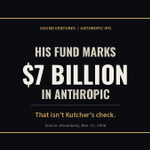
Bloomberg reported November 15 that Sound Ventures, the firm Kutcher co-founded with Guy Oseary, owns roughly 0.5% of Anthropic. At Anthropic's $1.4 trillion target IPO valuation, Bloomberg estimated that stake at about $7 billion, on $435 million invested, about 16 times the money in.
news.bloomberglaw.com/privat…
Anthropic's IPO, the first public sale of its stock, prices Wednesday night, November 18, and starts trading Thursday, November 19, on the Nasdaq as $ANT, at $70 to $78 a share. The 0.5% comes from a person familiar with the matter, not the prospectus, which has to name holders of more than 5% and does not name Sound Ventures, Kutcher, or Oseary.
techcrunch.com/2026/11/10/an…
Kutcher does not take that $7 billion home. Partners get a fee and a cut of profits, called carried interest, under contracts that are not public. In July he left to start a new fund with Morgan Beller and stays on as an adviser, TechCrunch confirmed, citing the Wall Street Journal.
techcrunch.com/2026/07/01/as…
The OpenAI figure is the same mix-up. A leaked list, reported by Inc. and not confirmed by OpenAI, put Sound Ventures at 0.15%, $30 million in, and about $1.3 billion at an $852 billion valuation. Adding that mark to the $7 billion Anthropic figure and handing Kutcher "nearly $8.2 billion" overstates what anyone can show. In May 2023 the firm closed a $240 million AI fund already half in OpenAI, Anthropic, and Stability AI.
inc.com/kevin-haynes/openai-…
techcrunch.com/2023/05/09/so…
On February 21, 2001, Kutcher was late to pick up Ashley Ellerin, a 22-year-old fashion student. He testified on May 29, 2019, that he looked through a window, saw what he took for red wine stains, and drove away. The next day he learned she was dead and told detectives, "I was freaking out." A jury on August 15, 2019, convicted Michael Gargiulo of murdering her. On July 16, 2021, Judge Larry P. Fidler sentenced Gargiulo to death.
latimes.com/local/lanow/la-m…
latimes.com/world-nation/sto…
After Danny Masterson was convicted in May 2023 of raping two women, Kutcher wrote a July 27 letter calling his That '70s Show co-star "an extraordinarily honest and intentional human being" and "among few people that I would trust to be alone with my son and daughter." Masterson was sentenced September 7, 2023, to 30 years to life. On September 14 Kutcher resigned as board chair of Thorn, calling the letter "yet another painful instance of questioning victims".
deadline.com/wp-content/uplo…
thorn.org/blog/an-update-fro…
On February 15, 2017, Kutcher told the Senate that Spotlight, Thorn's police tool, had "helped identify over 6,000 trafficking victims in the U.S., 2,000 of which were minors." In 2022, Forbes reported that Spotlight scrapes online sex ads into a police database covering trafficked children and consenting adult sex workers alike. In Europe, Thorn lobbied for a law that could require apps to scan private messages for child-sexual-abuse material, and Netzpolitik reported Kutcher's profile helped it reach Commission President Ursula von der Leyen. Follow the Money reported a Thorn lobbyist saying its technology "does not work in encrypted spaces."
foreign.senate.gov/imo/media…
forbes.com/sites/thomasbrews…
edri.org/our-work/how-a-holl…
ftm.eu/articles/ashton-kutch…
The $7 billion is a fund mark, not Kutcher's check.
Anthropic's IPO, and what the company told investors about open models, is here:
teapawt.org/brianskellenger/status…

1
138
Cantor Cut $NVDA 45% Before a 32% Drop. Lucky 🍀 or Insider Trading?
Cantor Fitzgerald, now run by the sons of Commerce Secretary Howard Lutnick (R), cut its reported Nvidia ($NVDA) common shares by 45% in the third quarter. After that snapshot date, the stock fell about 32%.
A Tuesday post said the firm "cut its $NVDA position 28%, avoiding a 32% drop." The 32% is about right. The 28% is not.
The source is Cantor's Form 13F, the quarterly holdings report large money managers file with the SEC. It is a snapshot of long positions on the last day of the quarter, not a list of trades or dates. Cantor Fitzgerald, L.P. filed it Monday, November 16, for the quarter ended September 30.
sec.gov/Archives/edgar/data/…
On June 30, Cantor reported 1.81 million Nvidia common shares, worth $362 million. On September 30, that was 1 million shares, worth $228 million, a 45% cut. The 28% figure only appears if you lump those shares with put options, contracts that pay if the stock falls. Cantor still held puts on 1.3 million shares, down only about 7%.
sec.gov/Archives/edgar/data/…
Nvidia closed at $228 on September 30. By November 16, the day Cantor filed, it had closed at $156, about a 32% drop from that quarter-end close. The stock had risen during the quarter, from $200 to $228, and peaked at $239 on October 6, after the snapshot. The filing does not say when during the quarter the shares came off.
investor.nvidia.com/stock-in…
A Cantor spokesperson told CNBC the 13F Nvidia positions "were entered into in the ordinary course of business in connection with client swap transactions," and that its own standalone bets have been "immaterial." A swap, here, is a contract that passes a stock's gain or loss to a client, and the dealer often holds the shares as a hedge. The form does not name clients.
cnbc.com/2026/11/13/howard-l…
Lutnick is not on the filing. He agreed in May 2025 to give up his economic interest in Cantor. The sale to trusts for his adult children closed October 6, 2025, with son Brandon, now chairman and CEO, as controlling trustee. Kyle is executive vice chairman. Ethics rules on a spouse's or minor child's holdings do not reach adult children. He is a Cabinet secretary, not a member of Congress, and no House or Senate trade report shows he sold Nvidia.
cantor.com/cantor-fitzgerald…
The STOCK Act, a 2012 law, says members of Congress and senior executive officials cannot use nonpublic government information to trade. They have to report their own, their spouse's, and their dependent children's stock trades over $1,000 within 45 days, or 30 days after they learn of it. The late fee is $200. Cantor's 13F is not that report. The House passed H.R. 7008 on July 22, 232 to 198, to bar members, their spouses, and their dependent children from buying individual stocks. The Senate failed to advance it September 30, 53 to 47, short of 60 votes. It is not law, and it would not have covered this firm.
energy.gov/gc/stop-trading-c…
congress.gov/bill/119th-cong…
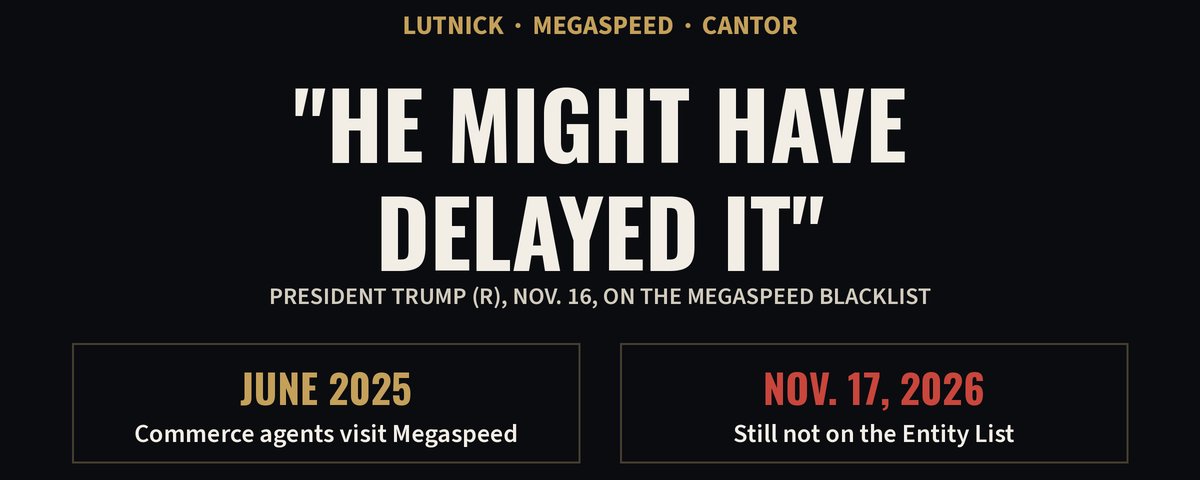
The New York Times reported November 15 that Lutnick "has been seen as a force slowing rules that would clamp down on the sale of Nvidia chips to data centers" outside China that rent computing power to Chinese firms. That is not the same thing as stopping chip smuggling. Axios reported he resisted listing Megaspeed, accused of diverting chips to China, on Commerce's Entity List. Commerce denied the confrontation Axios described with Treasury Secretary Scott Bessent (R). On November 16, Commerce issued a remote-access rule its press release said was "written by and at the direction of the Department of Treasury and the National Security Council."
nytimes.com/2026/11/15/us/po…
axios.com/2026/11/11/bessent…
bis.gov/press-release/bis-is…
Proven: the 45% cut, the 32% drop after September 30, the family trusts, and the client-swap explanation. Not proven: that Lutnick tipped his sons, or that the sold shares were the family's own bet. The filings do not show a crime.
The trail of Nvidia's best chips starts here:
teapawt.org/brianskellenger/status…

111
The Birth Notice Ran in 1961. The Claim Outlived the Proof | How to Illegitimize a President, Part 13
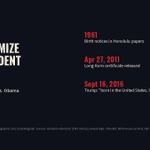
Nine days after Barack Obama (D) was born, the Honolulu Advertiser printed a Health Bureau notice: a son, Aug. 4, to Mr. and Mrs. Barack H. Obama. The Honolulu Star-Bulletin ran the same listing the next day, August 14, 1961. Hawaii officials later said the Health Department, not the family, sent those listings after getting the facts from the hospital. The charge was that he was not eligible, because he had not been born in the United States.
honoluluadvertiser.com/artic…
The Constitution says only a "natural-born citizen" can be president, meaning a citizen from birth. The claim, from people later called birthers, spread in spring 2008, while Hillary Clinton (D) was still fighting him for the nomination, in anonymous chain emails among some of her supporters. FactCheck later reported it found no evidence Clinton or her campaign pushed the rumor; her campaign denied it. Some supporters of Sen. John McCain (R) later kept it going.
factcheck.org/2015/07/was-hi…
In June 2008 the Obama campaign posted Hawaii's Certification of Live Birth, showing a birth in Honolulu on August 4, 1961, at 7:24 p.m. Skeptics still demanded the original paper record, the "long form."
factcheck.org/2008/08/born-i…
On October 31, 2008, Dr. Chiyome Fukino, Hawaii's health director under Gov. Linda Lingle (R), said she and the registrar of vital statistics had personally seen Obama's original birth certificate on file. The following July she added that those records verified he "was born in Hawai'i and is a natural-born American citizen."
health.hawaii.gov/vitalrecor…
health.hawaii.gov/vitalrecor…
Suits to throw him off the ballot were thrown out, including Berg v. Obama, 574 F. Supp. 2d 509 (E.D. Pa. 2008), filed by Philip Berg, a former deputy attorney general who had supported Clinton, and Kerchner v. Obama, 669 F. Supp. 2d 477 (D.N.J. 2009). The Third Circuit, the federal appeals court for that region, let both dismissals stand, 586 F.3d 234 (3d Cir. 2009) and 612 F.3d 204 (3d Cir. 2010), because the filers lacked standing, the right to bring the case. They did not try the birth records.
fec.gov/resources/legal-reso…
www2.ca3.uscourts.gov/opinar…
A CNN/Opinion Research poll in July 2010 found 27 percent of adults said Obama was probably or definitely born abroad. In March 2011, Donald Trump (R) went on The View and said, "There's something on that birth certificate that he doesn't like." A USA Today/Gallup poll of April 20-23, 2011, found 24 percent said the same.
newcomm.org/files/cnn/2010/i…
cbsnews.com/news/trump-vs-th…
news.gallup.com/opinion/poll…
On April 27, 2011, the White House released the long-form certificate. Hawaii Health Director Loretta Fuddy, serving under Gov. Neil Abercrombie (D), said she had seen the original records and vouched for the copies made April 25. The White House copy lists the place of birth as Kapiolani Maternity & Gynecological Hospital in Honolulu.
obamawhitehouse.archives.gov…
health.hawaii.gov/vitalrecor…
A May 5-8 Gallup poll then found 13 percent still said he was born abroad. On September 16, 2016, candidate Trump said, "President Barack Obama was born in the United States. Period." He also said Clinton and her 2008 campaign had started the controversy, which FactCheck had found was not supported. A YouGov/Huffington Post poll of September 17-19 still found 22 percent saying he was not born in the U.S.
news.gallup.com/poll/147530/…
cbsnews.com/news/donald-trum…
yougov.com/en-us/articles/16…
The records were in the newspaper in 1961, vouched for by Hawaii officials of both parties, and released in full in 2011. Why do some claims outlive the proof? Tell me below.
Previous episodes:
2: teapawt.org/brianskellenger/status…
3: teapawt.org/brianskellenger/status…
4: teapawt.org/brianskellenger/status…
5: teapawt.org/brianskellenger/status…
6: teapawt.org/brianskellenger/status…
7: teapawt.org/brianskellenger/status…
8: teapawt.org/brianskellenger/status…
9: teapawt.org/brianskellenger/status…
10: teapawt.org/brianskellenger/status…
11: teapawt.org/brianskellenger/status…
12: teapawt.org/brianskellenger/status…

HOW TO ILLEGITIMIZE A PRESIDENT, Part 12
Jan 6, 2005: Sen. Barbara Boxer (D-CA) and Rep. Stephanie Tubbs Jones (D-OH) objected to Ohio's electoral votes for George W. Bush (R). Senate vote: 74-1.
A protest of the process, or the result?
Part 11: teapawt.org/brianskellenger/status…

1
50
A Murder Trial, a Rapist's Letter and $7 Billion: The Kutcher File
Coin Bureau posted late Monday that Ashton Kutcher's $435 million Anthropic investment "to be worth $7,000,000,000 at IPO, per Bloomberg," and that a reported $30 million early OpenAI check is now worth more than $1.2 billion, for "nearly $8.2 billion". Those figures are the fund's, not Kutcher's payday.
Bloomberg reported November 15 that Sound Ventures, the firm Kutcher co-founded with Guy Oseary, owns roughly 0.5% of Anthropic. At Anthropic's $1.4 trillion target IPO valuation, Bloomberg estimated that stake at about $7 billion, on $435 million invested, about 16 times the money in.
news.bloomberglaw.com/privat…
Anthropic's IPO, the first public sale of its stock, prices Wednesday night, November 18, and starts trading Thursday, November 19, on the Nasdaq as $ANT, at $70 to $78 a share. The 0.5% comes from a person familiar with the matter, not the prospectus, which has to name holders of more than 5% and does not name Sound Ventures, Kutcher, or Oseary.
techcrunch.com/2026/11/10/an…
Kutcher does not take that $7 billion home. Partners get a fee and a cut of profits, called carried interest, under contracts that are not public. In July he left to start a new fund with Morgan Beller and stays on as an adviser, TechCrunch confirmed, citing the Wall Street Journal.
techcrunch.com/2026/07/01/as…
The OpenAI figure is the same mix-up. A leaked list, reported by Inc. and not confirmed by OpenAI, put Sound Ventures at 0.15%, $30 million in, and about $1.3 billion at an $852 billion valuation. Adding that mark to the $7 billion Anthropic figure and handing Kutcher "nearly $8.2 billion" overstates what anyone can show. In May 2023 the firm closed a $240 million AI fund already half in OpenAI, Anthropic, and Stability AI.
inc.com/kevin-haynes/openai-…
techcrunch.com/2023/05/09/so…
On February 21, 2001, Kutcher was late to pick up Ashley Ellerin, a 22-year-old fashion student. He testified on May 29, 2019, that he looked through a window, saw what he took for red wine stains, and drove away. The next day he learned she was dead and told detectives, "I was freaking out." A jury on August 15, 2019, convicted Michael Gargiulo of murdering her. On July 16, 2021, Judge Larry P. Fidler sentenced Gargiulo to death.
latimes.com/local/lanow/la-m…
latimes.com/world-nation/sto…
After Danny Masterson was convicted in May 2023 of raping two women, Kutcher wrote a July 27 letter calling his That '70s Show co-star "an extraordinarily honest and intentional human being" and "among few people that I would trust to be alone with my son and daughter." Masterson was sentenced September 7, 2023, to 30 years to life. On September 14 Kutcher resigned as board chair of Thorn, calling the letter "yet another painful instance of questioning victims".
deadline.com/wp-content/uplo…
thorn.org/blog/an-update-fro…
On February 15, 2017, Kutcher told the Senate that Spotlight, Thorn's police tool, had "helped identify over 6,000 trafficking victims in the U.S., 2,000 of which were minors." In 2022, Forbes reported that Spotlight scrapes online sex ads into a police database covering trafficked children and consenting adult sex workers alike. In Europe, Thorn lobbied for a law that could require apps to scan private messages for child-sexual-abuse material, and Netzpolitik reported Kutcher's profile helped it reach Commission President Ursula von der Leyen. Follow the Money reported a Thorn lobbyist saying its technology "does not work in encrypted spaces."
foreign.senate.gov/imo/media…
forbes.com/sites/thomasbrews…
edri.org/our-work/how-a-holl…
ftm.eu/articles/ashton-kutch…
The $7 billion is a fund mark, not Kutcher's check.
Anthropic's IPO, and what the company told investors about open models, is here:
teapawt.org/brianskellenger/status…

217
Leaked Files Show $582 Million in Epstein Flags | Deutsche Bank Files, Part 1
Deutsche Bank ($DB) flagged about $582 million in transfers tied to Jeffrey Epstein as suspicious. That number is in an internal document from the bank's U.S. financial-crimes unit, among more than 15 million files that journalists published today, November 17, 2026, in an investigation called Inside Deutsche Bank. The bank filed 21 suspicious activity reports. Those are the confidential notices a bank sends U.S. authorities when it thinks a transfer may involve a crime. The reports covered about 3,000 to 3,200 transactions from October 2013 to May 2019. The Financial Times said the flagged items included payments to women, transfers through shell companies, and money from billionaire associates Leon Black and Glenn Dubin. A flag is not a finding that every dollar was a crime.
thenewsminute.com/news/insid…
cnbc.com/2026/11/17/deutsche…
The $582 million is more than double the $250 million Sen. Ron Wyden (D-Ore.) cited in an August report. Wyden, a senior Democrat on the Senate Finance Committee, recommended a criminal investigation of Epstein's bankers. Part of the gap, the Financial Times said, is that Deutsche Bank's own review also counted checks and transfers that went through other banks.
finance.senate.gov/ranking-m…
finance.yahoo.com/markets/st…
Epstein was already a convicted sex offender when the bank took him as a client. He pleaded guilty in 2008 to soliciting a minor for prostitution and had to register as a sex offender. Deutsche Bank opened accounts for him in August 2013, after JPMorgan ($JPM) was winding that relationship down. The German lender hoped the accounts would bring in $2 million to $4 million a year. The files, as the Financial Times read them, show about $1 million a year for wealth management from 2015 to 2018. New York's banking regulator later found that conditions a reputational-risk committee had placed on the accounts never reached most of the relationship team, and that a compliance officer misread them. The bank told Epstein in December 2018 it was ending the accounts, after new reporting on the abuse, and shut the last two accounts three days after his July 2019 arrest.
dfs.ny.gov/reports_and_publi…
An internal review in Britain, summarized in September 2019, found at least 112 high-risk transactions and looked at possible links to abuse at Epstein's Zorro Ranch in New Mexico and at possible misuse of a charity called Gratitude America. A 2015 bank email described Ghislaine Maxwell, later convicted in the United States, as an alleged "co-conspirator in Epstein's illegal activities," then cleared a trust that listed her as a beneficiary because she was not herself a Deutsche Bank client.
thenewsminute.com/news/insid…
New York's Department of Financial Services fined Deutsche Bank $150 million in July 2020. That order covered the Epstein accounts and two other high-risk foreign banks the German lender cleared dollars for: Danske Bank's Estonian branch and FBME Bank. In 2023, Deutsche Bank agreed to pay $75 million to settle a lawsuit by Epstein's accusers, without admitting wrongdoing. Add those together and you get $225 million, the figure now making the rounds. The first fine was not Epstein only.
reuters.com/legal/us-judge-a…
This is the same bank that kept lending to Donald Trump (R) after he defaulted on a $640 million Chicago tower loan in 2008 and then sued the lender. David Enrich documented that history in his 2020 book Dark Towers. By 2020, Reuters put the outstanding loans at about $340 million. That lending, and the bank's 2021 exit, is a later part of this series.
reuters.com/article/usa-elec…
Deutsche Bank says the leaked material covers matters that "date back many years and in some cases as much as two decades," that it reviewed them at the time and worked with regulators, and that under CEO Christian Sewing it spent 7 billion euros on controls from 2019 through 2025.
cnbc.com/2026/11/17/deutsche…

BOLSHEVIK 2.0, Part 10: Seize the Builders
1928: Stalin's secret police arrest 53 engineers and managers from the Shakhty coal mines for "wrecking." Eleven get death sentences.
Election night 2026: "arrest Elon Musk / seize his factories / nationalize SpaceX." 28K likes. 🧵

Stalin wrote that he had "no doubt" peasants fleeing Ukraine "for bread" were organized by enemies of Soviet power, including agents of Poland. Police were told to catch them and send them back. Later counts: about 3.5 to 5 million dead in Soviet Ukraine.
teapawt.org/brianskellenger/status…
Stalin Barred Starving Peasants From Leaving Ukraine | Bolshevik 2.0, Part 12
On January 22, 1933, Joseph Stalin and Vyacheslav Molotov, chairman of the Soviet Council of People's Commissars, signed Directive No. 65/sh. Reports had reached them, the order said, that a "mass departure of peasants 'for bread'" had begun in Ukraine and the Kuban, the grain country of the North Caucasus. Stalin and Molotov wrote that they had "no doubt" the movement was organized by "enemies of Soviet power," including the Socialist-Revolutionaries, a rival party, and "agents of Poland," to agitate against the collective farms. Officials who had "overlooked" a similar exodus the year before were not to repeat it.
The order was blunt. Party and secret-police officials in the North Caucasus were "not to allow the mass departure of peasants" to other regions, or entry from Ukraine. Officials in Ukraine were "not to allow the mass departure of peasants from Ukraine to other regions," or entry from the North Caucasus. Police in Moscow, Belarus, the Volga and the Central Black Earth region were to arrest peasants from Ukraine and the North Caucasus who had "made their way north," separate out the "counterrevolutionary elements," and send the rest back to where they had come from. The text is held in the Russian State Archive of Socio-Political History and published on Wikisource.
The next day, Ukrainian Party secretary Mendel Khatayevich and Ukrainian government head Vlas Chubar told every region to stop selling train tickets beyond Ukraine to peasants who did not have a local-government exit permit or papers showing they had been recruited for state work.
Grain had already been taken under Stalin's procurement quotas. People tried to walk or ride out "for bread." The state shut the roads and the ticket windows and sent them home to starve. Later demographic work puts the death toll in Soviet Ukraine at about 3.5 to 5 million. A 2003 joint statement at the United Nations, signed by 25 countries, had put it at 7 to 10 million. The lower range is the one the later counts support. Kazakhstan and parts of Russia starved in the same years. Ukraine was hit especially hard, and this order named Ukraine and the Kuban.
Now 2026. Foreign Policy, on August 6, reported that the Black Sea's grain corridors are again at the center of Russia's war on Ukraine, as they were in 2022 and 2023, when a Russian naval blockade stopped Ukrainian maritime exports and shook food markets worldwide. This time, the magazine said, the problem is not a physical blockade of the channel. Russia is striking ships, crews, and cargo, and the insurance and freight risk has gotten so high that merchant vessels will not make the trip. "Grain isn't moving despite an open corridor." Ukraine had already shipped much of its recent harvest, and global stocks are relatively flush, so the shock is not yet the 2022 panic. The pattern is older than this war: food, and the routes that carry it, used as a lever.
The fair difference: 1933 was a government sealing its own peasants inside a famine. 2026 is a war between states, and there is no Holodomor unfolding in Ukraine this year. Nobody should talk as if the two are the same event. The method to watch is the older one. When people are already hungry, or when the world's bread moves through one sea, the power to close the exit is the power to decide who eats.
Sources: Directive 65/sh, Jan. 22, 1933, RGASPI, via Wikisource: ru.wikisource.org/wiki/%D0%9…
Holodomor death-toll range: en.wikipedia.org/wiki/Holodo…
Foreign Policy, Aug. 6, 2026: foreignpolicy.com/2026/08/06…
Previous parts:
Introduction: teapawt.org/brianskellenger/status…
1: teapawt.org/brianskellenger/status…
2: teapawt.org/brianskellenger/status…
3: teapawt.org/brianskellenger/status…
4: teapawt.org/brianskellenger/status…
5: teapawt.org/brianskellenger/status…
6: teapawt.org/brianskellenger/status…
7: teapawt.org/brianskellenger/status…
8: teapawt.org/brianskellenger/status…
9: teapawt.org/brianskellenger/status…
10: teapawt.org/brianskellenger/status…
11: teapawt.org/brianskellenger/status…
Full series: brianskellenger.substack.com…
3
BOLSHEVIK 2.0, Part 9: Model Trial
June 8, 1922: Moscow opens its first big show trial. In the dock: leaders of the SR party, 1917's top vote-getter.
Nov 2, 2026: Turkey resumes its mass trial of Istanbul Mayor İmamoğlu, Erdoğan's main rival. Secret witnesses next. 🧵
Grain had already been taken under Stalin's quotas. People tried to leave "for bread." The next day, Ukrainian officials stopped selling them train tickets out of the republic. Later counts put the dead in Soviet Ukraine at about 3.5 to 5 million.
teapawt.org/brianskellenger/status…
Stalin Barred Starving Peasants From Leaving Ukraine | Bolshevik 2.0, Part 12
On January 22, 1933, Joseph Stalin and Vyacheslav Molotov, chairman of the Soviet Council of People's Commissars, signed Directive No. 65/sh. Reports had reached them, the order said, that a "mass departure of peasants 'for bread'" had begun in Ukraine and the Kuban, the grain country of the North Caucasus. Stalin and Molotov wrote that they had "no doubt" the movement was organized by "enemies of Soviet power," including the Socialist-Revolutionaries, a rival party, and "agents of Poland," to agitate against the collective farms. Officials who had "overlooked" a similar exodus the year before were not to repeat it.
The order was blunt. Party and secret-police officials in the North Caucasus were "not to allow the mass departure of peasants" to other regions, or entry from Ukraine. Officials in Ukraine were "not to allow the mass departure of peasants from Ukraine to other regions," or entry from the North Caucasus. Police in Moscow, Belarus, the Volga and the Central Black Earth region were to arrest peasants from Ukraine and the North Caucasus who had "made their way north," separate out the "counterrevolutionary elements," and send the rest back to where they had come from. The text is held in the Russian State Archive of Socio-Political History and published on Wikisource.
The next day, Ukrainian Party secretary Mendel Khatayevich and Ukrainian government head Vlas Chubar told every region to stop selling train tickets beyond Ukraine to peasants who did not have a local-government exit permit or papers showing they had been recruited for state work.
Grain had already been taken under Stalin's procurement quotas. People tried to walk or ride out "for bread." The state shut the roads and the ticket windows and sent them home to starve. Later demographic work puts the death toll in Soviet Ukraine at about 3.5 to 5 million. A 2003 joint statement at the United Nations, signed by 25 countries, had put it at 7 to 10 million. The lower range is the one the later counts support. Kazakhstan and parts of Russia starved in the same years. Ukraine was hit especially hard, and this order named Ukraine and the Kuban.
Now 2026. Foreign Policy, on August 6, reported that the Black Sea's grain corridors are again at the center of Russia's war on Ukraine, as they were in 2022 and 2023, when a Russian naval blockade stopped Ukrainian maritime exports and shook food markets worldwide. This time, the magazine said, the problem is not a physical blockade of the channel. Russia is striking ships, crews, and cargo, and the insurance and freight risk has gotten so high that merchant vessels will not make the trip. "Grain isn't moving despite an open corridor." Ukraine had already shipped much of its recent harvest, and global stocks are relatively flush, so the shock is not yet the 2022 panic. The pattern is older than this war: food, and the routes that carry it, used as a lever.
The fair difference: 1933 was a government sealing its own peasants inside a famine. 2026 is a war between states, and there is no Holodomor unfolding in Ukraine this year. Nobody should talk as if the two are the same event. The method to watch is the older one. When people are already hungry, or when the world's bread moves through one sea, the power to close the exit is the power to decide who eats.
Sources: Directive 65/sh, Jan. 22, 1933, RGASPI, via Wikisource: ru.wikisource.org/wiki/%D0%9…
Holodomor death-toll range: en.wikipedia.org/wiki/Holodo…
Foreign Policy, Aug. 6, 2026: foreignpolicy.com/2026/08/06…
Previous parts:
Introduction: teapawt.org/brianskellenger/status…
1: teapawt.org/brianskellenger/status…
2: teapawt.org/brianskellenger/status…
3: teapawt.org/brianskellenger/status…
4: teapawt.org/brianskellenger/status…
5: teapawt.org/brianskellenger/status…
6: teapawt.org/brianskellenger/status…
7: teapawt.org/brianskellenger/status…
8: teapawt.org/brianskellenger/status…
9: teapawt.org/brianskellenger/status…
10: teapawt.org/brianskellenger/status…
11: teapawt.org/brianskellenger/status…
Full series: brianskellenger.substack.com…
2
BOLSHEVIK 2.0, Part 8: Wrong Words
June 1, 1922: Lenin's Criminal Code takes effect. Art. 70: "propaganda and agitation" aiding the "bourgeoisie" means exile or 3+ years.
Last week: UK police charged Kellie-Jay Keen over posts calling Islam a "death cult." Court Dec 4. 🧵

On January 22, 1933, Stalin and Molotov barred peasants from leaving Ukraine and the Kuban "for bread." Police were to catch those who made it north and send them home to starve. Later counts put the dead in Soviet Ukraine at about 3.5 to 5 million.
teapawt.org/brianskellenger/status…
Stalin Barred Starving Peasants From Leaving Ukraine | Bolshevik 2.0, Part 12
On January 22, 1933, Joseph Stalin and Vyacheslav Molotov, chairman of the Soviet Council of People's Commissars, signed Directive No. 65/sh. Reports had reached them, the order said, that a "mass departure of peasants 'for bread'" had begun in Ukraine and the Kuban, the grain country of the North Caucasus. Stalin and Molotov wrote that they had "no doubt" the movement was organized by "enemies of Soviet power," including the Socialist-Revolutionaries, a rival party, and "agents of Poland," to agitate against the collective farms. Officials who had "overlooked" a similar exodus the year before were not to repeat it.
The order was blunt. Party and secret-police officials in the North Caucasus were "not to allow the mass departure of peasants" to other regions, or entry from Ukraine. Officials in Ukraine were "not to allow the mass departure of peasants from Ukraine to other regions," or entry from the North Caucasus. Police in Moscow, Belarus, the Volga and the Central Black Earth region were to arrest peasants from Ukraine and the North Caucasus who had "made their way north," separate out the "counterrevolutionary elements," and send the rest back to where they had come from. The text is held in the Russian State Archive of Socio-Political History and published on Wikisource.
The next day, Ukrainian Party secretary Mendel Khatayevich and Ukrainian government head Vlas Chubar told every region to stop selling train tickets beyond Ukraine to peasants who did not have a local-government exit permit or papers showing they had been recruited for state work.
Grain had already been taken under Stalin's procurement quotas. People tried to walk or ride out "for bread." The state shut the roads and the ticket windows and sent them home to starve. Later demographic work puts the death toll in Soviet Ukraine at about 3.5 to 5 million. A 2003 joint statement at the United Nations, signed by 25 countries, had put it at 7 to 10 million. The lower range is the one the later counts support. Kazakhstan and parts of Russia starved in the same years. Ukraine was hit especially hard, and this order named Ukraine and the Kuban.
Now 2026. Foreign Policy, on August 6, reported that the Black Sea's grain corridors are again at the center of Russia's war on Ukraine, as they were in 2022 and 2023, when a Russian naval blockade stopped Ukrainian maritime exports and shook food markets worldwide. This time, the magazine said, the problem is not a physical blockade of the channel. Russia is striking ships, crews, and cargo, and the insurance and freight risk has gotten so high that merchant vessels will not make the trip. "Grain isn't moving despite an open corridor." Ukraine had already shipped much of its recent harvest, and global stocks are relatively flush, so the shock is not yet the 2022 panic. The pattern is older than this war: food, and the routes that carry it, used as a lever.
The fair difference: 1933 was a government sealing its own peasants inside a famine. 2026 is a war between states, and there is no Holodomor unfolding in Ukraine this year. Nobody should talk as if the two are the same event. The method to watch is the older one. When people are already hungry, or when the world's bread moves through one sea, the power to close the exit is the power to decide who eats.
Sources: Directive 65/sh, Jan. 22, 1933, RGASPI, via Wikisource: ru.wikisource.org/wiki/%D0%9…
Holodomor death-toll range: en.wikipedia.org/wiki/Holodo…
Foreign Policy, Aug. 6, 2026: foreignpolicy.com/2026/08/06…
Previous parts:
Introduction: teapawt.org/brianskellenger/status…
1: teapawt.org/brianskellenger/status…
2: teapawt.org/brianskellenger/status…
3: teapawt.org/brianskellenger/status…
4: teapawt.org/brianskellenger/status…
5: teapawt.org/brianskellenger/status…
6: teapawt.org/brianskellenger/status…
7: teapawt.org/brianskellenger/status…
8: teapawt.org/brianskellenger/status…
9: teapawt.org/brianskellenger/status…
10: teapawt.org/brianskellenger/status…
11: teapawt.org/brianskellenger/status…
Full series: brianskellenger.substack.com…
5
BOLSHEVIK 2.0, Part 7: Church Gold
Feb 23, 1922: Moscow decrees the seizure of church valuables "for the starving," sacred vessels included.
Oct 29, 2026: A Ukrainian court hears a bid to give a seized UOC cathedral to a rival church. 700+ parishioners barred from the case. 🧵

5
90
Starving families tried to leave Ukraine to find bread. On January 22, 1933, Stalin and Molotov ordered police to catch them and send them home. The next day, officials stopped selling them train tickets. About 3.5 to 5 million died in Soviet Ukraine.
teapawt.org/brianskellenger/status…
Stalin Barred Starving Peasants From Leaving Ukraine | Bolshevik 2.0, Part 12
On January 22, 1933, Joseph Stalin and Vyacheslav Molotov, chairman of the Soviet Council of People's Commissars, signed Directive No. 65/sh. Reports had reached them, the order said, that a "mass departure of peasants 'for bread'" had begun in Ukraine and the Kuban, the grain country of the North Caucasus. Stalin and Molotov wrote that they had "no doubt" the movement was organized by "enemies of Soviet power," including the Socialist-Revolutionaries, a rival party, and "agents of Poland," to agitate against the collective farms. Officials who had "overlooked" a similar exodus the year before were not to repeat it.
The order was blunt. Party and secret-police officials in the North Caucasus were "not to allow the mass departure of peasants" to other regions, or entry from Ukraine. Officials in Ukraine were "not to allow the mass departure of peasants from Ukraine to other regions," or entry from the North Caucasus. Police in Moscow, Belarus, the Volga and the Central Black Earth region were to arrest peasants from Ukraine and the North Caucasus who had "made their way north," separate out the "counterrevolutionary elements," and send the rest back to where they had come from. The text is held in the Russian State Archive of Socio-Political History and published on Wikisource.
The next day, Ukrainian Party secretary Mendel Khatayevich and Ukrainian government head Vlas Chubar told every region to stop selling train tickets beyond Ukraine to peasants who did not have a local-government exit permit or papers showing they had been recruited for state work.
Grain had already been taken under Stalin's procurement quotas. People tried to walk or ride out "for bread." The state shut the roads and the ticket windows and sent them home to starve. Later demographic work puts the death toll in Soviet Ukraine at about 3.5 to 5 million. A 2003 joint statement at the United Nations, signed by 25 countries, had put it at 7 to 10 million. The lower range is the one the later counts support. Kazakhstan and parts of Russia starved in the same years. Ukraine was hit especially hard, and this order named Ukraine and the Kuban.
Now 2026. Foreign Policy, on August 6, reported that the Black Sea's grain corridors are again at the center of Russia's war on Ukraine, as they were in 2022 and 2023, when a Russian naval blockade stopped Ukrainian maritime exports and shook food markets worldwide. This time, the magazine said, the problem is not a physical blockade of the channel. Russia is striking ships, crews, and cargo, and the insurance and freight risk has gotten so high that merchant vessels will not make the trip. "Grain isn't moving despite an open corridor." Ukraine had already shipped much of its recent harvest, and global stocks are relatively flush, so the shock is not yet the 2022 panic. The pattern is older than this war: food, and the routes that carry it, used as a lever.
The fair difference: 1933 was a government sealing its own peasants inside a famine. 2026 is a war between states, and there is no Holodomor unfolding in Ukraine this year. Nobody should talk as if the two are the same event. The method to watch is the older one. When people are already hungry, or when the world's bread moves through one sea, the power to close the exit is the power to decide who eats.
Sources: Directive 65/sh, Jan. 22, 1933, RGASPI, via Wikisource: ru.wikisource.org/wiki/%D0%9…
Holodomor death-toll range: en.wikipedia.org/wiki/Holodo…
Foreign Policy, Aug. 6, 2026: foreignpolicy.com/2026/08/06…
Previous parts:
Introduction: teapawt.org/brianskellenger/status…
1: teapawt.org/brianskellenger/status…
2: teapawt.org/brianskellenger/status…
3: teapawt.org/brianskellenger/status…
4: teapawt.org/brianskellenger/status…
5: teapawt.org/brianskellenger/status…
6: teapawt.org/brianskellenger/status…
7: teapawt.org/brianskellenger/status…
8: teapawt.org/brianskellenger/status…
9: teapawt.org/brianskellenger/status…
10: teapawt.org/brianskellenger/status…
11: teapawt.org/brianskellenger/status…
Full series: brianskellenger.substack.com…
2