

Constitutional, media, and tech law + miscellany. Formerly: Cato Institute's Robert A. Levy Center for Constitutional Studies; Mercatus Center at GMU.
Washington, DC
Joined January 2010
- Tweets13.7K
- Following374
- Followers2.3K
- Likes279




Brent Skorup retweeted

Best news I’ve read this month

NEW: Waymo mapping vehicles spotted in Arlington neighborhoods arlnow.com/2026/10/27/new-wa…

Brent Skorup retweeted

Legendary former Chicago Bears Head Coach Mike Ditka, who coached the Bears to a dominant victory in Super Bowl XX, has died at 86, according to reports.
Read more: wgntv.com/sports/legendary-f…

Brent Skorup retweeted
Today, @FinCENnews issued a final rule that permanently removes the requirement for U.S. companies and U.S. persons to report beneficial ownership information. FinCEN today also announced that it will delete previously reported information by U.S. persons from the beneficial ownership information database.
Brent Skorup retweeted

In the 1980s, experts tried to open this class of burned Roman scroll and assigned it a readability score of zero. Last month, researchers read nearly 5 feet of it, 20 columns of ancient Greek, without ever unrolling it.
The reason it took 40 more years is a physics problem, a brutal one. The ink is carbon. The carbonized papyrus is also carbon. Under a CT scanner, the writing and the page are the same material. X-rays pass through both identically, so a perfect 3D scan of the scroll shows you a perfect 3D scan of nothing.
The breakthrough was training AI to detect ink by texture instead of density. Dried ink subtly changes how papyrus fibers crack and sit, and a neural net can learn that micro-pattern even when the chemistry is invisible.
The people who cracked it were not papyrologists. Brent Seales, a computer science professor at Kentucky, spent 20 years on the scanning problem, then Nat Friedman turned it into an open contest in 2023. First letters were found by Luke Farritor, a 21-year-old SpaceX intern working nights. The grand prize team split $700,000. A crowdsourced contest solved what 250 years of careful physical unrolling mostly destroyed.
And the payoff is bigger than one scroll. This one appears to be a philosophical treatise on ethics and human nature. Another scroll from the same batch turned out to be "On the Gods, Book Eight" by Philodemus. Scholars did not know that book existed. Nobody knew there was a Book One.
The library it came from sat in a villa likely owned by Julius Caesar's father-in-law, roughly 800 scrolls, the only intact library that survived from the classical world. Some of those books were already centuries old when Vesuvius buried them. Part of the villa has never been excavated.
We may be about to read more lost ancient literature in the next decade than humanity recovered in the last five.


Brent Skorup retweeted

"Resolved, That these United Colonies are, and of right ought to be, free and independent States, that they are absolved from all allegiance to the British Crown, and that all political connection between them and the State of Great Britain is, and ought to be, totally dissolved"

Brent Skorup retweeted

BIG NEWS in #LoperBright. @NOAAFish has directed the New Eng. Fishery Mgmt. Council to rescind the industry-funded monitoring requirements for the herring fishery. If the council doesn't act, @CommerceGov may repeal them directly. Read more below. @CauseofActionDC

Brent Skorup retweeted

Apply to Cato University 2026: Criminal Justice Symposium cato.org/blog/apply-cato-uni… via @CatoInstitute

Brent Skorup retweeted

🚨 The Supreme Court unanimously rules that a crisis pregnancy center can challenge a New Jersey investigation seeking its donor information before enforcement, holding the subpoena itself chills First Amendment associational rights and creates standing.

Brent Skorup retweeted

“A History of Cronyism and Capture in the Information Technology Sector,” by Adam Thierer and @bskorup, Journal of Technology Law and Policy, Vol. 18, No 2 (2013).
scholarship.law.ufl.edu/jtlp…
Brent Skorup retweeted

You can get dragged into a police investigation by proximity alone — for now theverge.com/report/919664/c…


Brent Skorup retweeted

Colorado has lost at SCOTUS 3 times for laws that police speech. Now xAI is suing over the state’s AI “anti‑discrimination” law, arguing it pressures models like Grok to avoid lawsuits—not pursue truth. Are AI systems the “new libraries” for free expression?
ow.ly/4i3l50YOGZ0

Brent Skorup retweeted

The Supreme Court will hear oral arguments Monday in a case that could limit the government’s ability to obtain bulk digital data of device users with a single warrant, in a rare instance of the country’s top justices taking on digital rights. scoopmedia.co/493emJ8

Brent Skorup retweeted

BREAKING - Autonomous Vehicles (self driving taxis) in DC take a huge step forward as DC Councilmember Charles Allen expected to introduce legislation today to “operationalize” AV’s in the District. Unclear when this will come up for vote. @nbcwashington

Brent Skorup retweeted

This is my take too. No matter the technical legal outcome, AT&T and Verizon will almost certainly "win" by cementing what the government conceded about the extremely limited effects of FCC forfeiture orders.

Brent Skorup retweeted

Great perspective by @bskorup
Why the Tariff Case Was Never Just About Tariffs
cato.org/blog/why-tariff-cas…

Brent Skorup retweeted
The Supreme Court heard a major case today on whether the FCC can impose $100M+ in penalties without a jury trial. Cato’s amicus brief argued this violates the Seventh Amendment—agencies shouldn't be judge, jury, and enforcer of their own claims.
Read more: ow.ly/vtuF50YNEIr

Brent Skorup retweeted

An @IJ victory 13 years in the making! Ron Hines is a retired veterinarian who gave advice to pet owners around the world by email. Then the Texas veterinary board told him he couldn't give advice about any animal he had not physically examined. 🧵
ij.org/press-release/victory…

Brent Skorup retweeted

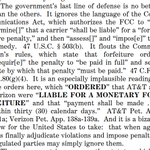
I was in the courtroom for today's Supreme Court arguments in AT&T v. FCC, on the Seventh Amendment right to a jury in FCC punitive enforcement proceedings. The government has conceded so much already in this case that the justices seemed frustrated by the almost metaphysical quality of the remaining question: Is an FCC finding of liability and order of forfeiture itself a punishment (triggering the jury right), or is the punishment only when the government *collects* the amount ordered?
The government now insists that anyone may ignore a final forfeiture order from the FCC and wait to be sued by the government, and that the forfeiture order carries no stigma or negative consequence on its own until it is actually paid and affirmed. As Jeffrey Wall argued for the carriers, that is not how telecom companies have understood the system for decades. Indeed, his most forceful argument was one based on experience; it appears no telecom company has *ever* chosen to ignore an FCC final order, not pay the fine, and wait to be sued for collection.
Nonetheless, some justices seemed open to the idea of writing an opinion holding that an FCC final forfeiture order is (as Wall put it) not even a paper tiger, but just paper. It is possible the Court will go that route, clarify that such an order on its own may carry no stigma and may not be used against a company in any way, and leave the current system in place in which there is no jury until the government comes to collect.
Nonetheless, such an opinion would be cold comfort to those who for decades have treated such orders as serious and binding, without the government ever disclaiming that understanding. As with the doctrine of "constitutional avoidance," all too often the government takes a maximalist view of its own powers until those powers are challenged in court, when the government changes its tune and adopts a minimalist view just in time to save the scheme from being struck down.
The simpler and better approach would be for the Court to simply hold, as it did in Jarkesy, that the agency enforcement scheme at issue in this case is punitive and thus triggers the jury right.

This morning the Supreme Court will hear arguments in consolidated cases challenging the @FCC's authority to impose massive civil penalties without a jury trial. After an administrative proceeding in front of an agency judge and without a jury, FCC issued final forfeiture orders against @ATT and @Verizon, finding them liable for alleged violations of federal data-protection rules and assessing penalties totaling more than $100 million combined.
Although these cases are about the FCC, the stakes extend far beyond telecommunications policy. If the FCC wins, it would allow agencies across the federal government to impose binding judgments first and offer a jury trial only later, if the government chooses to pursue collection. That reverses the constitutional order.
The Seventh Amendment protects the right to a civil jury trial in “suits at common law.” As the Supreme Court recently reaffirmed in SEC v. Jarkesy, government actions seeking civil penalties are historically analogous to common-law actions in debt—cases that were tried before juries. The jury is not merely a procedural formality. It is a structural protection against arbitrary government power, ensuring that ordinary citizens stand between the state and the imposition of punishment, whether that punishment is criminal or civil in nature.
Yet under the Communications Act, the FCC investigates alleged violations, makes factual findings, determines liability, and imposes binding monetary penalties all in-house, without a jury. These forfeiture orders are not advisory. They declare companies “liable,” create a debt to the United States, and carry immediate consequences, including reputational harm and future regulatory exposure.
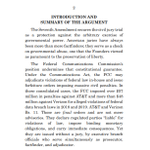
That is why @CatoInstitute has filed an amicus brief supporting the carriers in the case, co-authored by @bskorup and @AMXenos, in which we argue that the FCC’s forfeiture scheme violates the Seventh Amendment right to a jury.
In response, the government argues that the statute offers a supposed escape hatch: a company can refuse to pay and wait for the Department of Justice to bring a collection action in federal court, where a jury trial would be available. But as we explain in our brief, that “choice” is illusory. To preserve even the possibility of a jury trial, a company must openly defy a final agency order, risk additional regulatory retaliation, and endure years of uncertainty. Unsurprisingly, it appears no company has ever taken that option. Companies instead pay and seek review in a court of appeals—where no jury is available and where factual review is deferential to the agency.
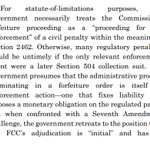
Our brief makes another, structural point. The government cannot have it both ways on the statute of limitations. To preserve penalties under the five-year statutory limit, the government treats the FCC’s forfeiture proceeding as “enforcement.” But when faced with the Seventh Amendment, it claims the same proceeding is merely “initial.” A process that is final enough to preserve penalty claims cannot simultaneously be too preliminary to trigger the jury right.
We urge the Court to adopt a straightforward rule: when an agency proceeding culminates in final agency action and is treated as enforcement sufficient to preserve civil penalties, it constitutes the adjudication of a legal claim for money. In such cases, the Seventh Amendment requires a jury before liability is conclusively determined. A later, optional enforcement suit cannot retroactively cure a Seventh Amendment violation. At the Founding, the jury’s role was antecedent—not remedial. Because the carriers’ liability was determined before they had access to a jury, the Supreme Court should rule that their Seventh Amendment rights were violated.
Brent Skorup retweeted

Great to see results in San Fran like those we have seen at @wmata. With our new gates fare evasion dropped over 80% collecting millions for better service, maintenance costs down & with other tools has resulted in the lowest crime we have ever had.

The stats here are kind of remarkable. BART's new fare gates have led to a 1,000-hour decline in clean up time; 41% drop in crime; and $10 million increase in projected revenue. theatlantic.com/ideas/2026/0…
