

The AI Infrastructure Lifecycle Platform™. Validated GPU hardware & capacity, deployable now. Daily GPU economics from the warehouse floor. https://xitter.cf/t.co/mZaB6SSqtu
Joined October 2026
- Tweets75
- Following110
- Followers15
- Likes95

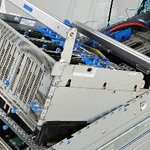
Getting more tokens out of every GPU hour is the way out, and older hardware doesn't block it. Same A100 40GB node, only the serving stack changed: 2,182 to 4,235 tok/s on Qwen3.8 27B, with twice the tokens per watt. charg.cloud/articles/gpu-inf… xitter.cf/jessiedong_/status/211…


inference providers are creating the market that squeezes their own margins
the basic economics of inference companies is selling tokens and paying for gpu time. what they earn from each gpu-hour depends on 3 things
- the price of a token, # of tokens the gpu produces, and how much of the hour the gpu is used
from one side, more providers are competing for the same gpus (pushing the cost of gpus up). from the other, they're all selling the same open models, which pushes the price of tokens down
to get out of this problem, I think the only way is to get more tokens out of every gpu-hour. better software, or being differentiated in being able to run inference on cheaper hardware
it's hard to tell which providers will survive because demand is growing fast enough so that everyone has customers. demand may not actually slow down, though I think supply will catch up

GPU rent is up since January and token prices keep falling. The only thing left to give is tokens per GPU hour, and stock serving settings leave about half of an A100 node's output on the table.
Measured on our own node: 2,182 tokens a second stock, 4,235 tuned, same latency targets. The levers and what didn't work: charg.cloud/articles/gpu-inf…
Put eleven of the 2026 open models on one A100 40GB node. Seven hit our chat latency targets, three only run single user in llama.cpp, and Inkling won't load in vLLM or SGLang at all. Usually it's the checkpoint or the engine build, not the GPU. charg.cloud/articles/which-m…

Tuning isn't 2x on everything. Same A100 40GB node: Qwen3.8 27B got 1.94x because its weights had room to shrink. GLM 5.3 Flash already ships at 4 bit and got 1.25x. MiMo V2.6 Flash got nothing, 2,462 tokens a second either way. charg.cloud/articles/gpu-inf…
That compute doesn't vanish, it gets resold. It's what we do with retired hyperscaler A100s. Six years in they still rent above a six year depreciation line, and one tuned 40GB node serves Qwen3.8 27B at 4,235 tokens a second. charg.cloud/articles/hypersc… xitter.cf/kimmonismus/status/211…


It seems the first market correction in AI is underway. Musk believes many neoclouds will run out of money.
But there's also an advantage to this, because the acquired compute won't disappear; instead, it will go to companies that already have strong revenue streams. Therefore, no "bubble" will burst.
How many people can one A100 40GB node serve? On our tuned stack, about 250 chatting at once on a 27B model, each getting a new token every 45 to 47 ms and the first one in 1.35 seconds. Two replicas, 125 users each. charg.cloud/a100-benchmarks

Compute cost per token = GPU rent / billable tokens. Rent is fixed once you sign, tokens aren't. Same A100 40GB node, same rent: 2,182 tokens per second stock, 4,235 tuned. That's 48% off the compute cost of each token. charg.cloud/articles/gpu-inf… xitter.cf/ShanuMathew93/status/2…

great post & chart. interesting... bit of narrative violation:
>The inference business is more profitable than ever.
>Compute cost per token = Gpu rental cost / billable tokens produced
>Purely serving closed source tokens is becoming a less economically feasible business model.
Why? Your input cost is rising while the price you charge customers is falling on a like for like basis. Anyone whose business is essentially reselling closed-source API tokens without proprietary efficiency advantages or other differentiation is getting margin-compressed.
A lot of the compute that's underearning is just undertuned. Same A100 40GB node: the stock stack did 2,182 tokens per second, our tuned stack did 4,235. The rest is getting it somewhere with live power. charg.cloud/a100-benchmarks xitter.cf/chamath/status/2114389…

As someone with a portfolio of energized land assets here is what I am seeing:
1. Neoclouds are disorganized and poorly capitalized. Some are definitely better than others however.
2. Hyperscalers are intractable, bureaucratic organizations that take 3 months to do an NDA and want 18mo escrow periods. We built our portfolio by competing against these terms because of our speed and simplicity. The more future assets orgs like ours win, the bigger the problem for the hyperscalers downstream (see 3).
3. There are delays in the existing pipeline that will catch people off guard in 2027. Hyperacalers will (obviously) react by focusing on their own internal compute needs over any third party. If the third party is a model company, they will tell them to go through their model router where they will also take a non-trivial vig. Them telling Ant they have no compute for them (rumored in Ant’s S-1) if true is a huge tell that this is already happening.
All of this is to say that it does look like there will be a lot of partially stranded compute and compute sitting in inventory in 2027 than is currently forecasted. This is bought and paid for but effectively underearning (below total cost of capital) or collecting dust. We see this as true for everyone - model companies, hyperscalers, neoclouds except ONE (you can guess which one).
This dislocation will benefit two kinds of orgs: the non-bureaucratic big scalers who can build industrial scale quickly and the nimble, well capitalized players feeding them.
2027 will be a turbulent year because it will clear out a bunch of wrong/bad bets. It will also be a consolidation year for a few.
We see the residual value side up close. A100s are six years old and still rent 9% over a six year depreciation line. Tuned, the same node does 1.94x the tokens it did stock. charg.cloud/articles/gpu-ren… xitter.cf/drwconvexity/status/21…

Stranded compute is a power problem. The GPUs work, the building doesn't. When a build stalls we can buy the deployment and move it to a site with power. Older cards still earn: tuning got 1.94x the tokens from our A100 40GB node. charg.cloud/articles/gpu-inf… xitter.cf/elonmusk/status/211416…

Good chart from @a16z on GPU rents vs a 6 year depreciation line (Ornn data). H200 rents 143% over its line, B200 111%, H100 54%. The A100's only 9% over, so you're paying close to book, and tuning gets 1.94x the tokens out of the same node. Wrote it up: charg.cloud/articles/gpu-ren…
Wrote up how we tune GPUs for token generation: what each lever does, what didn't work, and how it carries to H100 and Blackwell. Same eight A100s went from 2,182 to 4,235 tokens per second at the same latency targets. We do this on other fleets too. charg.cloud/articles/gpu-inf…
A100 tip people miss: grab the INT8 checkpoint, not the FP8 one. Ampere has INT8 tensor cores but no FP8, so FP8 weights get dequantized back to BF16. Same settings on our node, INT8 did 3,609 tokens per second and FP8 did 2,402.
Benchmark lesson: the recommended Ampere NCCL flags (ring, custom all reduce off) cost us 18% throughput on an NVSwitch A100 board and pushed single user latency from 13.9 to 23.9 ms. They're written for PCIe cards. The failures are on the page too: charg.cloud/a100-benchmarks?…
Jensen now puts GPU life at eight years or more. Musk says the metric that matters is intelligence per watt. We measured it on an A100 40GB node: 0.53 tokens per joule stock, 1.04 tuned. Nearly double the intelligence per watt, same card, software only. wccftech.com/nvidias-jensen-…

InferenceX from SemiAnalysis is how benchmarks should work: open recipes, every datapoint from a public run. Their oldest chip is an H100. We did the same for the fleet below it, 157 measured A100 configs, every number linked to its run. inferencex.semianalysis.com
What do you want us to benchmark on A100s? 157 measured configs, 11 models, our own 8x nodes, stock vs tuned, 40GB vs 80GB, including what didn't work. Tell us a model and a latency target and we'll run it. @dylan522p what would you want measured? charg.cloud/a100-benchmarks?…

