

目前是Etoro 台灣區僅有三位的 Elite等級經理人。 在這裡分享對於股市的個人看法 偶爾分享股市看法&有趣產業消息 已藍勾驗證|該帳號為etoro附屬認證 找志同道合的朋友~請多多指教啦~✨ ⚠️「請注意您的資本面臨風險」⚠️
Joined October 2024
- Tweets240
- Following1.2K
- Followers1.4K
- Likes452





Pinned Tweet
當我剛開始投資時,我很快意識到,能夠進入市場只是投資旅程的一部分。我真正想要的是一個可以向他人學習、交流觀點,並透過了解不同投資者的想法來建立信心的平台。
這也是我選擇 eToro 的原因之一。
eToro 不僅讓用戶能夠投資數千種全球資產,更與眾不同的是它所提供的社交投資體驗。平台擁有超過 4,000 萬用戶的社群,你可以在這裡關注市場討論、向其他投資者學習,並與同樣在投資路上探索的人互動交流。
相比獨自投資,eToro 讓你更容易發現投資想法、關注有經驗的投資者,並及時了解全球市場動態。
如果你感興趣,可以透過以下連結註冊 eToro 帳戶。在限定時間內,符合資格的用戶還有機會獲得最高價值 1000美元的免費股票,具體須受相關推廣條款及細則約束。
註冊連結:etoro.com/A128883_TClick.asp…
eToro is a multi-asset investment platform. The value of your investments may go up or down. Your capital is at risk.

116
Hi friends,
$NSDQ100 has broken below its quarterly moving average (60-day MA) and retested near the platform/base bottom from around September. Most popular stocks that were chased at high levels recently are currently sitting on unrealized losses. From what I’ve observed, long strategies that weren’t adjusted in time have mostly seen their net values fall below September levels.
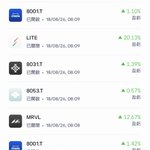
During yesterday’s Asian session, my account net value briefly recovered to around the October 14 level. However, last night $NSDQ100 dropped nearly 2.5%, causing the overall portfolio to give back some gains. Fortunately, during the Asian session I was able to take profits on $MU , $SNDK , $SPCX , and $6976.T , and rotated into large-cap names such as $NVDA , $GOOG , and $AVGO to improve defensiveness. Although some positions are still being dragged by the broader market, the overall exposure structure has been adjusted.
I remain constructive on the long-term development and technological iteration of the optical communications sector. If relatively reasonable entry points appear, I plan to reduce positions in $8002.T , $8031.T , and $8058.T and add to the optical communications group. After the adjustments made over the past few days, the weighting of large-cap stocks has increased and the thematic allocation is more focused. As a result, I feel more comfortable with the current portfolio configuration.
The AI theme still has considerable room to develop, but the path is likely to be highly volatile. This further underscores the importance of dynamic adjustments and active portfolio management.
Thank you to everyone for the support and trust. I’ll continue to update my views and positioning. For those who have the capacity and agree with the current direction, you’re welcome to make regular monthly contributions and walk this investment path together.
Best regards, @choose3395


1
39
I am Ming Jung Ho, and my eToro username is choose3395.
Before investing, I start with one principle: an opportunity I understand does not have to be borne alone. Markets are large and information is fragmented. Most people do not have time to watch prices every day, and no one should rebuild an entire portfolio because of a single headline. I make my allocation public so that anyone who wants to can follow it, and anyone who chooses to can copy it. Not because I have the standard answer, but because a method is only worth continuing if it can stand being seen.
I am currently an Elite investor on eToro. The figures shown are 1,332 copiers, assets under copy (AUC) of about $3.32 million, and a recent net increase of about $1.77 million. AUC is not money in my own account. It is capital that others have allocated to move with this set of holdings. These numbers change, and I treat them as a responsibility, not a scorecard.
My strategy is labeled Income, and the approach is closer to “prepare first, then wait.” The portfolio is not built around a single story. Part of it sits in value and shareholder-return holdings that can travel through cycles, such as Japanese trading companies. Part of it sits in areas still supported by cash flow and capital spending, such as AI-related platforms and infrastructure. When needed, energy and real assets are used to hedge inflation and supply shocks. The goal is not to beat the index every week. It is to keep the positions standing in different environments.
I write down my thinking on a regular basis. When I do, I compare the portfolio with common indexes and explain what this quarter is leaning into, what it is avoiding, and where the risk sits. Those who agree can stay. Those who disagree should leave. Copying is not outsourcing judgment to a name.
If this is the first time you are seeing this account, look at three things first: the current holdings, the risk score, and the most recent updates. Only after that, if you still agree, decide whether to allocate capital.
Capital is at risk. What I publish is an approach that will be adjusted, not a line that cannot be wrong.

1
55
Hi friends,
On Sep 18 I opened a small 2% watch position in TLT. VGIT is on my watchlist and has not been opened yet.
I would consider VGIT later only if short-term rates ease while the long end stays high, or if I want ballast without adding much more duration. For now, TLT is the test of the rate path.
I see AI capex as an important amplifier of this inflation cycle, not the only driver. Mega-cap spending on data centers and compute can lift local demand. People tied to AI and the stock market captured the upside; people far from AI who do not own equities mostly felt higher prices. That K-shaped split is real. It does not, by itself, mean the Fed must cut.
The practical case is narrower. If the giants cut capex guidance, demand heat and inflation pressure may cool, and the odds of rate cuts can rise. With the 10-year around 5% and the 30-year around 5.3%, TLT has more upside if long yields actually fall. If only the front end eases, I would look at VGIT rather than add ultra-long duration.
So TLT stays at 2%. The core remains Japan’s trading houses as the defensive sleeve and AI infrastructure as the growth sleeve. Treasuries are a satellite, not the main book. I will watch capex guidance, whether inflation cools, and whether long-end yields move down from around 5%. If the thesis holds, I can add TLT or open VGIT. If it fails, 2% is the cost of the test.
Thank you to friends for the support and trust. I will keep working hard.
Best regards, @choose3395
$TLT $VGIT $QQQ

1
55

Hi friends,
Today I observed market talk that CCL may be spec’d down and that M9 usage may fall short of earlier expectations. The core of this news is more like this: if CPO converts high-speed signals to optics at the chip level, motherboard demand for ultra-low-loss laminates may be revised lower. That belongs to the longer-term structure of “optics in, copper out.” But CPO penetration is still low over the next two years, and most in-rack interconnects still run on copper, so this should not be read as optical demand already exploding ahead of schedule.
In theory, this kind of news should be relatively positive for optical communications. However, Taiwan’s optical-comms group did not strengthen on it, which suggests the market is for now more focused on the challenge to the CCL upgrade thesis than on immediately adding optical orders. Based on “the news should have produced relative strength, but it didn’t,” I first took profits in $LITE , $COHR , and $MRVL to reduce event uncertainty. That does not mean I am bearish on optical communications over the long term.
$GLW is handled separately: besides fiber interconnect, the company still has a glass-substrate theme later, and that is not the same trade logic as this “M9 spec-down.” Given that the position is not especially high, I only trimmed it slightly. The freed-up capital was first rotated into $QQQ , with the aim of lowering single-theme volatility. I will continue to track CPO progress and the related group’s performance.
Thank you to friends for the support and trust. I will keep working hard.
Best regards, @choose3395
40

Hi friends,
This morning, after observing that Japanese stocks opened higher and that $NSDQ100 did not break to new lows again, I first reduced holdings in the less-core general trading company positions $8001.T , $8002.T , $8053.T , and $8058.T , concentrating capital more on AI-related core holdings by increasing the weight of $AVGO and $NVDA , and opened trial positions in $GOOG and $TSLA after the pullback.
Currently, the AI supply chain in the Taiwan stock market is strengthening again, with optical communications and semiconductor groups performing relatively well. I tentatively view this as a signal that short-term sentiment is stabilizing, but I have not yet treated this rebound as grounds for a full-scale increase in positions.
Tonight we will have the FOMC interest rate decision. Amid the noise of AI themes slowing over the past two days, if the Fed chooses to hike rates or the statement is hawkish, the market may still undergo another stress test. Therefore, this adjustment increases core exposure while retaining flexibility: if better prices appear, I will add again; if the trend weakens after the decision, I will also adjust the allocation.
Thank you to friends for your support and trust. I will continue to work hard.
Best regards, @choose3395

57
Hi friends,
Holding the Rhythm Amid High Oil Prices and AI Capex
This year’s market has not been easy. In early March, the U.S.–Iran conflict pushed oil higher, with crude briefly approaching $120. The market mostly treated it as a short-term shock; prices later fell back into the $70s and have recently risen again.
The SaaS cohort also saw valuation resets on the idea that they “might be replaced by AI.” Some companies, such as $SNOW , later showed they can work with AI and open new growth paths. That reminds me: narratives change, but risk management cannot.
We are still in an environment of elevated energy prices and continued capex expansion by tech giants. I have concentrated the portfolio into two main pillars, plus a demand-side layer:
1. The five major Japanese trading houses that benefit from inflation and commodity trade — $8001.T , $8002.T , $8031.T , $8053.T , $8058.T — together about half the book.
2. The AI supply chain closer to compute and transmission — $AVGO , $MRVL , $LITE , $COHR , $GLW .
3. Tech giants still investing in infrastructure — $AMZN , $GOOG , $TSLA — as front-end exposure to AI demand and capex.
This is not betting in every direction. It is one consistent thesis: high oil prices and supply uncertainty support the trading houses’ cash flow and pricing power; as long as AI capex has not stopped, prioritize optics, connectivity, and custom silicon rather than chasing the hottest narrative stocks.
In recent years I have steadily tightened the strategy toward “controlled drawdowns.” As of today, YTD return is 50.32%, with a max intraday drawdown of 3.14%, max weekly drawdown of 6.4%, and max YTD drawdown of 11.89%. The return comes from the structure I chose, not from stacking volatility.
Thank you for your support and trust along the way. I will keep putting risk first and move forward steadily.
Best regards, @choose3395

3
55
Hi friends,
I would like to briefly explain the current portfolio structure, as well as how I see the risk and return from here.
The portfolio is now concentrated in three main themes:
• Japan’s major trading houses (sogo shosha): $8058.T $8031.T $8002.T $8053.T
These names are used as a more defensive value sleeve, with exposure to commodities, trade, and shareholder-return policies.
• AI platforms and infrastructure: $GOOG $NVDA $TSLA $MRVL $VRT
This group represents the core cash-flow and capex beneficiaries of the AI buildout, including compute, custom silicon, and data-center power/cooling.
• Optical interconnects, semiconductor materials, space, and next-generation power: $LITE $COHR $GLW $3436.T $6976.T $SPCX $OKLO
This is the higher-upside sleeve. Optical names in particular remain tied to the next phase of AI networking demand, while SPCX and OKLO are more volatile, long-duration positions.
In simple terms, the intended return comes from AI infrastructure remaining a multi-year capex cycle, with Japan’s trading houses helping to balance valuation and volatility. The main risk is also clear: this is a fully invested equity portfolio with high theme correlation. If AI capex slows, or if high-beta names such as optical stocks, SPCX, and OKLO correct together, drawdowns can be meaningful.
I am aware of the concentration. That is why I will continue to manage position sizes carefully, avoid adding aggressively after sharp rallies, and keep Japan’s trading houses as a stabilizing allocation. If the optical or high-growth group pulls back with the broader market, I will look for better re-entry points rather than chase strength.
Thank you all for your trust and support. I will keep working hard.
Best regards, @choose3395

1
52
Hi friends,
This time I seized the pullback in some mainstream large-cap names and fully exited $QQQ, shifting capital from a broad-based allocation into more targeted AI infrastructure stocks.
New positions opened in SNDK, MU, MRVL, COHR, GLW, VST, and VRT:
• $SNDK and $MU to add memory exposure (NAND / data-center storage and HBM / DRAM);
• $MRVL , $COHR , and $GLW to add optical communications, fiber, and high-speed interconnects;
• $VST to add power supply and $VRT to add data-center cooling and power equipment.
Thank you to friends for your support and trust. I will keep working hard.
Best regards, @choose3395

2
63
Hi friends,
This morning, I took profits on the optical communications sector.
Although the group has performed strongly recently, based on risk management considerations—particularly as $LITE has approached the previous high resistance zone and shown signs of being pushed back—coupled with the Nasdaq index consolidating for three consecutive days, I decided to shift some capital into defensive positions: Japan’s five major trading houses (sogo shosha).
If the optical communications sector subsequently pulls back in tandem with the broader market, I will look for a suitable opportunity to re-enter.
Thank you all for your trust and support. I will continue to work hard and grow together with everyone!
$COHR $MRVL $GLW
Best regards, @choose3395

1
74


Hi friends,
$QQQ ytd:+19.29%
$VOO ytd:+14.38%
@choose3395 ytd:+40.34%、5y:+645.6%
The investment portfolio continues to hit new highs!🚀🚀🚀
🟢 August 13 US stocks: July PPI month-over-month rate was flat, Brent crude fell 2.1%, S&P 500 rose 0.65% to a new closing high, Nasdaq rose 0.81%; the market cut the probability of a September rate hike to about 35%.
• $WDAY +17.78% to $206.45: Silver Lake is in talks to acquire Workday; no deal has been signed yet, and the stock is already trading the potential acquisition premium.
• $SNDK +13.67% to $1,528.11: Investor Day outlined the long-term framework for fiscal years 2028–2030, NAND roadmap, and cash return commitments.
• $CSCO approx. -8.4%: Q4 revenue and EPS, as well as FY2027 guidance, all beat expectations, but the market still sold off due to concerns over gross margins and high valuation.
• $ARX +43.35% to $19.51: Thoma Bravo agreed to a cash acquisition at $20.25 per share; trading volume surged to 69.1 million shares.
• $CLBT -29.18% to $10.80: After Q2 earnings and the conference call, the stock saw a high-volume sell-off as the market significantly reassessed ARR acceleration and the full-year growth path.

53
Hi friends,
$QQQ ytd:+12.26%
$VOO ytd:+10.16%
@choose3395 ytd:+31.22%、5y:+597.15%
The investment portfolio continues to hit new highs!🚀
📅 US Stock Daily Report|July 31, 2026 (Friday)
The last trading day of July: Amazon’s earnings exploded vs. Apple’s disappointing plunge, as the market closed higher amid divergence.
📊 Market Close
🟢 S&P 500: 7,489.72 (+0.70%)
🟢 Nasdaq: 25,373.85 (+1.00%)
🟢 Dow Jones: 52,485.03 (+0.53%)
🔴 Russell 2000: 2,931.34 (-0.50%)
🌐 Macro Background
Q2 GDP annualized at only 1.5%, below expectations; June PCE rose 3.7% year-over-year, cooling slightly. The Fed this week held rates steady by a 9-3 vote, with three members voting for a rate hike—the biggest hawkish rift under Warsh’s tenure. September rate hike odds briefly exceeded 54%. Elevated oil prices + the 10-year yield approaching 4.71% kept the market from rallying freely.
👀 Watchlist
🟢 +2.93%| $NVDA $200.75 — AI capex narrative continues to strengthen, semiconductor sector rose in tandem; Aug 26 earnings will be this quarter’s final and most critical AI validation
🟡 +0.76%| $TSLA $311.21 — WSJ reported Tesla is evaluating spinning off its China business to pave the way for a SpaceX merger; Musk denied it on X, stock closed modestly higher; Kalshi prices merger odds at ~49%
🟢 +0.65%| $PLTR $123.06 — No major news, followed the market higher; Michael Burry shorting NVDA/PLTR/TSLA simultaneously became a hot contrarian topic on X
🔥 Tech Focus
🟢 $AMZN +~15%: AWS revenue $42.2 billion, operating margin 39.4%—fastest cloud growth in nearly 18 quarters. AI investments are starting to deliver real cash flow. Barclays raised target from $330 to $365
🔴 $AAPL -~9%: Q3 EPS and revenue both slightly beat, but services revenue missed expectations + China weakness + a one-time tariff refund boosted EPS by $0.11. Market sold off hard, closing near $302
💥 Cross-Sector Hotspot
🔴 $RDDT -~21% (largest drop since IPO): Q2 revenue $805 million (+61% YoY), EPS $1.25 massively beat, but CEO admitted Google traffic has become “choppy” + no new AI licensing deals. Market collapsed; seven brokerages including Wells Fargo cut price targets
🚀 Private Market Watch
Texas Stock Exchange officially rang the opening bell in Dallas today; OpenAI’s July monthly revenue reportedly surpassed its entire Q2 figure, intensifying the share battle with Anthropic.

2
72
Hi friends,
$QQQ ytd:+13.58%
$VOO ytd:+9.44%
@choose3395 ytd:+24.5%、5y:+671.38%
US Stock Market Daily Report | July 20, 2026 (Monday)
📊 Market Close
🔴 S&P 500: 7,443.28 (-0.19%)
🔴 Dow Jones: 51,839.26 (-0.59% / -307 pts)
⚪ Nasdaq: 25,508.07 (-0.05%)
🔴 Russell 2000: -0.67%
🌍 Macro Overview
The US launched its ninth round of airstrikes on Iran. Yemen’s Houthi forces announced a maritime blockade on Saudi Arabia, driving up Red Sea shipping risks. Oil prices held steady near 81 per barrel.
Long-term Treasury yields climbed higher as the market began pricing in a potential FOMC rate hike on July 29. Inflation concerns weighed on traditional sectors, while tech stocks continued to support the major indices on the back of AI narratives.
👀 Watchlist
🔴 -2.96%|$TSLA 369.57|Q2 earnings on Wednesday are the key catalyst. Options are pricing in ±8% implied move. FSD v14 Lite wide rollout is a minor positive.
🟢 +0.23%|$NVDA 203.28|Holding above 200. Semiconductors rose modestly with limited momentum.
🟢 +1.87%|$PLTR 134.85|AI software continues to draw strong inflows, supported by sovereign AI themes.
🔥 Tech Spotlight: AMD × Microsoft Helios
$AMD surged more than 5% intraday after Microsoft announced it will deploy AMD’s new Helios AI racks in Azure. This marks AMD’s most direct challenge yet to Nvidia’s dominance in AI infrastructure.
Meta, OpenAI, and Oracle are also early customers. AMD aims to generate tens of billions of dollars in AI data center revenue starting in 2027 thanks to Helios. The broader semiconductor sector followed higher: Micron +1.9%, Intel +2.1%.
💥 Cross-Sector Highlight: WBD Plunges
🔴 -3.76%|$WBD|A federal judge issued a 14-day injunction against Paramount Skydance’s 110 billion acquisition of Warner Bros. Discovery, ruling the deal “may” violate antitrust laws.
Trading volume spiked 115%. If the deal is not completed by September 30, Paramount will owe 650 million per quarter in timing fees. The next key hearing is scheduled for August 3.

182
Hi friends,
$QQQ ytd:+17.11%
$VOO ytd:+11.3%
@choose3395 ytd:+28%、5y:+693.41%
US Stock Daily Summary | 2026.07.15 (Wednesday)
Inflation cooled for two straight days. Capital rotated out of chips and into Big Tech. Behind the modest index gains was a violent sector rotation.
📊 Macro Outlook
June PPI fell 0.3% MoM, with the YoY rate dropping from 6.0% to 5.5% — far better than expected. Yesterday’s CPI also declined 0.4% MoM, bringing the YoY rate to 3.5%. The probability of the Fed holding rates steady in July rose to 84.5%.
U.S. forces launched a new round of strikes on Iran, pushing WTI crude up more than 1% to 80.
Index Closing Prices:
▲ S&P 500: 7,572.40 (+0.38%)
▲ Nasdaq: 26,269.23 (+0.62%)
▲ Dow Jones: 52,658.64 (+0.29%)
▲ Russell 2000: 2,976.26 (+0.39%)
🔥 Tech Highlights
🍎 +4.0%|$AAPL Hits All-Time High
Apple Intelligence officially approved by China’s Cyberspace Administration. It will integrate Alibaba’s Qwen and Baidu technologies. After nearly 22 months of waiting, Apple finally cleared the hurdle. AAPL surged 4%, lifting BABA more than 4% as well.
💥 Cross-Sector Hot Spots
💸 +17.2%|$PYPL — Stripe Offers 53B Acquisition
Stripe, together with Advent International, offered 60.50 per share (28% premium). PayPal’s board is expected to discuss as early as July 20. Neither side has issued an official statement yet.
📉 -8%|$MU + Chip Sector Selloff
Panic over China’s CXMT gaining ground spread quickly: MU -8%, $AMD and Intel each down 5-6%, $SOXX -4%. Reports that Apple is testing CXMT chips added to the worries. Analysts largely view this as a valuation correction.
📈 +7.4%|$BLK Q2 Earnings Blowout
BlackRock reported EPS of 13.91, smashing expectations. Assets under management (AUM) hit a record 15.34 trillion. Net inflows reached 191.7 billion in the quarter. The stock jumped more than 7% in a single day.
🚀 IPO Watch
$SPCX broke below its 135 IPO price for the first time. Just one month after listing, it has already fallen over 30% from its peak. Anthropic’s large-scale IPO is rumored to launch as early as October. The market is closely watching whether IPO enthusiasm is cooling

232
Hi friends,
$QQQ ytd:+18.02%
$VOO ytd:+10.8%
@choose3395 ytd:+23.8%、5y:+666.71%
US Stocks Rose Broadly on Thursday as AI Themes Override Geopolitical Risks
US stocks closed higher across the board on Thursday (July 9). Investors shifted their focus back to artificial intelligence (AI), successfully offsetting the uncertainty caused by rising tensions between the US and Iran.
The three major indices posted strong gains:
• The Dow Jones Industrial Average rose 139.02 points (0.27%) to 52,487.41.
• The S&P 500 climbed 60.93 points (0.81%) to 7,543.64.
• The Nasdaq Composite surged 336.24 points (1.30%) to 26,206.89, led by technology stocks.
Although international oil prices briefly spiked due to the Middle East situation, they gave back some gains on Thursday, indicating that the market is gradually digesting the conflict’s impact. The US military conducted airstrikes on approximately 90 targets in Iran, while Iran retaliated against US ally bases in the Middle East. However, President Trump disclosed that Iran had proactively reached out by phone to seek an agreement. Mediators from Qatar and Pakistan are also working to bring both sides back to the negotiating table, helping to ease market panic.
On the economic front, US initial jobless claims last week remained roughly flat compared with the prior week. The labor market’s resilience remains intact, providing the Federal Reserve with a stable foundation for assessing future interest rate paths.
Corporate News
$MU shares rose more than 4% to close at $991.64. The company announced a maximum investment plan of $3 billion aimed at strengthening the US domestic semiconductor supply chain ecosystem.
SK Hynix’s US depositary receipts
$SKHYV.24-7 completed pricing on Thursday, with market demand reaching 7 times the offered amount. This underscores investors’ strong confidence in the long-term demand for AI memory chips. The company is scheduled to officially list on Nasdaq on Friday.

1
98
Hi friends,
$QQQ ytd:+15.76%
$VOO ytd:+10.23%
@choose3395 ytd:+24.51%、5y:+670.71%
U.S. stocks closed lower on Tuesday (July 7), with the Nasdaq index falling more than 1%. The main reason was broad weakness across chip stocks, as investor concerns grew over whether the AI boom can continue to support the market rally.
Asian and U.S. chip stocks fell sharply in tandem. Although South Korea’s Samsung Electronics reported record-breaking earnings, the results still failed to meet the market’s excessively high expectations. Chip stocks continued to face heavy selling, reflecting growing investor worries about overvaluation after sharp volatility in AI-themed and memory stocks.
The next key focus will be on Friday, when South Korea’s SK Hynix is scheduled to list on Nasdaq via ADR. The market will use this event to gauge investor demand for chip stocks.
Of the S&P 500’s 11 major sectors, eight closed in the red. The industrials sector plunged 3.41%, and the materials sector fell 2.45%. Iran’s attack on a Qatari liquefied natural gas tanker near the Strait of Hormuz pushed oil prices higher, with Brent crude rising 3% to $74.16 per barrel, further weighing on market sentiment.
Investors are also watching the latest Federal Reserve meeting minutes, due to be released on Wednesday. These will be the first minutes released since new Fed Chair Kevin Warsh took office.
Corporate Highlights
• $SPCX has officially been added to the Nasdaq-100 Index, just 15 days after its listing — the fastest inclusion in history. The stock fell nearly 7% on its first trading day, but is expected to attract billions of dollars in passive inflows.
• $META launched its new AI image generation model, Muse Image, making it freely available to general users. The model has been integrated into advertising and subscription services as the company aggressively expands its AI revenue streams.
• $MU fell 4.7%, while SK Hynix ADR plunged 7.3%, dragging the semiconductor
$SOXX down 4.65%.
Additionally, Chinese AI startup DeepSeek is developing its own AI chips in an effort to reduce reliance on $NVDA and Huawei, heightening market concerns over intensifying chip competition.

94
Hi friends,
$QQQ ytd:+15.28%
$VOO ytd:+7.53%
@choose3395 ytd:+18.69%、5y:+625.71%
US stocks fluctuated lower on Friday as the market continued to digest several negative factors: cooling enthusiasm for AI themes, rising expectations of Federal Reserve rate hikes, and rumors that OpenAI’s IPO could be delayed until 2027.
Tech stocks and semiconductor names were broadly under pressure, while capital clearly rotated into defensive sectors and SaaS stocks. Notably, $MSFT and $CRM both rose nearly 6%.
Market sentiment was significantly impacted by the news that OpenAI is considering pushing its IPO back to 2027. Traders have begun to reassess the reasonableness of AI valuations and the sector’s long-term growth prospects.
Additionally, President Trump warned on Friday that if any country imposes a digital services tax on US companies, the US will respond by levying 100% tariffs on all goods imported from that country. This strong stance further boosted the SaaS group.
During trading hours, Trump issued a tough statement on Iran, accusing the country of openly violating the ceasefire agreement and warning that it would soon pay the price. After the market close, US Central Command confirmed that American warplanes had struck Iranian missile and drone storage facilities as well as coastal radar stations.
With rising international tensions exacerbating market volatility, high-valuation stocks have been hit the hardest. Names like $MU and $SNDK saw notable corrections, and MAG7 valuations have continued to adjust.
Therefore, I will continue to avoid high-valuation stocks and maintain my current portfolio allocation (Japan’s Big Five Trading Companies + SaaS names), while waiting for valuations to gradually normalize.
Thank you all for your continued support and trust — I’ll keep working hard!
————————————————————
$8001.T 、 $8002.T 、 $8031.T 、 $8053.T 、 $8058.T

99