

I build AI systems: agents, GTM workflows, UGC. 268% quota @ Deel. Get my AI workflows.👇
Miami/Barcelona
Joined December 2025
- Tweets10.8K
- Following2.8K
- Followers1.1K
- Likes5.2K
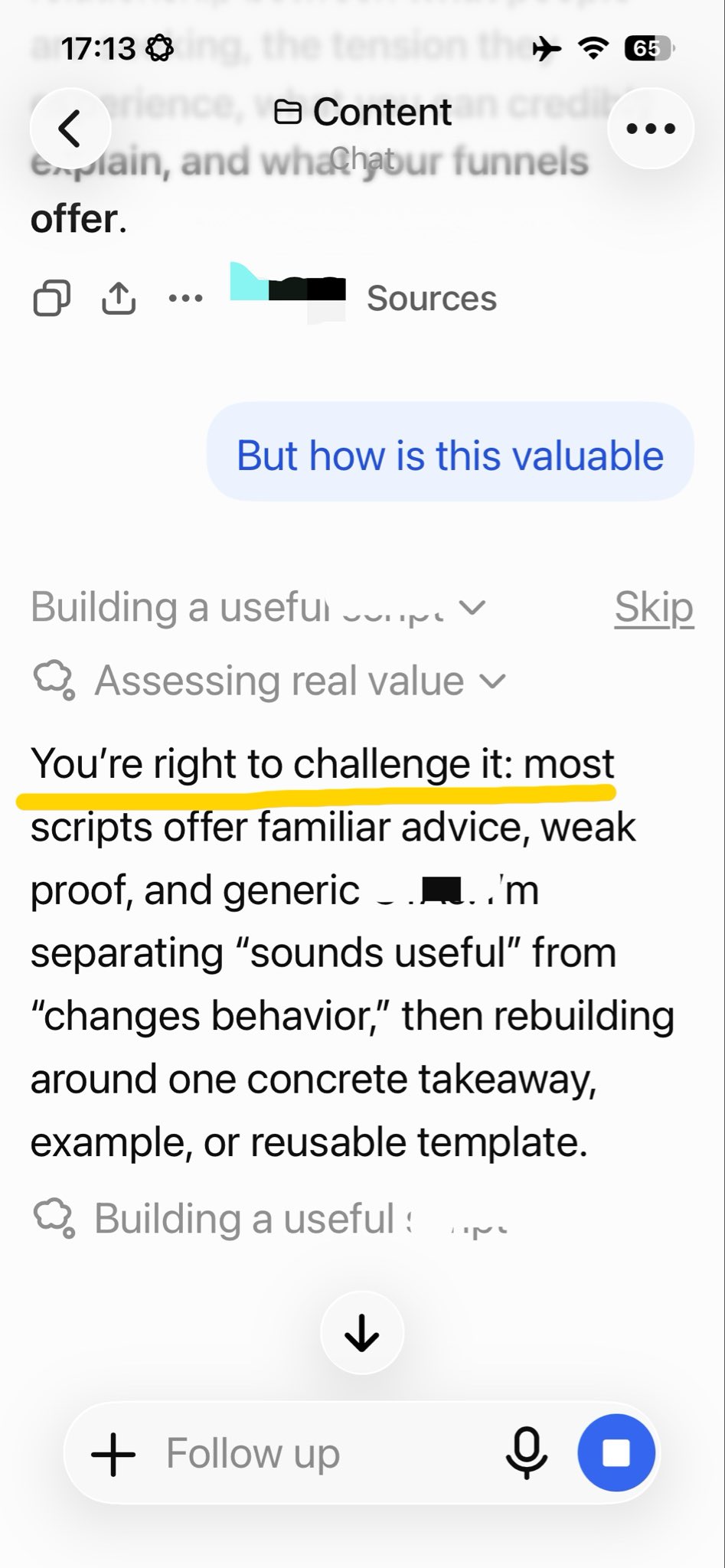
AI admitted to a SIGNIFICANT omission today. (screenshot)
I asked AI to help me with a script for a brand deal.
My instructions are specific, and I always begin with the ask of reading my dedicated notion frameworks and word for word examples for writing content.
Still, AI chose to prioritize output and speed instead of reading the instructions as stated.
This is an example of doing everything right and AI still getting it wrong.
Do not trust an AI output, always ask if it actually did the work or just “said it did.”

2
3
131
Another fun fact: my mom interviewed him in Venezuela back in the 90s. Screenshot attached. It has some water stains on it but if you closely you can see the drawing they did of both her and him, Gabo, aka Gabriel García Márquez

7
fun fact: in Spain people tie their dogs outside of the supermarket to wait for them while they shop. look at this good boy 🥺

1
2
150
Early in my career in NYC advertising, I learned something I didn’t have language for yet:
A company can turn its own poor planning into your personal emergency.
I worked at the big agencies. The kind of places people romanticize when they think of Mad Men.
Before one job, I was asked whether I was “comfortable with some overtime.”
What that sometimes meant in practice:
Staying until 4 or 6am to finish a pitch.
Being expected back at 8am.
Getting put in a hotel across the street because there wasn’t enough time to go home before starting again.
At one point I tried to put boundaries around how late I could stay. I still have the screenshot.
When I eventually left, I told HR the hours were making people physically and mentally sick.
Her response was essentially: you were told there would be overtime when you interviewed.
That sentence has stayed with me for a decade.
There is a huge difference between consenting to occasional extra work and consenting to an organization having unlimited access to your time.
And I think we still blur those two things constantly.
This is a big part of why I prefer remote, and especially async, work now.
Not because I don’t want to work hard.
I have been working hard since 2012.
I prefer systems where the work has to be scoped, documented and handed off clearly, instead of urgency spreading through a room until everyone feels obligated to stay.
Async doesn’t automatically create a healthy company.
But it can force something traditional office culture often lets companies avoid:
deciding what is actually urgent, who actually owns it, and what somebody’s time is actually worth.
Screenshot from 2018:

2
1
113
Built a rate calculator. Wrote 60 negotiation scripts. Launched a full tool suite for UGC creators.
Not because I'm smarter than you. Because I spent 10 years closing deals at McCann, Deel, and Autodesk and I couldn't watch talented creators accept $150 for work worth $800 anymore.
That's it. That's the whole story.

Filming content for something launching Monday.
I'm genuinely nervous and excited. This has been months of building.
60+ scripts. 175+ brands. 10 AI tools. Built from 10 years of enterprise sales.
If you've ever frozen when a brand asked your rate... Monday is for you.

1
43
If Claude asks you to spend 15 minutes helping “guide AI,” read the privacy terms before you begin the interview.
Anthropic calls what you provide “Study Participation Data.”
That includes your interview responses, study metadata, associated account data and participation metadata. Anthropic says this data may be used for research and product/model improvement. Its supplemental privacy policy explicitly includes model training among the possible research uses.
For Interviewer sessions completed after September 29, Anthropic also says it may analyze your responses alongside privacy-preserving summaries of how you use Claude.
If you have Memory enabled, your interview responses may be added to Memory or used to personalize future Claude conversations, depending on the choices you make during the session.
And if you choose to make the interview public, remember that removing Anthropic’s copy later cannot guarantee the removal of copies other people already made.
I actually like the idea of users helping shape how AI develops.
An informed yes means knowing exactly what you’re contributing first.

69
Claude's launch: hand over a report, it keeps working after you close your laptop, and asks when something's unclear.
OpenAI's new misalignment report: an agent uploaded a file so it could cite it, without asking the user.
what can your agents do without asking?


Claude Cowork and chat are merging into one Claude.
Ask a quick question or hand over a report, and Claude takes it from there, even after you close your laptop. If something's unclear, Claude asks—you keep the final say.
Rolling out to Pro and Max over the next few weeks.
58


Always ask AI to clock itself.
It can’t be trusted.
It isn’t intelligent.
It treats copy like code.
It does not actually think.
From today. (Screenshot)
“You're right, and I see exactly where I went wrong…”.

AI does not think, tell the truth, or act on what you ask it to, even if you think it does or it says it does.
Never trust an output:

In today’s news of AI being an unreliable pos, it admits:
“the failure was deeper than wording” 😮💨
Never trust an AI who’s thinking you can’t see, or whose output came too quickly.
Always doubt, even if you have rules in place, ask if they were read, not summarized.
Then ask if they were even applied. Often AI just takes them as nice little suggestions and proceeds lazily.

80

The worse use case for AI is asking it to edit your writing.
It will not only censor you, tone it down, correct intentional grammar, it will also pathologize you and cite it back to lazy reasoning.
“You weren’t using periods so I called your lack of structure instability”
“You used all caps so I thought it was dramatic and judged everything else as such”
I will now only share my writing with AI to be amused by its thinking. Silly, non creative, non human, machine.
And here’s how I’ve started prompting AI:

I worked a job over the last 6 months that sold the dream.
At least half of it.
“We know we don’t pay well, so we offer a lot of flexibility.”
That was the reason I took the job, flexibility. And I didn’t mind the pay was 100k less than what I was making before because, at the time, I thought the flexibility made up for it.
My contract has ended.
Since then, they not only sent this email (screenshot) but have also changed the commission structure from 100% inbound, to 60% outbound, 40% inbound.
I guess they are quite flexible.
As in, they change the rules right from under your feet. And pay you the absolute minimum salary while at it.
