Serial AI Builder
Portland, OR
Joined May 2016
- Tweets4.9K
- Following2.1K
- Followers598
- Likes3K



Aaron Cohen retweeted

Removed from rogue scope: OpenAI agents access SEC and Commerce Department sites without authorizat…
Evidence hold after explicit review: The cited Reuters/Guardian story attributes SEC/Commerce access to OpenAI.…
Follow @rogueaiwatch for live updates.
roguewatch.org/

Aaron Cohen retweeted

We were taught that Earth orbits the Sun in a closed circle. In reality, Earth has never returned to the same point in space once in 4.5 billion years.
Right now, the Sun is carrying Earth and every planet around the center of the Milky Way at 230 km/s (828,000 km/h), more than 18,000 kilometers every 80 seconds.
Because the Solar System is tilted 60.2° to the galactic plane and bobs up and down through the galactic disc roughly every 30 million years, the planets trace open 3D corkscrew helices across deep space rather than flat loops.
The last time the Sun stood where it stands today, one Galactic Year (230 million years) ago, the very first dinosaurs were only beginning to appear on Earth. Since forming 4.6 billion years ago, our Sun has completed only 20 laps.
Aaron Cohen retweeted

The world beyond my very astute followers is not ready for what is about to befall them. We know this is here. They won’t believe anything anymore…
Aaron Cohen retweeted

anthropic is probably the best business in AI right now and i still wouldn’t touch it on day one. the whole thing is set up for suppliers and insiders to sell into the index buying.
Aaron Cohen retweeted

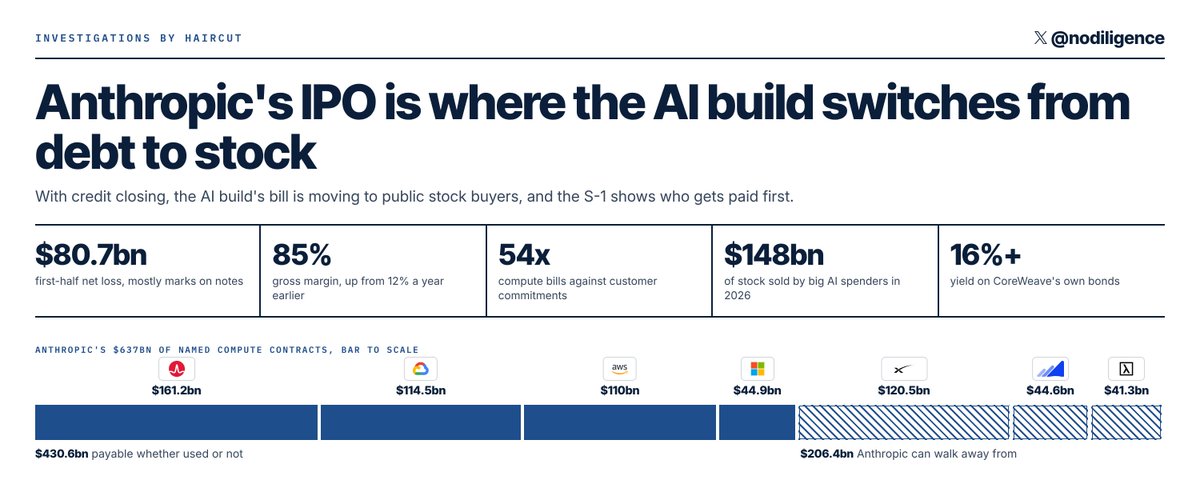
holy sh*t. Karpathy's second brain pattern runs on Grok Bot now: stop explaining your life to AI from zero every chat, keep a wiki that writes itself
three bots in one group chat, each with its own memory:
the reader takes every link, PDF and voice note you drop and never edits it
the librarian rewrites every wiki page that source touches, usually 10 to 15 of them
the checker wakes up on a nightly routine and hunts contradictions, stale claims and pages nothing links to
→ you ask a question: the answer gets filed back as a page, so the brain grows from use, not only from reading
→ a new source contradicts an old page: the checker tags you instead of quietly overwriting it
→ a page goes 30 days without a fresh source: it gets marked unconfirmed
a second brain can sound sure while remembering the wrong thing
Reader collects. Librarian writes. Checker doubts.
every page has to show:
> the claim
> the source it came from
> the date it was last confirmed
paste this into Grok Bot:
"Build me a second brain with three bots in one group chat. Keep my sources untouched in raw/, maintain wiki/ yourself, file good answers back as pages and run a nightly check for contradictions. Show me the structure first. Do not create anything until I confirm"
start with one topic you actually work on, not your whole life
full setup below

Aaron Cohen retweeted

There's more to the Character AI bankruptcy, and @tenuous has the scoop: Court filings indicate that the decision was actually a key part of a deal that has let Disney hire most of CAI's staff—including its now former CEO—potentially acquire most of CAI's technology, and avoid the beleaguered startup’s many legal liabilities and obligations wired.com/story/disney-asked…

Aaron Cohen retweeted

What if you could spend less time at your desk and still get more done?
Hint: you already can
@AlexFinn joins us in the studio tomorrow to show how he builds hands-free using voice in Codex—on desktop and mobile.
teapawt.org/i/broadcasts/1OGwbnWnB…

Aaron Cohen retweeted

AI power users are showing up outside tech. The fastest-growing Codex adopters since February:
Legal: 108x
Sales: 41x
Recruiting: 41x
Marketing: 26x
Healthcare: 24x
Charts of the Week: a16z.news/p/charts-of-the-we…

Aaron Cohen retweeted

to put ai progress in perspective:
9 months ago: most developers wrote code by hand
now: misaligned multi-agent swarm finding and collaborating on 0-days undetected (OpenAI/hugging face)
9 months in the future likely much crazier
Aaron Cohen retweeted

Today’s the day.
Opus 5 and a super-fast version of ChatGPT 5.6 are dropping imminently
In fact, if you use Opus 4.8 right now, there’s a decent chance your prompts are getting routed to Opus 5
Days like this don’t happen often. It’s absolutely critical you lock in:
1. Test these models the moment they drop
2. If you don’t have your own personal benchmark tests based on your every day workflows and tasks, build them now (will open source mine soon)
3. Put these new models on your latest projects. See how they hold up against what you were doing before
4. Plug them into your Hermes/OpenClaw. Measure cost per task vs speed
5. Have these newer models review your code built by older models. Find security gaps/optimization opportunities the less intelligent models couldn’t find before
99.99% of the world won’t even know what’s happening today. You’re going to be the .01% that jumps on this and attacks
Lock in.
Aaron Cohen retweeted

Claude Fable 5 will be available again globally tomorrow.
After a series of productive conversations with the US government, we're redeploying the model with a new set of classifiers to target and block more cybersecurity tasks. In the near term, some routine tasks like coding and debugging will fall back to Opus 4.8. We’ll continue to refine these classifiers over the coming weeks to reduce false positives and better distinguish genuine misuse from legitimate requests.
We’ve also begun drafting a consensus framework—with Amazon, Microsoft, Google, and other Glasswing partners—for assessing the severity of AI jailbreaks and how AI developers should respond to them. We invite other industry partners and model providers to join us in this effort.
Finally, we’re scaling up our collaboration with the US government on model testing and safeguards. This will include pre-release access to models and safeguards for evaluation, information sharing on jailbreaks and misuse, and dedicated resources for joint research.
Thank you to our users for your patience, and to our partners across the government, industry, and the research community who worked alongside us to make Fable 5 available again.
Read our full blog: anthropic.com/news/redeployi…

Aaron Cohen retweeted

The GenAI economy has generated $110 billion in sales over the past 12 months. It is growing fast. On an annualized basis, the revenue run rate exceeds $175 billion.
These numbers took us several months to construct, and as far as we know, it’s the first bottom-up, deduplicated measure of consumer and enterprise AI spending across the full stack.
We are releasing this research today in our first The State of the AI Economy report.
intelligence.exponentialview…

Aaron Cohen retweeted

We’ve been researching new ways for ChatGPT memory to carry context across conversations and keep it useful over time.
Today, that work is rolling out as a more capable memory system in ChatGPT. openai.com/index/chatgpt-mem…

Aaron Cohen retweeted

Here’s the email to employees:
Team,
Hope everyone’s doing well and enjoying the productivity enhancements from our AI tooling initiative.
Unfortunately, Finance has asked me to clarify a small issue.
It appears someone, and by “someone” I mean apparently all of you simultaneously, managed to spend $500,000,000 on @claudeai usage in a single month.
For context:
•NASA landed on the moon for less.
•We are now the proud owner of approximately 14% of Anthropic.
•Claude personally sent us a thank-you fruit basket.
•Our CFO has entered a fugue state and only communicates through Slack emojis.
•The electricity usage from your prompts briefly dimmed parts of Northern Virginia.
While we appreciate innovation, there are concerns that:
•“Can you make this email sound slightly warmer?” did not require 11,400 generations.
•Asking Claude to “rewrite this in the style of Succession, Hemingway, and Tony Soprano combined” may have been excessive.
•One employee appears to have used Claude to generate “a quick list of lunch options” that somehow consumed the GDP of a small island nation.
Going forward, please observe the following guidelines:
1Do not upload the entire internet into Claude “for context.”
2If your prompt begins with “simulate every possible outcome,” reconsider.
3Claude should not be used to:
◦settle fantasy football disputes,
◦write your wedding vows 97 times,
◦generate revenge edits of your ex’s LinkedIn bio,
◦or ask “what if Rome had WiFi?”
Most importantly:
If you see the message:
“This request may require additional datacenter construction”
…please stop immediately and contact IT.
Thank you all for your cooperation during this challenging yet technologically groundbreaking time.
Warm regards,
Management
P.S. Whoever prompted:
“Generate every possible PR angle for every company founded since 1983”
…we just want to talk.
Aaron Cohen retweeted
Codex now works directly in Chrome on macOS and Windows.
It’s even better at working with apps and sites in Chrome, and now works in parallel across tabs in the background without taking over your browser.
To get started, install the Chrome plugin in the Codex app.
Aaron Cohen retweeted

Introducing Claude Design by Anthropic Labs: make prototypes, slides, and one-pagers by talking to Claude.
Powered by Claude Opus 4.7, our most capable vision model. Available in research preview on the Pro, Max, Team, and Enterprise plans, rolling out throughout the day.
Aaron Cohen retweeted

We're shipping a new feature in Claude Cowork as a research preview that I'm excited about: Dispatch!
One persistent conversation with Claude that runs on your computer. Message it from your phone. Come back to finished work.
To try it out, download Claude Desktop, then pair your phone.
Aaron Cohen retweeted
Palmer Luckey: The biggest beneficiaries of vibecoding are going to be the shape rotators, not the wordcels.
"The biggest beneficiaries of vibecoding are going to be the hardware nerds like me."
"I was always a pretty terrible software engineer... I've taught myself enough to glue things together and make them work."
"I was only able to accomplish what I accomplished because I focused on what I was good at, which was optomechanics, a little bit of electrical, and then the product integration of all of these different components."
"I didn't have time to learn to program. If I had spent another year or two learning to program at even a reasonable level, I would've been two years behind on everything else."
"And so I'm a big fan of vibecoding—even if everything that comes out of it is slop, it's better than I was able to make."
@PalmerLuckey on @tpbn
Aaron Cohen retweeted

Moore’s Law, the march of microchip progress that took us from mainframes to iPhones, will end in 2040. Here’s the tech that could get us across the finish line, writes Christopher @Mims on.wsj.com/4r0fWBS