

Building where bits and atoms converge. @teachmelessons @goboxtrot
San Diego, CA
Joined November 2017
- Tweets2.4K
- Following629
- Followers1.1K
- Likes13.8K





This is a chance to get in early on some great content

I’ve been building companies for over a decade, and I’ve barely posted anything online. That’s changing in 2026.
Many of you could make the assumption that I got where I am today from some traditional founder bio path I took, but my obsession with building things started before college.
At 8 years old, I lived on a disc golf course in Austin. There used to be this creek that ran through it and athletes would lose their discs in the water. After every big storm, the lost discs would wash up into the shallows and I would go collect them.
I realized these discs had value, so I started taking them to frisbee golf tournaments and selling them to the players.
Because of this “business”, I made my first few thousand dollars before 4th grade.
Then, at 10, my mom (who was a professor) took a sabbatical to write a book, and we moved to Costa Rica for a year.
To share my experiences with friends back home, I coded up a basic website and started a blog. I wrote about my adventures in Costa Rica, most of which involved chasing wildlife with my Dad. This became my first exposure to tech and writing.
That year made me realize that I didn’t want a standard life.
Flash forward a few years, and I was 17 deciding where to go for college. I got into Duke and John Hopkins, but chose NC State on a full ride instead.
Because of that decision, I graduated debt-free, which meant I could take a risk starting a business out of college instead of chasing a paycheck.
My first company failed after 4 years, but we demonstrated enough promise that I landed a spot at Stanford for my MBA. The experience was incredible. It helped me process all the learnings from my first company and gave me the courage to try again.
Now, I'm building TeachMeTo: the opposite of the AI-centric, screen-heavy narrative that everyone's chasing in 2026.
There’s a lot more to each of these chapters, and I’ll be going deeper on all of them. But beyond the personal, here are some other things you can expect from me:
- How I think about building companies
- Why I’m building a real-world, in-person business in a world racing towards screens
- Raising vs. bootstrapping vs. the messy middle ground
- And what it means to raise kids who build their identity on something more durable than a like count
I’ll share what I got right, wrong, and everything in between.
If any of that sounds like your type of conversation, I’d love to have you along for the ride.

1
3
194
My prediction for 2024:
The Experience Economy takes off.
As we all use more technology, we're also starting to value real-life activities even more. We do a LOT online — and so we're increasingly looking for ways to have fun and learn things away from screens. Technology, paradoxically, is helping with this.
tech.co/news/predictions-fut…
The journey continues.
techcrunch.com/2023/09/25/te…

7
23
2,981
I'm pretty quiet on here these days. In case you're curious about what I'm up to, @TWaschenfelder wrote a nice breakdown. Thanks for the feature, Thomas! wealest.com/interviews/nick-…

3
9
1,053
“The network state is in many ways the apotheosis of American ideals: to reopen the frontier, to leave home in search of a better life, to literally start a new country.” — @balajis

Introducing: Praxis Projects
From the debates of the Athenian Agora to Independence Hall, would-be state builders welded together the great minds of their time to construct the future.
Today, we open the city-building process to you.
praxissociety.com/announceme…

“The ones who thrive long term are those who understand the real world is a neverending chain of absurdity, confusions, messy relationships, and imperfect people.”
— @morganhousel
collaborativefund.com/blog/d…
I think about this a lot: What about eCom is so attractive to young entrepreneurs?
Maybe it’s the fact that you can start and scale in just months from a laptop. No permission necessary.
There are few areas with such low barrier to entry for scrappy internet kids.
8
Sometimes the right idea is just too early.
This was written in 1997: a prescient, albeit mistimed exploration of a world with permissionless, interoperable flow of information to all your devices.
Sounds familiar…
h/t @philwinkle
wired.com/1997/03/ff-push/

1
Platform arbitrage is when you take top performing content from one medium, repackage it, and share it on another
Once you know what it looks like, you see it everywhere
Twitter gets better when you seek out the thinkers that aren’t reposting Wikipedia or Reddit info
2
16
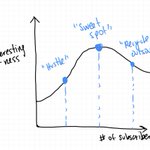
Have you ever noticed that some creators get “stale”?
I reflected on what the most interesting creators get right.
A theory of creator interesting-ness:
1
7
But if a creator innovates — engaging their audience to build community, finding new ways to add value, like podcasts, longer form content, a brand/business people can rally around — it makes you interesting all over again.
Only this time, to a massively larger audience.

2
3