





How does everyone else turn down elderly retirees? My fees usually don't make sense for them and everything's online, but even a gentle and respectful no seems to send them into a rage. Arlene let me have it a few minutes ago. #taxtwitter
Content creators are on Treasury’s official list of occupations for the “no tax on tips” deduction.
That doesn’t make your creator income tax-free.
Most of what creators earn isn’t a tip. Here’s how to sort yours 🧵
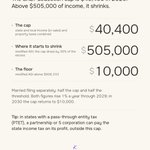
Then the limits (2025 through 2028):
Up to $25,000 a year.
No more than your net income from that business: profit after things like half your SE tax.
It shrinks once your modified AGI passes $150,000 ($300,000 married filing jointly). Married? File jointly.
Not the type to advise clients to chase new high-yield savings accounts for a fraction of a percent that barely moves the needle.
But X Money’s 6% is a no-brainer.
It’s normal that your business bank balance never seems to match your profit.
Because your bank balance doesn’t correlate 1:1 with profit.
Some cash leaves your account without ever hitting your P&L as an expense: owner draws and the principal on your loan payments. Only the interest is an expense.
And some expenses hit your P&L without any cash leaving: depreciation and amortization.
Enter the Statement of Cash Flows. It starts with your profit, adds back the non-cash expenses, shows the cash that went out for draws and loan principal, and ends on the change in your bank balance.
Review it next to your P&L and bank statement. You’ll immediately feel more informed about your business.
Good bookkeeping is like good plumbing. Nobody thinks about it until it breaks.
When your books are clean, nothing happens. No scramble in March. No surprise tax bill. No IRS letter you can’t answer.
And because nothing happens, it feels like you’re paying for nothing.
Then you see what bad books actually cost:
The deductions nobody caught because they were sitting on your personal card.
The quarterly estimates you guessed at because nobody knew what you’d made through September.
The loan that stalls because you can’t hand the bank a P&L you trust.
The cleanup bill to rebuild a year of transactions in April. Which usually costs more than keeping them right would have.
Your books aren’t just for your tax return. They’re the only real answer to “how’s the business doing?” Without them, your profit is a guess.
So if your books are boring, quiet, and done every month, that’s not nothing. That’s the job being done right.
I’ll never understand why people buy expensive cars and put stickers on them.
You’re a proud east west tech alum. We get it.
But now your S class looks like a college student’s laptop.

Big fan of the new @claudeai thinking indicator. Way better than the pulsing spark.
TikTokers usually turn up the volume on their atrocious tax claims as we get closer to year end.
And there’s a big one they get wrong every year: buying equipment.
For equipment that needs to be capitalized (i.e., recorded as an asset and depreciated), buying it by December 31 isn’t enough. Even if you use bonus depreciation or Section 179 to write it all off in year one.
The deduction goes to the year it’s placed in service. That means ready and available to use in your business. Not ordered. Not paid for. Ready.
Order a $3,000 computer on December 29 and it shows up January 5? You paid in 2026. You start using it in 2027. That’s a 2027 deduction.
Btw, cash sitting in your business account on December 31 doesn’t escape taxation because you left it in the business. Your profit is taxed whether you distribute it or not.
Which leads me to the biggie: NEVER buy equipment just for the write-off. If you don’t truly need it, you’re trading a dollar for 37 cents (or whatever your tax rate is). The deduction doesn’t give you the rest back.
Before you buy anything for a year-end write-off, ask yourself: will it actually be set up and ready to use by then? And would you buy it anyway?

IRS new feature alert:
Automatic Exemption from Penalty.
If you file or pay late, but your prior three years are clean (filed and paid on time, no penalties that stuck, no First Time Abate used), the IRS doesn’t charge the failure to file or failure to pay penalty. You don’t apply. You don’t call. It’s applied while your return is processed, and you get a notice telling you.
It’s replacing First Time Abate, the older version you had to ask for. That one still covers 2024 and earlier. For 2026 returns and later, it’s gone.
There is a nuance though: automatic means you don’t choose when to use it.
With First Time Abate, you request it. So you could save it for the year it actually mattered. This one gets applied to whatever penalty comes first, regardless of amount. Even a small one. And there’s no published way to turn it down.
You don’t get it again until you’ve stacked up three more clean years. And there’s no First Time Abate to fall back on.
This isn’t a reason to file late. You still owe the tax, plus interest on it. But starting with 2025 returns, you may automatically have a get out of penalty free card.
There are cumbersome rules around claiming the self-employed health insurance deduction.
Here’s how to make sure you get it right based on the type of entity:
Sole prop / single-member LLC: Policy can be in your name. Can’t exceed your business profit. No profit, no deduction.
Partnership: The partnership pays the premiums (or reimburses you) and reports them on your K-1 as guaranteed payments. Policy in your name, paid personally, never reimbursed? No deduction.
S corp: The S corp pays the premiums (or reimburses you in the same year) and adds them to your W-2. The catch: the deduction is capped at your Medicare wages (box 5), and the premiums generally don’t land there. No salary, no deduction.
All three: No deduction for any month you were eligible for a subsidized employer plan, including your spouse’s. Even if you didn’t enroll.
If you run a business and are expecting to claim this deduction, give your CPA a call to make sure you’re doing it correctly.
P&Ls get all the love.
But don't neglect your Balance Sheet.
That's where a business's skeletons are buried and the first place a good CPA is going to look.

My brother and I used to travel all over the country to ride the top coasters when we were kids
But putting your life on the line for like 2 minutes of going up and down really fast probably isn’t worth it

Theme-park operator Six Flags has closed several rides after a person died and several others were injured aboard one of its roller coasters in Georgia on Monday afternoon.
🔗 Read more: on.wsj.com/4s4JFMa
