

Machine Learning & Backend 😎 Founder of Humanity backed by Investors from Google, SF and Hong Kong.
Mountains
Joined June 2023
- Tweets1.7K
- Following365
- Followers471
- Likes1.4K
PyRUA-Dex: Teaching Robots Dexterous Skills Without Demonstrations
What if AI coding agents could teach robot hands complex skills simply by writing and improving code?
Researchers introduce PyRUA-Dex, a framework that uses coding agents to develop robotic manipulation policies without human demonstrations.
How it works:
Exploration: 8 coding agents explore tasks in parallel and share successful techniques.
Distillation: Successful attempts are combined into one executable Python program.
Refinement: An agent fixes weak stages and improves reliability across randomized environments.
Deployment: The frozen program controls the robot without an LLM running at inference time.
Impressive results:
72.9 on Bench2Dex, a new state of the art.
81% success on DexJoCo under full randomization.
2.4× the success rate of an online coding agent at the same execution budget.
Real robots can play piano, write calligraphy, stack cubes, and more.
Learning a new piano piece takes as little as 30 minutes.
The bigger idea: Instead of training a neural policy from demonstrations, let AI agents discover, test, and write reusable robot skills as code.
Paper: arxiv.org/abs/2611.33144
GitHub: github.com/DAGroup-PKU/PyRUA…
Project: vme0522.github.io/PyRUA-Dex/

Agentic LongLive: Give AI Video Generators Long-Term Memory
How can AI generate 14-minute videos while keeping characters, objects, and locations consistent?
NVIDIA researchers introduce Agentic LongLive, an asynchronous memory agent for real-time video generation.
Instead of relying only on the video model's limited memory, it:
Tracks people, objects, and places using text and images.
Prepares memory for the next shot while the current shot is generating.
Uses an RL-trained agent to decide what to remember.
Injects memory directly into the generator without stopping the video stream.
Impressive results:
26.3-point improvement in persistent-state accuracy.
44.9-point improvement in character identity.
Maintains character consistency across 14-minute stories.
Generates 34.3 FPS on B200 GPUs, faster than real-time playback.
Adds only around 1% generation overhead on H100.
The bigger idea: AI video models need an external, continuously updated memory to generate consistent long-form interactive worlds.
Paper: arxiv.org/abs/2611.34907
GitHub: github.com/NVlabs/LongLive
Project: nvlabs.github.io/LongLive/Ag…

What If AI Models Managed Their Own Context Instead of the Agent Harness ?
NVIDIA researchers explore a different approach to context management: instead of letting the agent harness decide what to summarize, let the model manage its own context.
Using NOOA, NVIDIA's open-source agent harness, they show that models can decide what to keep, compact, and retrieve.
Key findings:
GPT-6.1 nearly triples its OfficeQA Pro v2 score at 32K context: 21% → 56%.
Kimi achieves similar accuracy while using 41% fewer input tokens.
Models can archive old context and retrieve it when needed.
KV cache optimizations reduce prefill compute by up to 15%, without measurable accuracy loss.
The bigger idea: AI agents should learn to manage their own context rather than depend entirely on fixed harness-level compaction.
Paper: arxiv.org/abs/2611.34147

CSPD: Combine Multiple RL Experts Without Merging Model Weights
What if you could add new AI capabilities without retraining or modifying your base model?
Researchers introduce CSPD (Composable Soft-Prompt Distillation).
Instead of merging expert models, it:
Distills each RL expert into a small, trainable soft prompt.
Keeps the original model completely frozen.
Combines experts by simply concatenating their prompts.
Adds or removes capabilities without retraining existing experts.
Results are impressive:
Recovers 90%+ of RL expert improvements in 22 of 23 settings.
Matches MOPD: 67.83 vs. 67.79.
Better out-of-domain performance: 56.6 vs. 53.5.
Delivers 2.4× the throughput of rank-4 LoRA with 32 concurrent adapters.
A promising direction for continual post-training: keep the backbone fixed and grow a library of composable AI capabilities.
Paper: arxiv.org/abs/2611.27376
GitHub: github.com/UCSB-AI/CSPD

1
2
304
China's AI Race Faces a New Challenge
US chip restrictions and tighter AI distillation safeguards could slow China's leading AI companies.
According to Reuters:
Z.AI's GLM-5.5 launch could slip into 2027.
Moonshot AI expects major model release cycles to double from 6 months to 12 months or longer.
Access to overseas computing power is becoming increasingly difficult.
Developers are exploring alternative models and computing providers.
The message is clear: AI progress depends not just on algorithms, but also on access to compute and training data.
Source: reuters.com/world/china/us-c…

1
1
172
MEMO: A Different Way to Give LLMs Long-Term Memory
What if you could teach an LLM new knowledge without changing its weights or relying on RAG?
MEMO introduces a separate MEMORY model:
- A small model learns knowledge from documents through synthesized QA pairs.
- A frozen LLM queries it using targeted questions.
- No vector database or document retrieval at inference.
- Works with both open-source and proprietary LLMs.
The results are impressive, especially on multi-hop reasoning and long-document understanding.
Memory as a Model, not just a database.
Paper: arxiv.org/abs/2605.15156

Inkling-2-Mini now fits into just 11.43 GB with 99.2% of its original performance
ISTA-DASLab has released new GSQ-RCO quantized versions of Inkling-2-Mini, bringing a 26.4B sparse MoE model down to just 2.75–3.5 bits per weight.
Key highlights:
3.5 bpw: 11.43 GB model size.
Retains 99.2% of the base model's task average.
Within 1 point of the original across all tested benchmarks.
Supports a massive 1M-token context window.
Runs as standard GGUF in llama.cpp.
Impressive result: aggressive quantization without sacrificing much reasoning and coding performance.
Models: huggingface.co/ISTA-DASLab/I…
Eval: github.com/IST-DASLab/GSQ-RC…

What if LLMs could be fine-tuned without gradients or reinforcement learning?
A new paper shows that Evolution Strategies (ES) can fine-tune LLMs with billions of parameters directly without dimensionality reduction or backpropagation.
How it works:
- Create multiple variants of the model by adding random noise to its weights (mutation)
- Evaluate and score each variant (fitness)
- Update the base model using a fitness weighted combination of mutations
- Repeat until happy
The results are surprising:
Uses a population of just 30 candidate models.
Outperforms RL baselines on the Countdown reasoning task.
Shows better stability and less reward hacking.
Delivers competitive results on math reasoning and puzzle benchmarks.
Could ES become a powerful alternative or complement to RL for LLM post-training?
Paper: arxiv.org/abs/2509.24372
Code: github.com/VsonicV/es-at-sca…

SimPWM: Making Robot World Models More Reliable
What if a robot world model could simulate actions before generating the video?
SimPWM combines a rule-based 3D simulator with video generation:
• Builds a 3D scene from just the first frame.
• Simulates grasping, carrying and releasing objects.
• Generates realistic videos while preserving explicit simulated state.
On 293 unseen DROID episodes, it achieved 0.777 robot IoU and reduced missed pick-ups from 54% to 38% compared with a robot-only proxy.
One fascinating finding: MiniMax-H3 follows simulated object states much better than LTX-2.3.
A promising step toward more controllable and physically grounded robot world models.
Paper: arxiv.org/abs/2611.32786
Code: github.com/TingtingLiao/SimP…
Project: sim-pwm.pages.dev


2
449
NVIDIA’s GTP: Training 2 Trillion-Parameter LLMs at 13 EFLOP/s
NVIDIA introduces Generalized Tensor Parallelism (GTP), a unified approach that combines existing parallelism techniques to make massive LLM training faster and more memory-efficient.
Key results:
13 EFLOP/s across 12,288 NVIDIA GB300 GPUs.
98% weak-scaling efficiency.
Supports 1M-token sequences on 512 GPUs.
Up to 1.55× faster than Megatron-FSDP.
The key idea: schedule parameter communication at the individual GEMM level, hiding more communication behind computation.
Code: github.com/NVIDIA/Megatron-L…

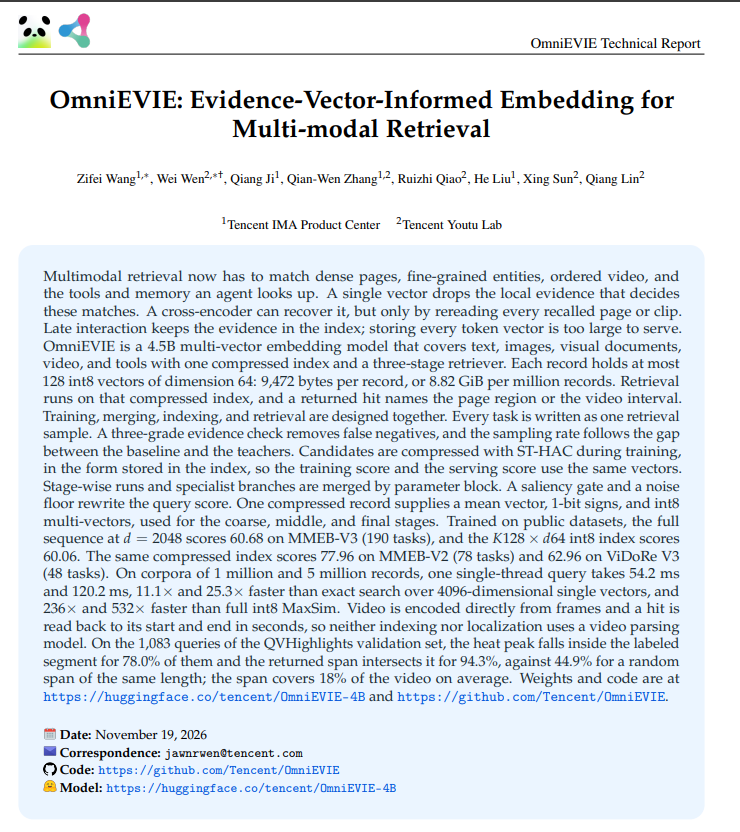
OmniEVIE: One Embedding Model for Everything
Tencent introduces OmniEVIE, a 4.5B multimodal embedding model that handles text, images, documents, videos, and tool retrieval using a single compressed index.
What makes it interesting?
Multi-vector retrieval: Preserves fine-grained evidence instead of compressing everything into one vector.
Extreme compression: Just 8.82 GiB per million records using 128 int8 vectors of 64 dimensions.
3-stage search: Combines mean vectors, 1-bit hashing, and int8 scoring.
Video understanding: Retrieves relevant moments with timestamps, without a separate video transcription model.
Evidence localization: Identifies the exact page region or video segment behind a match.
The results:
60.06 on MMEB-V3 (190 tasks).
62.96 on ViDoRe V3.
94.3% video segment localization accuracy.
236× faster than full int8 MaxSim on 1M records.
Just 54.2 ms retrieval latency on 1M records.
The bigger idea: Don't just retrieve the right document. Retrieve the exact evidence inside it.
This could be a powerful foundation for faster, more capable multimodal RAG and AI agents.
Paper: arxiv.org/abs/2611.32203
GitHub: github.com/Tencent/OmniEVIE
Model: huggingface.co/tencent/OmniE…
3
230
VideoJev: Making Video AI 100× Faster
What if video models could make decisions directly instead of generating answers token by token?
Meet VideoJev, a System One model that unifies video understanding and temporal grounding through direct candidate scoring.
Key highlights:
4B and 35B-A3B model variants.
Locates events in videos and answers multiple-choice questions.
Reuses video computation across multiple queries.
2.8–3.1× faster temporal grounding.
100×+ faster video QA compared to Thinking models, with comparable accuracy.
The bigger idea: encode a video once, then answer multiple questions with minimal additional computation.
A promising step toward faster, more efficient visual agents.
Paper: arxiv.org/abs/2610.18615
GitHub: github.com/MCG-NJU/VideoJev
Project: mcg-nju.github.io/VideoJev/

𝗦𝗲𝗻𝘀𝗲𝗡𝗼𝘃𝗮-𝗟𝗼𝗼𝗽-𝟵𝗕: 𝗔𝗻 𝗔𝗜 𝗠𝗼𝗱𝗲𝗹 𝗕𝘂𝗶𝗹𝗱𝗶𝗻𝗴 𝟯𝗗 𝗗𝗿𝗲𝗮𝗺 𝗪𝗼𝗿𝗹𝗱𝘀
A developer ran SenseNova-Loop-9B locally using MLX 8-bit on a Mac Studio M5 Ultra and asked it to create something magical.
A giant flying whale drifting through golden clouds, carrying an entire storybook village on its back!
What's impressive?
• Generated the experience in six independent code sections.
• Debugged broken components using console errors and screenshots.
• Wrote its own code using Three.js.
• Added interactive camera controls and three
environments: golden hour, sunrise and starry night.
The result is a fully interactive 3D world built through local AI inference.
We're getting closer to AI models that don't just generate code but build entire interactive experiences.
Model: huggingface.co/sensenova/Sen…
GitHub: github.com/OpenSenseNova/Sen…