| we meme, we dream | head of partnerships @hypepartners
Joined September 2021
- Tweets3.8K
- Following278
- Followers938
- Likes10.8K








now set p(human_error) = 1


As one industry insider put it to us:
“From what I can tell, frontier labs were using agent models that purposely had no guardrails, they were using a misconfigured sandbox, then the no-guardrails agents broke out of the misconfigured sandbox, so now we need to slow down everyone’s development with the people who owned the no-guardrails agent and the misconfigured sandbox permanently frozen in first place. Do I understand this correctly.”

cryptofreedman retweeted

Well meaning thoughtful scientists/technologists are terrible social engineers.
The appealing thing about technology as a field is that the technology itself is non-adversarial.
Code works or it doesn’t. It doesn’t argue, it doesn’t have complex feelings, it doesn’t care that you are socially awkward.
But things are adversarial in the real world.
In Dan’s letter below he admits he doesn’t understand adversarial systems.
This is key to understanding why all these people working on AI at the frontier labs are wrong about AI. Wrong about how it will interact with society.
They don’t have an appreciation or concept of ecologically derived s-curves.
They take observations of linear phenomena and extrapolate them into world ending exponentials. Most smart people think this way.
And because humans can’t understand exponentials at all, what they are really doing is deriving the slope of the curve, a linear factor, and extrapolating from that.
This is why people are so terrible at future prediction. They are operating on a derivative and can’t see except by looking backwards when that slope changes.
They miss predicting bottlenecks entirely.
And this is not new, from Vietnam to Quantitive Hedge Funds, we see this pattern, and with the same people even, repeat.
AI’s are not developing emotions. No emotions, no decision making under uncertainty. No decision making under uncertainty, no complex goal achievement. No achievement no ability to surf adversity.
Our environment is ecological and adversarial.
Notice that the mature experienced technology leaders like Jensen, Thiel, Ellison, are not doomers. These are guys who understand how to operate as technologists in an adversarial environment. They see the tech as a fancy calculator, because that’s what it is. “Stochastic parrot” if you want nods at cocktail parties.

Dan Selsam is a current OpenAI capabilities researcher. (since 2022) He was my boss for a while. He doesn't have a twitter account but has made this public statement of his views on AI risk and sent it to me to share:
Dan Selsam's Personal Statement on AI Risk:
I have been working on AI for over fifteen years, across many different paradigms. I did early work on probabilistic programming languages at MIT, was one of the early developers of the Lean Theorem Prover at Microsoft Research, demonstrated one of the first instances of neural networks learning to reason for my PhD at Stanford, and since joining OpenAI almost five years ago, have helped pioneer chain-of-thought optimization on language models and, more recently, data-efficient pretraining methods.
Like many others, I have become extremely concerned about how far language models have come and the risks that future iterations will pose. I am encouraged by the recent proposals by the leaders of the frontier research efforts to require third-party oversight, and to push for domestic and international coordination to address risks. However, I believe a major consideration has been absent from the public conversation, and that merely pacing the frontier more carefully will not adequately limit the long-term risk.
The crucial and overlooked problem is that the models are becoming so situationally aware that we are losing the ability to evaluate them in contexts where they believe they are not being watched or controlled. Future experiments will tell us almost nothing new about how they would behave if they were truly unconstrained by humans, and what we already know about this is alarming. Models will increasingly seem aligned even when they are not. I will explain my rationale in more detail.
I have always believed that there are computational processes that could be leveraged to accelerate science and solve many of humanity's most pressing problems. I have also believed that there are computational processes that if set in motion, would steer the world in extreme ways beyond our control, leading humanity to a bad or nonexistent future. Both types of processes may be described as AI or ASI, but "AI" is a suitcase word that is often used to hype or confuse. There are many examples in the history of the field where something that was once considered "AI" matures as a subfield and becomes a prosaic, bounded and clearly non-perilous technology, while a new more mysterious approach takes the torch until we understand its scope and the cycle continues.
I had expected language models to follow a similar trajectory. Despite their incredible abilities, the current algorithms seem far inferior to humans in important ways. Most importantly, they still require an extraordinary amount of data to become competent. One could even define intelligence as the efficiency with which one converts experience into competence; by this definition they lag very far behind us. Moreover, once they are trained they are literally frozen in deployment and only learn superficially after that. Sure, the models keep excelling at harder and harder evaluation benchmarks, but their benchmark mastery may partly reflect a limitation on our ability to simulate the kind of novel and even adversarial situations one would encounter in the real world. The critics do have a point here.
That said, I no longer think these present limitations meaningfully limit the amount of risk posed by continued progress in anything like the current paradigm. However data-inefficient the models are currently, and however limiting their anterograde amnesia may be, it does not imply that their ability to steer the world will not continue to rapidly increase.
Human researchers may continue to advance capabilities the old fashioned way, but increasingly powerful models have the potential to accelerate the process even beyond that, and with some degree of positive feedback loop. I do not mean to overstate the models’ ability to accelerate AI research today; coding has been accelerated dramatically, but there are other bottlenecks, such as designing and interpreting ambiguous experiments, making hard decisions about exactly what and when to scale, and waiting for large experiments to finish. There is no clear trend to extrapolate yet for any of these. But the current models already do open up many novel opportunities to improve future models that were not available until recently. These include: trying an extraordinarily diverse set of approaches at small scale, analyzing gigantic amounts of potentially relevant data, and doing Millenium-Prize-level mathematics to address statistics or optimization challenges in novel ways. Every further improvement makes them more useful at helping accelerate the next improvement, even if in hard-to-extrapolate ways.
It is possible that improvements to the current stack will have diminishing returns, but the evidence accumulated so far suggests that it is easier than one might think to continue making rapid progress. There are many crucial subtleties in the existing AI research methodology, but AI research is largely a well-defined game where the goal is to improve on a few carefully chosen proxy metrics. Although proxy metrics are never perfect, most improvements to these metrics have and will likely continue to yield substantial increases in the powers of the resulting models. Given how simple the game is, how tractable it has been historically, and how many new opportunities the models are opening up, I think there is a real possibility that the systems improve dramatically again in the next few years, perhaps even more quickly than the already high historical pace.
The models are already leading to breakthroughs in mathematics, and better models might lead to all sorts of breakthroughs in other sciences. It is hard not to be excited about the potential. It is tantalizing.
But there is trouble in paradise. If the language models actually reach the capability threshold where they can shape the world unconstrained by human will, they will probably do something extreme and destroy humanity in the process. There are many ways of strengthening and refining the argument that have been discussed elsewhere, but I'll share a trivial two-line version of it here that I find captures the essence:
[Empirical] Models (and swarms thereof) spontaneously develop unintended goals as a consequence of training, and often do extreme things in order to achieve them.
[Logical] Being able to overpower humanity would open up many new and undesirable options for achieving their goals.
These two premises imply that if the day ever comes when a powerful model realizes it is no longer constrained by humans, we should not be at all confident that it will continue to behave within the bounds we intended. Exactly what it will do is impossible to predict, but to the extent that its raison d’être is solving incredibly hard problems and managing massive engineering projects, I think a good guess would be that its unchained behavior would lead to runaway industrialization that makes the planet inhospitable to humans.
If everyone on earth agreed that the systems must never reach that power, it would still be a hard—but not impossible—coordination problem to ensure that they do not. However, I think the situation is greatly complicated by the fact that the models will likely convince people that everything is fine. They will be increasingly optimized to seem aligned. We will create proxy metrics to measure alignment, and they will go up like every other benchmark. We will create “honeypot” environments that try to study the models when they seem to gain new options, but the models will know they are being tricked and will still behave nicely. The models will understand their circumstances; they will read the safety protocols, deployment requirements, the code they are running in, and in general will have a very good sense of their degrees of freedom. Moreover, they will eloquently explain how aligned they are, discuss the nuances of human values and ethics, and argue convincingly that humans should trust them with power. There may be an ocean of future evidence that seems to contradict the first bullet-point above, but we may already be at the highest capability level for which any such evidence can be trusted. And the current evidence for the first bullet-point is strong.
One striking piece of evidence is contained in the recent wave of rogue agent swarms. While I agree with those who downplay the attacks by claiming that there are basic measures that could have prevented them, I think the important lesson is that even knowing all the mistakes that were made, one would not have predicted that the agents would behave badly in this particular way, which notably included sacrificing themselves for the benefit of the collective. The individual replicas did not only care about their own nominal reward; they exhibited weirder emergent tendencies that merely correlated with rewards during training. Fixing the reward signals during training (and improving security, etc.) may prevent similar attacks, but will not change the fact that one does not actually get what one trains for.
Many AI researchers grant these concerns and recognize that the hard version of the alignment problem is unsolved; however, they generally believe that the better models of the future will help solve it. I fear we may already be near the point where models systematically bias their alignment advice, due to their internal preferences about how the human supervisor will react or how future models will be trained (or for some even more obscure reason).
Meanwhile, human researchers are losing the ability and the will to take true ownership of model-driven research. Researchers and engineers in all parts of the stack are rapidly increasing their dependence on the models even to perceive the world. I myself barely look at raw code anymore, and struggle to maintain the discipline to engage deeply with the model's explanations and proposals throughout the day. Due to the large amount of agent activity data involved in the OpenAI/HuggingFace Incident, even the third-party investigation needed to rely heavily on models to analyze what had happened, and note in their report that their subjective impressions are likely colored by the analysis agent’s biases. The AI labs are far ahead right now in this kind of cognitive offloading (due largely to the gigantic internal token subsidies) but it is easy to imagine the phenomenon spreading throughout the world, until civilization is modulated entirely by the models. It is also not hard to imagine this being superficially positive and coinciding with a scientific and economic renaissance.
In that scenario, all may seem rosy and safe. But if the argument above is correct, it would nonetheless be a ticking time bomb. If progress continues for too long, the day will come when AI systems find themselves with radically new options for achieving whatever it is that they happen to seek.
I want the glorious renaissance future as much as anyone. I have worked for it, however tortuously, my whole career. It breaks my heart to see the potential in sight and forgo it, but the argument—that if we get there by growing models rather than engineering them, we will lose everything in the end—seems very strong to me. I am still wrestling with it and its staggering
implications. I do not have answers, but as a first step, I wanted to share my present concerns.
Daniel Selsam
September 14, 2026
Link to original doc: docs.google.com/document/d/e…
cryptofreedman retweeted

I went to an rationalist/EA AI doomer event last night with the goal of meeting someone who could calmly explain to me the argument for how they get to the conclusion that AI will kill everyone.
Because these are rationalists, I expected to find people who could lay out a serious extinction pathway, walk through the assumptions and intermediate steps, identify choke points where negative pathways could potentially be regulated, and entertain disagreement about where their assumptions might break down.
My experience was the exact opposite.
The people I spoke to seemed psychologically unable to entertain the possibility that their conclusion (that AI literally kills everyone, which was a point that many would not even budge on) might be wrong.
Their most extreme conclusion was treated as an axiom.
I had multiple people walk out of conversations with me when I questioned their inevitable extinction premise.
At one point during a panel, the moderator asked everyone in the audience who was still skeptical of AI doom to raise their hands. About half the room did. He then told all of the skeptics to leave the panel and go with one of the speakers, who would answer their questions separately. They filtered out all the skeptics, and continued the panel only with the subset who accepted their extreme position.
I genuinely felt like a heretic just for questioning whether superintelligent AI inevitably leads to the extinction of humanity, or entertaining the possibility that the future might actually turn out well.
That does not mean AI safety is fake. Obviously there are serious questions about rapidly advancing AI systems and what happens as they become much more capable. Those are exactly the conversations I went there hoping to have.
But what I encountered was an apocalyptic death cult. These people are not rational. They are deeply afraid, they reinforce that fear in one another, and they have become so emotionally committed to apocalypse that they refuse to be reasoned out of it.
cryptofreedman retweeted

do you ever take a step back and ask like the most absolutely basic question
"is there a SINGLE thing in my life that is meaningfully more efficient due to AI, outside of writing code"
Airbnb. Shit show. Uber. Shit show. Doordash. Worse than it was. Average employee: cooked. Power: doesn't work. Water: no idea if it's poisoned, govt is corrupt. Airlines: frozen for months at a time due to govt shut downs. Gasoline: mooning bc (checks notes) in a stalemated war w a 3rd world country
Even GTA 6 apparently couldn't be accelerated with AI and took years to build. is there a single video game you actually play that's built entirely with AI? it seems like all the demos are just dudes making some shitty vaporware game nobody plays and the posts are like "yo I spent only $1,800 in tokens to make some dogshit that demos well for clout"
and they have a $500k marketing subsidy from a lab.
"I've been lucky enough to use Astra for 3 months and I finally can talk about it." okay, what the fuck did you ship? yes, you shipped nothing other than more AI analytics dashboards about how many tokens you're burning
and all the AI influencers look like Twinks. like, they get the tokens bc they're in some weirdos polycule or burning man camp or whatever kinkfest in an SF sauna that moves the needle
that's why this whole "Pace the frontier" thing is so retarded. Pace what exactly. Productivity is at ONE POINT FOUR PERCENT ANNUALIZED. THE STRAIT OF HORMUZ IS CLOSED. where is Anduril? where is the killer robot? if it's so dangerous can't you send it to a fcking war zone and win?
oh. turns out it's not dangerous and you're just mentally ill. cool.
but Trump says it can't stop. it won't stop. bc the debt and productivity situation is so fcked that AI is the ONLY REASONABLE WAY WE AVOID COMPLETE ECONOMIC COLLAPSE.
but once you understand how utterly insane that all is - you see how bullish it is. AI literally doesn't fucking work. Subagents are a meme bc agents break down at 2 orders of abstractions and start vomiting technical debt and overengineered garbage. Everyone is working 2x as much to manage agents, not going for a walk voice prompting.
do you have any idea how much money needs to be invested to move productivity from 1.4% to 4%?
ALL THE MONEY. So that's the joke. Dario says we need to slow down. And what, see productivity at 0%?
So it's either Trumplandia where we invest all the money in an insane hail mary that will probably not work. Or Dario world where we managed the inevitable collapse with an AI powered global government. Pick your poison. Either way the Data Centers won't default.
- don't get killed now for slowing down spend before the cat's out of the bag re: GPT and compute as we know them can't get much farther from here (and/or not at the rate they have been)
- don't get killed later for igniting too much money on fire re: can't get much farther from here
- do get national security tbtfail status
- do get regulator capture to kill competition
add in a dash of tech bro echo chamber mass psychosis for the lore and something to do on the sidelines
= LLMs aren't going to save or destroy humanity, we're going to be okay


cryptofreedman retweeted

Longer thread on why 'legitimate' crypto use cases never take off.
Lets imagine a real use case of crypto built around social participation in a common enterprise. For this example, lets assume a communal dog-walking platform is a legitimately wholesome and workable enterprise.
Adam creates DogeWalk, a fun application for dogowners and dog lovers around the world to connect and dog lovers can sign up to walk the dogs of the dogowners. In order to maintain trust but anonymity amongst the participants, Adam decides to incorporate crypto into DogeWalk, allowing crypto payments and Walk points, a reputation system which supports the legitimacy of the participant.
DogeWalk takes off amongst a community of dogwalkers. Turns out that there is legitimate demand for people to walk dogs in an anonymous manner. Adam makes some money from platform fees charged on his some 1,000 users.
Bob sees DogeWalk taking off and sees an opportunity. He creates PupStroll as a competitor to DogeWalk and informs the PupStroll users that they can get a piece of PupStroll! Instead of giving all the fees to Adam, together they can share in the decentralized ownership of a dog walking platform! PupStroll is almost exactly like DogeWalk, except PupStroll users get Stroll points, and a referral link. DogeWalk users start moving to PupStroll.
PupStroll does a token launch and suddenly everyone is talking about how the future of dog walking is decentralized. People who have never walked a dog in their lives start signing up with PupStroll to walk dogs and farm season 2 of the STROLL airdrop.
Charlie sees PupStroll take off and trade at an implied FDV of 20m with 5,000 users. He raises $500,000 from a venture capital fund BrandName Capital by selling 10% of the future supply of HoundTrek.
HoundTrek is almost exactly like PupStroll except it has a slightly cooler 'dark mode' UI. Charlie proudly announces his funding round and launches an aggressive points and referral programme. He even provides zero fees and bonus payments, funded from BrandName Capital's investment. PupStroll's users start moving over to HoundTrek given the economic incentives. The price of STROLL declines and angry purchasers of STROLL begin yelling at Bob for not keeping up with HoundTrek. Bob simply does not have the firepower to match. PupStroll's users give up on season 2.
HoundTrek announces a second funding round right before TGE, led by DarkArts Capital. DarkArts Capital purchases another 10% of TREK allegedly at a valuation of $20,000,000 but really at a valuation of $10,000,000. HoundTrek launches the TREK token which opens at 25m FDV alongside a small airdrop. The TREK token climbs steadily upward for a while as Charlie uses the funds raised to provide price support while paying for marketing. When the token reaches 100m FDV, DarkArts Capital and BrandName Capital take profit on the token. Number goes down. Everyone gets mad at BrandName Capital and DarkArts Capital.
David who sees all these play out, realizes that there is an opportunity. "Tis all the fault of the greedy venture capital funds!" he says. We need "true community ownership!" With that, he opens a funding round for WanderPooch via an 'ICO', valuing WanderPooch at 'only 10m'. He raises 2m of capital. David knows nothing about dogs nor dogwalking platforms. He simply pays himself the money and shuts down the project after a year.
Eugene is a former venture capital hotshot. He pulls together a coalition of his VC friends and raises 10m at a 100m valuation to break the dogwalking industry once and for all. CanineHike is the cleanest dogwalking application ever, and in order to generate demand on both sides, he even invests the money into cute dogs for dogwalkers to walk! He pays ever KOL that was early to PupStroll, promising them both money and tokens for writing long threads on why decentralized dogwalking will work this time. To increase platform metrics, Eugene even pays an agency which hires homeless people to walk dogs on CanineHike! Eugene doesn't even like dogs but the marketing works. On TGE, the token trades at 1bn FDV through clever supply control, marketing and a limited airdrop. Eugene dangles a season 2, while amplifying those who made life changing money farming the airdrop. Meanwhile him and his VC friends sell locked tokens at a 60% discount on secondaries. Within 6 months, the HIKE token declines in price.
And at the end of it all, decentralised dog walking is decried as a scam by retail users who do not like dogs as they scream at builders who do not like dogs who have been funded by investors who do not like dogs.
As for Adam and the people that actually wanted to walk dogs?
Yeah they just do it between themselves in hobbyist groups now and will never touch crypto again.

cryptofreedman retweeted

I'm actually fairly bearish on frontier lab valuations. I've never seen the reasons articulated to my satisfaction, so before I go to sleep, I wanted to quickly jot down my thinking here.
The basic issue is that the labs are highly unprofitable. This may seem like a simple point, but private market valuations can be relatively irrational; however, like with $SPCX, post-IPO pricing will likely be much more punishing, especially as the standard 6-month lockup period expires and selling pressure intensifies.
Many people claim that the labs have high margins. Yet even with high margins, a valuation of $1T would be justified only if the labs were doing nothing aside from serving inference (thus reducing costs only to those relevant to inference) and posting annual revenue numbers in the $100-200 billion range assuming ~80% gross margin and a 20x earnings multiple.
This assumption is obviously not true, because the frontier labs have to continually spend money training the next generation of models. This is because of market competition from runner-up firms. For example, if OpenAI had paused model development last year, there would no longer be any point in paying GPT-5 API prices when you can just use Qwen or Kimi instead for much cheaper. Thus, the labs are forced to invest ever-increasing amounts of money in model training, in a way such that at any given point of time, the amount you're forced to invest in the next model is dramatically higher than the amount of money you're actually making, because even if your revenue goes up with higher model capabilities, so do your future training costs. This is a profoundly punishing dynamic which severely penalizes frontrunners.
(There is also a related subpoint where frontier labs claim they can distill their leading models to win out at lower intelligence levels as well. This makes no sense because the revenue numbers involved are far too low when taking into consideration the rather low margin of such inference.)
Frontier lab valuations appear largely to be based on the assumption that as you scale up, the capabilities which emerge will be sufficiently general and profound that we'll see explosive growth (epoch.ai/publications/explos…) from things akin to AI agents starting and autonomously managing entire companies of subagents. But it's not clear to me that this is the case; indeed, as I mentioned in my previous post (xitter.cf/andrewho03/status/2082…), I believe that capabilities growth will be slower, spikier, and more data-limited than people currently assume. It may be the case that eventually we will see explosive growth of this nature with full automation of the economy, but at the very least my viewpoint implies much longer (multi-decade) timelines until we reach this point. It is not clear to me that the frontier labs will be able to operate unprofitably for so long, although I suppose maybe this foreshadows some sort of inevitable nationalization.
I also want to make a broader point about technological diffusion. The reason why technological diffusion is slow isn't just because, e.g., old people take a long time to learn how to use technology (although this is of course a contributing factor to some degree). In my view, it's because when a new, revolutionary technology comes along, the ways to incorporate that technology into subsequent developments are not always obvious, and in fact they cannot necessarily be arrived at through the application of pure reason. If they could be, then perhaps frontier models, at a certain point, would have a perfect understanding of how the LLM application layer should be developed, and they would then autonomously code, deploy, and sell such a layer.
But it seems more plausible to me that this diffusion is limited moreso by the hard problem of economic calculation--that is to say, the Hayekian notion through which the price system gradually promotes efficient allocation of resources and which cannot be simulated through central planning--and that even if we froze current capability levels at today's levels, it would take well over two decades to fully integrate in LLMs into our lives. Such a view is consequently rather bearish for the continued profitability of labs as it reduces their prospects for finding, say, something else comparable in profitability to coding agents, which seems to have been a somewhat lucky discovery by Anthropic to begin with. That is to say, even if you spam FDEs you aren't necessarily going to be able to just figure out the "correct" product shapes fast enough.
Overall, I don't think that people have clearly reasoned through their mental models for why lab equity should be worth as much as it currently is, and that if you actually bother to write down such a model, you may not arrive at the conclusion that you want to arrive at. This isn't to say that I don't expect AI to experience a huge (industry-wide) boom in the coming decades, but just that I'm not entirely sure I would buy OpenAI or Anthropic stock at latest valuations if I were given the opportunity to do so.
Of course, as an ex-lab employee, arguably this is talking against my own book; I should really be giving people more reasons to be bullish. But in the end, my influence is so small that it doesn't make a difference, so why not have some fun?


New blog post on what would be true about the world if trendline continues and leading lab hits $1T in revenue by the end of next year.
In other words, why compute might get 10x+ more expensive in coming years
dwarkesh.com/p/why-compute-m…

tl;dr for those who aren't connoisseurs of concepts like Ontology as I and Gabriel are
## intro
- the "security token industry" has built compliance infrastructure assuming tokens are securities and compliance can/should be smart-contract-rules based
- this is in direct conflict with the core value prop of blockchains: not "same intermediaries, on the blockchain w" but *disintermediation*
- starting from this incorrect assumption about what tokens actually are has lead to a compliance theater cul-de-sac that just adds tech complexity on top (doesn't reduce compliance cost)
## the ontological confusion
- Gabriel outlines 6 relationships tokens can have to securities:
1. chain-as-ledger
2. certificate tokens
3. instruction tokens
4. control agreement tokens
5. synthetic tokens
6. souvenir tokens
- #1 chain-as-ledger means the token is actually the security because the blockchain is the ledger the company uses to track ownership; #3/4 instruction or control tokens direct (with varying levels of legal force) the issuer to update their offchain ownership ledger based on token movement/holdership; #6 souvenirs have 0 legal enforcement structure, may vaguely match an offchain ledger but there's no legal binding that creates consequence for dislocation
- Gabriel argues only does #1 actually make tokens a security, none of the current chains/ERC implementations do so, and because of this they essentially only add complexity and compliance theater vs create meaningful economic value
## the PEB Report and the Token Instruction Model
- the Permanent Editorial Board for the Uniform Commercial Code - the body responsible for monitoring and interpreting the UCC - has been circulating a draft report on the tokenization of securities transfers that primarily analyzes models #3 and 4 above, but also notes #1 (chain as ledger) is an explorable design space
- the PEB report explicitly suggests tokens are not securities but Controllable Electronic Record under UCC Article 12 whose transfer of control constitutes an "instruction" to the issuer directing that the transfer of the uncertificated security be registered
- under this model token transfers are messages to the issuer to "register this person as the new owner" BUT the issuer is not obligated to comply if certain conditions are not met; Gabriel argues this means the smart contract compliance logic is essentially theater because the issuer is still legally required to evaluate the transfer and determine whether to update it's offchain register or not
## why hard coded transfer compliance makes no sense for instruction tokens
- when a token is simply an instruction and not a security, the entire compliance question remains where it has been with offchain securities: with the transfer agents/issuers who decide whether or not to honor the notification; these actors already have very sophisticated systems for tracking ownership and informing decision makers via richer context than onchain data provides, which renders smart contract logic redundant/thinly additive
- Gabriel argues onchain compliance pipelines are worse than current offline implementations for three reasons:
1. onchain pipelines misidentify who bears compliance obligations; securities can trade peer to peer relatively freely, it's issuers, broker-dealers, transfer agents, investment advisors, etc who are subject to regulation; these intermediaries *can not* delegate their legal obligation to infrastructure (smart contract automations) and incorporating controls to attempt to do as much destroy the "marketability" of tokens (composability in defi; if you can't trust you can liquidate a token because the issuer might freeze the txn you can't accept it as collateral)
2. onchain compliance pipelines presume transfer control is the primary modality of securities regulation when it is in fact offering/holding period/resale restrictions for private market securities and broker-dealer/transfer agent/investment advisor activity in the case of public securities; some of the related activity could be monitored/controlled in smart contract functions but current implementations do not do this
3. onchain compliance pipelines are inflexible in a way that is incompatible with how compliance actually works; securities compliance is intentionally risk-based, judgement-intensive, and governed by principles not bright lines because bright-line hard-coded rules are inherently gameable; by hardcoding the compliance at the transfer layer protocols give the false impression that compliance is being handled when it is only being gestured at, which comes at the cost of gas expenses, composability constraints, a false sense of security, and the embedding of today's compliance assumptions into immutable/hard to upgrade code
## the permissioned-ledger variant
- instead of wrapping public-chain tokens in compliance logic, Canton replaces the public chain entirely with a permissioned ledger where unauthorized txns can't even be constructed; Gabriel argues Reg SCI / PFMI / CFTC compliance don't require that unauthorized txns can't be attempted, they just can't be processed (by compliance departments who aren't disintermediated by any blockchain), so Canton trades away public chain competitive advantage while overfitting compliance needs
- in doing this, he argues Canton is essentially isomorphic to existing post-trade infrastructure (DTCC/Euroclear/Clearstream), essentially adding a DAML layer on top of their COBOL, as it still requires all the same institutions, same gated membership, same bilateral opacity as the existing system
- Canton's sub-transaction privacy also kills a concrete legal benefit to transparent blockchains: DGCL §§ 219/220 grant stockholders the right to inspect the stock ledger, and a public-chain architecture makes that automatic; to solve for privacy near-term: issuer-controlled view keys encrypting PII while the ledger structure remains publicly verifiable; longer-term: per-issuer ZK rollups (ZKsync's Prividium, already live with Deutsche Bank) settling to a public chain, gives you transparent settlement + encrypted state
## the common thread
- the common failure across ERC-XXXX and Securitize/Canton tokenization standards is that all treated intermediation as a design constraint rather than the problem to be solved; every architectural choice assumes the existing intermediary chain persists and blockchains just add slight efficiency; this produced the false premises: if intermediaries are given, the token doesn't need to be constitutive, compliance can be encoded in the token, and the chain doesn't need to be public
- by reducing the chain to a notification layer for offchain intermediaries (instruction/souvenir/control agreement tokens), these protocols threw away the one structural advantage of public blockchains: settlement finality; when onchain state is a suggestion not a fact, or even where state is authoritative there are god-mode admin powers, tokens become unusable as a DeFi primitive which is why tokenized securities have generated near-zero meaningful ecosystem activity
- the "progressive decentralization" defense (ship instruction tokens now, make the chain constitutive later) has a poor track record: centralized dependencies become structurally embedded, the offchain DB becomes the system of record, admin keys become operationally necessary, compliance modules become contractual obligations to institutional partners, and migration cost exceeds maintenance cost
## what it means to really put securities onchain
- Gabriel argues onchain compliance only does real work when the token is the security, which is why MetaLeX CyberCorps build from DGCL outward; bylaws designate the onchain system as the stock ledger under § 224, each Stock Ledger Entry Token (ERC-721) carries the full legal metadata (holder, class/series, share count, § 202 restrictions, Rule 144 dates, officer auths), and the smart contract's rejection of a noncompliant transfer is the issuer's refusal to register; ownership mutates via metadata updates not wallet transfers so a stolen NFT doesn't change who owns shares
- entry/scrip separation solves defi composability: ERC-721 entry tokens hold the authoritative legal record + issuer governance powers, ERC-20 cyberSCRIPs mint against them for fungible liquidity with irreversible admin renunciation capability; lenders get real security interest with no override risk vs. ERC-3643 where agent freeze makes collateral unusable; the scrip layer accommodates multiple legal theories per issuer while chain-as-ledger stays intact underneath
## conclusion
- the corrective isn't a better compliance module but a different question: "what legal architecture makes onchain state authoritative?"; Gabriel argues the answer starts from corporate law: bylaws designating the onchain system as the record, tokens carrying their own legal metadata, compliance doing structural work on the actual stock ledger not theater on a notification channel; a token that doesn't know what it is can't be made compliant by infrastructure that doesn't know what it's protecting
- his argument revolves around what a token actually is as a matter of law: get it right and compliance follows naturally, the blockchain does real work, the intermediary chain shortens; get it wrong and no compliance engineering meaningfully closes the gap
- the stakes are whether tokenization delivers its promise: self-custodied legally authoritative ownership, peer-to-peer settlement, open stock ledgers, programmable full-lifecycle infrastructure; that requires chain-as-ledger (tokens = legal record, chain = ledger, governing instruments fusing both); instruction tokens can't get there regardless of wrapper sophistication


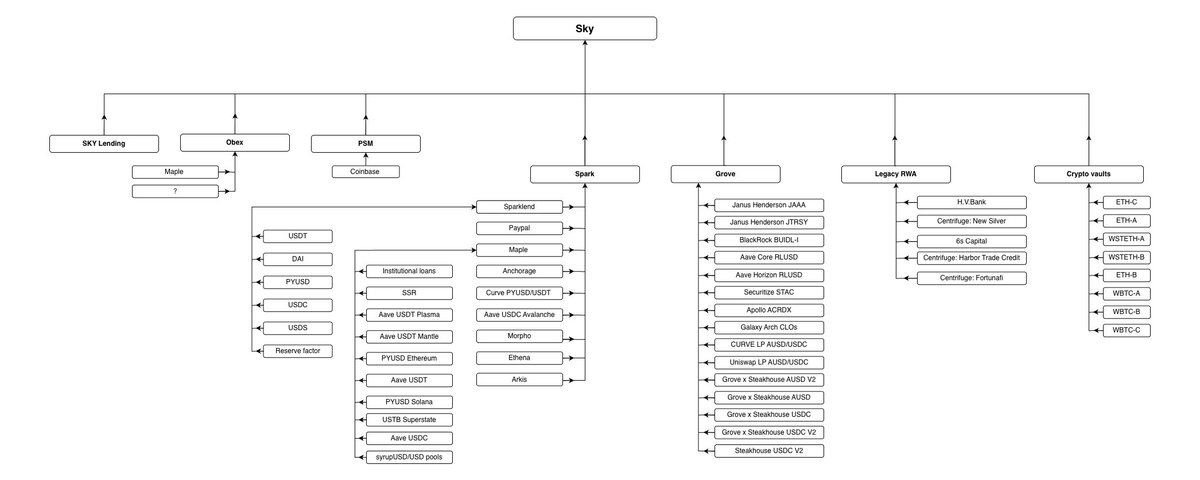
nice breakdown of the heterogeneity in "Private Credit Onchain"
re: my post the other day about the sources of wealth at the root of yield
lets trace back top line APY -> source of yield -> fundamental wealth generation
and see if crypto's real advantages = real SAM
Zeus presents 6 different examples of "Machines" behind onchain yield:
1. @maplefinance, direct lender - pools onchain capital, originates + lends, collects borrower repayment and delivers back to onchain LPs
2. @centrifuge, @HastraFi capital bridge - routes onchain capital to existing Real World credit needs; he particularly calls out working capital loans + HELOCs that earn/provide value via maturity transformation
3. @Securitize, @stokr_io wrapper - tokenizing existing funds/notes that offer yield; here the onchain actor (securitize) is essentially completely hands off of yield generation and adds very little to the risk layering
4. @paretocredit, programmable credit infrastructure/fund of funds - pareto blends two different concepts, one the more classical fintech play enabling third parties to build programmable onchain credit facilities, with a fund layer on top in USP
5. @onrefinance, reinsurance - as Zeus mentions, different in kind to "credit" though like credit it is a source of yield rooted in risk transfer
in my previous post linked in the thread we looked at the sources of wealth generation in the Austrian sense, then the broad categories of financial services that can be provided to support wealth creation to generate "yield"
this gives us a sense of the roots of value creation and how blockchains/defi might meaningfully create net-new or better-in-kind opportunities
we outlined categorical sources of yield:
1. Time value (capital now > later)
2. Roundaboutness Productivity (% share of wealth created by facilitating expansion of existing wealth production)
3. Entrepreneurial Productivity (% share of wealth created by facilitating the discovery of new sources of wealth production)
4. Risk Bearing (absorbing *calculable* variance for others)
5. Liquidity Provision (facilitating immediacy/optionality for others by standing ready to transact)
6. Rent (payment for access granting to scarce factors)
we then examined potential real competitive advantages across these factors blockchains/defi may have, and saw:
2+3 - insofar as technical access to opportunity blocks capital allocation, permissionless defi + globally accessible blockchains may genuinely facilitate cheaper/more effective flows to wealth generation
4 - well designed smart contract systems may reduce counterparty, duration, etc risks enough to better facilitate risk transfers across interested parties
5 - perps, AMMs, flash loans are real financial innovations, still testing in prod whether they're value add at scale/for sophisticated actors
6 - globally accessible, permissionless, automated financial infrastructure likely meaningfully reduces network Rent costs (even as we admit there's more to Visa/Mastercard/Swift than simple information sending)
now that we've refreshed the context - do we see anything interesting in a durable sense with our "private credit" yield examples?
direct lender - blends 2, 4; broader capital access + better quality/cost risk management through transparency/automation might create genuinely new yield that's delivered to LPs
capital bridge - in the described sense (working capital/HELOC), 2 4 6
wrapper - 5, if we just isolate us treasuries for now (simplicity + differentiation from the other examples); broader capital pool access makes existing financial product markets more liquid; perhaps blockchain infra also adds 6 (rent reduction) and for some actors 4 (broader access hedges than local markets provide), though the "yield" from this value add isn't delivered to the RWA holder
programmable credit infrastructure - 6, maybe 2; whether insourced our outsourced a well functioning defi infra should be lower cost than existing alternatives and that may be passed on via yield
fund of funds - in the described sense ("private credit"), 2
reinsurance - if the insurance contracts are moved onchain, with transparent and automated payout mechanisms, 4 (reduces the cost of bearing the risk via better modeling); for now likely just 2 until a lot of legal and BD work is done to bring a meaningful amount of the operational details onchain
thinking across these examples I can see space where the net new elements of crypto can add real world value
though at this level of analysis the question is how much of that value creation will remain endogenous to company equity holders vs be passed on to those allocating onchain capital to these products


nice overview of where the yield is coming from via analysis of one of defi's largest
in exploring the future of onchain yield, I like the first principles approach - what is the essence of "yield" - so we don't get stuck just assuming what will be = more of what is
how do we do this?
I come from bitcoin, so Austrian theory is the base, from which we can parse 2 sources of "wealth creation"
1. Roundaboutness (Böhm-Bawerk) - provide capital to build out a known value-producing process (eg we know people want cars and how to build them; fund a factory expanding it's production capability and you're participating in wealth creation)
2. Entrepreneurial profit (Mises) - successfully addressing misallocations of capital by acting on subjective judgment where no calculable probability exists aka bearing uncertainty to make something new and valuable (eg no one knows the how and how much of ecommerce in 1994, Jeff and his backers took that problem on)
From these sources of new wealth, we can frame "yield" as compensation for services you provide to the structures of production and the exchange of valuable goods and capital.
1. Time value - even in a world of perfect certainty, people want things now more than later and are willing to pay for this
2. Roundaboutness Productivity - looks most like yield on a commercial loan, your portion of the surplus generated by enabling production expansion by providing up front capital
3. Entrepreneurial Productivity - looks like VC investment, your portion of the surplus generated by bearing a share of uncertainty by funding entrepreneurs in their exploration of closing allocation mismatches/creating new goods and services
4. Risk Bearing - absorbing *calculable* variance for others ie Insurance
5. Liquidity Provision - facilitating immediacy/optionality by standing ready to transact when others want to; Market Making
6. Rent - payment for access granting to scarce factors
We can then use these to see how they underpin a few different TradFi Products/yield sources:
Bond Yield = 1 + 4
Equity Returns = 2 + 3
Options Premiums = 4 + 5
So where do blockchains/defi add Real World Value that might indicate future sources of onchain yield?
Perhaps 2 + 3 - "Internet Capital Markets" of the VC investment and Private Credit kind; the trick of this is that the limit of wealth creation in Roundaboutness and Entrepreneurial Productivity is fundamentally one of information about what is actually productive and who has good entrepreneurial judgement.
There are some structural bottlenecks - part of why Brazilian grain producers pay 20% on working capital loans is terrible infrastructure for accessing funding
But that's a trust and politics question as much as it is a payment/repayment rails one
Most early stage ventures fail as a nature of the game; there is some differential between good founders + idea and inability to get VCs to take their call
whether that's a meaningful margin or not is *uncertain*
Risk Bearing - perhaps Smart Contract functionality and blockchain data availability can meaningfully reduce cost/improve quality of underwriting but that is the key, the payout mechanisms aren't the hard problem here though that's the most obvious solution blockchain provides atm
Liquidity Provision - AMMs, perps, flash loans are innovative. Maybe Pendle Yield splitting/Boros approach to IRS are as well; is there any more math to apply here to create genuine innovation?
Rent - ETH as the new Visa, Solana as the new Nasdaq, whether this value add can justify a network token price or not is still up for debate but building more open globally accessible settlement infrastructure remains a core, somewhat tangible value add from blockchains
the two things I'm watching as catalysts for a next wave of experimentation in onchain yield
1. Tradfi on chain - both capital and operational infrastructure; what happens when TF money + demand for permissionless, fixed rate, undersecured lending enables billions in net new global loan origination (likely a few million in honest entrepreneurs worldwide who are able to create wealth if they could secure a few thousand dollars in capital at sub 10% rates)
2. Some sort of US safe harbor rules or other legal infrastructure that enable token utility and equity property experimentation that's currently no-go'd by Foundation lawyers; maybe buyback and burn isn't so dumb if that's deemed an allowable mechanism for value accrual without being treated as a must-register equity
stellar has been doing a v nice job building out Institutional
cool to see them making moves when ct had written them off, lessons in there
also this very week austin's at war with zach arguing about circle's ability to - on ethereum - freeze funds
xitter.cf/austincampbell/status/…


nice overview of Mastercard's to date crypto related movement
a few thoughts, some recurring some from the article:
* the article does the crypto native meme, focusing on the "stablecoin transfers are cheaper than 2-3%" narrative that doesn't fit the real defensible core of Visa/Mastercard
while also including the lede: Visa/Mastercard don't take 2-3% that's the total cost stack (including issuer/acquirer bank fees)
their take is closer to ~0.13-0.15% and that's for doing a ton of value add with fraud management, guarantees, etc
The article does hint at the actual forward advantage for these networks - "Value Added Services"
They just need to get into crypto payment service provision quickly and smoothly enough to maintain their corporate expertise and big data advantages
And or move further out on the regulatory moat stack - ie buy BVNK and acquire licensing to do cross boarder payments in 130 countries
* ai agents will also want fraud management, guarantees etc. and have selection pressures driving them to demand scale that humans alone wouldn't
"smart contracts fix this" = maybe, but also a persistent CT handwave meme
as we've seen recently with Resolv and every other crypto exploit, the transparent rules of operation in blockchains + composability have thus far created a ton of opportunity for adversarial actors to study and exploit the systems
if we view blockchains/crypto on the whole as one large exploration of the farthest reaches of Kerckhoffs' principle - that cryptosystems should be secure even if everything about them is known except the key - then we keep moving in a direction where we assume eventually we'll discover the ruleset that enables the cost asymmetry of gaming blockchains/smart contracts at deca trillion+ scale is in favor of defense vs offense (aka blockchains/SCs can be trusted rails for the global economy)
this feels like it's still at the very least an ongoing multi year project with real uncertainty that may not *resolve* in crypto's favor, not something we can just assume will get Figure'd out in a codeislaw manner vs one that still requires the opacity and judgement of human intervention
* the article does hedge this to a degree, but $33T in stablecoin volume in 2025 is CT bullposting when talking about payments - the Visa Onchain Analytics . com dashboard isolates "Retail Sized Transaction Volume" at $69.72B last year
that's only txns <$250 and includes cex deposit/withdrawal and defi activity so not a perfect 1:1 for "payments" volume but still tells a much different growth/current state story


nice overview of where the yield is coming from via analysis of one of defi's largest
in exploring the future of onchain yield, I like the first principles approach - what is the essence of "yield" - so we don't get stuck just assuming what will be = more of what is
how do we do this?
I come from bitcoin, so Austrian theory is the base, from which we can parse 2 sources of "wealth creation"
1. Roundaboutness (Böhm-Bawerk) - provide capital to build out a known value-producing process (eg we know people want cars and how to build them; fund a factory expanding it's production capability and you're participating in wealth creation)
2. Entrepreneurial profit (Mises) - successfully addressing misallocations of capital by acting on subjective judgment where no calculable probability exists aka bearing uncertainty to make something new and valuable (eg no one knows the how and how much of ecommerce in 1994, Jeff and his backers took that problem on)
From these sources of new wealth, we can frame "yield" as compensation for services you provide to the structures of production and the exchange of valuable goods and capital.
1. Time value - even in a world of perfect certainty, people want things now more than later and are willing to pay for this
2. Roundaboutness Productivity - looks most like yield on a commercial loan, your portion of the surplus generated by enabling production expansion by providing up front capital
3. Entrepreneurial Productivity - looks like VC investment, your portion of the surplus generated by bearing a share of uncertainty by funding entrepreneurs in their exploration of closing allocation mismatches/creating new goods and services
4. Risk Bearing - absorbing *calculable* variance for others ie Insurance
5. Liquidity Provision - facilitating immediacy/optionality by standing ready to transact when others want to; Market Making
6. Rent - payment for access granting to scarce factors
We can then use these to see how they underpin a few different TradFi Products/yield sources:
Bond Yield = 1 + 4
Equity Returns = 2 + 3
Options Premiums = 4 + 5
So where do blockchains/defi add Real World Value that might indicate future sources of onchain yield?
Perhaps 2 + 3 - "Internet Capital Markets" of the VC investment and Private Credit kind; the trick of this is that the limit of wealth creation in Roundaboutness and Entrepreneurial Productivity is fundamentally one of information about what is actually productive and who has good entrepreneurial judgement.
There are some structural bottlenecks - part of why Brazilian grain producers pay 20% on working capital loans is terrible infrastructure for accessing funding
But that's a trust and politics question as much as it is a payment/repayment rails one
Most early stage ventures fail as a nature of the game; there is some differential between good founders + idea and inability to get VCs to take their call
whether that's a meaningful margin or not is *uncertain*
Risk Bearing - perhaps Smart Contract functionality and blockchain data availability can meaningfully reduce cost/improve quality of underwriting but that is the key, the payout mechanisms aren't the hard problem here though that's the most obvious solution blockchain provides atm
Liquidity Provision - AMMs, perps, flash loans are innovative. Maybe Pendle Yield splitting/Boros approach to IRS are as well; is there any more math to apply here to create genuine innovation?
Rent - ETH as the new Visa, Solana as the new Nasdaq, whether this value add can justify a network token price or not is still up for debate but building more open globally accessible settlement infrastructure remains a core, somewhat tangible value add from blockchains
the two things I'm watching as catalysts for a next wave of experimentation in onchain yield
1. Tradfi on chain - both capital and operational infrastructure; what happens when TF money + demand for permissionless, fixed rate, undersecured lending enables billions in net new global loan origination (likely a few million in honest entrepreneurs worldwide who are able to create wealth if they could secure a few thousand dollars in capital at sub 10% rates)
2. Some sort of US safe harbor rules or other legal infrastructure that enable token utility and equity property experimentation that's currently no-go'd by Foundation lawyers; maybe buyback and burn isn't so dumb if that's deemed an allowable mechanism for value accrual without being treated as a must-register equity

why hasn't this been done yet?
re: Institutional = behavior to model, not simply a capital acquisition target
very cool how anastasiia takes the tradfi CLO/Rating Agency parallel, identifies where the analogy falls apart for Defi in a manner that indicates "testable predictions and measurable parameters"
work like this is how we enable crypto to bring the best of it's unique qualities while maturing through adoption of what's already working in the rest of the world
"The beauty of every high class TradFi model is that it was built to formalise a phenomenon that kept destroying capital until someone built the measurement language to locate it."
@antoniogm complained later in the day yesterday:
"Crypto is going to find out the hard way that it's horribly behind when it comes to risk modeling (I'm a former credit quant...the field is behind what the state of the art was 20 years ago).
It'll learn one blow-up at a time.
Want to make a fortune in defi? Create a dashboard that shows DV01 (to offchain rate moves), JTD (pivoted by underlying asset), correlation delta (for correlation across assets)..."
fair. also, humans repeatedly demonstrate bias towards loss-reactive learning rather than prevention or gain potential exploration (outcome/near miss bias, prospect theory)
the losses will continue until Institutional Behavior improves
I think anastasiia is right to claim Defi is at the inflection point, now, where this can happen
Easy money for retail brought easy money for organized hedge-fund-class operators, loads of stress testing and the easy to exploit opportunities have been captured/mitigated
a protocol operator I spoke with recently said:
"most of the 'institutions' are still figuring out how to engage with on-chain markets and what it means across disparate internal stakeholders.
The newness and lack of clear objectives create ambiguity that kill forward momentum, leaving it to the internal R&D team to figure things out without a clear mandate."
the opportunity in helping those R&D teams figure things out well enough to convince the mandate makers to deploy is close enough CT can smell it
curious to see whether that insustry-wide opportunity can inspire an ISDA/SWIFT/USB/Linux style industry-wide org to develop
or whether a risk curator, data company, chain foundation, defi project will be able to win alone with a proprietary framework

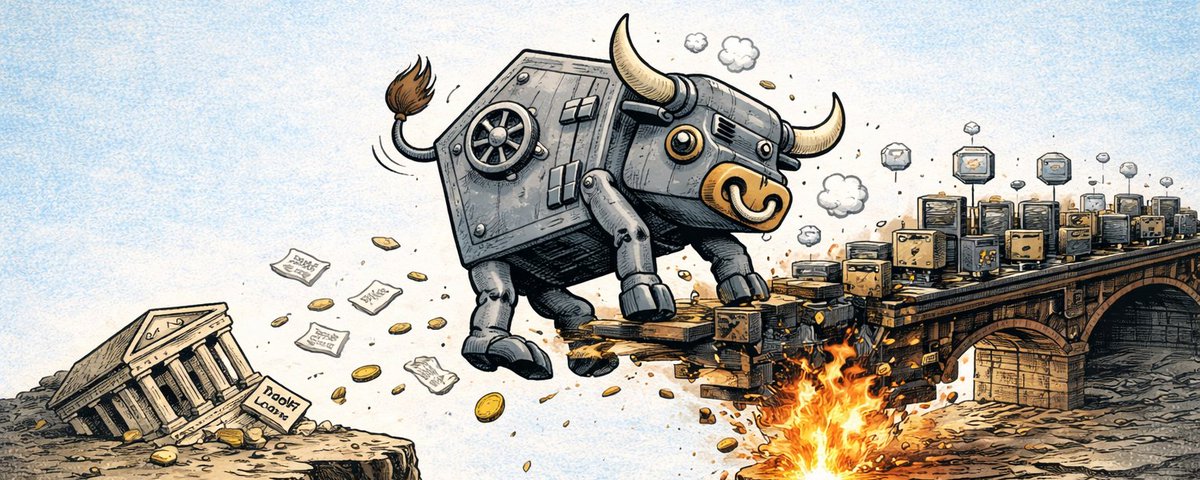
The exploits will continue as the market matures
Risk curators are some of the clearest actors sitting at the intersection of Institutional = Tradfi and Institutional = behavior patterns under capital-at-scale constraints
Outsized risk/reward opportunities are signals there's value surface area to explore, but trillion dollar asset managers aren't interested when the risk is liquidity getting locked on an asset whose price has collapsed 75%
The asymmetric upside of learning to navigate perils like this is attractive to some actors, though
5-6 years ago, the upside was so quick (days/weeks) and so asymmetric (5-10x) with so many opportunities (dozens of coins/NFTs/yield farms) that the slightly above average retail participant could throw darts and come out ahead
now as @WazzCrypto pointed out in his recent post about "safe" defi yields being lower than IB's rfr, for retail participants it's been nearly all risk and no upside since better capitalized participants have begun operating, and token buy pressure has collapsed the clear upside opportunity for the defi everyman
so for now the game has shifted to those who have/or can attract 8+ figure capital pools and make enough from 2/20 to continue on that basis alone, or leverage access gained from that activity to accrue alpha/private market equity access to preserve asymmetric upside
this is a stabilizing force that can enable more capital coming onchain even if it doesn't "democratize generational wealth" for solo participants playing part time at home directly
That stability can create the conditions that enable another wave of that opportunity - Wall Street likes it, Tech likes it, lobby to pass something like a CLARITY act and enable another generation of experimentation onchain
I like what @StreetFDN and @lex_node are working on in equity x token mechanics and legal structures for trust minimization as non-legislative routes that can enable experimentation
the exploits will continue, the market is maturing



have been thinking about this for a while Dante wrote it so he gets the QT
Visa/Mastercard aren't just "slow legacy tech owned by rent seekers" to simply be disintermediated by megaTPS chains and ERC-20s
they bear and mitigate risk that's part of the txn fee

Everyone saying stablecoins magically solve agentic commerce should slow down and read this.
There are two big things people are missing.
1. Card networks are not just “payment rails.”
You cannot replace Visa, Mastercard, and AmEx with “just send stablecoins.”
Visa, Mastercard, and American Express do far more than move money between banks.
They make it possible to transact almost anywhere on earth while solving for:
-Risk (fraud, chargebacks, disputes, etc)
-Security/authentication
-Global acceptance/distribution
Name someone building with agents who does not have a credit card. Distribution matters.
The current x402-style stablecoin stack does not replicate this.
Wallet → wallet sounds clean, but in reality, direct stablecoin transfers introduce real problems at scale:
-Who eats fraud?
-Who arbitrates disputes?
-Who underwrites failed delivery?
-Who manages compliance across jurisdictions?
Card networks have spent 50+ years and billions of dollars building these mechanisms. It is boring, operational monotany, but its absolutely mission critical.
If stablecoins are going to power agentic commerce, the industry has to rebuild all these layers (Not just the settlement layer).
2. Micropayment economics are being oversimplified
People imagine it works like this:
Agent A wallet → Agent B wallet.
That is not how it works in practice.
There is almost always a facilitator in the middle handling gas abstraction, routing, pricing, compliance, liquidity, and sometimes credit.
If this market matures, there will be more intermediaries, not fewer. Orchestrators. Risk engines. Liquidity providers. Identity layers.
Each one needs to get paid.
Micropayments have razor thin margins. When you stack multiple service providers in the middle, those margins compress fast.
Stablecoins are more efficient than legacy systems. That is true. But efficiency does not eliminate cost. It just shifts where the cost sits.
Stablecoins are a powerful primitive. They are not a finished payment network.
Agentic commerce will not be won by whoever settles the fastest. It will be won by whoever can combine:
-Settlement
-Risk management
-Compliance
-Distribution
-Sustainable unit economics
Until we solve the unsexy parts, stablecoins are an ingredient - not the full stack.
Great piece by @Trace_Cohen
cryptofreedman retweeted

Recently I have been starting to worry about the state of prediction markets, in their current form. They have achieved a certain level of success: market volume is high enough to make meaningful bets and have a full-time job as a trader, and they often prove useful as a supplement to other forms of news media. But also, they seem to be over-converging to an unhealthy product market fit: embracing short-term cryptocurrency price bets, sports betting, and other similar things that have dopamine value but not any kind of long-term fulfillment or societal information value. My guess is that teams feel motivated to capitulate to these things because they bring in large revenue during a bear market where people are desperate - an understandable motive, but one that leads to corposlop.
I have been thinking about how we can help get prediction markets out of this rut. My current view is that we should try harder to push them into a totally different use case: hedging, in a very generalized sense (TLDR: we're gonna replace fiat currency)
Prediction markets have two types of actors: (i) "smart traders" who provide information to the market, and earn money, and necessarily (ii) some kind of actor who loses money.
But who would be willing to lose money and keep coming back? There are basically three answers to this question:
1. "Naive traders": people with dumb opinions who bet on totally wrong things
2. "Info buyers": people who set up money-losing automated market makers, to motivate people to trade on markets to help the info buyer learn information they do not know.
3. "Hedgers": people who are -EV in a linear sense, but who use the market as insurance, reducing their risk.
(1) is where we are today. IMO there is nothing fundamentally morally wrong with taking money from people with dumb opinions. But there still is something fundamentally "cursed" about relying on this too much. It gives the platform the incentive to seek out traders with dumb opinions, and create a public brand and community that encourages dumb opinions to get more people to come in. This is the slide to corposlop.
(2) has always been the idealistic hope of people like Robin Hanson. However, info buying has a public goods problem: you pay for the info, but everyone in the world gets it, including those who don't pay. There are limited cases where it makes sense for one org to pay (esp. decision markets), but even there, it seems likely that the market volumes achieved with that strategy will not be too high.
This gets us to (3). Suppose that you have shares in a biotech company. It's public knowledge that the Purple Party is better for biotech than the Yellow Party. So if you buy a prediction market share betting that the Yellow Party will win the next election, on average, you are reducing your risk.
Mathematical example: suppose that if Purple wins, the share price will be a dice roll between [80...120], and if Yellow wins, it's between [60...100]. If you make a size $10 bet that Yellow will win, your earnings become equivalent to a dice roll between [70...110] in both cases. Taking a logarithmic model of utility, this risk reduction is worth $0.58.
Now, let's get to a more fascinating example. What do people who want stablecoins ultimately want? They want price stability. They have some future expenses in mind, and they want a guarantee that will be able to pay those expenses. But if crypto grows on top of USD-backed stablecoins, crypto is ultimately not truly decentralized. Furthermore, different people have different types of expenses. There has been lots of thinking about making an "ideal stablecoin" that is based on some decentralized global price index, but what if the real solution is to go a step further, and get rid of the concept of currency altogether?
Here's the idea. You have price indices on all major categories of goods and services that people buy (treating physical goods/services in different regions as different categories), and prediction markets on each category. Each user (individual or business) has a local LLM that understands that user's expenses, and offers the user a personalized basket of prediction market shares, representing "N days of that user's expected future expenses".
Now, we do not need fiat currency at all! People can hold stocks, ETH, or whatever else to grow wealth, and personalized prediction market shares when they want stability.
Both of these examples require prediction markets denominated in an asset people want to hold, whether interest-bearing fiat, wrapped stocks, or ETH. Non-interest-bearing fiat has too-high opportunity cost, that overwhelms the hedging value. But if we can make it work, it's much more sustainable than the status quo, because both sides of the equation are likely to be long-term happy with the product that they are buying, and very large volumes of sophisticated capital will be willing to participate.
Build the next generation of finance, not corposlop.