

Cardiologist and researcher, in cardiovascular magnetic resonance imaging, at the University of Minnesota
Minneapolis, Minnesota, USA
Joined January 2017
- Tweets58
- Following751
- Followers5K
- Likes6.4K
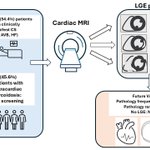


Frequency of Late Gadolinium Enhancement-Negative Cardiac Magnetic Resonance Imaging at Initial Presentation with Metabolically Active Treatment-Naïve Cardiac Sarcoidosis
academic.oup.com/ehjimp/adva…

Important data, but genetic testing yield in isolated cardiac FDG uptake was 12%. A negative panel (~88% of cases) neither excludes genetic cardiomyopathy nor confirms cardiac sarcoidosis. Genetic testing is a poor diagnostic test.

Chetan Shenoy retweeted
Prediction of ventricular arrhythmic outcomes in suspected cardiac sarcoidosis: a comparison of cardiovascular magnetic resonance phenotyping vs. societal recommendations for implantable cardioverter-defibrillator placement
academic.oup.com/eurheartj/a…
#WhyCMR #Epeeps #cardiotwitter


Chetan Shenoy retweeted
For reference, here's our work on CMR phenotyping:
pubmed.ncbi.nlm.nih.gov/4040…
pubmed.ncbi.nlm.nih.gov/3610…
pubmed.ncbi.nlm.nih.gov/3195…
pubmed.ncbi.nlm.nih.gov/3107…
#WhyCMR #sarcoidosis #cardiacsarcoidosis
Chetan Shenoy retweeted
They even extended our findings.
CMR phenotyping had much greater interobserver reproducibility than LGE quantification.
CMR phenotyping was 5-fold faster than LGE quantification.
FDG-PET added no incremental predictive value beyond CMR phenotyping.
Chetan Shenoy retweeted
In a prospective cohort of 206 patients (CHASM-CS), they found that ALL ventricular arrhythmia events occurred exclusively in patients with the high-risk (pathology-frequent) LGE phenotype.
There were NO events in the low-risk patients.
Chetan Shenoy retweeted
In science, successful replication is the ultimate quality check!
This is a highlight for our research group—David Birnie's group (one of the biggest names in cardiac sarcoidosis) just independently replicated our CMR phenotyping work!
doi.org/10.1093/ehjimp/qyag0…
@EHJIMPEiC #EHJIMP

Chetan Shenoy retweeted

📄 LGE phenotype vs burden in cardiac sarcoidosis: does pattern matter more than quantity?
🔗 DOI: doi.org/10.1093/ehjimp/qyag0…
🫀 In cardiac sarcoidosis, risk stratification for ventricular arrhythmias remains challenging.
This prospective study compares LGE burden vs LGE phenotype on CMR for predicting arrhythmic events.
✨ Key findings:
🔹 The “pathology-frequent” LGE phenotype strongly predicts ventricular arrhythmias
➡️ All arrhythmic events occurred only in this phenotype
🔹 Both approaches perform well:
LGE burden (quantitative %)
LGE phenotype (pattern-based)
👉 BUT:
🔹 LGE phenotype achieved 100% negative predictive value
➡️ No events in patients without this phenotype
⚡ Practical advantages of LGE phenotyping:
✅ Much higher reproducibility (κ = 0.97 vs 0.41)
✅ ~5x faster than LGE quantification
✅ Easier to apply in clinical routine
📊 Additional insights:
👉 Arrhythmic risk is mainly linked to scar-related re-entry, not inflammation
👉 FDG-PET did not add independent prognostic value
💡 Clinical take-home message:
👉 Pattern recognition may be as important as quantification
👉 LGE phenotype could:
improve risk stratification
guide ICD decision-making
simplify clinical workflows
🚨 Bottom line:
In cardiac sarcoidosis, how scar looks may matter more than how much scar there is.
#Cardiology #CardiacSarcoidosis #CMR #LGE #Arrhythmia #SuddenCardiacDeath #Imaging #RiskStratification #Electrophysiology 🫀⚡📊


In science, successful replication is the ultimate quality check!
This is a highlight for our research group—David Birnie's group (one of the biggest names in cardiac sarcoidosis) just independently replicated our CMR phenotyping work!
doi.org/10.1093/ehjimp/qyag0…
@EHJIMPEiC #EHJIMP
They even extended our findings.
CMR phenotyping had much greater interobserver reproducibility than LGE quantification.
CMR phenotyping was 5-fold faster than LGE quantification.
FDG-PET added no incremental predictive value beyond CMR phenotyping.
For reference, here's our work on CMR phenotyping:
pubmed.ncbi.nlm.nih.gov/4040…
pubmed.ncbi.nlm.nih.gov/3610…
pubmed.ncbi.nlm.nih.gov/3195…
pubmed.ncbi.nlm.nih.gov/3107…
#WhyCMR #sarcoidosis #cardiacsarcoidosis
Chetan Shenoy retweeted

Have you ever wondered whether your patient with CAD and cardiomyopathy truly has ischemic cardiomyopathy, or whether the CAD is a “bystander”?
You might be interested in our paper now out in Circulation @CircAHA
#simultaneouspublication
#AHA23
#cardiotwitter
#WhyCMR

Chetan Shenoy retweeted
Our reply to the second letter to the editor about our paper.
academic.oup.com/eurheartj/a…


Prediction of ventricular arrhythmic outcomes in suspected cardiac sarcoidosis: a comparison of cardiovascular magnetic resonance phenotyping vs. societal recommendations for implantable cardioverter-defibrillator placement
academic.oup.com/eurheartj/a…
#WhyCMR #Epeeps #cardiotwitter
Chetan Shenoy retweeted


Prediction of ventricular arrhythmic outcomes in suspected cardiac sarcoidosis: a comparison of cardiovascular magnetic resonance phenotyping vs. societal recommendations for implantable cardioverter-defibrillator placement
academic.oup.com/eurheartj/a…
#WhyCMR #Epeeps #cardiotwitter
Our reply to the second letter to the editor about our paper.
academic.oup.com/eurheartj/a…
Prediction of ventricular arrhythmic outcomes in suspected cardiac sarcoidosis: a comparison of cardiovascular magnetic resonance phenotyping vs. societal recommendations for implantable cardioverter-defibrillator placement
academic.oup.com/eurheartj/a…
#WhyCMR #Epeeps #cardiotwitter
Prediction of ventricular arrhythmic outcomes in suspected cardiac sarcoidosis: a comparison of cardiovascular magnetic resonance phenotyping vs. societal recommendations for implantable cardioverter-defibrillator placement
academic.oup.com/eurheartj/a…
#WhyCMR #Epeeps #cardiotwitter
Chetan Shenoy retweeted

Congratulations @cshenoy3 and team for another great piece of work in helping to unravel mysteries around cardiac sarcoidosis.