

@CSIS
Account based inUnited States!
About this account
- Account based in
- United States
- Connected via
- United States App Store
X says this location may be affected by a proxy or VPN.
Account-level information from X, not a live location or the device used for a specific post.
A bipartisan institution, CSIS is the top national security think tank in the world. Follows ≠ endorsements.
Washington, DC
Joined March 2011
- Tweets97.5K
- Following606
- Followers44K
- Likes1.9K





To address the challenges of rising Chinese and Russian economic coercion in Latin America and the Caribbean, the U.S. must leverage the current spate of U.S.-aligned governments in the region to build new architectures for economic and trade security, argues @HenryZiemer.
Read: bit.ly/4igZVX0

10/28-29 | For the 10th anniversary of the China Power Conference @ChinaPowerCSIS is bringing together leading experts for a discussion on core issues such as U.S.-China relations, China's evolving power, and Beijing's foreign and security policy.
Register: bit.ly/3VpGAKu

"In demonstrating its unreliability as a security partner, the United States is eroding allied trust in U.S. defense and technology suppliers and in NATO," writes @MaxBergmann.
More: csis.org/analysis/throttling…

Russia’s demand for drones was answered with an arrangement to manufacture the Iranian-designed Shahed on Russian soil. A @CSISKoreaChair report contends that the burgeoning labor force that powers the Alabuga drone factory has become a site of gross human rights abuses and human trafficking.
Read: bit.ly/4s6jAw7

"While bioweapons have historically been challenging to create and deploy, it is now becoming cheaper, faster, and easier for both state and nonstate actors to develop bioweapons. Without safeguards, AI and other advanced biotechnology tools lower the knowledge barrier to create harmful biological agents," write @CSISHealth experts.
Read: bit.ly/4eij1tq

"The record shows that terrorism motivated by opposition to AI is possible but not that a broader campaign has begun. The threat would grow if attackers began to copy and inspire one another, if extremist communities rewarded violence, or if opponents concluded that peaceful politics cannot stop AI risks," write @dbyman and @rileydmccabe .
More: csis.org/analysis/will-ai-co…

A new @AustraliaChair interactive tool explores the security relationships between Pacific Island countries and Australia, the U.S., New Zealand, China, and Taiwan and points to a regional security architecture in transition, shaped by intensifying competition between China and the region’s established security partners.
Explore here: bit.ly/486HU7Q

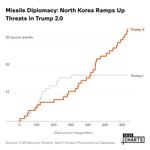
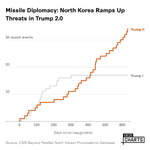
21 months into Trump’s second term, North Korea has carried out 34 missile launch events, double the 17 at the same point in his first term, and fired at least 93 missiles, already more than in all four years of his first term combined, write @VictorDCha and Andy Lim.
Read: bit.ly/4eIGq7v

Given Western concerns over Beijing’s trade practices, European leaders visits with President Xi send a particularly strong signal to Washington: Traditional allies are willing to hedge their technological dependencies for greater economic security, write @Steinbergf and Riccardo Bosticco.
Read: bit.ly/4dPHPcc

Space superiority requires credible military options to protect U.S. forces and counter adversaries’ use of space. Integrating space control capabilities into joint operations can strengthen deterrence and preserve U.S. advantage, write @CSISAerospace experts.
Read: bit.ly/4ifnH4K

"Taiwan’s position in Asia’s first island chain should not become the main reason why the United States supports Taiwan’s security. The main focus of U.S. policy should be preventing a PRC attack on Taiwan and the regional and global catastrophe it would cause," writes Thomas Christensen.
Read: csis.org/analysis/not-just-i…

A new @CSISdefense report in The Value of U.S. Land Power series argues that the U.S. must make important decisions over where to prioritize global posture, how to train and retain talent, and which capabilities present the best investment as an effective and responsible tool of U.S. statecraft.
Learn more: csis.org/analysis/preparing-…

10/28-29 | Join @ChinaPowerCSIS for China's Power: Up for Debate, CSIS's premier annual China conference. This year's event brings together leading experts for two days of discussion and debates on core issues underpinning China's power and U.S.-China relations.
Register: bit.ly/3VpGAKu
ICYMI: Last week @csiserep hosted a conversation with UK Secretary of State for Defence Wes Streeting on how both countries can keep deterrence credible in Europe and beyond.
Watch: youtube.com/watch?v=herXCjqP…
In the wake of the Riyadh airport attacks, Saudi Arabia risks getting sucked into another long, costly war that ultimately only emboldens the Houthis and deepens the regional conflict. @CSISMidEast expert @AllisonMinor_ outlines a better approach.
Read: bit.ly/4imqyd8

"The Pentagon announced initiatives shaping drone acquisition, “legacy” systems procurement, supply chains, officer commissioning, senior officer management, and base operations. Some have bipartisan support; some face opposition; all face a long process," writes @MarkCancian.
Read: bit.ly/4jzlEuy

CSIS retweeted

Excited for the launch of our new @CSIS @AustraliaChair digital platform that aggregates more than 50 security arrangements with Pacific Island Countries onto one interactive map. Check out the new tool below 👇 @CSISGeopolitics

Who is competing for security influence in the Pacific, and where? Our new interactive map plots the security relationships between Pacific Island countries and Australia, the US, New Zealand, China, and Taiwan. csis.org/programs/australia-…
Fierce competition for strategic influence has prompted a proliferation of security-related agreements across the Pacific Islands region in recent years. A new interactive tool from the @AustraliaChair maps 56 of these arrangements across 14 Pacific countries.
Read: csis.org/programs/australia-…
A new working paper from @csisdefense considers modernization questions confronting the Army and Marine Corps, assessing force structure, joint enabling roles, recruitment and training, budget constraints, and acquisition priorities.
Read: bit.ly/4jtyA55
Europe is both a vast market and a coproducer of U.S. technology. To outcompete China, the United States must offer allies a stake in building the future rather than exploit their dependencies, write @csiserep's @Steinbergf with Riccardo Bosticco.
Read: bit.ly/4dPHPcc