





Apa lagi Cina mau

This post by Tycoon Lee Kim Yew, Mahathir's crony, has gone viral in the Chinese community. I am providing the AI translation for all. It is clear he is losing hope for the future of the Chinese community.
Let me know if you agree with him ...
#Malaysia #Chinese #Politics #Future


1
143


cts retweeted
🚨BREAKING: Spain deploys IRON HAM, the Bacon Squad’s latest weapon to regain control of Ceuta.
🤖 Made with AI
cts retweeted

In 1965 Malaysia kicked Singapore out of the Malaysian federation, and Tunku Abdul Rahman thought he had won. He had dumped a port city with no oil, no farmland, no fresh water, and two and a half million people crammed onto an island smaller than Lake Tahoe. Sixty years later Singapore's GDP per capita runs past $84,000 while Malaysia limps along under $12,000. The man who got expelled built the richest patch of dirt in Asia. The man who did the expelling built the New Economic Policy.
Let's study what happened.
Start with what Singapore lacked. No resources. No hinterland. No domestic market worth the name. By every theory that says a nation needs raw materials to prosper, Singapore should have starved. Instead Lee Kuan Yew made his country a place where capital felt safe. Low tariffs. Easy entry for foreign firms. Courts that enforced contracts instead of shaking down the parties. Corporate tax dropped to 17 percent, personal rates capped at 22, no tax on most capital gains. Money flowed in because money is not stupid.
Malaysia chose the opposite. The New Economic Policy was racial central planning dressed up as fairness. Bumiputera quotas demanded that ethnic Malays hold 30 percent of corporate equity, that government contracts favor Malay-owned firms, that universities admit by race rather than ability. The state picked winners by bloodline. Predictably, the productive Chinese and Indian minorities took their capital and brains elsewhere, much of it to (where else) Singapore. You distort prices and incentives long enough, the talented people leave. They always leave.
Lee Kuan Yew was not perfect. The man jailed opponents, sued journalists into poverty, and ran a soft authoritarian state with a fondness for caning. He banned chewing gum, which is the kind of thing a control freak does when he runs out of real problems. Singapore is no libertarian paradise. The government owns Temasek and GIC, sovereign wealth funds sitting on close to a trillion dollars combined, and public housing covers 80 percent of the population. Plenty there for a free market thinker to dislike.
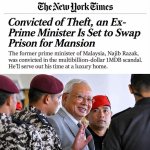
But here is the lesson Malaysia missed. Lee understood the difference between an interventionist government and a parasitic one. Singapore's state stayed mostly out of the price system. It kept inflation low, the currency credible, the bureaucracy clean, and trade open. Transparency International ranks it the fifth least corrupt country on earth. Malaysia sits at 57th, with a former prime minister, Najib Razak, currently serving time for looting 1MDB to the tune of billions. One country treated public office as a trust. The other treated it as a buffet.
Capital responds to incentives, not slogans. When Singapore guaranteed property rights and kept the rules predictable, Exxon and Shell built refineries, banks set up regional headquarters, and the port became the busiest transshipment hub in the world. When Malaysia told investors that race would override merit and that the rules could change whenever a minister felt like it, the smart money discounted everything by a risk premium. Over fifty years that premium compounds into a $70,000 gap in living standards.

