

This is the official account of Dr. Alhassan Iddrisu, Government Statistician, Ghana Statistical Service
Accra, Ghana
Joined November 2024
- Tweets366
- Following116
- Followers381
- Likes177


What does Africa see in the mirror?
At the opening of #STATCOM10, one message was clear: averages hide people. A low jobless rate can hide millions in insecure work.
Ghana's next steps: data that flows across government, stats linked to maps, and numbers that miss no one.
#DataForDevelopment #STATCOM10
#GSS


Ghana had about 5 million room-nights available every month from July to October 2025.
Room-nights used fell to 1.95 million in September 2025, then rose 9.6% to 2.14 million in October 2025.
This video highlights the full breakdown of the Accommodation Occupancy Report (Jul 2025-Oct 2025).
Access the Accommodation Occupancy Report on the Ghana Statistical Service: statsghana.gov.gh
#AUS #Tourism #Economy #GSS


October was Ghana's busiest month for rooms in four months. What changed?
Room use rose 9.6% from September, and foreign guests jumped from 25,822 to 39,781.
Swipe through our five quote cards from the July to October 2025 Accommodation Unit Survey. See who fills Ghana's rooms, where, and what to do next. Use these statistics, do not just read them.
I sincerely thank the accommodation establishments, NTAC, our partners and the hardworking GSS staff who made this bulletin possible.
#AUS2025 #GhanaStatistics #tourism #economy


AI is only as smart as the data we feed it.
At #FASDEV XII during #STATCOM10, we agreed: fix the basics first. Good data, strong institutions, steady funding at home.
For Ghana, that means AI-ready data, the Statistics Bill, and numbers every citizen can trust.
#STATCOM10 #FASDEV12 #GhanaStatisticalService #AIReadyData #DataForDecisions


A number on a shelf saves no one. A number in Parliament can save lives.
At #STATCOM10, I shared Ghana's 7-year journey with Parliament: 100+ MPs reached, 120+ staff trained, poverty data for all 261 districts.
Next: a formal pact with Parliament.
No MP should vote blind.
#STATCOM10 #GhanaStatisticalService #DataForDecisions #PARIS21 #UNECA #Ghana


Data must do more than count people. It must help improve their lives.
At a STATCOM 2026 side event on the policy relevance of data, I shared a simple lesson: statistics matter when they reach the right people, at the right time, in a form they can use.
In Ghana, better data is helping us see what averages can hide. We now have information on mobile businesses (many run by young women) and poverty estimates for all 261 districts.
The picture is not the same everywhere: poverty levels differ sharply from one district to another. Seeing those differences helps decision-makers better understand where support is needed.
Our next steps are clear: keep listening to the people who use data; produce timely, trusted information at the levels where decisions are made; explain the findings simply; and work with government, Parliament and local leaders to put the evidence to use.
We must also make the data easy for communities to access and understand.
When people are counted, their needs can be seen.
When the evidence guides decisions, public resources can better reach those who need them most.
Let’s make every number count for people.
#DataForDecisions #STATCOM10 #GhanaStatisticalService #DataForDecisions #OfficialStatistics #LeaveNoOneBehind #Ghana #Africa


Producer price inflation was 4.8% in September 2026, up from 4.4% in August.
In simple terms, the prices received by producers for their goods and services at the factory gate before reaching the shops were, on average, 4.8% higher than in September 2025.
This video explains the headline numbers, key drivers, what they mean, and the actions the data point to.
Access the full report on the GSS website: statsghana.gov.gh
GSS sincerely appreciates our market players, market readers, data partners, and hardworking staff whose contributions make these statistics possible.
Better data. Better decisions. Better outcomes for Ghana.
#GSSData #GhanaPPI #ProducerInflation #DataForDevelopment
#Economicgrowth


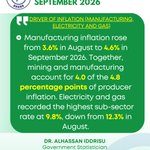
Producer prices rose by 1.3% in just one month. What is driving the change?
Ghana’s producer price inflation reached 4.8% year-on-year in September 2026, up from 4.4% in August. Month-on-month inflation fell to 1.3%, driven mainly by mining and quarrying.
The quote cards below unpack the headline numbers, key drivers, what they mean, and the actions the data point to.
GSS sincerely appreciates our market players, market readers, data partners, and hardworking staff whose contributions make these statistics possible.
Better data. Better decisions. Better outcomes for Ghana.
#GSSData #GhanaPPI #ProducerInflation #DataForDevelopment
#Economicgrowth


Ghana's economic activity expanded by 7.4% in July 2026, compared with 4.9% in July 2025.
Put simply, for every GHC100 of goods and services Ghana produced in July last year, it produced about GH$107.40 this July, after removing the effect of
inflation.
This video highlights the key findings. Use it.
Access the July 2026 MIEG report on our website: statsghana.gov.gh
#OfficialStatistics #MIEG #GhanaEconomy
7.4%: That’s how fast Ghana’s economy grew in July 2026, up from 4.9% a year earlier.
Services grew 12.2% and delivered almost two-thirds of that growth. Industry rose from 0.4% to 5.4%. Agriculture grew 3.7%.
What drove these numbers, and what do they mean for you? Swipe through the four cards below.
My sincere thanks to the farmers, businesses, households, ministries, departments and agencies who supplied the data, and to the hardworking staff of GSS who made this release possible.
The full data is free on the GSS website and StatsBank. Use it.
#MIEG #GhanaStatistics #DataForABetterGhana


From March 2025 to June 2025, Ghana recorded 1.78 to 1.86 million domestic guests every month, compared with 23,000 to 30,000 foreign guests.
But foreign guests stayed three to nine nights on average, against one to two nights for domestic guests. Volume and length of stay both drive guest nights.
Find the full breakdown of the Accommodation Occupancy Report (Mar 2025-Jun 2025).
Access the Accommodation Occupancy Report on the Ghana Statistical Service: statsghana.gov.gh
#AUS #Tourism #Economy #GSS
Ghana's first nationally representative Accommodation Unit Survey is here. Between March and June 2025, about 5 million room-nights were available each month, yet only 4 in 10 were occupied.
Swipe through our five quote cards to see how occupancy differs by establishment type, size and region, who fills our rooms, and what to do next. Use these statistics, do not just read them.
I sincerely thank the accommodation establishments, NTAC, GTA, our partners and the dedicated GSS staff who made this possible.
#AUS2025 #GhanaStatistics #DataForDevelopment #GSS #EconomicGrowth


September 2026 inflation is 5.2%, up from 5.0% in August but down from 9.4% a year ago.
In simple terms, what cost GH₵100 a year ago now costs GH₵105.20.
This video unpacks the details of the September 2026 CPI figures.
Access the full September CPI data on the Ghana Statistical Service website: statsghana.gov.gh
#GhanaCPI #ghanastatisticalservice #inflation #economy
September 2026 inflation is 5.2%, up from 5.0% in August but down from 9.4% a year ago. Prices rose 1.1% over the month, after falling 1.0% in August.
In simple terms, what cost GH₵100 a year ago now costs GH₵105.20.
The five cards below show what is driving prices, where they are rising fastest, and how households, businesses and government can use these numbers.
Thank you to the market players who share their prices, our market readers, the media, and the dedicated staff of GSS.
Plan, price and negotiate on official figures. Access the full data at statsghana.gov.gh
#GhanaCPI #ghanastatisticalservice #inflation #economy


Ghana sold more than it bought from the rest of the world in Quarter Two of 2026, with a trade surplus of GH133.8iilion (US$1.3bbllion). But the surplus was 70% smaller than in the first quarter, as imports rose by almost half while exports held steady.
Find the full breakdown of the Q2 2026 Trade Newsletter in this video.
Access the Q2 2026 Trade Newsletter on the Ghana Statistical Service: statsghana.gov.gh
#trade #EconomicGrowth #GhanaStatisticalService #ImportExport
Ghana sold more than it bought. But did we sell more goods?
Our Q2 2026 Trade Newsletter is out, and the answer is in the 5 cards below.
They cover a GH₵13.8 billion (US$1.3 billion) trade surplus, gold earning is almost 3 of every 4 cedis export , import prices up 22.7%, and record trade with West Africa.
Swipe through all 5, then read the full report on the GSS website.
Thank you to the Customs Division of the Ghana Revenue Authority, importers, exporters and the dedicated staff of GSS who made this possible.
Reliable data. Better decisions. A stronger Ghana.
#DataForDevelopment #TradeStatistics #EconomicGrowth #GhanaStatisticalService


