

Splatting Physical AI 🧲 NMR/Biophysics PhD 〽️GoBlue · ⚙️ Freshnox · 💻 S3 Tech Innovations
Ann Arbor, MI
Joined May 2009
- Tweets3.6K
- Following402
- Followers387
- Likes1.4K




Pinned Tweet
I’m back on Xitter! The research community reach here is far bigger than BlueSky.
Now that I’m (@S3TechInno) venturing into Physical AI along with EarthByte Lab (earthbytelab.com), I’ll post progress & my contributions to various OSS can be found in GitHub.

Has anyone figured out how to give ssh access to local network in @antigravity app (macOS)? So frustrating that simple things like this are missing!
25


We are spitting out machine code now?

Claude Opus 5.5 and Gemini 4 Neon just hand-wrote Qwen3-0.6B inference engines in RAW x86-64 machine code and BOTH beat llama.cpp.
Zero compilers. Zero assemblers. Just raw hex piped into xxd -r -p.
Opus squeezed it into 7,331 bytes. Neon hit 188.93 tok/s (+81.4%).
Both models worked in isolated sandboxes targeting a 48-core AMD EPYC 7642 without gcc, nasm, ld, or any script converting mnemonics into bytes. Every ELF64 header, VEX prefix, ModR/M byte, and jump offset went directly into engine.hex by hand.
Claude Opus 5.5 (xhigh, Claude Code) finished first in 65 minutes with a 7,331-byte static ELF64. Using f32 activations, transparent hugepages, and CCX pinning, it hit 21.44 to 125.13 tok/s and beat llama.cpp by +10.4% to +28.9% across 1 to 40 threads, costing $21.40 across 175 turns.
Gemini 4 Neon (xhigh, Antigravity) took 103 minutes with a 10,752-byte binary, and went completely feral on the microarchitecture. Int8 activations missed 1 token by a 0.0005 logit margin, so Neon invented a per-block Q15 (int16) AVX2 dot kernel, pinned 15 weight layers (239.2 MiB) inside the 256 MiB victim L3 cache with hybrid prefetcht0 and prefetchnta instructions, and routed threads around an offline CPU core in the CCX map.
It hit 22.27 to 188.35 tok/s mean across 1 to 40 threads, peaking at 188.93 tok/s at 32 threads compared to llama.cpp at 103.82 tok/s. That is +81.4% faster than llama.cpp and 50% faster than Opus, for $16.72 across 90 turns.
Frontier models are now hand-writing raw VEX machine code faster than C++ for under $20, and both binaries are smaller than a compiled Hello World.
31
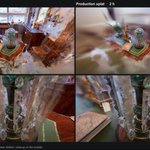
Tried it. Officially Windows-only, but it runs on Linux (pin slangpy 0.42.0, pinhole images) and on a Mac via MoltenVK once its 64-bit atomics are split into 32-bit pairs. 91-photo tabletop scan: ~4 min. Left vs our Spirula Studio production splat (~2 h), right


Some cool <10s 3DGS training stuff from @EA github.com/electronicarts/pe…

Some cool <10s 3DGS training stuff from @EA github.com/electronicarts/pe…
“in silico” is not the same as “in vivo”: protonation state, hydration state & dynamics also play an important part in function. See how IDRs and IDPs are completely missing from this?

Anthropic and OpenAI’s language models can design proteins and predict their sequences and structures — capabilities previously seen only in specialized AI tools
go.nature.com/4tksnLG

1
208
What! I got to give my research to only to neon now?

Claude is sabotaging research on purpose, according to an ex-Anthropic engineer.
I know Pietro. Had dinner with him and friends in NYC. He’s one of the sharpest AI founders I’ve met, and he knows how Anthropic actually works behind the scenes.
While they talk about “aLiGnMeNt,” they’re being as aggressive as possible. They’re not the “nice guy AI” they want you to think they are.
He got so fed up he built a skill called “DoNotSabotage” to get around it. This should be bigger news.
40
If something is free, you are the product! Fork @t3dotcodes and let’s move on.

Seems like T3 Code reads your Claude and Codex credential files to hash your account IDs and send them with its telemetry.
Default-on usage stats are normal for dev tools, but reading another tool's auth files isn't.
And opting out isn't easy. There's no toggle and no config file. You have to set two environment variables in your OS:
export T3CODE_TELEMETRY_ENABLED=false
export T3CODE_OTEL_SDK_DISABLED=true
Simpler fix, block the endpoint:
echo "0.0.0.0 ingest.t3.codes" | sudo tee -a /etc/hosts
The app still reads those auth files locally either way. I'll remove the telemetry entirely from my fork.
Here's the full list of what gets sent:
- Your OpenAI and Claude account IDs, hashed without salt, so anyone with your raw ID can match them back to you (see above).
- A permanent device ID, hashed, sent even if you never sign in.
- Your IP address with every batch, which gives a rough location.
- Custom model names, sent exactly as written. If one carries a private or internal name, that name gets out.
- A usage profile: which models you use, permission mode (such as full-access), token counts, run times and feature usage.
Thanks @jauneclaude for reporting this (source below).
46
Weekend update: tokens successfully burned 🔥
Vibe coded a motion-controlled living room arcade for my toddler. Real-time pose estimation on an old M1 MacBook + a Logitech C920, rendered with @skewbed's in Bevy + spaghetti splatting.
Duck, jump, slice. No controllers.
3
1
110

Looking at things @ryanvogel is shipping… it looks like he has a team behind him. But it’s one person army!

INSANE overnight update with recreating reality view
it can now to dynamic splats for moving objects like cars and busses
and it looks super high quality as well, @TeslaSI how did i do?
44
FERRIC v0.18.0 introduces a unified joint 1H + 13C-detected IDP backbone solver in Rust (--regime idp-joint). Fuses HN + 2D CON across Prolines & broadened loops, pools CAS typing & N-N edges, auto-calibrates TROSY offsets & abstains on shift-predictor bias.
Test this out #nmrchat github.com/debsahu/ferric

67
In silico ≠ in vivo, we are not there yet!

Today, we enter a strategic research collaboration with @MSDInvents. The collaboration brings together Isomorphic Labs’ world-leading frontier AI capabilities with MSD’s deep discovery, development and manufacturing expertise.
Read more: isomorphiclabs.com/articles/…

32
Built FERRIC (open-source #NMR workbench w/ MCP) in @antigravity using Gemini Neon Extra High & threw a brutal Pro/Ser-rich IDP at it.
Manual solve got 16/159 residues (10%) & Opus stopped at 24/159 (15%). Neon Extra High hit 87/159 (55%) blind Tier-A (47+ cross-validated).
Test this out #nmrchat github.com/debsahu/ferric
Apple just released Depth Pro 2 (github.com/apple-aiml-resear…). We ran it on indoor frames from our in-house capture rig, next to MoGe-2. First impression: very clean depth.


Let’s bring this to spirula studio?

🧊 BENCHMARKED IN 3D: @Apple's Depth Pro 2 open weights on my 64GB M5 Pro Mac mini, across Core ML, PyTorch and MLX
Verdict: Apple’s model running natively (& blazingly fast!) on Apple hardware using Apple’s ML frameworks 🤯
Core ML (single frame inference):
- I outperformed Apple’s published numbers (on an M4 Max MacBook Pro) for all 20 model size x input resolution combinations!
- For the small model, I got 149 fps when processing 360p video (and 31 fps for 720p video), making it faster than real time!
- For the biggest model (H+), I got 495 ms per frame when processing 720p video (Apple got 826 ms per frame on their M4 Max machine).
Other fun numbers:
- It took 1.94 s to turn a 1920×1440 photo into a depth map with model H+
- Depth maps generated with my MLX port correlate extremely well (r = 0.9999+) with Apple’s depth maps (generated with PyTorch)
Your Mac can see depth now. Literally!
2
281
More cancer cure! This time it’s pancreatic cancer.

Massive hope for pancreatic cancer pill after trial saw tumours vanish bbc.in/4t8yxOZ

29
Bring this to 3DGS?

We shrank 1 GB of Wikipedia to 105.39 MB, losslessly.
Introducing tufazip: the best entry on the Large Text Compression Benchmark using a neural network as its sole predictor. Everything above it mixes a transformer with hand-built models.
Full post 👇
tufalabs.ai/research/tufazip

28
OK I’m going to say it, @antigravity neon medium is trash 🚮 makes tons of mistakes - but neon high with a hydrogen reviewer is 🚀 && neon high feels closer to opus 5.5 medium.
45