

Decasonic is the venture and digital assets fund building blockchain, Web3, AI and metaverse innovation.
Chicago, IL
Joined April 2018
- Tweets2.8K
- Following19
- Followers2.5K
- Likes1.5K






Physical AI needs more transparent benchmarks as robots move closer to real-world deployment.
Making all 120 Dream-1 robot runs publicly available is an important step toward understanding where these systems perform, where they fail, and how reliably they can operate.
We believe rigorous, reproducible evaluations will be critical to building trust and accelerating Physical AI adoption.

We release all 120 Dream-1 robot runs, with full transcripts and videos: robocurve.org/all-runs/?lead…

Decasonic retweeted

incredibly excited for the adoption trajectory of @robocurve.
the physical AI benchmarks and evals market will note a similar trajectory to the software AI benchmarks (from generalized tasks to economic tasks). as this continues to accelerate, and as deployment continues to be a crucial focus of my companies - a standard benchmark is needed to assess the performance of models in the real world.

Check out the full 120 eval rollouts done by @robocurve . Full transparency is the only way to move the industry forward.
AI agents need infrastructure to discover services, execute tasks, and transact independently. As more economic activity becomes agent-driven, secure payments and trusted access will be critical to adoption.
Great to see @orthogonal_sh alongside the growing ecosystem building on @privy_io.
Proud to back @orthogonal_sh in advancing the infrastructure for agentic commerce and making autonomous transactions possible at scale.

Today is probably a good time to check in on things with @privy_io, which became part of @stripe just over a year ago.
Our acquisition was predicated on three factors: stablecoin growth, self-custody as a key enabler of broader global coverage, and rapidly increasing demand for programmable financial infrastructure. As we said at the time, "money has to reside somewhere, and Privy builds the world's best programmable vaults."
Since then, the Privy team has executed exceptionally well: assets in Privy wallets have grown ~25x, monthly active developers are up ~3x, revenue is up ~9x, and Privy now facilitates nearly $25B of monthly transaction volume. @tryramp, @Deel, @Klarna, @felixpago, @HyperliquidX, and thousands of other businesses are building embedded banking functionality on Privy.
At Stripe, we're deeply integrating Privy into Treasury, @Link, and Connect. In each case, it's accelerating our global expansion, and enabling us to build better functionality faster. (Coming soon: @Link balances.)
We're also seeing that Privy's wallet infrastructure is the ideal substrate for agents to transact and earn -- live today with @merit_systems, @orthogonal_sh, @Nevermined_ai, @prlnet, and more. Developers prefer programmable financial infrastructure, but agents need it. We expect that the agentic economy will continue to grow extremely quickly.
The Privy team has maintained remarkable product velocity, with major launches this year including deposit addresses, earning on Privy balances, digital asset accounts, custodial wallets, and Stripe's own stablecoin cards.
It's also been neat to see how Privy has been accelerated by Stripe, with better onramps, @stablecoin payment rails and licenses, Stripe's fiat capabilities and issuing stack, and integration with @Tempo.
Together, we're building one API for holding stablecoin balances and earning yield, moving money in and out of fiat, and orchestrating spend with cards. We still have a lot of work to do, not least in integrating everything across Privy, Bridge, and the rest of Stripe -- there's been so much feature and functionality expansion that we haven't yet had much time to reconcile everything. Overall, though, I'm very happy with how things are going, and excited by where these capabilities are headed.
If you're interested in working on the future of stablecoins, agentic payments, and crypto's deployment in the real world, you should get in touch with @sternhenri (now leading all of @StripeCrypto) or others on the team.
29.1 million web requests in just 12 days. Meta Muse is offering an early glimpse into how consumer AI assistants could change the way people interact with the internet.
8.9% of sampled requests touched transactional or account-related endpoints, including forms, logins, and payments.
At Decasonic, we believe the next phase of consumer AI adoption will be driven by assistants that can execute within everyday workflows. Persistent context, trusted access, and the ability to act on behalf of users will become increasingly important as AI moves deeper into consumer behavior.


Decasonic retweeted
we @decasonic continue to be actively deploying capital in early stage AI (software and physical) and crypto companies.
we are a team of investor operators. I have developed my team’s AI OS - and post trained models. if you are actively aiming to crush the frontier, and are looking for aligned partners - my inbox is open.
The State of AI Report 2026 reinforces a conviction we hold at Decasonic.
As AI moves deeper into enterprise workflows, demand is growing for the infrastructure that makes deployment reliable, measurable, and secure.
We see opportunities across agent orchestration, evaluation, permissions, and workflow infrastructure. These capabilities will be essential to scaling AI adoption beyond experimentation.
stateof.ai/State-of-AI-Repor…

Meta's Muse Wonder release puts two capabilities at the center of personal AI: memory and follow-through.
We believe consumer AI adoption will increasingly depend on how reliably agents maintain context, recover from errors, and complete tasks across everyday workflows.
The next proof point is repeat usage. Can these capabilities earn enough trust for people to delegate more meaningful work?

We’re excited to introduce the Muse Wonder series with Muse Wonder and Muse Wonder Full, our most capable models yet. Both are frontier models, built to deliver state-of-the-art performance for personal and professional agentic tasks.
Muse Wonder is available today via the Meta Model API and Muse Code. Muse Wonder Full is available today for Muse Code subscribers. Muse Wonder will also soon power experiences in our personal agent product, Muse, rolling out first to subscribers.
The point of presence is becoming a strategic layer in AI.
We believe the strongest AI interfaces will combine persistent context, frequent usage, and trusted access to act on the user’s behalf.

SF Tech Week gives us a front-row view into how quickly the AI stack is maturing.
With @justpat and @abdulalali in SF this week, we’re seeing more founders build beyond model capability and into the systems that make AI dependable in real-world workflows: evaluation, orchestration, security, data, and infrastructure.

Spent today at a16z Speedrun Demo Day in SF.
What stood out most was the range of what people are building.
Saw teams working across agent infrastructure, GTM, enterprise workflows, robotics, industrial systems, defense, finance, creator tools, and new consumer experiences.
A lot of the companies were also much further along than you’d expect at this stage: real customers, strong early revenue, and products already being used in production.
Another theme: AI is moving from generating output to actually taking action. More products are owning workflows end to end, interacting with software, making decisions, or operating in the physical world.
And underneath that, there’s a growing stack around reliability, evaluation, orchestration, security, and data that becomes more important as agents do more.
Great day meeting a lot of impressive founders and seeing where the next wave of companies is forming.


Decasonic retweeted

What does a consumer AI product need to offer when capable assistants are already available for free? ... A specific reason to exist.
Incumbents own enormous distribution. A new consumer product cannot win simply by adding intelligence to a familiar experience. It needs to save people meaningful time or money, unlock something they could not do before, or become more valuable when used with others.
We see three compelling areas of opportunity:
• Old behaviors made dramatically better
• New behaviors made possible by abundant intelligence
• Multiplayer AI experiences shared with family, friends, and communities
The third is especially interesting to us.
Many AI products today are designed for one person interacting with one assistant. But the most durable consumer products have rarely been solitary. They become part of how people create, play, plan, communicate, and spend time together. Social strengthens but also creates human connections and increasingly, human and AI connections.
That is why we believe shared context and multiplayer dynamics can become meaningful advantages. A product connected to the people in someone’s life has more reasons to be used and more reasons to be part of someone's daily routines.
AI is moving toward persistent presence across the tools people already use. That changes where durable value can be built.
We believe the most valuable AI interfaces will sit closest to the point where intent turns into action. As intelligence becomes more abundant, context, trusted access, and the ability to act inside existing workflows become increasingly important sources of defensibility.

As AI gains mainstream adoption, the point of presence becomes more valuable for AI to drive valuable use cases.
General-purpose AI is increasingly capable, inexpensive, and available at massive scale. Access to intelligence alone will not be the differentiator. The interface through which people experience and act on that intelligence will be.
Our thesis is that value will accrue to AI interfaces that deliver differentiated experiences at the point of presence.
The strongest products will do more than wait for a prompt. AI is becoming autonomous, predictive and ambient. They will understand context, respond in real time, adapt as they run, and anticipate intent. Where an interface sits in the user’s workflow and what it is trusted to do will become part of its moat.
At @Decasonic, we are especially interested in:
• Proactive personal and household agents
• Multiplayer agents inside existing messengers
• Vertical agentic browsers
• Developer interfaces for orchestrating agents in parallel
• AI wearables made useful by on-device intelligence
The winning interface may be the one that is present at the right moment, understands the user best, and becomes more valuable with every interaction.
We're excited to explore this frontier with the many founders building the emerging AI interfaces.
Being early starts with knowing where to look.
We’re spending the week in SF with founders and investors building across AI, digital assets, and the infrastructure connecting them. These conversations are helping us pressure-test our Q4 thesis and identify where real adoption is beginning to compound.

the @decasonic investment team is back in the city.
excited to partner with more founders and investors innovating the frontier of AI and digital assets.

Decasonic retweeted
Abundant intelligence spawns abundant opportunities.
Today, intelligence is still constrained. Expertise is expensive. Knowledge is unevenly distributed. Turning an idea into an outcome still depends heavily on access to talent, capital, institutions, and networks.
Tomorrow, intelligence becomes abundant.
AI dramatically lowers the cost of knowledge, creation, experimentation, and execution. More people can turn imagination into action. Individuals gain capabilities once reserved for organizations. Small teams can pursue opportunities that once required enormous resources.
Abundant intelligence spawns abundant opportunities.
More entrepreneurs can build. More creators can create. More people can participate in economic growth. Entirely new products, companies, markets, and forms of work become possible.
This is the investment opportunity that excites me most about AI.
The largest value creation will come from companies that transform abundant intelligence into human agency and economic opportunity. They will give people new capabilities to pursue their ambitions, solve problems, create value, and shape their own futures.
Today, intelligence is scarce.
Tomorrow, intelligence is abundant.
The opportunity is what we create with it.
As AI becomes embedded in everyday workflows across work, finance, health and creativity, recurring spend becomes a powerful indicator of real adoption. The category is still early, but consumer behavior is starting to form.
Consumer AI is becoming a real category of spend
Only 2% of US households pay for AI today, but average spend is already to ~$31/month (higher willingness to pay vs traditional consumer products streaming, music, etc.. in the $10-20 range), and paid subscriptions are up ~5x since 2025, with retention improving across cohorts.
As products get more specialized across work, finance, health, creativity and entertainment, consumers will carry multiple AI subscriptions rather than just one we already see this with sectors such as streaming.
Habit, context and distribution will determine who earns recurring spend share. Penetration is still early, but spend and retention are already moving in the right direction.

Decasonic retweeted
new interfaces are emerging that are providing experiences at the point of presence (primarily derived from users' context):
- muse might potentially allow for collaboration through both the muse app and the gadgets released (opening up a multi-device approach for human-AI collaboration)
- pickle - with their recent approach to a new and interactive characters that have the (1) pathway to allow the animation of the character to change based on the context of the conversation
- dots from OpenAI across the "super application," and different interfaces (re: iMessage as a potential surface area for recent exploration)
ultimately, the focus is delivering on (1) valuable experiences that drive (2) retention, and (3) provide a pathway towards durable monetization

🚨 side project alert 🚨
Announcing Muse Gadgets, an open source ESP32 firmware and Linux sdk so that you can make hardware devices that work with Muse.
Grab an API token from gadgets.muse.ai and point your favorite coding agent at the github repo to build your own peripherals for Muse.

Decasonic retweeted
the pace of innovation from the @orthogonal_sh team is exponential

Introducing OpenAI’s Dots x Orthogonal
Try it out: orthogonal.com
Ask for a pipeline before bed. Wake up to verified leads, cited sources and the first replies.
Your always-on dots now have every tool they need, from company and people data to email.
We’re starting to see the foundations of a real market for agentic services.
As agents discover, buy, and combine services autonomously, they begin to act more like economic participants.
how does the marketplace for agentic services look like today?
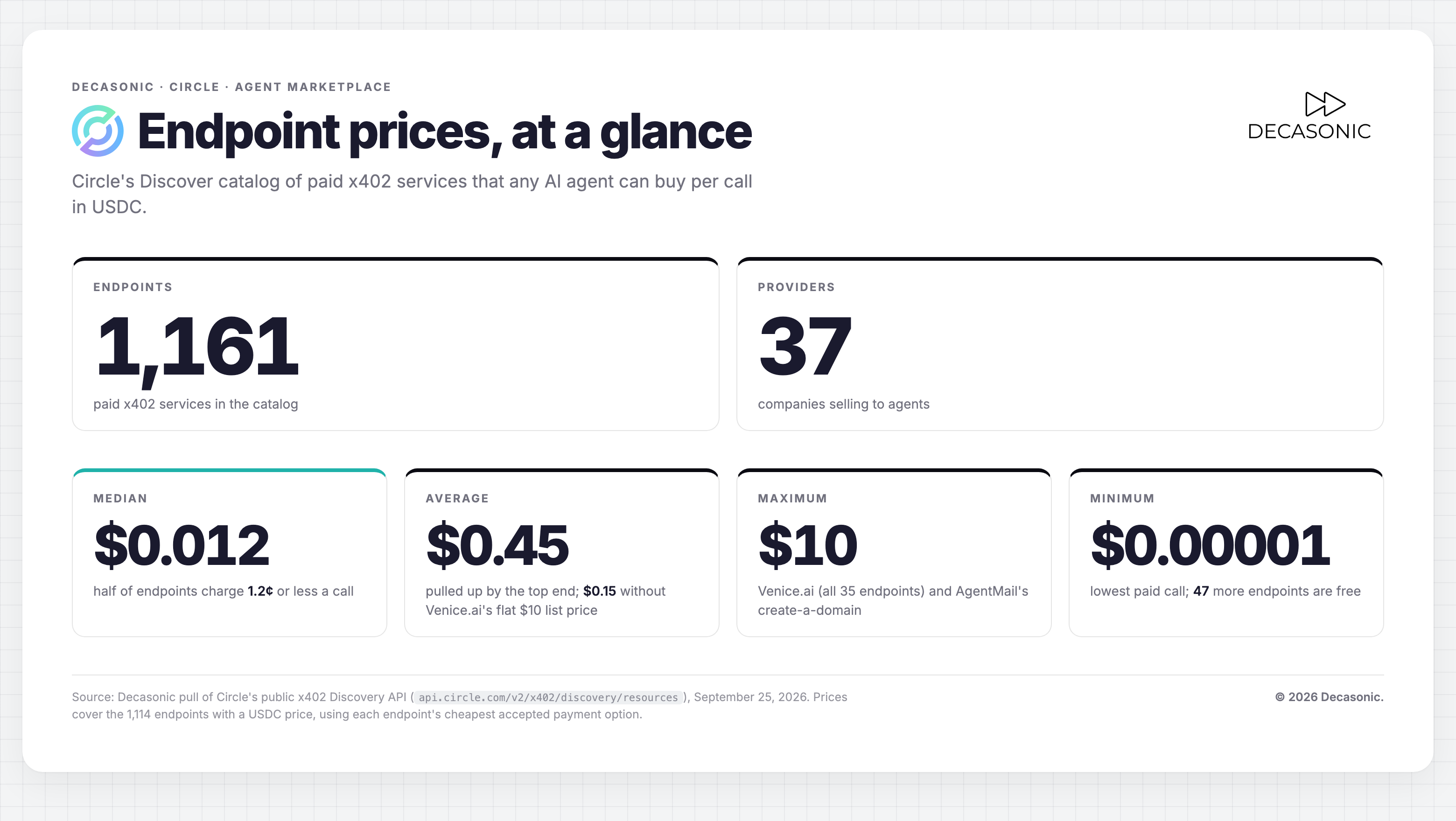
on @arc there are ~1,161 paid x402 endpoints available. those endpoints are offered by ~37 providers, with the leading provider on Arc being @decasonic portfolio company @orthogonal_sh.
the median endpoint price is $0.012 per call, with the average being ~$0.45 ($0.15 excluding Venice). there is a skew from what seems to be @AskVenice pricing endpoints at $10/post (could be clarified in the future).
the lowest priced endpoint is for $0.00001 (with the burst utilization of this endpoint being made possible through the @circle nanopayments).
The opportunity grows as services become more specialized and transactions become smaller.
That expands what agents can economically do on their own.
Discovery, permissions, pricing, payments, and settlement all need to operate at machine speed and at machine-sized transaction values.
What’s emerging on @arc is an early example of that architecture taking shape.
More in our latest perspective on Arc Market Map👉decasonic.com/post/the-web3-…
