

Managing Editor, Outlook Business (https://xitter.cf/t.co/n6NOqGPsBp)
New Delhi, India
Joined May 2016
- Tweets7.3K
- Following3K
- Followers2.2K
- Likes5.9K







Pinned Tweet
📢📢For India's spacetech ecosystem to flourish, it is critical for tech transfer and sharing of infra by ISRO with the private sector to continue and pick up even more speed.
Why?
In 2004, Shah Rukh Khan portrayed an engineer working in NASA in the movie 'Swades'. It tapped into a familiar refrain of the time. If you were in school or college then, you might have heard a rumour (of course BS, but only in hindsight) - that 40% or 60% of engineers in NASA were Indians. Yet, this falsehood captured the pain of India's brain drain.
Today, the tide is turning. Young Indians (many of them ex-ISRO scientists) are launching rocket start-ups in the country. Investments are starting to pour in. India recently got its first spacetech unicorn. And a few conglomerates are getting serious about aerospace. Nobody talks about most NASA engineers being Indians anymore.
A lot is happening. And it could not have happened without ISRO, which has been the front and centre of all of it. The big shift was kickstarted a few years back when ISRO began sharing its know-how and infra with start-ups.
The September cover story of @outlookbusiness talks about the coming of age of Indian spacetech startups and how ISRO is essential to their success.
Grab your copy from the stands!


Five years ago, when India opened up its space sector, we had two clear objectives: enable ISRO to conquer new frontiers and empower our private industry to scale up.
Today, we are seeing both take shape.
EOS-05 is a major achievement by ISRO, and this is just the beginning.
At the same time, from barely a handful of space startups five years ago, India today has over 450. Indian private industry has already flown a rocket to orbit.
Now comes the real test: scaling up.
We have set ourselves an ambitious target of 50 launches a year by 2030.
A goal of this scale cannot be achieved by one organisation alone. Government and private industry have to build this future together.
ISRO’s research will continue to push the frontiers of what is possible. Private industry must translate that momentum into manufacturing at scale: more rockets, more satellites, more launch capacity and new technologies.
That is how we will build a complete space ecosystem and create the capacity to match our ambition.
The opportunity before us is immense: build in India, launch from India and serve the world from India.
We are well on our way to taking India’s space sector to a new orbit, figuratively and literally. @isro @INSPACeIND
Deepsekhar Choudhury retweeted

India’s young generation is questioning two promises: that education leads to a secure future, and that raising its voice can bring change.
The November 9 issue of Outlook explores India’s growing graduate employability crisis, with more degrees failing to guarantee jobs as AI reshapes the workplace. It also profiles Neha Bora, the student leader who keeps returning to the streets despite being detained, as student politics finds a new lease of life.
From the value of a degree to the power of dissent, what does the future hold for a generation demanding more?
Read the November 9 issue of Outlook for The New Rebel and Degree Delusion. Pick up your copy or read the issue online.
#TheNewRebel #DegreeDelusion #NehaBora #OutlookIndia


Remember the Pepsi Thi Pi Gaya ad around the time of Kanhaiya Kumar protests?
With the clip of Rahul offering a bottle of Sting to Priyanka in a protest going viral, life comes full circle for PepsiCo


Dashami scenes #iykyk 🤣

Massive coming from sitting SC judge

'Strikes At Heart Of Constitution': Top Court Judge On Mass Deletion Of Voters
ndtv.com/india-news/no-whata…
@SrishtiOjha11 reports
Deepsekhar Choudhury retweeted

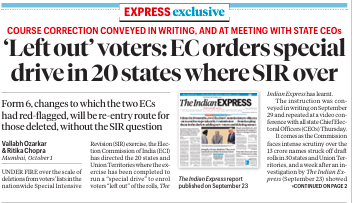
The widest-reaching impact of @IndianExpress' Election Commission investigation yet.
10 days after our investigation into the rupture inside the Election Commission, the poll watchdog has told all 20 states where SIR is over to run a “special drive” to bring back voters “left out” of the rolls.
State CEOs have been told to identify voters deleted as unmapped or for “logical discrepancy” and that BLOs should go house to house to help bring them back. They will use Form 6 to apply for inclusion of such “left out” voters.
And the question added to Form 6 in July, asking whether your parents were on the last SIR roll, which one Commissioner called “unauthorised/illegal,” now applies only during the “SIR phase.”
What does that mean? In the 20 states where SIR is over, “left out” voters and first-time voters will use the plain statutory Form 6, without the question seeking details of their family’s link to the last SIR.
Reporting with @vallabhozarkarr.
indianexpress.com/article/in… via @IndianExpress
🤣

Nothing surprising about this. If you are a consultant what would u tell a company with own GCC- simple, go to external service provider.
And if client is working with an external service provider what would u tell him- simple, have yr own GCC.
Same way they tell diversified companies to focus and for focused companies to diversify etc.
Deepsekhar Choudhury retweeted

Blackstone went from zero exposure to Indian hospitals to about 40 in three years

Deepsekhar Choudhury retweeted

EC removes Form 6 change two Commissioners had called ‘illegal’ indianexpress.com/article/in…

Deepsekhar Choudhury retweeted

Baseten partners with OpenAI to let OpenAI enterprise customers use existing commitments for open models served by Baseten within Codex or via the Responses API (@dannieherz / Baseten)
(Visit Techmeme dot com for the link and full context!)
Deepsekhar Choudhury retweeted

wtf i thought this was some bullshit but its actually insanely clever. the merchant lists the bills' serial numbers on their website, you can tell you bought a genuine product bc the numbers match. counterfeiters wouldnt dare printing fake currency.


Deepsekhar Choudhury retweeted

25 years of working. Story no. 2.
Sometime in 2009 I was working at the Mint office in Delhi. I was still in the weekend team and hadn't yet joined the digital team as Managing Editor.
One day I was asked to write a profile of a then celebrity entrepreneur who was running a national chain of retail stories. In fact at the time he was India's largest retailer of mobile phones.
I was handed this job because the entrepreneur was an IIMA alumnus, and so was I, and I had some access to alumni networks, people who went to school with him and so on.
At the time the company was going through some turmoil. But they had just acquired a logistics firm, and talking heads on TV were talking about how this was going to turn things around.
The one problem they had was logistics, the experts said. This acquisition was a super smart move. The channels even had investors come on air to discuss the whole thing.
So as part of my profile research I checked out the logistics company's website. And I was like: wait. This is just a Wordpress template with minor tweaks. There was nothing here. There was no sign at all that this was an actual company. No sign of contact details either. But then I checked the domain registry, looked at the WHOIS information, and got a phone number in Chennai.
An old man picked up. Said nothing and hung up.
Weird. So then I decided to look at the source code of the website. Because back in the day web developers often left comments or a trail of info in the source code.
I could clearly see this was a shoddy, low-effort thing. That had been put together just days before the announcement. So weird.
And so I had a word with the editors and then called up the celebrity entrepreneur's company. I didn't go through the usual PR channel. Instead I just called up their HO in Chennai.
Guess what? The same old man picked up.
I immediately knew what was going on. This dude was acquiring an entirely fake company that he himself had created, in order to desperately siphon funds out of the parent company.
Two hours later we noticed that several previous acquisitions had been similar frauds.
The next day we broke the story, the investors sued him, and the dude eventually went to jail. For someone in the weekend team to get a Page One story was pretty rare. But to have one with this impact was rarer still.
And all because I decided to make a few phone calls and look at the source code of a website or two. Something that none of the TV channels thought to do for days and days even as they covered the story breathlessly.
Moral of the story: Always always always look at the details. Forensic journalism is the best. I still do some of it these days. But mostly pass on the leads to working journalists and so on. But friends, there are always trails. Always. Look into almost any corporate announcement closely enough and you will see stories that you are not supposed to.
Deepsekhar Choudhury retweeted
The Election Commission of India is under fire like never before.
The SIR has struck 13 crore names off draft rolls, putting the EC at the centre of intense public debate over its role in deciding who gets to vote — and who doesn’t.
HOWEVER, what nobody knew: through that same period, some of the sharpest questions were being asked from inside.
Out today, after months of work. Our #ExpressInvestigation 🧵
(1/10)

Deepsekhar Choudhury retweeted
Bernstein: Many of India's large caps represent a "bygone economic era"
Foreign institutional investors will return to trade, but have "little reason" to invest in India


Deepsekhar Choudhury retweeted

From a partner at Menlo, one of the early investors in Anthropic:
"The instinct in our business is to answer with company identification: just pick the right neo lab and you'll be fine. I think that's the trap. When price has become the signal, being right about the company is not enough, because you can be right about the company and still be wrong about the price by a factor of ten."

A few thoughts on the current state of venture capital.
When the Music Is Playing
In July 2007, a few weeks before the credit markets seized up, Chuck Prince, then the CEO of Citigroup, gave an interview to the Financial Times. The line everyone remembers is this one: "As long as the music is playing, you've got to get up and dance." He was mocked for it for years afterward, and he lost his job a few months later. But I have come to think he was saying something honest. He wasn't claiming the music would play forever. He was admitting that he couldn't sit down while it was still going, and neither could anyone else in his seat.
I've been thinking about that quote a lot lately, because right now is the most disorienting period in venture capital I can remember, and I have been doing this for a while.
Here is what makes it disorienting. It's not that things are bad. Some things are spectacular. We have companies in our portfolio growing faster than anything I have seen in my career, and I don't say that lightly. At the same time, we have companies with no revenue, no product, and a founding team you could fit in a conference room raising billions of dollars at valuations of $10 to $50 billion. Both of these things are true at once, and if you try to reason about them with the same framework you will drive yourself crazy.
Two ideas have helped me make sense of it. Neither is mine.
The first is reflexivity, which George Soros has been writing about since the 1980s. In most of life, perception follows reality: the weather is what it is, and your opinion of it changes nothing. In markets, it runs the other way too. Prices change what participants believe, and what participants believe changes the prices. The feedback loop can run for a long time, and while it's running it looks exactly like progress.
Here is how reflexivity is playing out in AI. Full disclosure: Menlo is an investor in Anthropic, so read the following with that in mind. People watched a frontier lab go from a $4 billion valuation to $18 billion, then $60 billion, then $180 billion, then $380 billion, and now something close to a trillion. They drew the obvious conclusion: that is what a neo lab looks like. So the next neo lab gets priced off that path, not off anything it has built. Then it gets marked up in a subsequent round, and the markup itself becomes the proof. Look at Thinking Machines. Look at Reflection. At that point valuation has stopped being an output of the metrics and has become the metric. Nobody is discounting cash flows. They are discounting the last round.
Soros is very clear about one thing, and it's the part people skip: you cannot know when or how a reflexive process ends. You only know that it does. Every one of them has.
The second idea is Chuck Prince's, and it explains why smart people keep dancing even when they can see the loop for what it is. As far as I can tell, there are two groups on the dance floor.
The first group got in early. Firms like ours were in some of these AI companies before the numbers got silly, and the paper gains are enormous. When you are sitting on gains like that, you start to feel like you're playing with house money. I have been around long enough to know that house money is the most dangerous kind, because you don't respect it the way you respect money you had to earn.
The second group missed the early rounds and knows it. Their LPs know it too. So they are trying to make up for lost time by writing very large checks very late, which is the one strategy almost guaranteed to turn a missed opportunity into a real loss.
House money on one side, FOMO on the other, and reflexivity feeding both. That's the whole story. Everyone has a reason to keep dancing, and the reasons are different, which is why nobody can talk anyone else off the floor.
So what do you do? The instinct in our business is to answer with company identification: just pick the right neo lab and you'll be fine. I think that's the trap. When price has become the signal, being right about the company is not enough, because you can be right about the company and still be wrong about the price by a factor of ten. The public-market investors I admire figured this out a long time ago. They spend as much time on how much to own as on what to own.
The winners in venture over the next decade will be the firms that treat portfolio composition and position sizing as seriously as they treat sourcing. How much of the fund is in companies whose valuation rests on the last round rather than on revenue? What happens to the portfolio if the reflexive loop breaks next year instead of in five? Those are not exciting questions. They are the ones that will matter.
The music will stop. It always does. Dance if you must, but know where the chairs are.


Deepsekhar Choudhury retweeted

SAUDI PIPELINE OUTAGE THREATENS 4% OF GLOBAL OIL SUPPLY
Saudi Arabia could lose up to 4 million barrels per day of exports — roughly 4% of global supply — if its critical East-West pipeline does not restart within days, Reuters reports.
Saudi storage at Yanbu can sustain exports for only 5-7 days, according to sources. With repair estimates potentially stretching to 5-6 weeks, a prolonged outage risks deepening the global oil crunch and adding further pressure to inflation and bond yields.

