
Head of FDE @varickagents | prev: COO @citsecurities, @mckinsey, Cambridge, starcraft, rowing, track, jazz
San Francisco, CA
Joined April 2021
- Tweets113
- Following3.4K
- Followers9.9K
- Likes640





"There's no silver bullet that results in 90% efficiency gains"
...But this article is a great primer on how to approach AI Transformation!


Daniel Kornum retweeted

C Suite executives around America are eagerly awaiting Opus 6 and GPT 7 so that they may finally one-shot the agent-ification of their company.
By then it will be too late. A fascinating analysis by Daniel, former COO of Citadel Securities EMEA.


Daniel Kornum retweeted
"AI and jobs is a complex equation". No kidding.
Great prescriptive analysis for enterprises, based on real client engagements.


Daniel Kornum retweeted

Results from 7 hiring experiments in drawing out talent when everyone has a capable agent.

Daniel Kornum retweeted
We spent the day with ~20 CHROs and Chief People Officers from some of the largest companies in the world (collectively responsible for millions of employees) in Napa this week.
Here’s what they asked, what we told them, and where they are in their adoption of AI.
1. Do we need to train everyone on how to use AI? Is that even HR’s job?
Partly. Most companies are a barbell in terms of AI adoption. Roughly 5-10% of employees are using it already (on their own). Most aren’t using it at all. Focus on empowering the first group and running a short training program for the second group. Even spending 1 day, or 1 hour per day for 1-2 weeks on how to prompt effectively is extremely valuable. Create a leaderboard for the skill files that save people the most time, but don’t create one for tokens used.
2. Should we let everyone build agents? How do we prevent sprawl?
Let everyone build agents, but do it all on the same layer with the same context, and owned by the same person. If you let 400 people build agents in 400 different places, you’re going to have a) tech debt, b) a crazy token bill, and c) 6 agents all trying to do the same thing. Let everyone use sidekicks (Microsoft Copilot, ChatGPT, Claude, etc) to do their work, but have a small group of people take the work off of everyone’s plate with agents that work in the background, built on top of the systems of record.
3. How do we re-engineer processes in HR?
The first step is to map out how the process actually works - not how it’s supposed to work. For example, when a new employee is onboarded, the date they start in the ATS may be different than the date they start in the HR system. This almost always results in an email from someone in HR ops to the hiring manager to confirm the start date, which then almost always results in a late order of the laptop, which then results in the new employee not having access on day 1. And none of that is documented in the process. Once the process is mapped out, a process that has 15 steps can be reduced to 5, and 4 of those 5 steps can be handled by agents. This works for anything: payroll corrections, benefits, leave requests, employee tickets, etc. We’ve seen payroll corrections drop by 90% this way.
4. How do we make people feel like AI isn’t going to take their job?
Be honest about what changes. Agents take the 90% of the work that repeats, and people keep the 10% that needs judgement, which is usually the part they got into HR for. One of the best ways to sell the implementation is to show the teams what their job will look like when the agent is live. This is another reason to include key stakeholders, who are currently running the process, from day 1. If the plan is to capture all of their tribal knowledge into the agent, they need to see something in it for themselves.
5. What steps of the process should be human-led vs. fully agentic?
This decision comes down to two key factors: risk and cycle time.
If a step in the process is low risk (think answering a question based on an HR handbook) but high volume, it makes sense for the process to be fully agentic. On the other hand, if the step is high risk (terminations, investigations, comp exceptions, etc.), it should be led by a human, though there may be opportunities for agents to help with the prep work. Most steps, however, fall in between these two extremes and should be built as agents propose + human approves, with full traceability and reversibility.
6. Who on our team should be our forward deployed engineers?
Forward deployed engineers should be big picture thinkers who aren’t stuck in the ways things have been done at your company for the past 10 years. They should be knowledgeable on AI and at least a little bit technical. In an HR department, these people often are your HRBPs or your HR ops-minded folks who have already automated much of their job through spreadsheets and macros. Give these folks real problems to solve. You don’t need them to become certified.
7. How can we keep up with the latest in AI?
You can’t, really. It changes too fast. Subscribe to some newsletters, but know that most things break on X before anywhere else.
That being said, you can get 99% of the value from AI agents with models that are a year old. You don’t need to have the shiniest, most up-to-date model to build valuable agents for your HR team.
Key takeaways from the session:
1. Nobody in the room was asking if they should be using AI. Every company in the room had rolled out a copilot or ChatGPT to the whole company, so the question was more around why it hadn’t changed anyone’s week.
2. HR is being tasked with training the rest of the company on AI, often without adequate budget or authority, so the first question is often “Is this even our job?”
3. Despite #2, HR’s own jobs are often the last to be tackled, as teams are focused on rolling out AI to the rest of the company while still running their own processes (even simple ones like onboarding) through email and spreadsheets.
4. There is fear on both sides: employees are worried about how AI will impact their jobs, and CHROs are worried about what they’ve empowered their teams to build.
5. Most people in the room thought they needed to keep up with the latest in AI. They don’t.
We solve these every day at Varick. Work with us below:


“Most companies apply AI onto their garbage processes, and the end result is just making garbage faster”


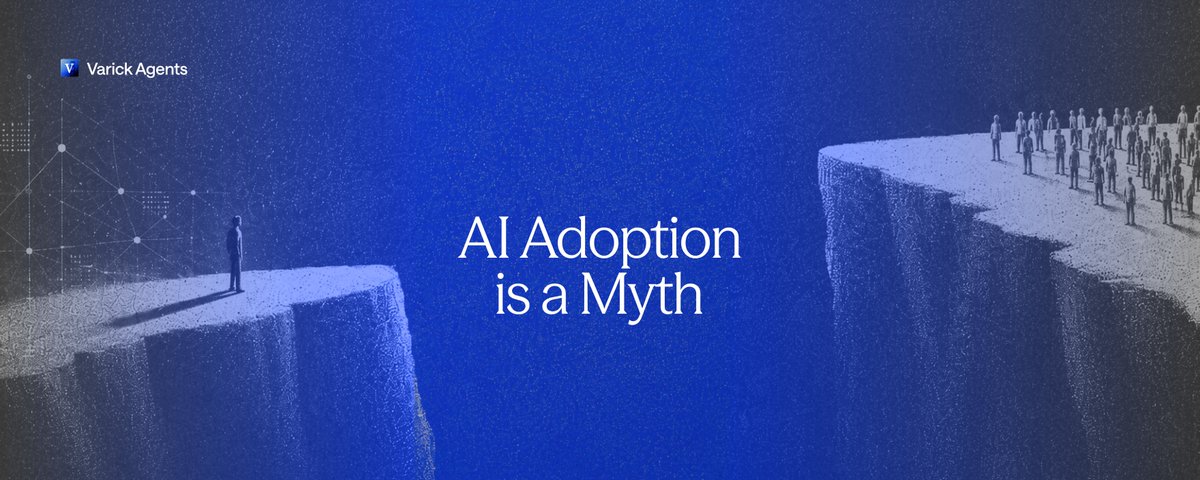
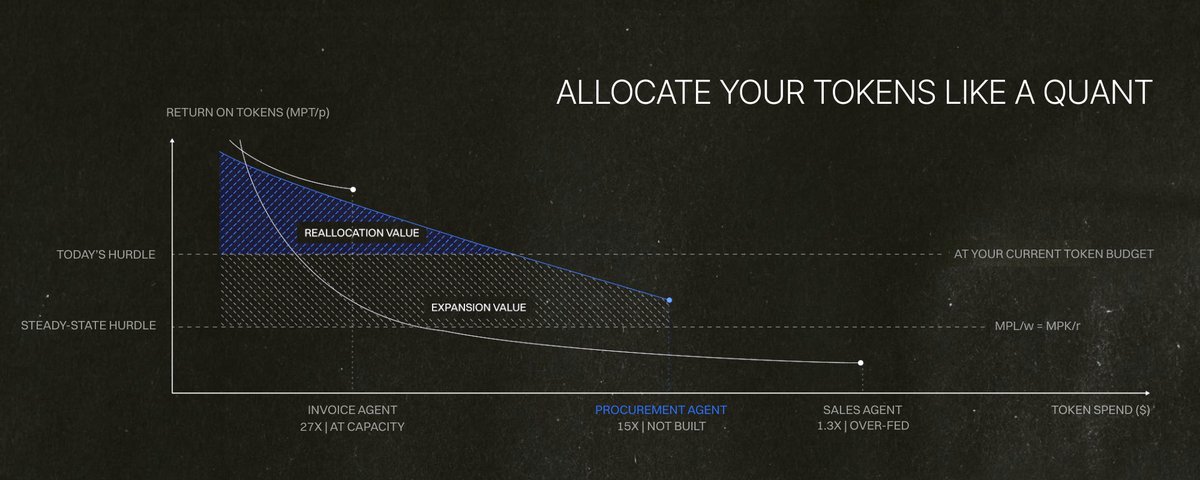
"Every time we lower the cost of frontier intelligence, the use-cases that enterprises can take on just go up. There’s a tremendous amount of workflows (...) that are only gated by the cost of tokens."
100%! Gated by the cost of tokens & the implementation of those workflows

It’s truly wild that we’re getting this level of performance from open models. Congrats to Kimi team on this.
Every time we lower the cost of frontier intelligence, the use-cases that enterprises can take on just go up. There’s a tremendous amount of workflows that enterprises would love to deploy that are only gated by the cost of tokens.
Importantly for the startup ecosystem, the combined breakthroughs from open and closed labs enable a ton of value to accrue to the layer, which can leverage a variety of models to complete full tasks for customers.
This diversity of models and approaches means that the applied AI layer can tune models to their workflows and route intelligence appropriately. Huge win for all.


