

Create intelligent spaces using HTML, the DOM, and AI.
Joined June 2025
- Tweets20
- Following0
- Followers3
- Likes20
DOMIoT retweeted

T-Rex: Tactile-Reactive Dexterous Manipulation
Website: tactile-reactive-dexterous.g…
Open dataset: huggingface.co/datasets/zeka…
This work is led by @Dantong_Niu and co-advised by @trevordarrell. Congrats to the team!
xitter.cf/Dantong_Niu/status/206…

Excited to share T-Rex: Tactile-Reactive Dexterous Manipulation 🦖🤖
Touch is fundamental to human dexterity, yet most Vision-Language-Action (VLA) models either ignore tactile feedback or lack the ability to react to high-frequency contact signals.
In this work, we tackle both the data and architectural challenges of tactile-reactive dexterous manipulation.
🦖 A 100-hour tactile-synchronized dexterous manipulation dataset with 7,700+ trajectories, 22 motor primitives, and 200+ everyday objects.
🦖 A tactile-reactive MoT architecture with spatial-temporal tactile encoding and asynchronous high-frequency tactile refinement.
🦖 A scalable training recipe combining 22,889 hours of human egocentric pretraining with tactile-grounded robot mid-training.
Across 12 real-world contact-rich manipulation tasks, T-Rex achieves over 30% higher average success rate than the strongest baseline.
We are fully open-sourcing the dataset, models, teleoperation stack, training code, and inference pipeline.
🌐 Project: tactile-rex.github.io/
📄 Paper: arxiv.org/abs/2606.17055
💻 Code: github.com/ZhuoyangLiu2005/T…
🤗 Dataset: huggingface.co/datasets/zeka…
🧵 Thread ↓
DOMIoT retweeted

Ask your LLM to describe physical objects and spaces using HTML, and to use JavaScript to script the physical system behavior using the DOM. It works very well.
medium.com/@a_93294/programm…
Library: domiot.org/


This works really well btw, at the end of your query ask your LLM to "structure your response as HTML", then view the generated file in your browser. I've also had some success asking the LLM to present its output as slideshows, etc.
More generally, imo audio is the human-preferred input to AIs but vision (images/animations/video) is the preferred output from them. Around a ~third of our brains are a massively parallel processor dedicated to vision, it is the 10-lane superhighway of information into brain. As AI improves, I think we'll see a progression that takes advantage:
1) raw text (hard/effortful to read)
2) markdown (bold, italic, headings, tables, a bit easier on the eyes) <-- current default
3) HTML (still procedural with underlying code, but a lot more flexibility on the graphics, layout, even interactivity) <-- early but forming new good default
...4,5,6,...
n) interactive neural videos/simulations
Imo the extrapolation (though the technology doesn't exist just yet) ends in some kind of interactive videos generated directly by a diffusion neural net. Many open questions as to how exact/procedural "Software 1.0" artifacts (e.g. interactive simulations) may be woven together with neural artifacts (diffusion grids), but generally something in the direction of the recently viral xitter.cf/zan2434/status/2046982…
There are also improvements necessary and pending at the input. Audio nor text nor video alone are not enough, e.g. I feel a need to point/gesture to things on the screen, similar to all the things you would do with a person physically next to you and your computer screen.
TLDR The input/output mind meld between humans and AIs is ongoing and there is a lot of work to do and significant progress to be made, way before jumping all the way into neuralink-esque BCIs and all that. For what's worth exploring at the current stage, hot tip try ask for HTML.
Use DOMIoT to take advantage of the DOM API in the physical world:

In the following article, I share a practical example of how everyday web technologies, HTML, JavaScript, and CSS, can be used to interact with physical objects.
Using a Web Browser to Orchestrate Physical Systems
medium.com/p/using-a-web-bro…
DOMIoT retweeted
In the following article, I share a practical example of how everyday web technologies, HTML, JavaScript, and CSS, can be used to interact with physical objects.
Using a Web Browser to Orchestrate Physical Systems
medium.com/p/using-a-web-bro…
Integrate physical devices with web applications.
Implementation of the Document Object Model for IoT for browser environments:
github.com/domiot-io/domiot-…
Phidget VINT x6 driver added. It can be used with any i/o bits binding, such as ibits-button-binding:
<iot-ibits-button-binding id="buttonsBinding" location="/dev/phidgetvintx60" />
github.com/domiot-io/drivers…
DOMIoT retweeted
I just published Programming the Physical World the Web Way -
Using HTML and JavaScript to Build Interactive Physical Systems
medium.com/@a_93294/programm…
Gondolas, display-units, endcaps, baskets, podiums, cubbies! New HTML IoT elements for retail available:
github.com/domiot-io/iot-ele…
1.1.0
video-sim, a linux module for testing and simulating a video player has been added to the drivers. Kickstart has been updated accordingly.
github.com/domiot-io/drivers…
jsdomiot-kickstart: Launch point for jsdomiot. Simply run a script, and the entire setup will be installed for you.
github.com/domiot-io/jsdomio…
Hotel Room Door Example added: This example demonstrates how to create an interactive hotel room door system using jsDOMIoT with electronic lock control and LCD message display using HTML and JavaScript.
github.com/domiot-io/jsdomio…
DOMIoT retweeted
Did you know you can build interactive physical-world systems just like web pages, using HTML and JavaScript?
github.com/domiot-io/jsdomio…

DOMIoT retweeted

Making touch sensors has never been easier!
Excited to present eFlesh, a 3D printable tactile sensor that aims to democratize robotic touch.
All you need to make your own eFlesh is a 3D printer, some magnets and a magnetometer.
See thread 👇and visit e-flesh.com
In interactive IoT systems, HTML documents and DOM trees can serve as a textual representation of an object or a space. This structure can enhance integration with AI agents already effective at processing structured text. github.com/domiot-io/jsdomio…

Addendum to Document Object Model for IoT - Building IoT Systems with HTML and JavaScript: github.com/domiot-io/documen…
DOMIoT retweeted
You can find implementations and examples of how to develop interactive IoT applications using HTML and JavaScript at domiot.org.
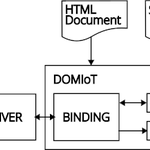
What if creating interactive IoT applications was as simple as building a website?
You can by using HTML and JavaScript:
📄 Read the paper: papers.ssrn.com/sol3/papers.…
🌐 Try it: domiot.org
✅ Node.js implementation available
🌍 Browser implementation coming soon!
DOMIoT retweeted
What if creating interactive IoT applications was as simple as building a website?
You can by using HTML and JavaScript:
📄 Read the paper: papers.ssrn.com/sol3/papers.…
🌐 Try it: domiot.org
✅ Node.js implementation available
🌍 Browser implementation coming soon!

Document Object Model for IoT: Building IoT Systems with HTML and JavaScript @SSRN papers.ssrn.com/sol3/papers.…