

Energy Executive, Husband and Father. Thinking, Speaking and Writing about Energy and Leadership
Charleston, SC
Joined May 2009
- Tweets2.1K
- Following1.2K
- Followers955
- Likes1.6K






Doug Haugh retweeted

You bought a house, and you think you own it?
Stop paying your property tax and watch what happens. The sheriff arrives. The auction proceeds. Your "ownership" turns out to be a rental agreement with a landlord who prints its own money and writes its own rules.
Government overreach is the entire operating logic of the state, expanding wherever it meets no resistance. In 1913 the top federal income tax rate was 7 percent and applied to almost nobody. By 1944 it hit 94 percent. The ratchet only turns one direction.
Every regulation carries a gun behind it. The FDA tells you which drugs you may put in your own body. The IRS reads your bank records. Lockdown officials in 2020 decided your barbershop was "nonessential" while liquor stores stayed open (they understood their subjects).
Free market thinkers made the point long ago: the state produces nothing. It redistributes, taxes, and forbids. Every expansion of its authority shrinks the space where you act as a free person.
You are permitted your freedoms. That word should terrify you.

Most AI pilots don’t fail because of the model. They fail because organizations aren’t ready to scale.
That’s the real takeaway from my recent Future of Convenience podcast conversation between very experienced industry guys I like to listen to: Dan Munford and Jeffrey Rubin.
Listen to this podcast on the GC website or see links to Spotify and Apple Podcasts lnkd.in/gthdt-5N
We’ve entered a new phase of AI adoption:
👉 The question is no longer “Can we build it?”
👉 It’s “Can we operationalize it at scale?”
And that’s a completely different challenge.
From what we’re seeing across industries, a few patterns are clear:
🔹 Pilots are easy. Production is hard.
Controlled environments hide the complexity of real-world data, systems, and users. What works in a demo often breaks at scale.
🔹 Data is still the bottleneck.
Without reliable, well-governed data, even the best AI models underperform. Most “AI problems” are actually data problems.
🔹 Integration > innovation.
The real work is connecting AI into existing workflows, systems, and decision-making processes—not building flashy use cases.
🔹 Change management is everything.
AI adoption is as much about people as it is about technology. If teams don’t trust or use it, it doesn’t matter how good it is.
🔹 Value beats volume.
Scaling AI isn’t about running more pilots—it’s about focusing on fewer use cases that deliver measurable business impact.
✅The companies that are winning with AI aren’t experimenting more..They’re executing better. They treat AI as infrastructure, not a side project.
They design for scale from day one.
And they stay relentlessly focused on outcomes.
1
1
100
Doug Haugh retweeted

They want you to be ashamed of the American Dream
Your grandpa showed up with a suitcase and $40. Didn't speak the language. Didn't know anyone. Washed dishes until he could afford something better. Saved enough to buy a truck. Started a business. Then bought the building.
Your grandma watched it happen. And she raised four kids to believe they could do it too.
That's the American Dream.
It never mattered if you were born here or came on a boat. What mattered was what you were willing to build.
A kid grows up on a cattle farm in the middle of nowhere Nebraska. His dad never finished high school. His mom works the register at the only store in town.
Nobody in his family has ever left the state.
He tinkers with engines after school. Builds things out of scrap. Shows up to college with everything he owns in the back of a pickup truck.
Ten years later he's running a manufacturing company.
Not because his parents had connections. Not because someone handed him a trust fund or a last name that opened doors.
Because this is America. And in America, you're allowed to try. You're allowed to dream.
And the numbers prove it.
~23 million millionaires in this country. 79% of them are self-made.
902 billionaires. More than anywhere else on the planet.
13 out of the 15 richest people in the world are American.
73% self-made. They didn't inherit empires. They built them. In garages. In dorm rooms. In strip malls. On kitchen tables.
Jeff Bezos never knew his biological father. He started Amazon out of a garage and couldn't afford a desk so he bought a door from Home Depot and screwed four legs onto it.
Larry Ellison was abandoned by his mother at nine months old. His adoptive father told him he'd never amount to anything. He dropped out of college twice and built Oracle into a $200 billion empire.
Oprah was born into poverty in rural Mississippi to a single teenage mother. She became the most influential media figure on the planet.
Three people who had every reason to fail. Look what they built instead.
Tell me where else a broke kid with no connections can build a billion-dollar company and nobody asks who his father was.
You won't find it. Because every other system on this planet was built to keep people where they were born. Castes. Classes. Last names. Bloodlines. Old money. Old power.
America was built to break all of it.
An entire generation has been brainwashed into being ashamed of it.
They taught your kids that this country was built on nothing but slavery and genocide.
They put it in the textbooks. The movies. Every feed.
Until your 19-year-old can't say "I love my country" without feeling like he has to apologize.
They told you the American Dream was a lie sold to keep people down.
53 million people born in other countries chose to live here.
71% of them say they'd do it all over again.
They didn't pick France. They didn't pick Germany. They didn't pick China. They picked here.
Because they already know what you've been gaslit into forgetting.
Don't let them do this to you.
Don't let some professor who's never built anything tell your kids that the country their great-grandparents bled for is irredeemable.
Don't let some activist with a blue check convince you that a nation of 22.7 million self-made millionaires is a monument to oppression.
Don't let a politician shame you into believing that the people who build are the villains. Every time this country creates greatness, they tell us to apologize for it.
And don't you dare let a foreigner who's never set foot here tell you what your country is.
They've never watched a janitor's daughter become a surgeon.
They've never seen a single mom put herself through night school and end up running the department.
They've never sat at a Thanksgiving table where five different accents argue about football and nobody thinks twice.
That's not some ad, it's a Thursday.
Somewhere right now a kid is lying on the floor of a studio apartment doing homework while his mom works a double. He doesn't have a trust fund. He doesn't have a single connection that matters.
But he's got a shot. A real one. Because he lives here.
And if you let them take that from him, what are you even defending?
This is the country that looked at the moon and said "we choose to go, not because it is easy, but because it is hard."
So build.
I hope you understand what's at stake.

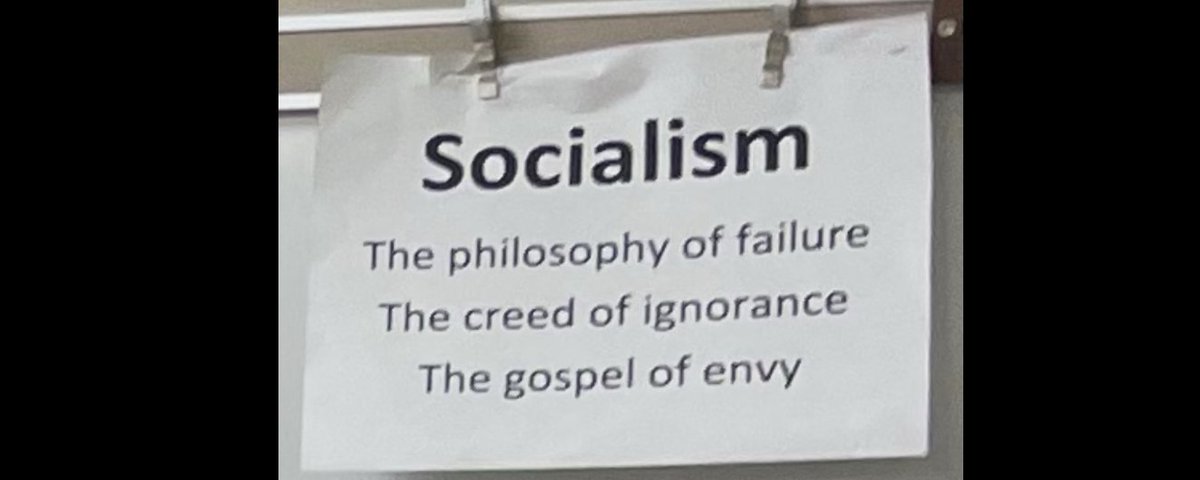
Because socialism is not defeated by white papers and policy memos.
If its power comes from myth, then the only serious response is a better story.
The Return of Industrial Policy Brings the Physical Economy Back Into Focus - How Marco Rubio’s speech on national security in Munich highlights the importance of energy policy and investment in industrial capabilities.thinkingonenergy.com/2026/02… via @doughaugh

Electricity Affordability, AI Data Centers, and the Real Drivers of Rising Rates thinkingonenergy.com/2026/01… via @doughaugh

1
56
With regime change and seizing oil on the high seas becoming normalized I have been thinking about what the economic system around all this is going to look like.
It certainly isn’t globalized free trade. Adam Smith didn’t design his theory for a mercantilist world and it looks like that may be closer to what we now have.
Comparative advantage assumes competition among firms and markets but today’s global economy is increasingly dominated by state action.
So what happens when:
• One side practices free trade
• The other subsidizes, restricts, and strategizes
• And the referee now actively takes a side
Listening to Howard Lutnick recently forced me to revisit the economics many of us learned in college and question our assumptions about how things work.
This isn’t an argument against free trade.
It’s an argument about what it takes to preserve it.
🔗 Free Trade in a Mercantilist World
thinkingonenergy.com/2026/01…

64
Doug Haugh retweeted

I’ve had a lot special moments at Clemson but this one is at the top of the list. @_BlazeWatson_ and I went up 2,000 feet in a helicopter to get this shot. Something we’ll never forget. 🐅🎥
🚀 So far this year, we have 262 orbital launches, on day 308. Not quite daily service to orbit, but getting darn close. The U.S. and China together account for nearly 90% of all orbital launches, with a total global lift capacity between 2000 to 3000 metric tons to low Earth orbit.
This is amazing by historical standards, but looking back on this a few years from now this may look tiny because just handful of Starships can equal that in weeks with fully reusable flights.
So when lift becomes this cheap and abundant, the economics of what we build in space start to change, especially for energy and computing.
Imagine solar power stations that never experience night, or data centers in orbit powered by continuous sunlight.
📈 Read the full analysis and see how cheaper lift could turn orbit into the next industrial platform:
👉 thinkingonenergy.com/2025/11…
#Energy #SpaceEconomy #AI #SolarPower #ThinkingOnEnergy #SpaceX #Starship #Innovation #CleanEnergy #DataCenters


1
1
99
🚀 The Economics of Lift Have Flipped
For decades, space-based solar power has lived in the realm of thought experiments, experiments that were technically plausible but economically out of reach. Launch costs were too high, arrays too heavy, and beaming power back to Earth too lossy.
Starship’s reusable lift could cut costs by 20–50× compared with today’s rockets, dropping launch below $200 per kilogram.
At this price point, putting high-specific-power solar arrays into orbit starts to look less like science fiction and more like early-internet economics.
1
74
Doug Haugh retweeted

I saw this video this morning on my feed and I think it so eloquently explains what Charlie Kirk was put on this earth to do.
“When people stop talking, that’s when you get violence, that is when civil war happens”

⚡ The Global Energy Arms Race: Why U.S. Nuclear Permitting Must Catch Up – Thinking On Energy thinkingonenergy.com/2025/05…

1
4
104