

Our mission is to speed up negative emissions, CEO @carbon_drawdown, VP @nep_brussels
Fürth/Nürnberg, Germany
Joined December 2008
- Tweets12.6K
- Following464
- Followers12.4K
- Likes6K




Pinned Tweet
It’s Not Just the Rock—It’s the Soil (And it holds on tight) -- Our latest greenhouse study with data from our greenhouse experiments is now available on EGUSphere as a pre-print.
After five years of EW field&lab work and a two‑year greenhouse experiment (focussed on a subset of 4 soil types, 13 rock and industrial feedstocks), our new preprint on enhanced weathering has gone online on EGUsphere. In the blog post linked below, we walk through what we actually saw when we tracked alkalinity in leachate and cation retention in soils.
A few takeaways for EW and CDR projects:
* Soil type is as important as rock type. pH, clay content, carbonates and CEC can completely change whether added rock dust shows up as measurable alkalinity export or mostly stays in the soil.
* Alkalinity export alone underestimates and can even misrepresent CDR. In our experiment, 10–50× more cations stayed in soil pools than left in leachate over 1–2 years.
* A large part of “theoretical” CDR is delayed or locked in soil processes that current models and MRV approaches may not yet capture well.
If you work on EW deployment, MRV or modelling, the details matter here. We summarise the key results, implications, and what we are doing next (including new experiments and sample collaborations) in the blog (see 1st comment)


Google finally made the Docs suggestions API public — so Remy 🐀 got its biggest upgrade. Claude's edits now land as real Google Docs suggestions: Accept ✓ / Reject ✗ buttons, works even on comment-only links. AI proposes, you decide. Free & open source: github.com/dirkpaessler/remy

Blog Artikel: dirkpaessler.blog/2026/10/07…

It's 𝗢𝗰𝗲𝗮𝗻 𝗣𝗵𝗼𝘁𝗼 𝗙𝗿𝗶𝗱𝗮𝘆 where I invite you to a 15 second ocean meditation with one of my photos or videos.
Let's protect the beauty and abundance of our oceans!

This last part of our XXL Lysimeter Experiment is about plumbing, and it's not glamorous: keeping measurements trustworthy over years is harder than the chemistry itself.

None of this argues against in-situ MRV. It argues for engineering it properly: anchor your gauges, over-provision your sensors, report coverage honestly.
Read Part 6 and the entire series here: carbon-drawdown.de/blog/2026…

A soil-CO₂ sensor sounds like the ultimate shortcut. Weathering consumes CO₂, so bury a probe and read carbon removal straight out of the ground. Part 5 of our XXL Lysimeter Experiment shows why that's not how it works, and what these sensors are actually good for instead.

Soil-CO₂ sensors won't count your carbon. But they're a genuine window into the soil as a living system, and that's worth building.
Read Part 5 here: carbon-drawdown.de/blog/2026…

It's 𝗢𝗰𝗲𝗮𝗻 𝗣𝗵𝗼𝘁𝗼 𝗙𝗿𝗶𝗱𝗮𝘆 where I invite you to a 15 second ocean meditation with one of my photos or videos.
Let's protect the beauty and abundance of our oceans!

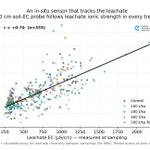
Alkalinity is the number we actually care about, and it's slow and expensive: pump the leachate, ship it to a lab, titrate. Part 4 of our XXL Lysimeter Experiment asks a more practical question: can a sensor buried in the soil, logging continuously, stand in for that lab work?

Read Part 4 here: carbon-drawdown.de/blog/2026…
